When should carnations be sown, and how should they be handled after the flowers fade?
Carnations are grown by many people in daily life and are very beautiful. When should carnations be sown? How should they be handled after the flowers fade?
When to sow carnations:
Note that carnations are not heat-tolerant and prefer a cool environment; they grow poorly at a temperature of 30°C, and the best germination temperature is around 20°C. Colorful peppers can still be planted now. Carnations cannot be planted now; the season you planted them before may also have been wrong. They should be sown indoors in early spring or sown in the open field in September-October, and protected over winter, with the temperature not higher than 15°C and not lower than 0°C. Just pot them up in spring.
Suitable growing environment conditions for carnations
1. Light: Carnations are long-day plants that enjoy plenty of sunlight. Apart from the seedling stage and full bloom period, there is no need to worry about damage from strong light, and with supplementary light the flower crown diameter and color vividness can be increased. Light intensity has a clear positive correlation with cut flower yield per unit area.
2. Temperature: Carnations prefer cool conditions and are not tolerant of heat, but they can endure a certain degree of low temperature. If the summer temperature is above 35°C or the winter temperature is below 9°C, growth becomes very slow or even stops. During high-temperature summer periods, corresponding cooling measures should be taken, and in winter plastic film should be used or they should be moved into a greenhouse to maintain a suitable temperature.
3. Water: The root system of carnations is a fibrous root system. Long-term water accumulation in the soil or medium, excessively high humidity, or long-term high temperatures on the leaf surface are all detrimental to their normal growth and development. Therefore, drip irrigation is advocated, and attention should also be paid to water quality and the salt content of the water.
4. Substrate: Carnations like soil that retains fertilizer well and has good aeration and drainage performance, with heavy loam being the best. The suitable soil pH for their growth is 5.6-6.4. Some soil analysis experiments show that within a pH range of 5.95-7.9, the soil organic matter content has no obvious effect on flowering; it is mainly determined by soil texture.
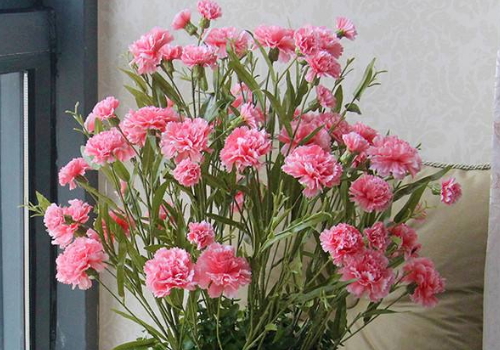
How to handle carnations after the flowers fade:
Generally, just cut off the flower stalks and place them on a bright, ventilated balcony. Adding a little nutrient solution each time you water will help the plant grow better and more vigorously and bloom again.
Well, that is all for the introduction to carnation growing issues. Everyone understands now, right?
Essential tips for growing common flowers, flower cultivation exchange
Common flowers
Many flowers bloom in spring: plum blossom, narcissus, winter jasmine, primrose, daphne, camellia, white magnolia, purple magnolia, Viburnum macrocephalum, clivia, crabapple, tree peony, herbaceous peony, lilac, azalea, Western azalea, cherry blossom, banana shrub, rose, redbud, kerria, weigela, forsythia, Yunnan yellow jasmine, Scotch broom, cyclamen, Phalaenopsis, Dendrobium, hyacinth, tulip, iris, calla lily, pot marigold, crinum lily, spider lily, begonia, fuchsia, shrimp plant, geranium, cineraria, corn poppy, snapdragon, verbena, petunia, peach blossom, plum blossom, pear blossom, lily, crabapple, Arctotis, gaillardia, calendula, sunflower, Phalaenopsis, Western azalea narcissus, Cymbidium goeringii, daphne, Christmas cactus, Schlumbergera, camellia, cyclamen, wintersweet, lady's slipper orchid, cape jasmine, silver willow, late chrysanthemum, gladiolus, carnation, Chaenomeles speciosa, forsythia, late camellia, spring azalea, peach blossom, Malus halliana, tulip, orange, bitter orange, grape.
There are relatively fewer plants that bloom in summer: Coreopsis, gentian, globe amaranth, Stachys, water lily, delphinium, baby's breath, lotus, lotus, cockscomb, impatiens, jasmine, pomegranate, osmanthus, pagoda tree flower, hibiscus, crape myrtle, Chinese rose, rose, banksia rose, spring-summer azalea, wisteria, Viburnum macrocephalum, weigela, hydrangea, Scotch broom, herbaceous peony, Epiphyllum, spider lily, Lantana, begonia, fuchsia, iris, petunia, moss rose, Aglaia odorata, jasmine, Michelia alba, gardenia, southern magnolia, Chloranthus, kumquat, Ligustrum quihoui, hibiscus, pomegranate, oleander, hibiscus, tamarisk, canna, dahlia, hollyhock, Serissa, various cactus balls, trumpet vine, Epiphyllum, Hypericum, yucca, Murraya paniculata, Codiaeum, Caladium, Pilea, variegated ivy, bougainvillea, hosta, Lycoris, Zephyranthes.
Flowers that bloom in autumn: chrysanthemum, osmanthus, salvia, amaranth, canna, cotton rose, hollyhock, dahlia, lotus, water lily, marigold, four o'clock flower, hosta, hibiscus, salvia, coleus, Kochia, osmanthus, Western azalea, cyclamen, sasanqua, poinsettia, Cymbidium, Phalaenopsis, Oncidium, Chinese rose, camellia, lily, yellow-flowered sophora, anthurium, marigold, begonia, tuberose, Gypsophila, gladiolus, Gerbera, Zephyranthes, blood lily, daylily, freesia, early chrysanthemum, amaranth, canna, Cymbidium ensifolium, cotton rose, hollyhock, autumn chrysanthemum, red maple, cape jasmine, Chinese tallow, smoke tree, ginkgo, trident maple, persimmon, camphor, Boston ivy.
Flowers that bloom in winter: nandina, plum blossom, poinsettia, clivia, narcissus, wintersweet, primrose, cineraria, begonia, camellia, plum blossom, Christmas cactus, spring azalea, freesia, calla lily, cyclamen, Cymbidium goeringii, throat grass chrysanthemum, begonia, poinsettia, freesia, Haworthia, sasanqua, early camellia, coral tree, pyracantha, tiger thorn, winter cherry, lady's slipper orchid, winter jasmine, cape jasmine, silver willow, late chrysanthemum, gladiolus, carnation.
Essential tips for growing flowers
Soil, flower pots, watering, fertilizing, light, pests and diseases, pruning
I. Preparation of potting soil
1. Garden soil is the main component of potting soil. It is formed from garbage, fallen leaves and other materials through composting and high-temperature fermentation. We usually also call the soil in green belts garden soil.
2. Leaf mold, also called mountain soil, is a natural humus soil formed from decomposed leaves. Besides being used to prepare potting soil, it can also be used alone to grow flowers that like acidic soil, such as azaleas and camellias.
3. River sand can be ordinary coarse sand. It is a basic material for potting soil. Mixing in a certain proportion of river sand helps with aeration and drainage.
4. Peat, also called turf peat or peat moss. It is ancient plant material buried underground that has not fully decomposed and is rich in organic matter. Adding peat helps improve soil structure and can be used mixed or alone.
5. Rice husk ash is the ash left after burning rice husks and is rich in potassium fertilizer. Mixing it in makes the soil loose.
6. Sawdust, after being fermented and decomposed, can be mixed into potting soil and can also change the looseness and water absorption of the soil.
7. Moss, after being dried in the sun and mixed into potting soil, can make the soil loose with good water permeability and air permeability.
Leaf mold, garden soil, river sand
General herbaceous flowers 30 50 20
Greenhouse flowers 40 40 20
Woody flowers 40 50 10
II. Selection of flower pots
1. Clay pots: flower pots fired from clay, available in red and gray, with good drainage and air permeability, low price, and complete specifications, most suitable for home flower growing.
2. Purple clay pots: exquisitely made, simple and elegant, mostly purple, with complete specifications, but their water and air permeability is not as good as clay pots. They are used for planting moisture-loving flowers and trees and can also be used as decorative outer pots.
3. Porcelain pots: made from porcelain clay and coated with colored glaze. Exquisite workmanship, clean and elegant, beautiful in shape. The disadvantage is poor drainage and air permeability. They are mostly used as outer pots for clay pots, to decorate indoor spaces or display flowers.
4. Glazed ceramic pots: ceramic pots coated with various colored glazes, beautiful in appearance and diverse in form, but poor in drainage and air permeability, mostly used as bonsai pots.
5. Water pots: no drainage hole at the bottom, diverse in form, used for growing hydroponic flowers such as narcissus.
6. Plastic pots: colored plastic pots are now sold on the market. They are light, beautiful, and not easy to break.
III. Watering flowers
You need to look at the variety and habits of the flowers, as well as the size of the plant shape, the texture and size of the flower pot, the temperature differences through the four seasons, soil conditions, and so on. Flowers with different physiological characteristics must be treated differently. Generally, drought-tolerant flowers include cactus and Echeveria; semi-drought-tolerant flowers include camellia, rubber tree, geranium, asparagus fern, and asparagus grass; mesophytic flowers include Chinese rose, hibiscus, and sago palm; moisture-tolerant flowers include Monstera deliciosa, calla lily, and Alocasia (peace lily); aquatic flowers include lotus, water lily, bowl lotus, water hyacinth, and water caltrop.
Some books and magazines say that watering flowers should be "water thoroughly after the soil dries out" and "water when dry, stop when wet." These sayings should be understood rationally and not taken too literally. It can be said that no flower can be allowed to dry out completely; completely dried soil will cause physiological diseases in flower growth. In principle, no matter what kind of flower, the soil in the pot should be kept "moist but not wet, dry but not parched." Of course, achieving this is not easy and requires more care, observation, and practice.
An old gardener has a very practical saying: "Water thoroughly, but do not let it leak." This saying is not only very practical but also very scientific.
When you realize it is time to water, but you also feel the potting soil does not seem too dry, then delay another one or two days. Do not water early, to avoid making the potting soil too wet. When watering, you must water thoroughly and not give half water - that is, the top of the potting soil is wet while the bottom is dry, which will harm the flowers.
Another watering method is to spray water on the flowers. Spraying water can not only increase the humidity on the leaf surface of the flowers but also increase air humidity, and it can also wash off dust and pests from the leaf surface. In the north, spraying water on flowers is a very good watering method.
When watering, pay attention to the water temperature. Through the four seasons, air temperature differs and the temperature difference changes greatly, so you should also pay attention to changes in water temperature when watering. In any season, do not take water directly from the tap and use it immediately; instead, let it sit for two or three days until the water temperature is equal or close to the air temperature before using it to water flowers. The same applies when spraying water on flower leaves; if the temperature difference between the water and room temperature (air temperature) is too great, it will harm the flowers. In principle, water used in summer should be 3°C lower than the air temperature, and water used in winter should be 3°C higher than the air temperature.
Water management: newly drawn tap water should be placed in a wide-mouthed bottle, jar, or non-toxic plastic bucket, without a lid, and used after sitting for 2-3 days. If it has been stored for more than 5 days, do not use it again, because the water quality has deteriorated and is not good for flower growth.
IV. How to fertilize flowers
Fertilizing flowers is very particular. If too much is applied, branches and leaves grow excessively; if fertilizer is lacking, branches become thin and weak, leaf color turns yellow, and the plant is susceptible to pests and diseases.
Therefore, when fertilizing, pay attention to the following key points: First, for newly planted, newly potted, or just repotted potted trees and potted flowers whose roots have been damaged, it is temporarily better not to fertilize. In spring and summer, when potted flowers and potted trees are in their peak growing season, more fertilizer must be applied. After autumn begins, potted flowers and potted trees grow slowly, so less fertilizer should be applied. In winter, when flower trees enter dormancy, stop fertilizing. Do not fertilize on rainy days or around noon during high-temperature midsummer (fertilizer applied on rainy days is easily lost, and fertilizing in high-temperature weather easily damages the root system). It is best to fertilize on cloudy days, in the evening, or when the potting soil is slightly dry, first removing weeds and loosening the soil, which helps fertilizer water penetrate into the soil and accelerates fertilizer decomposition. But the next morning, you must water thoroughly, commonly called return water, which both helps absorption of fertilizer water and avoids fertilizer damage.
Second, apply thin fertilizer frequently, with a small and dilute amount each time. Generally speaking, from the beginning of spring to the beginning of autumn, apply a thin fertilizer solution every 15 days (seven parts water, three parts fertilizer); after the beginning of autumn, apply once every 30 days; after the beginning of winter, stop fertilizing.
Third, note that the nutrients potted flowers and potted trees mainly need are nitrogen, phosphorus, and potassium. Nitrogen fertilizer promotes the growth of branches and leaves, such as peanut bran, soybean cake, and ammonium sulfate; phosphorus fertilizer promotes bright flower color and plump fruit, such as superphosphate and crushed bone meal; potassium fertilizer promotes root development and firm plants, such as potassium sulfate and plant ash. Therefore, apply according to the plant's growth condition, and also according to variety characteristics and growth conditions. Fourth, bonsai flowers are best given organic fertilizer, also called farmyard manure, such as human excrement and urine, poultry manure, bone meal, peanut bran, soybean cake, and various green manures and plant ash. These fertilizers contain different components of nitrogen, phosphorus, and potassium. As far as possible, do not use chemical fertilizers, because chemical fertilizers leave acid radicals or salt radicals, and the potting soil will become acidic or alkaline, hindering plant growth. In addition, fertilizer should be applied at the edge of the pot.
V. Light
Light is the energy source for flowers and plants to manufacture nutrients. Without light, photosynthesis cannot proceed, and the growth and development of flowers will be seriously affected. Most plants can only have abundant flowers and lush leaves under sufficient light conditions. Different types of flowers have different light requirements. A flower proverb says: "Shade for camellia, sun for peony, half shade and half sun for four-season orchid." According to the different light intensity requirements of flowers, they can roughly be divided into sun-loving flowers, neutral flowers, and shade-loving flowers. (1) Sun-loving flowers. Most ornamental flowers and ornamental fruit flowers belong to sun-loving flowers, such as magnolia, Chinese rose, pomegranate, plum blossom, crape myrtle, and citrus. Among foliage flowers, there are also a few sun-loving flowers, such as sago palm, palm, and Codiaeum. Most aquatic flowers, cacti, and succulents also belong to sun-loving flowers. All sun-loving flowers like strong light and cannot tolerate shade. If sunlight is insufficient, branches and leaves tend to grow excessively, tissues become soft and weak, leaf color becomes pale and yellow, flowering is difficult or poor, and they are prone to pests and diseases. (2) Shade-loving flowers. They grow well under shaded environmental conditions, such as asparagus fern, camellia, azalea, hosta, pothos, lucky bamboo, ivy, Gloxinia, Monstera deliciosa, and begonia. If exposed to strong light for a long time, branches and leaves become scorched and yellow, growth stagnates, and in severe cases they may even die. (3) Neutral flowers. They grow well under sufficient sunlight, but in summer when light intensity is high, they should be slightly shaded, such as osmanthus, jasmine, Michelia alba, and hydrangea. In summary, various flowers have different light requirements, and even the same flower has different light requirements at different stages of growth and development. The amount of light needed by seedlings can be gradually increased, while sun-loving chrysanthemums require short-day conditions to form flower buds.
VI. Pest and disease control methods
When general flower lovers see abnormal flower growth, they all say there is pest or disease damage, and no matter what pesticide it is, they spray it indiscriminately, causing the flowers to wither and die faster. In fact, flowers have many sources of disease with different types of damage, and it is absolutely impossible to cure all flower diseases with just one or two medicines.
In the process of home flower growing, adverse environmental effects and infection by harmful organisms are often encountered, causing a series of morphological and physiological changes in flowers, collectively called flower diseases.
1. Physiological diseases: caused by non-biological factors such as unsuitable environmental factors including temperature, humidity, soil, and fertilizer, resulting in physiological disorders and pathological changes in flowers, often manifested as leaf discoloration, yellowing, scorched leaf tips and edges, leaf drop, flower drop, and fruit drop. As long as environmental factors are improved, the symptoms will ease, and the flowers will gradually grow strong and healthy. In this situation, there is no need for chemical treatment at all.
2. Infectious diseases
(1) Viral diseases: Viruses are tiny parasites without cellular structure. They infect through insects, grafting, cuttings, and mechanical injuries such as pruning. After flowers become diseased, the main symptoms include mosaic patterns, necrotic spots, leaf yellowing, deformity, and witches' broom. These viruses overwinter in seeds, diseased plant residues, soil, and insect bodies.
Methods to control viruses: First, soil disinfection. You can use burnt soil or formalin (40%) diluted 50-300 times, spray the soil wet, cover with plastic sheeting, open and turn it after 5 days, and use it as flower potting soil after three more days. Then use virus-free planting materials and excellent disease-resistant varieties, and control pests (aphids, red spiders, etc.) in time. If diseased plants are found, pull them out immediately and burn them (because there is currently no specific cure). Through these comprehensive measures, the occurrence and spread of viral diseases can be controlled.
(2) Bacterial diseases: Bacteria are single-celled microorganisms found everywhere. They often spread through flowing water, rainwater, insects, seeds, soil, and diseased plant residues, and invade flower plants through stomata, lenticels, nectar glands, and wounds, such as soft rot and bacterial wilt.
Control of bacterial diseases: 1. For potted plants, use sterilized soil or new soil. 2. When disease occurs, spray with agricultural streptomycin or penicillin at 350-700 units/ml. You can also spray with 75% alcohol, 5% carbonic acid, or 0.1% potassium permanganate.
VII. Pruning
Master the pruning time. The suitable period for pruning varies with variety and pruning purpose, and generally can be divided into growing-season pruning and dormant-season pruning. Dormant pruning should be carried out in early spring when sap just begins to flow and buds are about to sprout; too early or too late is unsuitable. During the growing season, heavy pruning is generally not suitable; light pruning is preferable. For example, Chinese rose and rose should have their faded flower branches cut off promptly after the flowers fade.
Master pruning methods. To inhibit flower growth or promote branching, you can use your fingers or scissors to remove the growing point of young shoots; to reduce nutrient consumption and promote vegetative growth, it is best to pinch off adventitious young buds by hand before they become woody; when transplanting flowers and trees, part of the leaves should be cut off; for ornamental fruit plants, if there are too many flower buds or young fruits, they should be thinned by hand early; to obtain large flowers and fruits, excess flower buds can be removed early. When pruning flowers and trees, use a saw for thick branches and shears for thin ones, and the cut should be smooth. When sawing thick branches, prevent tearing the trunk bark when the branch breaks; for those whose flowering and fruiting are affected by excessive growth of flowering branches, part of the roots should be cut to weaken absorption capacity and inhibit vegetative growth. For potted flowers, root pruning should be done when potting or repotting.
Coral flower picture collection, coral flower language and meaning
The coral flower originates from tropical and subtropical regions of the Americas and was later introduced to China. Because of its beautiful plant shape and gorgeous flowers, it is often grown as a potted plant to decorate rooms, and it is also cultivated and planted in parks in many provinces and regions in southern China. Let's learn more about the appearance characteristics and flower language meaning of the coral flower with the editor!
Morphological characteristics of the coral flower
Herbaceous or semi-shrub; stem 4-angled, up to about 1 m tall, with forked branching.
Leaves stalked, ovate, elliptic to ovate-lanceolate, 9-15 cm long, 4.5-8.5 cm wide, apex acuminate, base broadly cuneate, decurrent, margin entire or slightly wavy, lateral veins 6 per side, dark green above, light green beneath, lateral veins raised and obvious on the underside.
Spicate inflorescence composed of a panicle, spike-like, terminal, up to 8 cm long, when falling the entire inflorescence falls together with the lower leaf-like bracts; bracts oblong, about 2 cm long, apex acute, base cuneate, stalked, margin ciliate; bracteoles linear, 1.5 cm long, 2 mm wide; calyx lobes linear-lanceolate, nearly equal in size, 0.6-1 cm long; flowers pink-purple, about 5 cm long, with sticky hairs, labiate, corolla tube slightly shorter than or equal to the lips, upper lip apex slightly concave, lower lip reversed, apex shallowly lobed; stamens exposed, inserted at the throat, filaments thread-like, 2.5 cm long, anther cells unequal in height, connective broad.
Coral flower language and meaning
Admiration, delicate feelings, nobility. Coral flower is also called Brazilian plume flower and is a perennial evergreen subshrub. The stems of the coral flower are very beautiful, and the branches look as if they have been polished. The entire branch is covered with flowers the size of soybean grains; what looks like flowers is actually a changed-color calyx. Representative coral flowers include deep red coral flower, coral flower with large ornamental flowers, and coral flower with red and white flowers setting each other off; these are all very representative among horticultural varieties. The leaves are green with a somewhat brownish tinge, and their ability to resist frost is especially strong.
What use value does the coral flower have?
1. Treating women's diseases
The coral flower has a short flowering period, and its blooms are delicate and soft, generally rose-purple or pink. The coral flower can be eaten, made into porridge, used in stir-fries, or made into soup. Dried coral flowers can also be used to make tea.
Its effects mainly treat various women's diseases, such as uterine bleeding, poor blood circulation, and cardiovascular and cerebrovascular diseases. Eating coral flower can help women relieve these symptoms, but do not take it continuously for a long time; it should be taken at intervals.
Coral flower can also nourish the skin and preserve beauty, helping our skin, nails, and hair grow healthily.
2. Ornamental value
The coral flower blooms in summer and autumn, with vigorous and bright blooms and red inflorescences. When growing under bright sunlight, you will see an especially soft and beautiful coral flower. Therefore, people usually use the coral flower as a garden ornamental flower to green and beautify the environment. So it is a relatively common potted ornamental flower in gardens. The coral flower has a long flowering period, and the plant is shade-tolerant, so potted plants are very suitable as bedroom decoration, beautifying the space, cultivating character, and purifying your mind.
Key care points for coral flower
Coral flower likes light. Apart from proper shading in summer when light is strong to avoid direct sunlight, it should receive more sunlight in spring and autumn. In northern regions, it is generally moved indoors in early to mid-October. After being moved indoors, place it in a sunny spot, stop fertilizing, and keep the potting soil on the drier side, because too much watering at this time can easily cause leaf drop and root rot. During overwintering, the room temperature should be kept above 12°C, and it is advisable to spray and wash the branches and leaves once every 7-10 days with clean water close to room temperature. This can both increase air humidity and keep the plant clean, which helps photosynthesis and is very beneficial to its growth and flowering.
For potting soil, it is best to choose a culture soil mixed from leaf mold, garden soil, and a small amount of sand, plus a small amount of bone meal as base fertilizer. After seedlings are potted and grow to about 15 cm tall, pinch the tips to encourage more branching and more flowering. For mature plants, carry out pruning once each year in early spring together with repotting, keeping the plant height below 50 cm and encouraging a full plant shape. In the growing season, besides frequently keeping the potting soil moist, it is also necessary to frequently sprinkle water on the ground near the flower pot to increase air humidity. Generally, apply a thin soybean cake fertilizer solution once every 10-14 days, and promptly cut off faded flowers after they wither.
As mentioned above, each flower has its own unique flower language and meaning. For example, the common rose represents love, carnation represents respect, and lily represents purity, while coral flower represents admiration. If you want to confess your feelings, giving a coral flower is very suitable!