Cucumber Seed Planting Methods and Germination Days Explained
Cucumber is a vegetable that is super delicious, and many people love to eat it. So how do you plant cucumber seeds? How many days until they germinate:
How to plant cucumber seeds:
1. The sowing time for balcony cucumber seeds is generally in early spring from January to March, though of course sowing can also be done in summer and autumn from June to August. For spring sowing, use seed soaking and sprouting followed by seedling raising or direct sowing with plastic film mulch, while for summer and autumn sowing you can choose either seed soaking with direct sowing or dry seed direct sowing. With the dry seed direct sowing method, seedlings generally emerge in 3-4 days, while seed soaking and sprouting is even faster. When the cucumber has developed 1-2 true leaves, it can be transplanted and planted out.
2. To grow cucumbers, choose a good container, which can be a flower pot, wooden tub, professional growing box, foam plastic box, etc. The most important thing is drainage and breathability, and the depth of the cultivation layer should be about 40 cm. For the growing soil, it is best to choose a fertile, loose, well-draining potting mix, as this is more conducive to its growth.
3. After choosing the container, the most important thing before planting is seed soaking. First soak the seeds in 55°C warm water for 20 minutes, keeping the temperature constant, and you must stir constantly during soaking. After the water temperature drops to room temperature, continue soaking for 6-8 hours. Then remove the seeds, wrap them well in a damp gauze, and place them at 25-28°C to sprout. Once half of the seeds have gradually shown white sprouts, they are ready for sowing.
4. Evenly sow the soaked seeds on the finely crumbled potting soil, then cover with a thin layer of soil about 1 cm thick. After sowing, water thoroughly once to settle them in, keeping them warm and moist to help the seedlings recover. During the cucumber seedling stage in spring, control the moisture; during the growing period, keep the soil moist at all times; during the flowering period, control watering; and during the fruiting period, the water requirement is high, generally requiring watering once every two to three days.
5. Applying enough base fertilizer is what ensures better cucumber growth. At planting time, sufficient base fertilizer is needed, mainly decomposed organic fertilizer, and during the fruiting period, fertilize in combination with watering, applying a compound fertilizer once every 5-7 days. Cucumber roots have weak absorption ability and are sensitive to high-concentration fertilizers, so topdressing should be done frequently and lightly, topdressing once every 6-8 days, and after harvesting the first batch of cucumbers, hill up soil and fertilize once. Pay attention to phosphorus and potassium fertilizers to avoid excessive vine growth and early aging.
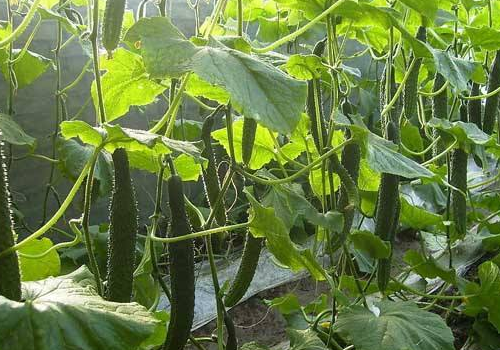
6. When the cucumber tendrils appear, set up an A-frame trellis to train the vines. Insert bamboo poles on the outer side of the seedlings, one pole corresponding to each seedling. Tie the upper ends of the two rows of bamboo poles together. When the vines grow too tall to stand upright, tie them promptly, and thereafter tie them once every 3-4 leaves. The tying string should form a "8" shape with the trellis pole and the vine, which prevents the vine from rubbing against the pole or sliding down. Do not tie the vines too tightly; it should be loose enough to insert an index finger. Each time you tie the vines, fix the top of the vine at the same height for easy management, and it is best to do this in the afternoon, as it is less likely to break the vines and leaves.
7. Cucumbers can be harvested about 10 days after the first fruit, and from sowing to planting out takes only about 45 days, from planting out to the first fruit setting about 30 days, and the harvest period is 1-2 months. However, during the process of growing cucumbers, be careful to maintain the optimal growing temperature of 20-28°C. If it exceeds 30°C, growth will be poor, and below 10°C, growth will stop, so the temperature must be well controlled. In hot summer, a shade net should also be added before seedling emergence.
8. When the main vine of the cucumber reaches the top of the trellis, pinch it promptly, mostly when it has grown 30-35 leaves. Pinching can promote the growth of second-crop cucumbers. Pinching should be done according to the characteristics of the variety; varieties that easily bear second-crop cucumbers are mostly pinched one month before vine removal. Pinching too early results in low yield, while pinching too late fails to give full play to the second-crop fruiting. Pinching, removing tendrils, and removing old leaves are all essential steps. Only by doing these well can you ensure normal growth, flowering, and fruiting of cucumbers, and also prevent and control pests and diseases.
How many days for cucumber seeds to germinate:
When sown at an ambient temperature of about 25°C, they emerge from the soil in 5-7 days, unfold their cotyledons in 7-8 days, unfold their true leaves in 12-14 days, and flower in about 60 days.
In addition, if you soak the seeds in 52°C warm water for 10-12 hours before sprouting, they will germinate in 3 days. Sow immediately afterward, which can save seeds.
That covers the planting methods for cucumber seeds. The germination time is related to temperature.
What are the methods for quickly germinating cucumber seeds?
[Common Questions] What are the methods for quickly germinating cucumber seeds?
[Expert Answer] The methods for quickly germinating cucumber seeds are as follows:
1. Warm water seed soaking method:Put the dry seeds into 55°C-60°C warm water and stir constantly, treating for about 10 minutes. When the water temperature drops to 28-30°C, soak the seeds for 4-6 hours, rinse them clean, and then sprout them.
Cucumber seeds
2. Chemical disinfection method:Soak the seeds in 0.1% carbendazim hydrochloric acid solution for 1 hour, rinse with clean water, then soak in clean water for 4 hours, and they are ready for soaking and sprouting.
3. Seed coating treatment method:Some cucumber seeds are already treated at the time of sale by the seed production unit with a seed coating containing fungicide and various trace elements. Treatment with a seed coating agent has a good sterilizing effect. Treated seeds can be directly soaked and sprouted, or directly sown.
After the seeds are disinfected, remove them, rinse once, drain off the water and shake dry, wrap them in cloth, and place them at 27-30°C to sprout. During sprouting, turn the seeds frequently so they receive uniform warmth. After about 24 hours they begin to sprout. When the seeds show root tips, the temperature can be lowered appropriately, maintained at 22-26°C, and after about two days they will sprout uniformly. If germination coincides with an overcast day when you cannot sow, wrap the seeds well in a damp towel and place them in a cool place at about 10°C to inhibit further growth of the young sprouts. This practice is called "holding back the sprouts."
[Editor's Conclusion] Cucumber seeds generally germinate in about a week in spring. If you want them to germinate faster, you can soak and disinfect them. The specific steps have been introduced to you above by the First Agricultural Economics editor, and we hope this is helpful to you.
How to sprout cucumber seeds?
Image: Cucumber seed sprouting
[Common Questions] How do you sprout cucumber seeds, and what are the techniques?
[Expert Answer]
1. Warm water seed soaking method: Put the dry seeds into 55°C-60°C warm water and stir constantly, treating for about 10 minutes. When the water temperature drops to 28-30°C, soak the seeds for 4-6 hours, rinse them clean, and then sprout them.
2. Chemical disinfection method: Soak the seeds in 0.1% carbendazim hydrochloric acid solution for 1 hour, rinse with clean water, then soak in clean water for 4 hours, and they are ready for soaking and sprouting.
3. Seed coating treatment method: Some cucumber seeds are already treated at the time of sale by the seed production unit with a seed coating containing fungicide and various trace elements. Treatment with a seed coating agent has a good sterilizing effect. Treated seeds can be directly soaked and sprouted, or directly sown.
After the seeds are disinfected, remove them, rinse once, drain off the water and shake dry, wrap them in cloth, and place them at 27-30°C to sprout. During sprouting, turn the seeds frequently so they receive uniform warmth. After about 24 hours they begin to sprout. When the seeds show root tips, the temperature can be lowered appropriately, maintained at 22-26°C, and after about two days they will sprout uniformly. If germination coincides with an overcast day when you cannot sow, wrap the seeds well in a damp towel and place them in a cool place at about 10°C to inhibit further growth of the young sprouts. This practice is called "holding back the sprouts."
[Editor's Review] Seed sprouting is a preparatory step before planting many crops. It allows for faster seedling emergence in less time, and is sometimes very helpful for seizing the farming season. Different crop seeds have different sprouting conditions, and the methods and techniques also differ. The above methods can be used for sprouting cucumber seeds.