How to grow camellia seeds and whether they can be kept indoors
Camellia is a plant that many people like, and it is super lovable, so how do you grow camellia seeds? Can they be kept indoors:
How to grow camellia seeds:
1. Seed collection and storage
In autumn, harvest the fruit immediately when it begins to crack slightly, place it indoors in a cool, ventilated place to dry, and take out the seeds after the fruit cracks naturally. After collecting the seeds, sow them immediately, or treat them by stratification in sand. Wash fine sand clean with water and disinfect it, then place the seeds and fine sand in layers in a suitable container, cover the top with fine sand 5 cm thick, then bury the container in soil, and check frequently to prevent mold and rodent damage.
2. Seed treatment
Seed treatment: Camellia seed coats are hard, and only after treatment can the seeds germinate quickly and uniformly. The following methods can be used: first, score the seed coat with a sharp knife; second, soak the seeds in warm water at 40-50°C for half an hour, then soak them in clean water at 20-25°C for 5-6 days, and take the seeds at the bottom as sowing seeds; third, soak them in a 100μg/g gibberellin solution for a full day and night. (Note: sowing camellia does not require cracking the shell; cracking the shell damages the protective body of the embryo and is not good for germination.)
3. Sowing
Place the hilum facing sideways, cover with a layer of fine fertile soil, cover with a layer of plastic film, and keep the soil moist so the seeds germinate and emerge as early as possible.
4. Management after emergence
When the seeds germinate and emerge from the soil, remove the film on a cloudy day or in the evening. One month after the seedlings emerge, apply some organic fertilizer or chemical fertilizer each month. During seedling growth, loosen the soil in time, and it should be shallow rather than deep, then gradually deeper later. When leaf blight or damping-off occurs, spray a Bordeaux mixture with a mass fraction of 0.8%.
5. Moderate light
Camellia needs suitable light, but also fears high temperatures and direct scorching sun. In spring and late autumn, move the camellia to a balcony or the ground with more light to receive all-day sunlight, promoting plant growth and development, promoting flower bud differentiation, and making the flower buds robust. In summer, when sunlight is strongest, move the flowerpot to a shaded, sun-facing, well-ventilated environment for care, or move it to a north balcony or the lower part of a south balcony for cultivation.
6. Suitable temperature
Temperature is an important condition for the physiological activities of camellia. Camellia likes warmth, and the most suitable temperature for growth is 18°C to 25°C, with relative humidity of 60% to 65%. For camellia growth, spring shoots generally begin to stir in mid-to-late March, sprout in April, form terminal buds in mid-to-late May, stop growing, and gradually differentiate into leaf buds or flower buds. From flower bud formation to flowering takes 180 to 240 days.
7. Appropriate nutrients
Camellia is a flowering plant that likes fertilizer, because it has a strong tree form, many leaves, and a relatively long flowering period, so it also needs a lot of fertilizer. During fertilization, apply enough liquid fertilizer, and combine it with repotting to apply enough slow-release fertilizer. According to the size of the flowerpot, apply 3 grams to 80 grams of decomposed cake fertilizer powder or dried chicken and duck manure per pot, place it at the bottom of the pot and mix it evenly with the bottom soil. According to the plant's growth stage, apply additional organic fertilizer. Except during the coldest winter and hottest summer, apply decomposed cake fertilizer water once to twice a month. Fertilization method: scrape open the soil around the pot edge by about 2 fen, pour the liquid fertilizer into the ditch, then cover it with soil immediately to avoid odors.
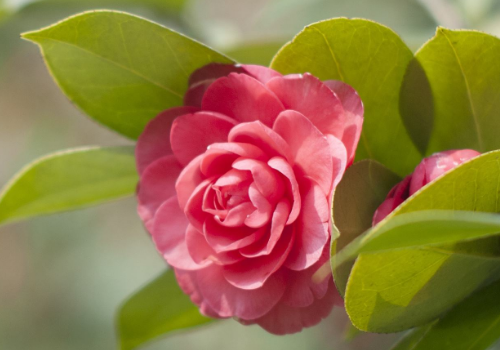
Can camellia be kept indoors:
Indoors is possible, but it needs frequent ventilation. If potted camellia at home is managed improperly, it is very easy for wilting and death to occur, which gives flower growers a headache. The reasons are mainly two factors: first, poor ventilation of the roots, and second, insufficient humidity on the leaf surface.
When the camellia root system lacks oxygen, it leads to difficulty breathing, decline in internal physiological vitality, and over time the root system gradually rots and dies. After spring begins, special attention must be paid to ensuring the drainage holes at the bottom of the pot are not blocked. When planting camellia in large pots and wooden barrels, insert several specially made drainage rods into the pot, that is, when potting, depending on the size of the pot, insert several hard paper cylinders around the pot, fill the cylinders with river sand, then pull out the round paper cylinders to ensure good drainage. For camellia, it is best to choose clay pots, which have good air permeability, while porcelain is the worst. For soil, slightly acidic mountain soil is best, and field mud is the worst. If mountain soil plus clay pots is used, it is beneficial to camellia growth and less likely to cause wilting and death.
The space where camellia branches and leaves are located lacks humidity, especially under dry air and high temperature and high heat, camellia is prone to losing water balance in the branches and causing death. Therefore, potted camellia should keep the environment as moist as possible, with some water tanks or water basins placed around it. When the high-temperature season arrives, frequently spray water on the leaf surface of potted camellia and on the ground around the pot to increase air humidity in a small area and lower the ground temperature. At the same time, when spraying water, it is best to add a little edible vinegar to the water. First, it can clean the leaf surface; second, it can increase the acidity in the pot soil and avoid chlorosis; third, it can kill bacteria and insects on potted camellia.
In addition, if potted camellia is not repotted for a long time, the growing environment deteriorates, which is also one of the reasons camellia does not bloom or dies. Camellia is best repotted once a year, and the repotting time is after flowering in spring. At the very least, it should be repotted and the soil changed every other year, and the root system trimmed. Another harm of not repotting for a long time is that the soil easily becomes compacted, and permeability is poor when watering, causing the top to be wet and the bottom dry. Repotting, trimming the root system, removing part of the old soil, and adding new soil are very beneficial to its growth. During the seedling stage of potted camellia, if urea is used as a top dressing, special caution is needed. If the concentration is too high (when applying liquid fertilizer, it should generally be diluted with water 600-1000 times), applying urea will cause leaf drop, seepage of plant cell fluid, and can very easily kill the plant.
The planting method for camellia seeds is introduced here. It can be kept indoors, but attention must be paid to ventilation and so on.
Is camellia toxic, and is camellia suitable for keeping indoors / Non-toxic and with many benefits when kept indoors
Camellia, a very beautiful ornamental flower. If you understand it, everyone should know that camellia flower colors are very vivid. In life, there is a saying that the more colorful something is, the more toxic it is, and from this a rumor has spread that camellia is toxic. So is camellia toxic? Is camellia suitable for keeping indoors? Here, the editor will answer your questions.
1. Is camellia toxic, two situations
In life, as one of China's top ten famous flowers, the beauty of camellia inspires admiration, but some people also raise this question in doubt: is camellia toxic? For this, the editor found two results: first, camellia is toxic; second, camellia is not toxic. The details are as follows:
1. Camellia is non-toxic
Before growing camellia, some people say it is toxic! In fact, camellia is not toxic. Some people just confuse it with another plant. So, keeping camellia at home does not require worrying about harm. Not only is it non-toxic, camellia also has many effects and uses. As a medicinal material, it can also help treat many diseases.
2. Camellia is toxic
There are many varieties of camellia. Ordinary camellia is not toxic, but there is also one called datura camellia that is extremely toxic. It is understood that the seeds, fruit, leaves, and flowers of datura are all toxic, with the seeds being the most toxic. After children mistakenly eat 3-8 of them, poisoning can occur, and the consequences are very serious.
2. Is camellia suitable for keeping indoors, suitable
Generally speaking, the camellia we usually grow is non-toxic, and camellia also has a long flowering period and a pleasant floral scent. So is camellia suitable for keeping indoors? Obviously it is suitable. Not only is it suitable, there are also many benefits to keeping camellia indoors.
3. Benefits of keeping camellia indoors
1. Strong ornamental value
Camellia always blooms quietly when the weather turns slightly cool in late autumn, so it is very suitable for planting at home for the owner to enjoy. Keep camellia at home, and after it blooms, its brightly colored flowers and refreshing floral fragrance both make people feel relaxed and happy. Being able to have such beautiful scenery at home is truly a great blessing in life.
2. Purifies the air
Camellia has a strong ability to absorb carbon dioxide, and it also has strong resistance to harmful gases in the air such as smoke, hydrogen sulfide, chlorine, hydrogen fluoride, and fumes, purifying the air. So a beautiful environment and purifying the air are also one of the benefits of keeping camellia indoors.
3. Feng shui effect of camellia
Besides the above two points, the benefits of keeping camellia indoors are also reflected in feng shui. Keep camellia at home. Whenever winter comes and people feel lazy, seeing such camellia that fills people with vitality will also inject vitality into themselves again and encourage them to strive upward.
In addition, placing a pot of camellia on the balcony can not only beautify the home environment and purify the air, but also improve home feng shui. Because the balcony is relatively open and sunlight is relatively sufficient, it is itself very suitable for growing camellia. Moreover, cultivating camellia on the balcony also has the effect of bringing vitality and wealth.
Overall, camellia is beautiful and not difficult to grow. More importantly, the camellia we commonly see is non-toxic, so friends who are tempted can get a pot and try growing it. If you do not know how to grow it, you can also look at the cultivation methods for camellia. That is all the editor has to introduce about whether camellia is toxic, hoping it can help everyone. Finally, may everyone's camellia bloom beautiful flowers.
Camellia cultivation methods, how to grow camellia
Growing plants at home has become a popular trend nowadays. Among them, camellia has become the first choice for many households because of its relative advantages. However, encountering various problems during cultivation is unavoidable. Today the editor will explain camellia cultivation methods to everyone, so people no longer have to be troubled by growing it.
First, let us understand the relevant attributes of camellia:
Camellia is an evergreen shrub or tree, and it is mainly grown in larger amounts in China's Fujian, Yunnan, and other places. Camellia likes a semi-shaded growing environment, is not tolerant of severe cold or intense heat, has high soil requirements, likes slight acidity, is not tolerant of alkali, requires a dry air environment, and its fruit matures each autumn.
Camellia cultivation methods
First, light conditions. Camellia avoids strong light, so when planting, special attention must be paid to sunlight. In spring and autumn, sufficient light is required, but in summer, direct sunlight must be avoided. If camellia is exposed to strong light for too long, it is very easy for it to die. If conditions permit, moving it under a sun shelter is best.
Second, temperature attention. Camellia is not tolerant of cold or heat, and its most suitable temperature is 18-25 degrees, so the ambient temperature must not be too high or too low, otherwise it will affect its growth. Special attention must be paid to winter: the indoor temperature must be above 3 degrees. If it is below 0 degrees, it will suffer frost damage.
Third, watering matters. Camellia likes a moist environment, so special attention must be paid: it cannot be too dry, cannot be too wet, and cannot alternate between dry and wet. Generally in spring, it can be watered more, which is good for sprouting. In summer, water twice, morning and evening, and it is best to water onto the leaf surface. Never water when the plant is at high temperature. Autumn is the same as spring, but in winter, watering must be noted: it is best to water before and after the plant, and do not water every day. It is best to water once every two or three days.
Fourth, key points of fertilizing. Camellia relatively likes fertilizer, so special attention must be paid to the use of fertilizer throughout the cultivation process, such as adding phosphorus and potassium fertilizer when potting, but fertilization also has a limit and must not be too much. Generally, fertilize about 3 times during the nearly half year after flowering, and fertilizing once in winter is enough. In order to make the flowers more beautiful, it is best to add more phosphorus fertilizer to the fertilizer.
Fifth, pruning branches. Pruning of camellia is very important. Generally, branches that affect the tree shape and diseased or weak branches are cut off, and flower buds are also organized. Once flower buds are too dense, they must also be thinned. After flowers fade, they should also be removed in time, which can reduce nutrient consumption.
Sixth, repotting camellia. Many people overlook this point. Many people plant it and then never repot it. In fact, this is very wrong. Camellia generally needs repotting once every two years, and it should be changed to a larger pot, which is beneficial to its growth. The timing of repotting must be given special attention, and it is best in April. When repotting, attention must also be paid: do not remove all the old soil, and add a small amount of base fertilizer inside, then water.
Seventh, prevention and control of diseases and pests. Camellia is very prone to disease, and there are mainly two common diseases: black mold disease and anthracnose. At this time, it is only necessary to spray 0.5-degree Bordeaux mixture. The main pest of camellia is the tea shoot moth, and at this time it is mainly enough to cut off the infested shoots.
Eighth, soil requirements. Soil is the foundation of camellia growth. All nutrients and so on of camellia are obtained from the soil, so the soil requirements are quite high. Generally, the soil should have relatively high humus content, with a pH between 5-6.5, slightly acidic. The best soil formula is: 50% mountain soil, 40% wood chips or edible mushroom residue, and 10% cake fertilizer powder or livestock manure and phosphate fertilizer powder.
Ninth, air circulation. The place where camellia grows has extremely high requirements for air circulation, and it is most suitable for growing in a gentle breeze, but camellia is very afraid of northwest wind and strong wind, because northwest wind and strong wind easily cause water to evaporate too quickly, causing camellia supply and demand to lose balance, which is not good for camellia growth.
Camellia propagation
First type, sowing
Sowing technology is very common in many professional cultivation gardens, mainly used for breeding new varieties. Generally speaking, if this method is used, seeds are collected in December, sown in February-March, and flower after 3-4 years. When sowing, the soil covering thickness is about 2 cm, and it will germinate in one month to one and a half months. In the second spring, it can be transplanted.
Second type, cuttings
This technique can be said to be the most used method now. Generally, tender branches from the tree are taken in spring for cuttings, but one point must be noted: before inserting, the base of the cutting must be soaked in a naphthalene acetic acid solution for about 10 hours, which can greatly increase the rooting rate. After inserting, spray water and shade, and never let strong light shine directly on it. The air humidity should be kept between 85%-95%, and the surrounding temperature at 25-30 degrees. In this way, about one month after insertion, new roots will be produced at the base of the cutting. At this time, gradually reduce shading and increase light. When the seedlings are 50-80 cm tall, they can be planted in place.
Third type, grafting
This technique is somewhat difficult, and not just anyone can do it. The grafting time is generally better from early April to late September. Grafting has many benefits and can artificially improve varieties, but the technical requirements are very high, and it is not recommended for home growers to do it themselves.
Fourth type, tissue culture
Tissue culture technology is relatively cumbersome. Generally, its explants include anthers, embryos, buds, and so on, and it is usually divided into juvenile and mature types. The culture solutions for the two are different. For juvenile, 0.5-1.0 mg/L of 6-benzyladenine can be used; for mature, WPM plus 2.0 mg/L of 6-benzyladenine and 0.01 mg/L; this method mainly requires attention to the rooting method. The specific procedure is: soak the base of the tender shoot in a 1 mg/L indolebutyric acid solution for 15-20 minutes, then inoculate it onto a basic medium containing no growth substances, carry out dark treatment for 10-15 days, and after rooting, transplant and harden the seedlings in 20-30 days.