How to Grow Rainbow Pink (Dianthus barbatus) Seeds? A Detailed Guide to Its Differences from Dianthus plumarius
Rainbow Pink is a type of plant that many people know about, and a great many people are familiar with it. So how do you grow Rainbow Pink seeds? And what is the difference between it and Dianthus plumarius?
How to grow Rainbow Pink seeds:
Propagation is commonly done by sowing, cuttings, and division. The optimum temperature for seed germination is 21 to 22°C. Sowing propagation is generally carried out in September. Sow in an open-field seedbed, keep the soil moist after sowing; germination occurs in 5 days after sowing, and seedlings emerge in about 10 days. The optimum temperature for seedling growth is 10-20°C. When the seedlings grow 4-5 leaves, they can be transplanted, and they bloom the following spring.
They can also be directly sown in the open field in September or sown in pots in a cold room from November to December, and planted out in the open field in April of the following year. Cutting propagation is carried out from October to late February to March of the following year. During the period of lush branches and leaves, cut 5-6 cm long young shoots as cuttings; roots form 15-20 days after insertion.
Division propagation is mostly done after flowering using old plants, and can be carried out in autumn or early spring. For example, division can be done in April; pay attention to drainage in summer, strengthen fertilizer and water management after September, and they will bloom again in early October.
What is the difference between Rainbow Pink and Dianthus plumarius:
1. Differences in alternative names
Dianthus plumarius is also called feathered pink or groundcover pink.
Rainbow Pink, alternative names: bearded pink, American pink, ten-pattern brocade.
2. Differences in growing environment
Dianthus plumarius prefers warmth and ample sunlight, and is not cold-tolerant. It requires deep, fertile soil; for pot cultivation, the soil should be loose and well-drained.
Rainbow Pink is cold-tolerant but not tolerant of severe heat; it prefers sunny, high, dry, well-ventilated sites and well-drained fertile loam.
3. Differences in distribution areas
Dianthus plumarius: the Yangtze River basin and areas to its north.
Rainbow Pink is mostly distributed in Northeast China, North China, the Yangtze River basin, and Southeast Asia.
4. Differences in flower color
The flower colors of Dianthus plumarius include purple, pink, and white, and it is fragrant.
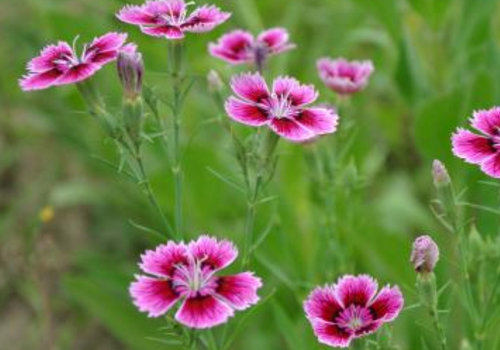
Rainbow Pink is usually red-purple, with white speckled markings, toothed at the apex, and bearded at the throat.
That concludes the introduction to the planting methods for Rainbow Pink seeds, and the differences from Dianthus plumarius. Now you know how to grow them!
Rainbow Pink Dianthus barbatus L. Rainbow Pink Illustrated Guide: How to care for Rainbow Pink / How to propagate Rainbow Pink
Rainbow Pink ProfileRainbow Pink Dianthus barbatus L.
Alternative names: Chinese pink, Luoyang pink, stone chrysanthemum, embroidered bamboo, velvet-cut flower, bearded pink, American pink
Classification: perennial herbaceous flower
Family and genus: Plantae, Angiosperms, Dicotyledons, Caryophyllales, Caryophyllaceae, Dianthus
Full bloom period: summer and autumn
Rainbow Pink, alternative names: bearded pink, American pink, ten-pattern brocade, (scientific name: Dianthus barbatus L.) belongs to Caryophyllales, Caryophyllaceae, a perennial herb 30-60 cm tall, with lanceolate leaves; petals usually red-purple, with white speckled markings; capsule ovate-oblong; flowering and fruiting period May-October. Rainbow Pink is cold-tolerant but not tolerant of severe heat, and the whole plant or root of Dianthus can be used as medicine. It has the effects of clearing heat, promoting diuresis, breaking blood stasis, and promoting menstruation. There are more than 300 species in the same genus. It is native to Northeast China, North China, the Yangtze River basin, and Southeast Asia.
Rainbow Pink Cultivation Methods and Precautions Introduction to Rainbow Pink
Rainbow Pink, alternative names: bearded pink, American pink, ten-pattern brocade, (scientific name: Dianthus barbatus L.) belongs to Caryophyllales, Caryophyllaceae, a perennial herb 30-60 cm tall, with lanceolate leaves; petals usually red-purple, with white speckled markings; capsule ovate-oblong; flowering and fruiting period May-October. Rainbow Pink is cold-tolerant but not tolerant of severe heat, and the whole plant or root of Dianthus can be used as medicine. It has the effects of clearing heat, promoting diuresis, breaking blood stasis, and promoting menstruation. There are more than 300 species in the same genus. It is native to Northeast China, North China, the Yangtze River basin, and Southeast Asia.
Morphological Characteristics of Rainbow Pink Stems
Rainbow Pink is a perennial herb, 30-60 cm tall, the whole plant hairless. Stems erect, angular. Leaves lanceolate, 4-8 cm long, about 1 cm wide, apex acute, base gradually narrowed, connate into a sheath, entire, midvein obvious.
Flowers
Rainbow Pink has numerous flowers, aggregated into heads, with several leaf-like involucral bracts; pedicels very short; bracts 4, ovate, apex caudate-acuminate, margin membranous, finely toothed, equal to or slightly longer than the calyx; calyx tubular, about 1.5 cm long, lobes sharply acute; petals with long claws, limb ovate, usually red-purple, with white speckled markings, apex toothed, throat bearded; stamens slightly exserted; ovary oblong, style linear.
Fruit
The capsule of Rainbow Pink is ovate-oblong, about 1.8 cm long, apex 4-cleft to the middle; seeds brown, flat-ovate, smooth.
The flowering and fruiting period of Rainbow Pink is May-October.
Ecological Habits of Rainbow Pink
Rainbow Pink is cold-tolerant but not tolerant of severe heat; it prefers sunny, high, dry, well-ventilated sites and well-drained fertile loam. The optimum temperature for seed germination is 21-22°C.
Cultivation Techniques of Rainbow Pink Planting Methods
Rainbow Pink is commonly propagated by sowing, cuttings, and division. The optimum temperature for seed germination is 21 to 22°C. Sowing propagation is generally carried out in September. Sow in an open-field seedbed, keep the soil moist after sowing; germination occurs in 5 days after sowing, and seedlings emerge in about 10 days. The optimum temperature for seedling growth is 10-20°C. When the seedlings grow 4-5 leaves, they can be transplanted, and they bloom the following spring. They can also be directly sown in the open field in September or sown in pots in a cold room from November to December, and planted out in the open field in April of the following year. Cutting propagation is carried out from October to late February to March of the following year. During the period of lush branches and leaves, cut 5-6 cm long young shoots as cuttings; roots form 15-20 days after insertion. Division propagation is mostly done after flowering using old plants, and can be carried out in autumn or early spring. For example, division can be done in April; pay attention to drainage in summer, strengthen fertilizer and water management after September, and they will bloom again in early October.
Management and Care
Rainbow Pink is a perennial herbaceous flower with weak perennial staying power, and is mostly cultivated as a biennial or annual plant. Potted Dianthus requires sufficient base fertilizer, with 2-3 plants per pot. When the seedlings grow to 15 cm tall, remove the terminal buds to encourage branching; afterward, pay attention to appropriately removing axillary buds, otherwise too many branches will disperse nutrients and result in small flowers. Appropriately removing axillary buds concentrates nutrients and can promote larger and more colorful flowers. During the growth period, it should be placed in a sunny, well-ventilated place for care, keeping the soil moist, and applying a diluted decomposed liquid fertilizer about once every 10 days. If there is too much rain in summer, pay attention to drainage and loosening the soil. Dianthus easily crossbreeds, so those saving seeds need to plant them in isolation. Before flowering, some axillary flower buds should be removed in time, mainly to ensure the terminal flower buds bloom. In winter, water less; if the temperature is maintained at 5-8°C, it will bloom continuously through winter and spring.
Disease and Pest Control of Rainbow Pink
Rainbow Pink often suffers from rust disease and red spider mite damage. For rust disease, spray with 1500 times dilution of 50% carboxin wettable powder; for red spider mites, spray with 1500 times dilution of 40% omethoate emulsifiable concentrate.
Distribution Area of Rainbow Pink
Rainbow Pink is native to Northeast China, North China, the Yangtze River basin, and Southeast Asia, and is widely distributed. Except for the hotter regions of South China, it is distributed almost everywhere in China.
Medicinal or Dietary Therapeutic Value of Rainbow Pink
The medical information and health dietary therapy information on Huahua.com is for reference only and cannot be used as a basis for diagnosis or medical treatment. Any health issues should be consulted with professional medical personnel, and treatment of any disease should follow a doctor's advice.
Ultimate flower-protecting mission: Love yourself, start from reality, and strictly follow doctor's advice. For illness, do not be careless, do not delay, do not give up hope; face it bravely, warm the silent world with love, and care for the flower field in your heart with your heart.
Medicinal Overview
Bamboo Grove Breeze - Laoshan Dianthus Tea. Laoshan stone bamboo, medicinal name Quemai (Dianthus superbus), a purely wild herbaceous plant that grows in rock crevices on mountain cliffs, hence the name stone bamboo. It contains saponins, carbohydrates, and vitamins A and C, and has the effects of clearing heat, reducing inflammation, promoting diuresis, and dredging collaterals. "Compendium of Materia Medica" states: taste bitter and cold, non-toxic.
Medicinal Value
Treats dysuria and various types of urinary obstruction, inability to urinate, expels thorns, resolves carbuncles and swellings, improves eyesight and removes eye film, induces abortion and expels the fetus, discharges retained blood. Nourishes kidney qi, expels abnormal counterflow in the bladder, stops cholera, promotes hair growth, treats the five types of strangury, amenorrhea, breaks blood clots and discharges pus, treats hemorrhoids and fistula with bloody stool, eye swelling and pain and toxic swellings, treats weeping sores and women's genital sores. Due to the special growth habits of Laoshan Dianthus and the climate environment of Laoshan, stone bamboo has a long growth period and is harvested few times each year for tea, which makes Laoshan Dianthus tea rich in nutrients, naturally pure in quality, and uniquely distinctive. It is called "Laoshan green" by locals, and even nicknamed "Lao green". The carefully crafted Laoshan Dianthus tea has a jade-green color, a rich and lasting aroma, a fresh and strongly fragrant taste, a bright green liquor color, and tender leaf residues that form buds, lifelike; after drinking, it leaves a lingering fragrance on the lips and teeth, is sweet and promotes salivation, and leaves an endless aftertaste, truly a supreme tea. At the same time, it is indeed a top-grade health beverage.
Landscape Uses of Rainbow Pink
Rainbow Pink has a low plant form, stems like bamboo, and verdant foliage. Its natural flowering period is May-September, and it can bloom from late spring to mid-autumn; potted in a greenhouse, it can bloom in all four seasons. Flowers are terminal on branch ends, solitary or in pairs, and also in paniculate cymes. The flower diameter is not large, only 2 to 3 cm, but the flowers are abundant, rising one after another, and the ornamental period is relatively long. Flower colors include white, pink, red, pink-red, scarlet, purple, light purple, yellow, blue, etc., colorful and endlessly varied. In gardens, it can be used for flower beds, flower borders, flower terraces, or pot cultivation, and can also be used in rock gardens and as edging on lawns. When planted in large patches, it can serve as a landscape groundcover material. In addition, Dianthus has the ability to absorb sulfur dioxide and chlorine gas, so it can be planted in large quantities wherever there are toxic gases. It is also excellent for cut flower viewing.
Cultural Background of Rainbow Pink
When it comes to Dianthus flowers, not many people may know them; but mention carnations, and people are more familiar. In fact, what we commonly call Dianthus flowers is the general term that includes Chinese pink; American pink, also called Rainbow Pink; and clove pink, namely what people commonly call carnations, and Chai Duo, etc. In China, in Europe and America, and even in the hearts of people all over the world, the feelings of missing and respecting mothers are placed in Dianthus flowers. Dianthus flowers have become a symbol for commemorating "Mother's Day" in many countries around the world, becoming the mother's flower, and among this there is a little-known legendary story!
It is unknown which dynasty or era it was, but in a great mountain in the Northeast lived an ordinary family with the surname Shi. The old couple had only one son named Shizhu. The family had no property and no land, and relied entirely on old man Shi going into the mountains to dig herbs for a living. Unfortunately, when Shizhu was just babbling and learning to speak, old man Shi fell to his death while digging herbs in the mountains. From then on, mother and son depended on each other, and life became even harder. Shizhu's mother alone took on the burden of raising her son. Every day she went into the mountains to dig mountain goods to exchange for a little grain, which she mixed with wild vegetables to make porridge. Just like that, more than ten years passed in a flash. Shizhu's mother went through countless hardships and finally managed to raise Shizhu into a young man of seventeen or eighteen.
Children from poor families mature early. Shizhu was good in every way, helping his mother inside and out. It was just that from childhood he had suffered hardship and poverty, and his body was very frail. Not only
could he not, like other young men, independently support the family and let his aging mother rest, but he had also had since childhood a shameful illness - bed-wetting. A young man of seventeen or eighteen, yet he did not dare mention taking a wife. Alas, poor and sick, who would be willing to become this family's daughter-in-law? The son was sensible, but as a mother she saw it in her eyes and felt pain in her heart. From then on, Shizhu's mother no longer dug mountain goods when she went into the mountains; she learned from old man Shi and began digging medicinal herbs. But she was getting older; how could she climb those rugged mountains and enter those deep forests? Besides, there were thousands upon thousands of medicinal herbs; which one could cure her son's illness? Yet Shizhu's mother did not fear the high mountains and dangerous roads, and went to dig herbs every day. Each time she discovered a new herb, she first tasted it herself: pungent, bitter, numbing, astringent - as a mother, she first tasted all the sweetness and bitterness of the world. Several times she was poisoned by the herbs, her face swelled and her eyes turned red, but she quickly ate some heat-clearing and detoxifying herbs and finally pulled through. Searching and searching like this, one year passed, two years passed, three years passed, but the herb that could cure her son's illness was still not found.
In the blink of an eye, it was the fifth or sixth month of the third year. That day, Shizhu stopped his mother, who was about to go out again, and said tearfully: "Mom, don't go. I won't treat my illness, and I won't take a wife. You worked so hard to raise me, and not only have I been unable to repay you, but I have dragged you down. As a son, I am truly sorry to my mother." Shizhu's mother also held back tears, touched Shizhu's head and said, "Son, as your mother I know you are filial, but how could any mother in the world watch her son tormented by illness and not try to save him? Besides, if I find the medicine that can cure your illness, then it will not only cure your illness, but also cure other people in the world with this illness. It will not only settle this mother's worries, but also help other mothers." After saying this, she resolutely went out. This time she walked farther and climbed higher. But after rushing about for a day, she still found nothing new. Seeing that it was getting late, with mountain winds blowing in gusts and cold air piercing, Shizhu's mother could not help but sigh and sit on a mountain rock to rest her feet. She thought that she had gone far today and would not be able to make it back tonight. Worrying about her sick son, and even more thinking that she herself was getting older and older, and that when the time came she would not even be able to climb mountains, nor even walk, how could she keep looking for medicine? The more she thought, the more anxious and sad she became, and she could not hold back her tears; two streams of hot tears fell all the way into the crevices of the mountain rocks. But unexpectedly, a miracle happened at this moment: in the mountain crevice touched by her hot tears, a flower suddenly grew. This flower plant was only about one chi tall, with slender leaves and flowers growing at the tips of the branches. The flowers were not large; several small flowers clustered together like an umbrella. The small pink flowers swayed slightly in the mountain wind, as if greeting her. Shizhu's mother quickly rubbed her eyes, thinking perhaps she was old and her eyes were dim, and wondered why she had never seen such a beautiful flower in these wild mountains before. But when she opened her eyes, the flower was still nodding and smiling there. While Shizhu's mother was astonished, she heard a sweet girl's voice speaking: "Old mother, pull up this whole flower, take it home and boil it in water for your son to drink. It can cure your son's illness." Shizhu's mother only heard the voice but saw no one; in the wild mountains there was only that flower smiling. Shizhu's mother immediately understood that this was a flower fairy helping her and treating her son's illness. Shizhu's mother was so happy that she also felt energized. Looking up, ah, the wild mountains were dotted with these beautiful flowers. She quickly pulled up many and ran down the mountain holding them.
When she got home, Shizhu was anxious, not knowing where to find his mother. Shizhu's mother happily told Shizhu the whole wonderful encounter on the mountain, and according to the flower fairy's instructions, boiled the collected flowers together with their roots in water for Shizhu to drink. As soon as the medicine was boiled, the thatched cottage was filled with waves of delicate fragrance. Shizhu took it for three consecutive days, and not only was his bed-wetting problem cured, but he also became much more energetic, always feeling as if he had inexhaustible strength all over. Shizhu was originally a filial child, and once he recovered, he no longer wanted his mother to go up the mountain to dig herbs and toil. Before long, he married a wife, and the whole family lived happily ever after. Afterward, the news that Shizhu's mother had met a flower fairy while gathering herbs and used these flowers and plants to cure her son Shizhu's illness spread quickly. All the poor people who had a similar illness came to Shizhu's mother asking for these flowers and plants to treat their illness, and none failed to be cured. People were grateful to the flower fairy, and even more understood that the flower fairy had also been moved by Shizhu's mother's love and therefore took the initiative to help. Each time people wanted to find these flowers and plants, they could not name them; they only knew that the flowers Shizhu's mother found could cure illness, so they casually called them "Shizhu's mother's flowers," and as they called them over and over, they simply became "Shizhu flowers."
To this day, Shizhu flowers are still a Chinese herbal medicine, with special efficacy in treating painful, dribbling, and rough urination. Up to now, Shizhu flowers are still one of the most ordinary flowers. They do not have the wealthy grandeur of peonies, the endlessly unbeaten charm of Chinese roses, the delicate and affectionate beauty of peonies, or the fragrant self-appreciation of orchids... but they represent the great feelings of mothers. Like Shizhu's mother, for her child she spared no hardships, and for future generations she silently dedicated herself. In the world there is no person without a mother, and so Shizhu has also become a flower that everyone loves.
Flower Language of Rainbow Pink
Rainbow Pink flower language: talent, boldness, and pure love.
Meaning: Rainbow Pink's pale red flowers edged in white always give people a delicate, pitiable feeling no matter when. The white edging looks like a ring of exquisite and lovely lace, like a cute young girl. Long, long ago, when people saw Dianthus growing in wild mountains and by rivers, they must have touched the cute and pitiable little flowers while thinking of the person they secretly loved. Therefore, the flower language of talent, boldness, and pure love should match the flower's form extremely well.
Rainbow Pink Pictures
Rainbow Pink Chinese Pink, Rainbow-Pink Rainbow Pink Illustrated Guide: How to care for Rainbow Pink / How to propagate Rainbow Pink
Rainbow Pink ProfileRainbow Pink Chinese Pink, Rainbow-Pink
Rainbow Pink Cultivation Methods and Precautions Introduction to Rainbow Pink
Perennial herb, often cultivated as a biennial flower. Stems smooth and much branched, leaves opposite, linear-lanceolate. Rich flower colors, including white, red, yellow, pink, purple-red, orange-red, or with markings; there are distinctions between notched and single or double petals. Can be used for flower beds, flower borders, flower terraces, or pot cultivation. Can be used for flower beds, flower borders, flower terraces, or pot cultivation. Flowering period April to October, concentrated in April to May. Suitable for flower beds or pot cultivation; in horticultural cultivation there are also dwarf three-inch Dianthus and five-inch Dianthus, both of which are hybrid cultivated varieties of Rainbow Pink. Can be used for flower beds, flower borders, flower terraces, or pot cultivation Can be used for flower beds, flower borders, flower terraces, or pot cultivation Native to China, likes sun, is cold-tolerant, drought-tolerant, taboo against waterlogging, prefers well-drained, fertile sandy loam. Capsule oblong, seeds flat-round, dark brown. Can be used for flower beds, flower borders, flower terraces, or pot cultivation. Can be used for flower beds, flower borders, flower terraces, or pot cultivation.
Flower Language of Rainbow Pink
Flower language: pure love, talent, boldness. Dianthus, with pale red flowers edged in white, always gives people a delicate, pitiable feeling no matter when. The white edging looks like a ring of exquisite and lovely lace, like a cute young girl. Long, long ago, when people saw Dianthus growing in wild mountains and by rivers, they must have touched the cute and pitiable little flowers while thinking of the person they secretly loved. Therefore, the flower language [talent], [boldness], and [pure love] should match the flower's form extremely well.
Cultivation Techniques of Rainbow Pink
Dianthus has a long history of cultivation in China. The Ming dynasty "Flower History" records: "Dianthus flowers must be lifted and divided every year to flourish." This concisely summarizes the characteristic that Dianthus should be divided and replanted frequently. The Qing dynasty "Flower Mirror" also mentions: "branches and leaves like reeds, slender and verdant." Dianthus is a perennial herbaceous flower with weak perennial staying power, and is mostly cultivated as a biennial or annual plant. Potted Dianthus requires sufficient base fertilizer, with 2-3 plants per pot. When the seedlings grow to 15 cm tall, remove the terminal buds to encourage branching; afterward, pay attention to appropriately removing axillary buds, otherwise too many branches will disperse nutrients and result in small flowers. Appropriately removing axillary buds concentrates nutrients and can promote larger and more colorful flowers. During the growth period, it should be placed in a sunny, well-ventilated place for care, keeping the soil moist, and applying a diluted decomposed liquid fertilizer about once every 10 days. If there is too much rain in summer, pay attention to drainage and loosening the soil. Dianthus easily crossbreeds, so those saving seeds need to plant them in isolation. Before flowering, some axillary flower buds should be removed in time, mainly to ensure the terminal flower buds bloom. In winter, water less; if the temperature is maintained at 5-8 degrees, it will bloom continuously through winter and spring. Cultivation essentials: propagate by seed, grows vigorously. Besides Rainbow Pink, there are also Dianthus japonicus, American pink, etc. Among them, American pink prefers cooler climates. Pruning the first round of flowers can encourage a second bloom with a larger plant shape and more flowers. Likes slightly alkaline soil; in winter the medium should not be too wet.
Disease and Pest Control of Rainbow Pink
Often suffers from rust disease and red spider mite damage. For rust disease, spray with 1500 times dilution of 50% carboxin wettable powder; for red spider mites, spray with 1500 times dilution of 40% omethoate emulsifiable concentrate.
Morphological Characteristics of Rainbow Pink
Dianthus flowers are so named because their stems have nodes and swell like bamboo. They are perennial herbaceous plants, but are generally cultivated as annuals or biennials. In the north, sown in autumn, they bloom the following spring; in the south, sown in spring, they bloom in summer and autumn. Plant height 30-40 cm, erect and clustered. Stems erect, jointed, much branched, leaves opposite, linear or linear-lanceolate. Calyx tubular, flowers solitary or several clustered at the stem tip, forming cymes, flower diameter 2-3 cm, flower colors include purple-red, scarlet, pink, purple-red, pure white, red, variegated; single petals 5 or double, apex serrated, slightly fragrant. The middle-lower part of the upper side of the petals forms a beautiful black ring pattern; when fully open, the petal surface is like a dish shining with velvety luster, brilliant and colorful. Flowering period April-October, concentrated in April-May. Capsule oblong or long-round, seeds flat-round, dark brown.
Ecological Habits of Rainbow Pink
Likes sun, is cold-tolerant, drought-tolerant, taboo against waterlogging, prefers well-drained, fertile sandy loam. It is cold-tolerant but not tolerant of severe heat; it prefers sunny, high, dry, well-ventilated sites and well-drained fertile loam. Propagation is by sowing and cuttings; the optimum temperature for seed germination is 21 to 22°C; sow in autumn and plant out the following spring; double-petaled varieties that do not easily set seed are divided or cut in autumn. The whole plant of Dianthus can be used as medicine, with the effect of clearing heat and promoting diuresis. Dianthus is a perennial root herbaceous flower of the Caryophyllaceae family, now mostly cultivated as a biennial flower. Plant height 30-50 cm, white-green. Stems clustered, smooth and hairless. Leaves linear or lanceolate. Flowers solitary, single or double, in light red, red, light purple, purple, white, mixed colors, etc., petal margins serrated; flowering period May-September. Capsule oblong, seeds black. There is another type produced in Europe, called American pink, with flowers in cymes.
Distribution Area of Rainbow Pink
Native to Northeast China, North China, the Yangtze River basin, and Southeast Asia, widely distributed. Except for the hotter regions of South China, it is distributed almost everywhere in China.
Cultural Background of Rainbow Pink
When it comes to Dianthus flowers, not many people may know them; but mention carnations, and people are more familiar. In fact, what we commonly call Dianthus flowers is the general term that includes Chinese pink; American pink, also called Rainbow Pink; and clove pink, namely what people commonly call carnations, and Chai Duo, etc. In China, in Europe and America, and even in the hearts of people all over the world, the feelings of missing and respecting mothers are placed in Dianthus flowers. Dianthus flowers have become a symbol for commemorating "Mother's Day" in many countries around the world, becoming the mother's flower, and among this there is a little-known legendary story!
It is unknown which dynasty or era it was, but in a great mountain in the Northeast lived an ordinary family with the surname Shi. The old couple had only one son named Shizhu. The family had no property and no land, and relied entirely on old man Shi going into the mountains to dig herbs for a living. Unfortunately, when Shizhu was just babbling and learning to speak, old man Shi fell to his death while digging herbs in the mountains. From then on, mother and son depended on each other, and life became even harder. Shizhu's mother alone took on the burden of raising her son. Every day she went into the mountains to dig mountain goods to exchange for a little grain, which she mixed with wild vegetables to make porridge. Just like that, more than ten years passed in a flash. Shizhu's mother went through countless hardships and finally managed to raise Shizhu into a young man of seventeen or eighteen.
Children from poor families mature early. Shizhu was good in every way, helping his mother inside and out. It was just that from childhood he had suffered hardship and poverty, and his body was very frail. Not only
could he not, like other young men, independently support the family and let his aging mother rest, but he had also had since childhood a shameful illness - bed-wetting. A young man of seventeen or eighteen, yet he did not dare mention taking a wife. Alas, poor and sick, who would be willing to become this family's daughter-in-law? The son was sensible, but as a mother she saw it in her eyes and felt pain in her heart. From then on, Shizhu's mother no longer dug mountain goods when she went into the mountains; she learned from old man Shi and began digging medicinal herbs. But she was getting older; how could she climb those rugged mountains and enter those deep forests? Besides, there were thousands upon thousands of medicinal herbs; which one could cure her son's illness? Yet Shizhu's mother did not fear the high mountains and dangerous roads, and went to dig herbs every day. Each time she discovered a new herb, she first tasted it herself: pungent, bitter, numbing, astringent - as a mother, she first tasted all the sweetness and bitterness of the world. Several times she was poisoned by the herbs, her face swelled and her eyes turned red, but she quickly ate some heat-clearing and detoxifying herbs and finally pulled through. Searching and searching like this, one year passed, two years passed, three years passed, but the herb that could cure her son's illness was still not found.
In the blink of an eye, it was the fifth or sixth month of the third year. That day, Shizhu stopped his mother, who was about to go out again, and said tearfully: "Mom, don't go. I won't treat my illness, and I won't take a wife. You worked so hard to raise me, and not only have I been unable to repay you, but I have dragged you down. As a son, I am truly sorry to my mother." Shizhu's mother also held back tears, touched Shizhu's head and said, "Son, as your mother I know you are filial, but how could any mother in the world watch her son tormented by illness and not try to save him? Besides, if I find the medicine that can cure your illness, then it will not only cure your illness, but also cure other people in the world with this illness. It will not only settle this mother's worries, but also help other mothers." After saying this, she resolutely went out. This time she walked farther and climbed higher. But after rushing about for a day, she still found nothing new. Seeing that it was getting late, with mountain winds blowing in gusts and cold air piercing, Shizhu's mother could not help but sigh and sit on a mountain rock to rest her feet. She thought that she had gone far today and would not be able to make it back tonight. Worrying about her sick son, and even more thinking that she herself was getting older and older, and that when the time came she would not even be able to climb mountains, nor even walk, how could she keep looking for medicine? The more she thought, the more anxious and sad she became, and she could not hold back her tears; two streams of hot tears fell all the way into the crevices of the mountain rocks. But unexpectedly, a miracle happened at this moment: in the mountain crevice touched by her hot tears, a flower suddenly grew. This flower plant was only about one chi tall, with slender leaves and flowers growing at the tips of the branches. The flowers were not large; several small flowers clustered together like an umbrella. The small pink flowers swayed slightly in the mountain wind, as if greeting her. Shizhu's mother quickly rubbed her eyes, thinking perhaps she was old and her eyes were dim, and wondered why she had never seen such a beautiful flower in these wild mountains before. But when she opened her eyes, the flower was still nodding and smiling there. While Shizhu's mother was astonished, she heard a sweet girl's voice speaking: "Old mother, pull up this whole flower, take it home and boil it in water for your son to drink. It can cure your son's illness." Shizhu's mother only heard the voice but saw no one; in the wild mountains there was only that flower smiling. Shizhu's mother immediately understood that this was a flower fairy helping her and treating her son's illness. Shizhu's mother was so happy that she also felt energized. Looking up, ah, the wild mountains were dotted with these beautiful flowers. She quickly pulled up many and ran down the mountain holding them.
When she got home, Shizhu was anxious, not knowing where to find his mother. Shizhu's mother happily told Shizhu the whole wonderful encounter on the mountain, and according to the flower fairy's instructions, boiled the collected flowers together with their roots in water for Shizhu to drink. As soon as the medicine was boiled, the thatched cottage was filled with waves of delicate fragrance. Shizhu took it for three consecutive days, and not only was his bed-wetting problem cured, but he also became much more energetic, always feeling as if he had inexhaustible strength all over. Shizhu was originally a filial child, and once he recovered, he no longer wanted his mother to go up the mountain to dig herbs and toil. Before long, he married a wife, and the whole family lived happily ever after. Afterward, the news that Shizhu's mother had met a flower fairy while gathering herbs and used these flowers and plants to cure her son Shizhu's illness spread quickly. All the poor people who had a similar illness came to Shizhu's mother asking for these flowers and plants to treat their illness, and none failed to be cured. People were grateful to the flower fairy, and even more understood that the flower fairy had also been moved by Shizhu's mother's love and therefore took the initiative to help. Each time people wanted to find these flowers and plants, they could not name them; they only knew that the flowers Shizhu's mother found could cure illness, so they casually called them "Shizhu's mother's flowers," and as they called them over and over, they simply became "Shizhu flowers."
To this day, Shizhu flowers are still a Chinese herbal medicine, with special efficacy in treating painful, dribbling, and rough urination. Up to now, Shizhu flowers are still one of the most ordinary flowers. They do not have the wealthy grandeur of peonies, the endlessly unbeaten charm of Chinese roses, the delicate and affectionate beauty of peonies, or the fragrant self-appreciation of orchids... but they represent the great feelings of mothers. Like Shizhu's mother, for her child she spared no hardships, and for future generations she silently dedicated herself. In the world there is no person without a mother, and so Shizhu has also become a flower that everyone loves.
Efficacy and Effects of Rainbow Pink
The whole plant or root of Dianthus can be used as medicine. It has the effects of clearing heat, promoting diuresis, breaking blood stasis, and promoting menstruation. Rainbow Pink has a low plant form, stems like bamboo, and verdant foliage. Its natural flowering period is May-September, and it can bloom from late spring to mid-autumn; potted in a greenhouse, it can bloom in all four seasons. Flowers are terminal on branch ends, solitary or in pairs, and also in paniculate cymes. The flower diameter is not large, only 2 to 3 cm, but the flowers are abundant, rising one after another, and the ornamental period is relatively long. Flower colors include white, pink, red, pink-red, scarlet, purple, light purple, yellow, blue, etc., colorful and endlessly varied. In gardens, it can be used for flower beds, flower borders, flower terraces, or pot cultivation, and can also be used in rock gardens and as edging on lawns. When planted in large patches, it can serve as a landscape groundcover material. In addition, Dianthus has the ability to absorb sulfur dioxide and chlorine gas, so it can be planted in large quantities wherever there are toxic gases. It is also excellent for cut flower viewing. Medicinal value. Bamboo Grove Breeze - Laoshan Dianthus Tea. Laoshan stone bamboo, medicinal name Quemai (Dianthus superbus), a purely wild herbaceous plant that grows in rock crevices on mountain cliffs, hence the name stone bamboo. It contains saponins, carbohydrates, and vitamins A and C, and has the effects of clearing heat, reducing inflammation, promoting diuresis, and dredging collaterals. "Compendium of Materia Medica" states: taste bitter and cold, non-toxic. Its effects include: treating dysuria and various types of urinary obstruction, inability to urinate, expelling thorns, resolving carbuncles and swellings, improving eyesight and removing eye film, inducing abortion and expelling the fetus, discharging retained blood. Nourishes kidney qi, expels abnormal counterflow in the bladder, stops cholera, promotes hair growth, treats the five types of strangury, amenorrhea, breaks blood clots and discharges pus, treats hemorrhoids and fistula with bloody stool, eye swelling and pain and toxic swellings, treats weeping sores and women's genital sores. Due to the special growth habits of Laoshan Dianthus and the climate environment of Laoshan, stone bamboo has a long growth period and is harvested few times each year for tea, which makes Laoshan Dianthus tea rich in nutrients, naturally pure in quality, and uniquely distinctive. It is called "Laoshan green" by locals, and even nicknamed "Lao green". The carefully crafted Laoshan Dianthus tea has a jade-green color, a rich and lasting aroma, a fresh and strongly fragrant taste, a bright green liquor color, and tender leaf residues that form buds, lifelike; after drinking, it leaves a lingering fragrance on the lips and teeth, is sweet and promotes salivation, and leaves an endless aftertaste, truly a supreme tea. At the same time, it is indeed a top-grade health beverage.
Rainbow Pink Pictures