How do you plant clover seeds, and what is the difference between clover and four-leaf clover?
Clover is a kind of plant that many people know. It is quite pretty, and you can grow a whole patch of it. So how do you plant clover seeds? And what is the difference between clover and four-leaf clover:
How to plant clover seeds:
1. Sowing and seed treatment. The best time to sow white clover is in spring and autumn. The optimum growing temperature is 19-240C. For spring sowing, you can sow from late March to late April, once the temperature stays above 150C. For autumn sowing, it is generally from mid to late September. Before sowing, the seeds should be soaked. For every jin of seed, add 1.5 jin of water, plus 1 gram of ammonium molybdate, and soak for 12 hours. Add 5-10 kg of calcium magnesium phosphate fertilizer and 5-10 kg of fine soil or yellow sand, mix evenly, and then sow.
2. Land preparation. White clover seeds are tiny, and the seedlings have weak ability to push through the soil. Before sowing, be sure to level the ground and rake it fine to help emergence. When planting in areas with heavy clay soil and high rainfall, ditches should be opened and beds made to improve drainage. For mountain planting to use fresh grass, it is best to choose a more shaded area or a section with relatively moist soil. For interplanting in orchards, before sowing you need to weed and loosen the soil between the fruit tree rows, level the ground, and sow 1-2 days before rain.
3. Planting method. When planting between fruit tree rows, you can broadcast or drill. For drilling, leave 15 cm between rows. Sowing should be shallow rather than deep, generally 0.5-1.5 cm. For single-species sowing, the seeding rate is 0.5-0.75 kg per mu, by broadcasting or drilling, with 30 cm row spacing for drilling. It is better to mix the seed with an equal amount of fertile soil before sowing. When mixed with tall fescue, ryegrass, and others, the seeding rate should be reduced appropriately. During the seedling stage, weeds should be removed in time to help white clover form a turf.
4. Fertilizing. White clover belongs to the legume family and has its own nitrogen-fixing ability, but during the seedling stage the rhizobia have not yet formed, so a small amount of nitrogen fertilizer needs to be added. Applying a small amount of nitrogen fertilizer helps strengthen the seedlings, and adding phosphorus and potassium fertilizer has a very good yield-increasing effect. After the turf has formed, only phosphorus and potassium fertilizer need to be added. Before sowing, apply 20-25 kg of superphosphate per mu, along with a certain amount of barnyard manure as base fertilizer. If the plants are short and the leaves are yellow at emergence, apply a small amount of nitrogen fertilizer. Generally, 15 days after emergence, apply 2.5 kg of urea, 5 kg of potassium fertilizer, and 5 kg of calcium magnesium phosphate fertilizer to promote strong seedlings and increase grass yield.
5. Field management. White clover grows slowly during the seedling stage and is easily invaded by weeds, so weeds should be removed frequently during the seedling stage, especially for spring-sown clover. If sown in September, it buds and blooms in April of the following year, reaches full bloom in mid-May, and the grass layer is 15-20 cm high at flowering, which is the suitable time for cutting and use. After cutting, its regrowth ability is strong, quickly forming a second grass layer covering the grassland. In hot seasons, white clover stops growing. In the 2-3 years after the grass layer cover has formed, large weeds should be removed in time. If missing plants occur due to high temperature and drought in summer, reseeding can be done in autumn to restore grassland productivity. If planted on a large scale as grazing land, light grazing can be carried out 1-2 months after sowing, when weeds are 20-25 cm tall, to suppress weed growth. White clover has few diseases, but if harvesting is not timely, brown patch and powdery mildew sometimes occur. It can be cut and used first, then controlled with Bordeaux mixture, lime sulfur mixture, or carbendazim.
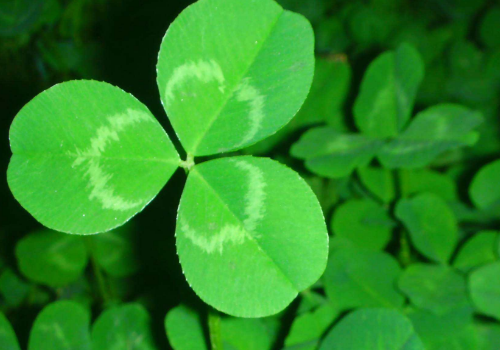
What is the difference between clover and four-leaf clover:
Clover is a perennial herbaceous plant, generally with only three small leaves. The leaf shape is heart-shaped, and the darker part at the center of the leaf is also heart-shaped.
Four-leaf clover is a mutation of clover.
Among 100,000 clover plants, you may find only one four-leaf clover, with a chance of about one in 100,000. The edges of four-leaf clover should have serrations, and the leaf area near the center is dark black. Four-leaf clover is also called the lucky clover, and it is precious precisely because it is rare.
That is all for the introduction to how to plant clover seeds. Now you have figured out the difference between clover and four-leaf clover, right! It is just one more leaf.
Clover seed sowing method
Clover (four-leaf clover is a rare variant of plants in the genus Trifolium) is a general term for many herbaceous plants with trifoliate palmate compound leaves, mainly including certain species in the genera Trifolium and Medicago of the Fabaceae (legume family), as well as the genus Oxalis in the Oxalidaceae family. The main propagation method is sowing. Now let us take a look at the clover seed sowing method!
Clover sowing time
Clover can be sown in spring or autumn. In spring, sow in late March; in autumn, sow in mid-September. In the south, autumn sowing is dominant, while in the north, spring sowing is dominant. It can also be sown in summer, but after sowing, the surface soil must be kept moist or covered with mulch for shade. The sowing rate of clover is preferably 8-10 grams per sq m. Each gram of clover has 1400-2000 seeds. Theoretically, 1 seed per square cm of soil can meet the need for turf formation. The actual sowing rate is larger than the theoretical sowing rate.
Clover sowing method
When sowing clover, divide the seeds equally according to the plot area and the determined sowing rate, mix the seeds evenly with dry soil or fine river sand, and broadcast by hand. If building a lawn over a large area, a cyclone seeder can be used for broadcasting. The sowing depth is 1-1.5 cm. After the seeds are broadcast onto the seedbed, a lawn rake can be used to rake the seeds into the soil, or fertile soil or substrate can be used to cover them by 1 cm.
Management after clover sowing
1. Management before turf formation: Clover grows slowly during the seedling stage. After the seeds are sown onto the seedbed, if a sprinkler irrigation system has been installed in advance, sprinkler irrigation can be used. If there is no sprinkler irrigation system, a self-made nozzle can be used for manual spraying irrigation. Spray every morning or evening, always keeping the seedbed surface moist until emergence. After emergence, the number of water sprays can be reduced, but careful management is still needed. Seedling-stage management lasts about 30-50 days. During this period, in addition to paying attention to watering to keep the seedbed moist, weeds must also be removed at any time, mainly by hand pulling, to prevent weed damage.
2. Management after turf formation: Because clover has strong invasiveness, it does not need intertillage and weeding. Because nitrogen-fixing rhizobia can absorb nitrogen from the air and convert it into a form usable by plants, fertilizing should focus on phosphorus and potassium fertilizer, with no or little nitrogen fertilizer. During the peak growing season and overwintering, sufficient water must be supplied to ensure vigorous growth and safe overwintering. Before midsummer, one cutting can be carried out and watered thoroughly to keep the plants green. Before overwintering, cut once more and water thoroughly for winter. In this way, when it turns green the next year, there will be no yellow withered branches and leaves on the turf surface. It has strong pollution resistance and pest and disease resistance, and few pests and diseases. When pests such as leafhoppers, weevils, and cutworms are found, they can be killed by spraying dimethoate, dichlorvos, and others.
How to plant clover and what is clover used for
Clover is a very common plant and is very similar in form to alfalfa. Clover is a symbol of happiness, so it is usually planted in courtyards. At the same time, clover also represents good luck. Once you find a clover with four leaves, it means good things are about to happen.
How to plant clover
1. Soil
Clover seeds are tiny, the seedlings are slender and weak in emerging from the soil, and growth during the seedling stage is extremely slow. Before planting, the soil needs to be deeply plowed, the ground leveled, and clods broken up fine so that the sowing layer soil is loose and level.
2. Sowing
The best time to sow clover is in spring and autumn. For spring sowing, you can sow from late March to late April, once the temperature stays above 15°C. For autumn sowing, it is generally from mid to late September. Before sowing clover, the seeds need to be soaked. For every 1 kg of seed, add 1.5 kg of water, plus 1 g of ammonium molybdate, and soak for 12 hours. Mix 5-10 kg of calcium magnesium phosphate fertilizer with 5-10 kg of fine soil or yellow sand, then sow.
3. Fertilizing
Clover belongs to the legume family and has its own nitrogen-fixing ability, but during the seedling stage the rhizobia have not yet formed, so a small amount of nitrogen fertilizer should be added to help strengthen the seedlings. Adding phosphorus and potassium fertilizer has a very good yield-increasing effect. After clover grows larger, only phosphorus and potassium fertilizer need to be added.
4. Care
For clover lawns that have grown for more than 2 years, the soil layer is compact and has poor aeration. In spring and autumn, before turning green and before regrowth after grazing or cutting, harrowing and soil loosening should be carried out, and fertilizer should be applied together with soil loosening to facilitate the growth and development of new buds and new roots. Clover has relatively high soil moisture requirements. Where irrigation conditions are available, irrigate when the soil is dry or together with topdressing.
5. Pests and diseases
Clover has few diseases, but if harvesting is not timely, brown patch and powdery mildew sometimes occur. It can be cut and used first, then controlled with Bordeaux mixture, lime sulfur mixture, or carbendazim.
What is clover used for
1. Medicinal value of clover
There are mainly two kinds of clover. One is Trifolium, whose Chinese medicinal name is “Sanxiao Cao”, and whose flowers can be white or red, with the effects of clearing heat and cooling blood. The other is Oxalis, which includes wild types with yellow flowers, as well as purple-leaf or red-flowered types, and also has the effects of clearing heat, cooling blood, and calming the mind. Clover has certain therapeutic effects on diseases such as jaundice and gastric ulcer bleeding, and also relieves symptoms such as stomach heat pain and weak spleen and stomach. So the value of clover should not be underestimated. A small body has great value.
2. Decorative role of clover
As a fresh plant, clover can be used as a potted plant for home decoration. It can make the home environment comfortable and also beautify the household atmosphere. It can also be planted together with other plants as a foil for beauty, appreciated from another angle.
3. Greening and planting value of clover
Clover is widely distributed and highly adaptable. Among them, white clover is an excellent forage grass rich in protein and minerals. It can adapt to both acidic and alkaline soils and has great potential for promotion in our country. At the same time, because it also plays a huge role in soil and water conservation, it can be used as a green plant. In addition to its decorative role, it can also be planted on a large scale, with good economic and ecological benefits.
The flower language of clover
The flower language of clover is happiness and good luck.
The story of clover
According to legend, whoever finds a clover with four leaflets, that is, a four-leaf clover (also called lucky clover), will gain happiness. So in some European countries, people who see clover by the roadside almost always collect it, press it flat, and give it to others later, thereby expressing their good wishes to friends.
In Ireland, on St. Patrick's Day every March 17, everyone wears a clover flower ball. It is said that St. Patrick once used a clover to explain the Trinity to the freedom-loving Irish people. But now it is already hard for people to determine whether what St. Patrick used as a metaphor was clover or the yellow-flowered plant with blue flowers. However, clover is indeed a symbol typically inherited by Christianity. Very early on, it was the symbol of the threefold unity of the three priestly ranks of the Celts. And the vigorous growth of clover also made it a symbol of vitality. The Druids had already given the four-leaf clover the same meaning as today, that is——happiness.
But in fact, if you search carefully, four-leaf clovers are not that hard to find. Yet people still long for four-leaf clover because four-leaf clover represents people's beautiful wishes, hoping that good things will come to them. Especially for young girls, the symbolic meaning of four-leaf clover is very remarkable.