How to care for Paphiopedilum (slipper orchid) during its flowering period, and does it bloom only once in its lifetime?
Paphiopedilum, also known as the slipper orchid, is a type of plant that many people love, and it is not just ordinarily beautiful, so what is the method for caring for Paphiopedilum during its flowering period? Does it bloom only once in its lifetime:
Paphiopedilum flowering period care methods:
Temperature control and shading: Paphiopedilum is native to low-latitude, high-altitude regions, so it cannot grow normally under temperatures that are too low or too high. When overwintering, special attention must be paid to keeping it warm; the nighttime room temperature should be above 10°C, and the daytime temperature should be 5°C to 10°C higher than the nighttime temperature. Paphiopedilum also relatively likes sunlight, but direct sunlight must be avoided. In autumn, more than 70% of sunlight should be blocked, and in winter, more than 50% of sunlight should be blocked; only in this way can it bloom well. Maintain humidity: Paphiopedilum likes humid environments and has very poor drought resistance, and its flowering period coincides with the dry autumn and winter seasons, so the potting soil must be kept moist, and water should often be sprinkled around the flowerpot to maintain relatively high air humidity. If humidity is insufficient, the leaves are prone to turning yellow and shrinking, directly affecting its flowering.
Moderate fertilization: During the growth period, Paphiopedilum should be given phosphorus and potassium fertilizers and an appropriate amount of nitrogen fertilizer. If there is too much nitrogen fertilizer, it will grow luxuriantly with dark green leaves but will not bloom; if it lacks phosphorus and potassium fertilizers, it will likewise rarely bloom. It is best to apply fully decomposed, diluted cake fertilizer water. If conditions permit, it is best to spray 1‰ potassium dihydrogen phosphate onto the leaf surface every 10 to 15 days to let the leaves absorb it; the effect is very good.
Ventilation and pest prevention: When overwintering indoors, Paphiopedilum should be placed in a ventilated spot; otherwise, scale insect damage may occur. Once pests are found, they can be gently brushed off manually with a soft brush, then rinsed clean with clear water, and then controlled with pesticides such as dimethoate, trichlorfon, and methidathion.
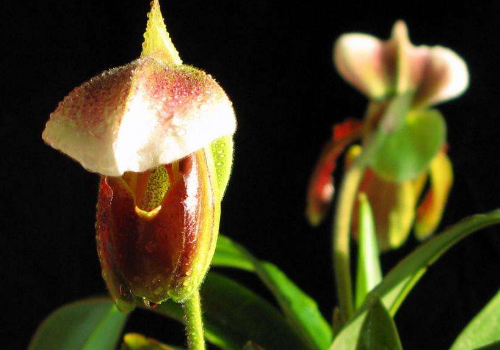
Does Paphiopedilum bloom only once in its lifetime:
Paphiopedilum does not bloom only once in its lifetime; rather, each shoot blooms only once. After blooming, the shoot slowly withers, while new shoots grow beside the original roots and bloom again. With good management and care, there will be flowers every year.
That is all for the introduction to Paphiopedilum flowering period care methods. It does not bloom once a year; rather, each shoot blooms once.
The survival strategy of orchids
If you ask what animal is the smartest, the answer should be humans, because humans know how to make things serve their own use. Then what is the smartest plant? From the perspective of making things serve one's own use, there is no doubt that orchids are the smartest among plants. From seed germination, growth, all the way to flowering and fruiting, orchids need to use other organisms to help complete their life history.
Orchid seeds have their own distinctive characteristics among plants, mainly shown in the following aspects. First, they are huge in number and highly variable. A single orchid capsule (commonly called a seed pod) can contain as many as 4 million seeds, but at minimum only 20-50 seeds, a difference of 80,000 to 200,000 times. Second, the seeds are very small; seeds are generally 0.05-6 mm long and 0.01 to 0.9 mm wide (the diameter of a hair is generally 0.08 mm). Third, the seed structure is simple. In orchid seeds, the outer seed coat accounts for the vast majority, but the embryo is very small; generally the embryo is only about 1/110 the size of the seed, with the smallest embryo being 0.1 mm long and only 0.078 mm wide (equivalent to the diameter of a hair). The embryo of an orchid seed has no cotyledons or endosperm, which is to say that the orchid mother plant does not provide any substance to help its offspring (the seeds) germinate and grow in the early stage. Fourth, the interior of the outer seed coat of orchid seeds has many air-filled cavities, so orchid seeds are very light; the heaviest orchid seeds are only 14-17 centigrams (1 centigram equals 1/100 gram), while the lightest are only 0.3-0.4 centigrams. Such light seeds can drift with the wind to places far from the mother plant to settle down. At the same time, the surface of the outer seed coat of orchid seeds has a layer of tightly arranged cells, so water cannot easily penetrate quickly into the seeds, thus allowing orchid seeds to float on the water surface and drift over long distances. Of course, orchid seeds can also be spread through animals, such as by adhering to animal fur or mud-covered claws, or to bird feathers, and can also be spread through animals eating them, and even through human activities. For example, a species of Epipactis distributed in North America was spread from Europe to North America through human activities. Orchid seeds are enormous in number and have the ability to disperse over long distances, yet orchid plants are not very common on Earth. Orchids can only be seen in some relatively special places, such as stone walls, stone surfaces, tree trunks, branches, and some soils with very high calcium content. In a mountain gully about 2.5 km long and about 0.5 km wide in the Huanglong scenic area of Sichuan, we found more than 30 species of terrestrial orchids, with tens of thousands of orchid plants growing together. Huanglong Gully is a travertine mountain gully that gradually rises from south to north. It is precisely the unique travertine in the gully that provides a suitable habitat for orchid growth, forming a vegetation type dominated by orchids that is completely different from neighboring mountain gullies. Orchid seeds do not have any stored nutrients to help them germinate and grow. When orchid seeds germinate and grow together in the same habitat as other plant seeds that have cotyledons or endosperm, orchid seeds are obviously a “disadvantaged group.” Their germination and the growth of seedlings after germination cannot compete with other plants, because plants with cotyledons or endosperm can rely on the nutrients stored in the cotyledons or endosperm during the seed germination stage and seedling stage to get through this critical and difficult period. This is the main reason why orchids always grow in special habitats where other plants find it difficult to grow. So how do orchid seeds germinate and grow in these special habitats? The secret lies in the fact that during germination and growth, orchid seeds use fungi to help them absorb nutrients and water. It has been found that orchid seeds must use fungi for help when germinating under natural conditions. Some orchid species need fungi to help them absorb nutrients and water throughout the entire development process from seed germination to seedling, growth, and mature plant; this is the case for saprophytic orchid species that lack chlorophyll. For example, there is an orchid in Australia that grows below the surface of the ground for its entire life, and it must have fungi to help it absorb nutrients so as to complete its entire life history. Some species even need different fungal species to help at different growth and development stages. The most typical example is the famous medicinal plant Gastrodia elata. Through nearly 30 years of research, Chinese scientists discovered for the first time that Gastrodia elata seeds need fungi called Mycena species to help obtain nutrients and germinate during the seed germination and seedling growth stages, and after the germinated seedling (protocorm) grows other cultivated tubers, it then needs a fungus called Armillaria mellea to help it grow and develop. There are also some orchid species that no longer need fungi for help after the seedling growth stage, but fungi still exist in the roots and even stems of these orchids. Some of these fungi are beneficial to the orchids, while some have no obvious benefit to the orchids. Therefore, in the critical and difficult period of germination and seedling growth, tiny orchid seeds cleverly rely on the help of fungi to survive and reproduce in places where other plants find it difficult to survive.
In the process from seed to seedling, orchids adopt a strategy of sowing widely and harvesting little, producing an enormous number of seeds, but only a very small portion of the seeds can germinate, grow, and finally become mature plants. However, in the process from flowering to fruiting, they adopt a completely different all-or-nothing strategy. The all-or-nothing strategy of orchids is mainly shown in that, on the one hand, they gather all their pollen into pollinia, so that either the pollinator carries away all the pollen and deposits it on the stigma, thereby ensuring enough pollen to develop into sperm cells (haploid male gametes) to combine with the egg cells in the ovary (haploid female gametes) and finally grow and develop an enormous number of seeds; or the pollinia cannot reach the stigma and are all wasted, causing the greatest (100%) waste of male resources. Among all flowering plants, only orchids and plants of the Asclepiadaceae adopt this strategy of either succeeding or dying. On the other hand, the flowers of each orchid species attract only one species or one type of specific pollinator to visit. This can make the flower structure of an orchid species match its pollinator very closely, thereby greatly improving the pollination efficiency of the orchid. But at the same time, this strategy of attracting only one species or one type of pollinator means another risk, namely that if this specific pollinator is relatively scarce, then the flowers of some orchids will not be visited by pollinators and cannot normally set fruit and reproduce. Therefore, how to attract the pollinator's “eye” as much as possible becomes an important task of orchid flowers. Most orchids, like other plants, attract pollinator visits by providing nutrients as a reward, and these nutrients mainly include nectar and so on. Sometimes orchids also provide pollinators such as wasps and bees with nesting materials, such as wax or oil-like substances, as rewards. To provide rewards to pollinators, the plant itself must pay the cost of energy. In order to accurately provide limited rewards to the contributors that can best pollinate the orchid, orchids hide their rewards in concealed positions, and only special pollinators can obtain these rewards, and these special pollinators are often the pollinators that can best pollinate the orchid. The most famous example is the story proposed by Darwin of the contest between the length of the floral spur and the length of the pollinator's proboscis. In 1862, based on an orchid called Angraecum from the Madagascar archipelago, whose floral spur has a spur as long as 30 cm, Darwin predicted that there must be an insect on the island whose proboscis length could match the length of the orchid, because Darwin believed that the length of the floral spur and the length of the pollinator's proboscis were determined by the selective forces of coevolution between insects and plants. 126 years later, Swiss scientists finally discovered on the Madagascar archipelago a moth that serves as the pollinator of this Angraecum, and the length of its proboscis is exactly around 30 cm. This discovery verified that Darwin's prediction was correct, and also verified the existence of a coevolutionary relationship between insects and plants.
Generally speaking, flowers that can provide rewards to pollinators are not very brightly colored, and their flower shapes are not particularly unusual, at least among the large orchid family. But why are orchids in nature so brilliantly colored and strangely shaped? The secret lies in the fact that more than one third of orchid species do not provide rewards to pollinators. How can they both avoid providing rewards to pollinators and still attract pollinators to visit? Clever orchids use various means of all kinds to trick pollinators into pollinating them. Orchids' methods of deceiving pollinators are clever and their tricks are diverse. One deception strategy is that orchid flowers resemble female insects in color, shape, and texture, but more commonly they produce odors that stimulate male insects to mate, thereby luring male insects to mate with the orchid flowers. Scientists call this mating behavior of male insects pseudocopulation. During pseudocopulation, the insect carries the orchid's pollinia on its body, and when it is deceived again into pseudocopulation the next time, it deposits the pollinia it carries onto the stigma. In addition, some orchid species can also mimic insect egg-laying sites, luring female insects to lay eggs, and during the insect egg-laying process they pollinate the orchid. A classic example is some Paphiopedilum species among slipper orchids, whose petals, lip bases, or edges have aphid-like tubercles. The larvae of hoverflies rely on aphids as a food source, so hoverflies generally seek places with aphids to lay eggs. These Paphiopedilum orchids cater to their preference and lure them onto the flowers to lay eggs, thereby providing pollination services for the Paphiopedilum. What is more, some orchids can even deceive insects into visiting by mimicking the places where insects sleep at night or mimicking the nests of bees, ultimately achieving the purpose of pollination.
It is precisely because orchids, at the two key stages of their lives, the seed germination and seedling growth stage and the flowering cultivation stage, cleverly use their “wisdom” and rely on other organisms to provide services for them, that the orchid family is “flourishing with many members” and presents a scene of great prosperity. In terms of the number of species, the orchid family has about 800 genera and nearly 20,000 species, second only to the Asteraceae (1,000 genera, 25,000-30,000 species), occupying the position of the second largest family of flowering plants. China has 175 genera and about 1,300 species of orchids. In addition to its huge family and numerous members, orchids are also very widely distributed. Orchids can be found in every corner of the Earth's land except the North and South Poles and extremely arid desert regions. They can epiphytically grow on the treetops of towering trees in tropical rainforests, and can also hide underground and live a reclusive life unnoticed by the world. They can grow on islands and land near sea level, and can also grow on high mountains at an altitude of more than 5,000 m.
Everything always has both advantages and disadvantages. Orchids flourish with the help of other organisms, but it is precisely because of their dependence on other organisms that their lives become very fragile. If the other organisms that provide help to orchids change, the normal life history of orchids will be interrupted, and the continuation of life will be affected. Orchids are very sensitive to environmental changes, especially changes in the biological environment, and are also particularly vulnerable to the impact of human activities. Therefore, orchids especially need people's care, and are especially worthy of people's care and protection. From the perspective of biological evolution, the vast majority of orchid species are in an active period of evolution and specialization. Therefore, the protection of orchids means, to some extent, the protection of the future of biodiversity on Earth.