When should you plant Oriental lilies, and how many times do they bloom in a year?
Oriental lily is a plant that many people like and that is fairly common. When should you plant Oriental lilies? How many times do they bloom in a year?
When to plant Oriental lilies:
Autumn, because Oriental lilies are suited to being planted at (15-23 degrees), so I think it should be autumn. Lilies are perennial bulbous plants that like a warm, dry environment with deep soil.
Oriental lily is one type of lily, also known as Casablanca and "lily of the sky". Its places of origin include the Himalayan region, Australia and various other areas. The Oriental lily is the queen among lilies; the spots often seen on flowers of the Liliaceae family cannot be seen on its petals. So its pure white petals always open so proudly, and its flower meaning is "great love". It can always come into contact so directly with your great love.
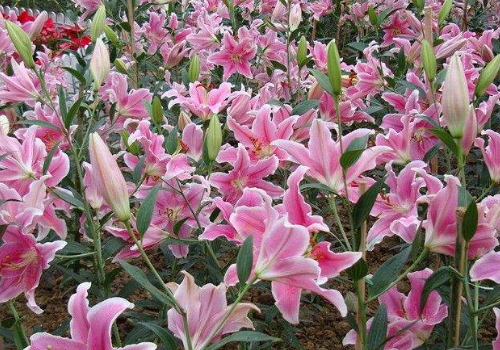
How many times does an Oriental lily bloom in a year:
Twice. March to June, and September to November.
Oriental lily flowers: purity, wedding blessings, nobility
Oriental lilies represent wealth and wedding blessings, and are suitable for giving to couples about to marry.
Many people choose Oriental lilies when giving flowers to their girlfriend; this not only expresses the blessing of “may all things go as you wish”, but also implies “great and pure love”. It is also praise for a girlfriend or wife, implying that only pure, flawless Oriental lilies are worthy of the girlfriend's or wife's temperament. Generally speaking, Oriental lilies are wrapped with roses and other fresh flowers into a beautiful bouquet, which better sets off the beauty of the Oriental lilies.
Well, that is all for the introduction to Oriental lilies; I trust everyone understands now.
How many times does an Oriental lily bloom in a year, and how long is the Oriental lily flowering period / it blooms from May to July
Everyone must be familiar with the Oriental lily; its flower form is graceful, its flower colours are rich, and it is the queen among lilies, deeply loved by flower growers. In daily life, many flower growers keep Oriental lilies, and they all look forward to it blooming, so when does the Oriental lily bloom? How many times does an Oriental lily bloom in a year? How long is the Oriental lily flowering period? Here, let the editor explain it for everyone.
1. When does the Oriental lily bloom, May
The beauty of the Oriental lily needs no repeating, but many flower growers do not know when it blooms! After careful checking, the editor has learned that the Oriental lily is a flower that blooms in summer, specifically from May to July.
2. How long is the Oriental lily flowering period, 2 months
If planted in September-October of the previous year and cared for strictly according to the Oriental lily cultivation method, then the Oriental lily will bloom from May and keep blooming until July, with a flowering period as long as 2 months, which is quite a lot longer than the roughly half-month flowering period of ordinary lilies!
3. How many times does an Oriental lily bloom in a year, once
On this question, everyone really only needs to pay attention to one point: the Oriental lily is one kind of lily, and lilies belong to bulbous plants. According to the editor's research, bulbous plants can bloom only once a year, so the Oriental lily blooms only once a year, but as long as the underground bulb can be kept well, it can bloom every year.
4. Oriental lily flowering period management
1. In summer, because the temperature is high, if the room is closed up, it is prone to insect pests. So during the Oriental lily flowering period, flower growers should prevent it from being harmed by some pathogens, and also guard against some pests biting and damaging its roots and stems. As for what to do when Oriental lilies get insects, there is a detailed introduction earlier, so I will not say more here.
2. The optimal growing temperature for Oriental lilies is 16-24 degrees C; below 5 degrees C or above 30 degrees C, growth almost stops. And the Oriental lily flowering period is in summer, so everyone should always pay attention to the temperature; when the temperature exceeds 30 degrees C, cooling measures should be taken.
3. In order for the Oriental lily to keep blooming, flower growers can apply extra phosphorus fertiliser for 1-2 days during the flowering period. In addition, to make the bulb plump, spent flowers should be cut off promptly after blooming to reduce nutrient consumption and prepare for blooming the next year.
5. Appreciation of Oriental lily blooming pictures
How are Oriental lilies, and Oriental lily cultivation and propagation methods
The Oriental lily likes a warm, humid environment with plenty of sunlight. It is relatively cold-tolerant and fears high temperatures and high humidity. The suitable growing temperature for Oriental lilies is 15-25 degrees C; below 10 degrees C, growth is slow, and above 30 degrees C, growth is poor. During growth, a daytime temperature of 21-23 degrees C and a nighttime temperature of 15-17 degrees C are best. Bulbs for forcing cultivation must be stored at a low temperature of 7-10 degrees C for 4-6 weeks. The lily's water requirement is moisture, which is good for the growth of stems and leaves. If the soil is too wet, waterlogged or drains poorly, the lily bulb will rot and die. For potted lilies, watering should gradually increase as the plant grows; water supply should be sufficient during the flowering period, water should be reduced after flowering, and watering should stop after the above-ground part withers. If the potting soil is too wet, it will likewise cause the bulb to rot.
Oriental lily cultivation methods1. Soil: Oriental lilies like fertile, deep soil rich in humus and most dislike hard clay; well-drained, slightly acidic soil is best, with a soil pH of 5.5-6.5.
2. Watering: watering only needs to keep the potting soil moist; the potting soil should not be too wet, otherwise the bulb easily rots.
3. Light: potted lilies have different requirements for light intensity at different growth stages. At the bud stage, shading treatment is needed, and if the leaf temperature is too high, appropriate shading should also be used. In other growth periods, light should be strengthened, especially during flower development. Temperature: the growth and flowering temperature of Oriental lilies is 16-24 degrees C; below 5 degrees C or above 30 degrees C, growth almost stops; only above 10 degrees C does the plant grow normally, and above 25 degrees C growth stalls again. If the winter nighttime temperature is below 5 degrees C for 5-7 days in a row, flower bud differentiation and flower bud development will be seriously affected, delaying flowering or even causing blind flowers and split flowers.
4. Fertilising: lilies need relatively large amounts of nitrogen and potassium fertiliser, which should be applied once every 10-15 days during the growing period, while phosphorus fertiliser should be limited, because too much phosphorus fertiliser will cause the leaves to turn yellow. (During the flowering period, extra phosphorus fertiliser can be applied for 1-2 days.)
5. Pests and diseases:
(1) Grey mould: use captan, thiophanate and zineb at 500 times dilution for control
(2) Damping-off: before planting, soak in 500 times dilution of thiram or 50 times dilution of 40% formaldehyde for 15
(3) Root rot: it is necessary to pull out the diseased plants, then use dexon to disinfect the soil
(4) Pests: for aphids, mites, white grubs and cutworms and the like, use omethoate, dicofol and poison bait for control.
6. Pruning: to make the bulb plump, lilies can be cut off at the base after flowering to reduce nutrient consumption, because flowering has already used up a lot of the bulb's nutrients. If you want to keep the bulb for continued planting, you must continue fertilising to replenish the bulb's nutrients. After one month, the bulb can be dug out, the fibrous roots cut off, and it can be refrigerated for a period to break dormancy, then planted later, but the quality of the flowers will decline.
Points to note when cultivating Oriental lilies1. Flowering period regulation: if you want Oriental lilies to bloom in November to early February of the following year, first treat the bulbs at 13 degrees C for 2 weeks (14 days), then treat at 3 degrees C for 4——5 weeks (28——36 days), so they can bloom in November——December. If you want them to bloom in January——February, first treat at 13 degrees C for 2 weeks, then treat at 8 degrees C for 4——5 weeks (28——36 days); at this time, after planting, the nighttime temperature is relatively low, so heating should be added to keep it at about 15 degrees C.
2. Bud abortion treatment: in forcing cultivation of lilies, when the flower bud grows to 1——2 cm, if light is insufficient, bud abortion easily occurs. Bud abortion often occurs from the end of October to mid-March of the following year, and can be addressed by artificial supplementary lighting. The method is to hang one 40-watt high-pressure sodium lamp, or an ordinary waterproof incandescent lamp, every 8——10 sq m; supplementary lighting starts when the flower bud is 0.5——1 cm and continues until harvest. At a temperature of 16 degrees C, maintaining lighting for about 6 weeks, from 8 p.m. each day to 4 a.m. the next morning, has a very good effect on preventing bud abortion, advancing flowering and improving cut flower quality.
3. Plants growing too tall: during the growing period, Oriental lilies should also have the pot turned once a week. Otherwise the plant easily grows lopsided, affecting its appearance.
Oriental lily propagation methods 1. Bulbil cultivation methodThis method is suitable for varieties that produce bulbils, such as the Tiger lily variety and others. Harvest mature bulbils in summer; in late September to early October, open sowing furrows 4 cm deep at a row spacing of 12-15 cm, sow 1 bulbil every 4-6 cm in the furrow, and after sowing cover with about 3 cm of soil. Before the ground freezes, earth up, cover with grass and put on film to help them overwinter safely. When seedlings emerge in spring of the 2nd year, remove the covering grass and film, cultivate and weed, and apply appropriate additional fertiliser and water to promote vigorous growth of the seedlings. After the above-ground part withers in autumn, dig out the small bulbs, then sow at a row spacing of 30 cm and a plant spacing of 9-12 cm, covering with soil about 6 cm thick; following the management method of the previous year, cultivate for another 1 year, and in autumn you can harvest seed bulbs that have reached standard size; some small bulbs that have not reached standard can continue to be cultivated.
2. Small bulb cultivation methodThis method is suitable for varieties that produce small bulbs, such as the Tianxiang lily variety and others. When digging up the large edible bulbs in autumn, collect the small bulbs in the soil and sow them according to the bulbil cultivation method. Because small bulbs are larger than bulbils, the sowing distance should be slightly larger than when sowing bulbils; after 1 year of cultivation, most small bulbs can reach seed bulb standard, and the smaller bulbs can continue to be cultivated.
3. Scale cutting propagation methodIn autumn or spring, select well-developed scales from fully mature bulbs, cut the scales off from the base with a sharp knife, first soak in 500 times dilution of benomyl solution for 30 min to sterilise, take them out and dry them, then insert and sow them into a seedbed of sandy loam soil. When inserting the scales, the base faces downward, and the insertion depth reaches 1/2-2/3 of the scale, with a scale spacing of 4-5 cm. After insertion, shade immediately and water frequently to maintain soil water-holding capacity at 75%, but the seedbed soil must not be too wet, to prevent the scales from rotting. Generally, 15-20 days after insertion, 1-2 embryo bulbs grow from the cut at the lower end of the scale, and afterwards they take root and grow leaves; apply additional fertiliser and water at the right time to promote growth. In autumn, small bulbs the size of corn kernels can form; after digging them out, sow them again according to the bulbil cultivation method and cultivate for another year to reach seed bulb standard.
4. Core cultivation methodThis method is suitable for single-headed bulb varieties. When harvesting lilies in autumn, carry out strict selection, eliminate diseased lilies, weak lilies and lilies with abnormal flesh colour, select well-developed ones, peel off the middle and outer scales of the bulb for market or processing, and use the remaining thumb-thick lily core together with the root disc as the seed bulb; cultivate in a seedbed for 1 year, and it can reach seed bulb standard.
5. Seed cultivation methodThis method is suitable for varieties that can flower and set seed and thus produce seeds, such as the Tiger lily, Shan Dan and other varieties. Collect mature seeds in autumn and sow them immediately into seedbed soil. The seedbed soil is made by mixing 4 parts middle-layer garden soil, 4 parts fully decomposed and finely crushed compost and 2 parts fine sand evenly, and spreading it flat in the seedbed about 10 cm thick. After broadcast sowing the seeds, cover with 3 cm of fine soil, then cover with grass and film. If the autumn sowing method is chosen, the seeds can first root in winter, and in the following spring the seedlings emerge early and grow quickly. Be sure not to delay sowing until the spring of the 2nd year, otherwise seedling emergence is very late and the germination rate is low. After seedlings emerge in spring, remove the film and grass, carry out thinning, then cultivate and weed frequently and apply additional fertiliser at the right time to promote growth. The bulbs harvested in autumn are very small and must continue to be cultivated for 4-5 years before they can serve as seed bulbs.