How many colors does the Chandelier Kalanchoe come in, and how should it be propagated by cuttings?
Chandelier Kalanchoe, this is also a type of succulent plant, and it grows super beautifully. When it blooms, how many colors does the Chandelier Kalanchoe come in? How to propagate by cuttings:
How many colors does the Chandelier Kalanchoe come in:
There are currently about 70 or more varieties of Chandelier Kalanchoe, so the colors are also very numerous. However, most Chandelier Kalanchoes are mainly in colors that resemble chandeliers, such as red, orange, purple, and pink.
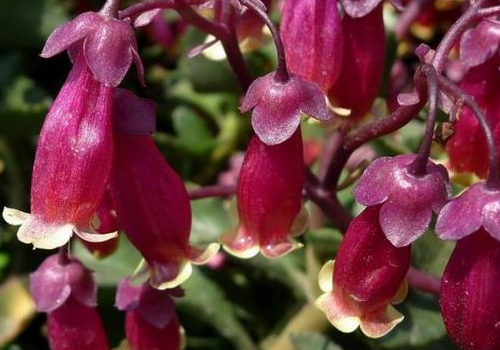
How to propagate Chandelier Kalanchoe by cuttings:
1. Stem cuttings
The Chandelier Kalanchoe, like the Kalanchoe, belongs to the succulent plants. Propagating it by stem cuttings is very easy. Many flower enthusiasts on Yanghua Daquan now share Chandelier Kalanchoe stems by regular mail, and easily root a pot of them.
I won't say much about the key points of cutting. Just choose a good stem and stick it into the soil. Under normal conditions, it will survive. But there is one situation: when the soil is unsuitable, it is very difficult to root. Many flower enthusiasts use pure vermiculite or perlite for cuttings. This medium has good air permeability and makes survival relatively easy. But if you choose garden soil or soil with poor air permeability, cutting will become much more difficult.
2. Leaf propagation
Leaf propagation of the Chandelier Kalanchoe is relatively easy, and the cutting cycle is short. In one week it can send out fine roots, and after 10 days the leaf can grow small seedlings. The specific method is:
Break off the leaves of the Chandelier Kalanchoe by hand. Remember not to use a knife. Let the leaves dry slightly in a cool, shady place, then place them on a flower pot saucer or other container with the base of the leaf facing up. After 1~2 days, when the leaves are slightly dry, you can spray a little water appropriately, but do not spray water every day. Place them on the balcony, and in about a week roots will emerge.
That's all for the introduction to the colors of the Chandelier Kalanchoe. Now you know the cutting method for this Chandelier Kalanchoe, right!
Common Succulent Blooming Records
I suddenly realized that after arriving in Chongqing I completely turned into a foodie... I really do work very seriously.
=。=
After returning to Weihai at the end of the month, I will start reorganizing the blog and prepare for a revamp~ The content will also become a bit richer.
Along this whole trip I have been constantly and seriously taking records~
Before starting the records, let me toss out a link to an old blog post about succulent blooming:
http://blog.sina.com.cn/s/blog_68c08bcf0102e0es.html
It is an article written quite a long time ago, and a lot of the content may feel a bit behind the times~
But some of the basic parts of the knowledge are still pretty good~
I won't repeat and edit it here.
Because what I feel most in the process of growing plants is constant change. Every year, many novel things are discovered.
The history of human civilization and human evolution are both closely related to plants, so there is still a lot, a lot to learn~
This record is mainly about the blooming of some succulents at home from last winter to before my business trip in August this year.
Actually many others also bloomed, but sometimes I habitually cut them off directly and did not take photos.
What is rather strange is that this year the succulents at home seemed to have conspired together and all bloomed at once.
Especially some that had been grown for 2-3 years, and even some that had been bought several years ago and then grown for more than 2 years, all bloomed this year~
In their native habitats, many succulents bloom once a year, mostly concentrated in spring each year, but due to changes in region
and changes in climate and environment, the habits of the plants have also undergone great changes, so the blooming time has become unstable.
For example: a Xiaorenji (Aeonium sedifolium) that took 3 years to bloom (in the north) may bloom in just one year in the home of some flower enthusiasts in the south.
It can even happen that blooming times differ within the same city, which shows that the environment has a very great effect on plants.
There are still many uncertain factors, but well, it is enough for everyone to know that succulents can also bloom~
These unknown and uncertain factors are also quite interesting to figure out slowly on your own~
Especially after blooming, you can try some artificial pollination, collect the seeds after they form, and wait to sow them in spring and autumn.
Next year you might even be able to cultivate new varieties yourself~ Actually, many times I have also wanted to try
but due to limited space at home, I really could not arrange it, so I gave up. After the glasshouse is set up in autumn, I will sow in large quantities and give it a try.
When everyone is crazily adding more succulents, you should also consider your own home situation. I have always felt that what suits you best is the best.
Now I have also started selecting some varieties. Those suitable for growing at home get developed more, and those that cannot be grown well no matter what are completely abandoned.
Now let me introduce them one by one~
[Crassulaceae, Aeonium genus]
After looking at some materials and records from some enthusiasts, I have always felt that they die after blooming, especially the Black Aeonium.
So I am very afraid of them blooming~~~
As a result, this time most of the Aeoniums at home bloomed.
Then, holding the determination that they would surely die, I observed them, and found that it was actually not that terrifying...
It is certain that this process consumes a large amount of nutrients, because after blooming the whole succulent becomes somewhat thin and weak.
It is true that they die after blooming, but only the branch that bloomed dies. After the flowers fade, new branches will still grow from the side branches.
So it is not that they die completely just because they bloom~
However, the flowers of this type are not very pretty. If you find signs of blooming,
as long as it is not for pollination and propagation, you can just cut them off directly...
Among them, the Xiaorenji (Aeonium sedifolium) blooming is super stunning! I strongly recommend viewing the flowers and not cutting them off!
[Aeonium 'Airaanjin']
[Aeonium 'Qingshengjin' / 'Yanrihui']
[Xiaorenji (Aeonium sedifolium)]
The purple string of bananas (Othonna capensis) blooming is very beautiful, especially when the leaves have been sunned to purple and then it blooms with small yellow flowers.
The visual contrast between the two colors, light and dark, is especially strong~ So this is also one of my super favorite varieties.
[Purple String of Bananas (Othonna capensis)]
[Aizoaceae]
This type feels like it is all about the flowers~
When not blooming, it is just a clump of wild grass, but once it blooms it is very stunning~
Especially when various colors are mixed together, a whole patch blooming is also very striking~
I still remember the "rainbow chrysanthemum" I photographed earlier at Chenshan Botanical Garden, which is also an Aizoaceae type. A large patch blooming with colorful flowers was simply breathtaking~
Blooming seems to have little effect on the plants, and after the flowers fade there is no need to specially remove them. It is almost a free-range type.
Another thing, this type's blooming is also related to sunlight. Only after sufficient sunlight can large patches of flower buds form.
[White Phoenix Chrysanthemum]
The pearl string of pearls blooming is fragrant. Although blooming has no effect on the plant, after the flowers fade they will slowly dry up.
In the end they become like dandelions. With a gentle blow, a piece of goose feather floats down, so after they dry up they must be removed immediately.
Otherwise, on a windy day, be careful that the balcony turns into a chicken farm in one second....
[String of Pearls]
[Bendragon]
[Kuai Dao Luan Ma]
Kalanchoes are actually all quite good. This type has quite a few varieties, and flower enthusiasts who like them can also try collecting some.
When they bloom together, it is also very spectacular~
[Chandelier Kalanchoe]
[Sihai Bo]
[Stem Aizoaceae]
This thing is absolutely one of the most stunning bloomers among succulents. Usually it looks dark and unremarkable,
but the moment it blooms it instantly becomes a queen~ Very worth seeing~
A strongly recommended variety.
[Meili Lian]
[Crassulaceae, Sedum genus]
The Sedum genus gave me a heavy blow this year. I really suspect they all conspired to bloom~
At first I thought Sedums were good for use as ground cover, so I planted them all in the flower bed, including large patches of Sedum dasyphyllum 'Major' transplanted into the courtyard flower bed.
As a result, I found that too much chicken manure had been put in the flower bed, and all the Sedums: Sedum hispanicum, Sedum dasyphyllum 'Major', Sedum lineare, Sedum reflexum, etc.
all became huge and extremely ugly! They completely lost their original beauty, so you still need to be cautious with fertilizer. Personally, I suggest not using heavy fertilizer.
Perhaps because the fertilizer was sufficient, the nutrients kept up, and on top of that the usual sunlight was also very, they began to bloom on a large scale.
It just so happens that this type's blooming is the completely die-off type. The patches of Sedum that used to be lush green in the courtyard are now not even soil crumbs are left.
But later I also found that the Sedum hispanicum planted in baskets without fertilizer not only did not die off after blooming, but even grew new branches.
For ones like Sedum dasyphyllum 'Major', after blooming, the flower branches wither, but new buds will still sprout from the base.
So I guess that the die-off after blooming in this type of succulent is also somewhat related to fertilizer~
I feel that the Sedum genus is still quite nice when blooming, especially Sedum lineare and Sedum dasyphyllum 'Major'. Sedum lineare blooms with golden yellow flowers,
while Sedum dasyphyllum 'Major' blooms with small white five-pointed star flowers~ Both are very beautiful~
Relatively speaking, Sedum hispanicum is much less impressive.
You just obediently keep your cute state and that is enough~
[Sedum hispanicum]
[Other varieties]
Some kind of hybrid Echeveria 'Dongyun'. The flowers look very much like those of the Graptopetalum genus. Actually, I am confused too~
I just feel that this type's flowers themselves are not very pretty, but the small shape of the flowers is still quite nice~
[Sedum dasyphyllum 'Major']
Bao Huazhuang is very strange. It feels like an Aeonium genus, but it is actually a Sedum, and its blooming is also very beautiful.
The flowers do not have too much effect. After they finish blooming, you can cut them off directly. I think Bao Huazhuang's leaves themselves are already very beautiful.
As long as you give them more sun, several colors can appear~
[Bao Huazhuang]
[Xing Meiren]
Monanthes blooming is very common, and almost no effect on the plant itself can be seen.
The small flowers' color is similar to the leaf color, not very eye-catching, so you can just leave them alone~
[Monanthes]
[Echeveria genus]
This type's blooming is very beautiful. Most are mainly yellow, and there are also red and orange ones.
Most will consume quite a lot of nutrients, but as long as the plant is healthy enough, the effect is actually not great, except for a few individual types.
For example: Black Prince. The Black Prince's flower stalk is very long, and it blooms with super large patches of red flowers, consuming nutrients very heavily.
When the flowers finish blooming, the plant itself becomes very fragile, but it will not die. With slow care it will still grow back well.
Common hybrid Echeveria crosses use this kind of mutual pollination, and then the seeds are sown to produce new varieties.
Friends who are interested can give it a try~
It is also quite interesting.
I especially like the scene of large patches of Echeveria blooming at the same time. It looks very spectacular~
After the flowers fade, just cut off the flower stalk. I said before that the leaves on the flower stalk can be broken off for leaf cuttings.
Later I found that the flower stalk can also be directly used for cuttings, and it will produce roots. Some flower enthusiasts also say that the flower stalk can also produce new branches.
So far I have not succeeded, and I will continue to try and observe in the future~
[White Peony]
[Pachyphytum genus]
These feel pretty similar to Echeveria, but the flowers are even cuter in shape~
Especially Pachyphytum 'Amethystinum', Pachyphytum 'Starburst' and the like, their blooms are absolutely gorgeous~
You definitely have to wait for them to bloom and take photos to remember it~
After the flowers fade, just cut off the flower stalk; it seems to have little effect on the plant itself, maybe because the leaves are so plump
[Pachyphytum 'Machucae']
[Echeveria 'Yamatomishiki']
[Echeveria 'Chihuahuaensis']
[Echeveria 'Shaviana']
[Echeveria 'Derluergii']
[Echeveria 'Frosty Morn']
[Echeveria 'Black Prince']
[Crassula]
This type blooms even more casually; most flower branches die back after blooming, and since they have a strong branching ability themselves
you can pretty much leave them alone~ Later they will sprout a big mass of branches on their own~
But for someone with OCD like me
I really can't stand those dried branches just hanging there, so no matter what I'll cut them off with scissors...
The flower colors are also very rich~
Although some flowers look quite small, they are very beautiful when photographed with a macro camera~
[Crassula 'Hairy Star']
[Echeveria 'Ivory']
[Echeveria 'Moon Goddess']
Xiaoyu is a bit more special among Echeveria; the flower stalk withers after blooming, but new branches will also grow
So there's not much to worry about~ If you're afraid, you can just cut it off directly~
The flowers actually aren't that pretty~
[Xiaoyu]