What to Do When Mimosa Leaves Turn Yellow? Causes and Solutions
Mimosa is a relatively easy plant to grow, but there are some things to keep in mind. What do mimosa leaves look like? What should you do if they turn yellow?
What mimosa leaves look like:
Mimosa leaves resemble feathers - they are alternate bipinnate compound leaves, with 2 to 4 pinnae on the common petiole arranged in a palmate pattern, and as many as 14 to 48 leaflets.
Mimosa leaves have fairly long petioles, and the front end of the petiole splits into four rachises, each bearing two rows of oblong pinnules. The common petiole is very long, with a swollen base called the pulvinus - that is, at the base of the pinnules, rachises and petiole of the mimosa there is a thickened portion called the pulvinus. The leaves are bipinnate compound leaves, with 2 to 4 pinnae in a palmate arrangement, and 14 to 48 leaflets, oblong, 0.6 to 1.1 cm long and 1.5 to 2 mm wide, with bristles along the margins and veins.
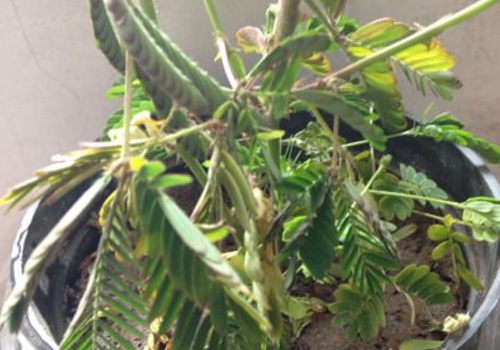
What to do when mimosa leaves turn yellow:
There are the following causes:
1. Overwatering. Overwatering can cause leaves to turn yellow or even die from waterlogging.
2. Iodine or phosphorus deficiency; you can apply some fertilizer containing iodine or phosphorus.
3. Too much sunlight. Avoid exposing the plant to blazing sun.
4. Unsuitable soil. Replace with soil containing molybdenum.
Well, that is all about mimosa leaves - I hope everyone understands now.
What to Do When Mimosa Leaves Turn Yellow - Solutions for Yellow Mimosa Leaves
Mimosa is a very easy plant to keep alive, and it looks great indoors or on a balcony. However, improper care can also lead to yellow leaves, so what should you do when mimosa leaves turn yellow? Let me tell you the solutions for yellow mimosa leaves.
What to Do When Mimosa Leaves Turn Yellow: Yellow leaves on newly transplanted mimosa
Mimosa leaves sometimes turn yellow, and there can be many reasons. If yellowing and wilting occur after transplanting, you can place the plant in a shaded spot to let it recover, and once it returns to normal, care for it in the usual way.
What to Do When Mimosa Leaves Turn Yellow: Yellow mimosa leaves not caused by transplanting
1. Low temperature
If the yellowing is not caused by transplanting, in winter you can place the pot on a windowsill indoors. Generally, an indoor temperature of about 10 degrees is enough for it to get through the winter smoothly, so that growth is not affected by temperatures that are too low. It should be placed in a spot with plenty of sunlight so the roots grow faster, and it needs frequent watering, preferably every day.
2. Low temperature
In summer, if the weather is relatively hot and dry, you can water once in the morning and once in the evening each day, because lack of water may cause the leaves to turn yellow, and at that point the leaves will no longer close when touched. We need to apply topdressing during the seedling stage, using fertilizer once every half month, but if you do not want the plant to grow too large, you can use a little less.
3. Light
Overall, the main way to deal with yellowing leaves is to move the plant to a spot with good indirect light to get some sunlight, but not too much. In addition, to avoid loss of nutrients, it is recommended to remove the yellow leaves.
What to Do When Mimosa Leaves Turn Yellow
Yellow leaves on newly transplanted mimosa
Mimosa leaves sometimes turn yellow, and there can be many reasons. If yellowing and wilting occur after transplanting, you can place the plant in a shaded spot to let it recover, and once it returns to normal, care for it in the usual way.
Yellow mimosa leaves not caused by transplanting
Low temperature
If the yellowing is not caused by transplanting, in winter you can place the pot on a windowsill indoors. Generally, an indoor temperature of about 10 degrees is enough for it to get through the winter smoothly, so that growth is not affected by temperatures that are too low. It should be placed in a spot with plenty of sunlight so the roots grow faster, and it needs frequent watering, preferably every day.
Lack of water
In summer, if the weather is relatively hot and dry, you can water once in the morning and once in the evening each day, because lack of water may cause the leaves to turn yellow, and at that point the leaves will no longer close when touched. We need to apply topdressing during the seedling stage, using fertilizer once every half month, but if you do not want the plant to grow too large, you can use a little less.
Light
Overall, the main way to deal with yellowing leaves is to move the plant to a spot with good indirect light to get some sunlight, but not too much. In addition, to avoid loss of nutrients, it is recommended to remove the yellow leaves.