Can You Eat Bee Balm? A Detailed Guide to Sowing Season
Bee balm is also a type of mint, and many people love to eat it; it is so delicious you cannot get enough of it, really tasty. So, can you eat bee balm? What season should it be sown:
Can you eat bee balm:
Bee balm is indeed edible. Although it is not the same type of plant as ordinary mint, it does not let down the word "mint." Bee balm can be made into sauces, vinegar, vegetables, desserts or candies, and can also be used to flavor beverages, toothpaste and medicines. When made into essential oil, mint has a very good cooling and refreshing effect, and can also treat vomiting. Dried bee balm leaves can also be used to make tea, as well as an herb used in aromatherapy.
What season should bee balm be sown:
Bee balm is sown in spring and autumn.
Before sowing, the seeds can be soaked in warm water below 40°C for 24 hours. When soaking, remove the plump seeds floating on the water surface before sowing; this can promote fast and uniform sprouting. For seeds that are relatively large with hard seed coats, use a sharp knife to cut open the seed coat before sowing, which can shorten the emergence time and increase the germination rate.
When sowing, you can use broadcasting or dibbling, but dibbling saves more seeds. After sowing, lightly cover with a clean medium; the covering thickness should preferably not exceed twice the thickness of the seed. After sowing, seal the surface of the pot with plastic wrap, and poke several holes in the plastic wrap. On one hand this can retain moisture, and on the other it can prevent the seeds from being affected by external forces. Finally, place the seeds in a cool, ventilated place and wait quietly for germination.
When new shoots sprout, the pot should be moved to a bright place, but it must not be directly exposed to the sun. When the seedlings grow tall enough to touch the plastic wrap, the plastic wrap can be removed. When the seedlings grow two leaves, they can be placed in a spot with direct sunlight in the morning and evening to avoid leggy growth; at this time, you can also begin fertilizing once a week. When the seedlings have about 5 or more leaves, they can be transplanted into 3-inch pots.
Bee balm is edible, and it is sown in spring and autumn when it is neither too cold nor too hot.
What Season Is Bee Balm Sown In? Bee Balm Propagation Methods
There are many types of mint. According to differences in origin, efficacy and function, we can clearly distinguish different mints. Bee balm is one type of mint. It is native to the Americas, so it is called bee balm; it is also called wild bergamot. Regarding the cultivation techniques of bee balm, the editor will explain in detail below.
What season is bee balm sown in
Bee balm is sown in spring and autumn.
Before sowing, the seeds can be soaked in warm water below 40°C for 24 hours. When soaking, remove the plump seeds floating on the water surface before sowing; this can promote fast and uniform sprouting. For seeds that are relatively large with hard seed coats, use a sharp knife to cut open the seed coat before sowing, which can shorten the emergence time and increase the germination rate.
When sowing, you can use broadcasting or dibbling, but dibbling saves more seeds. After sowing, lightly cover with a clean medium; the covering thickness should preferably not exceed twice the thickness of the seed. After sowing, seal the surface of the pot with plastic wrap, and poke several holes in the plastic wrap. On one hand this can retain moisture, and on the other it can prevent the seeds from being affected by external forces. Finally, place the seeds in a cool, ventilated place and wait quietly for germination.
When new shoots sprout, the pot should be moved to a bright place, but it must not be directly exposed to the sun. When the seedlings grow tall enough to touch the plastic wrap, the plastic wrap can be removed. When the seedlings grow two leaves, they can be placed in a spot with direct sunlight in the morning and evening to avoid leggy growth; at this time, you can also begin fertilizing once a week. When the seedlings have about 5 or more leaves, they can be transplanted into 3-inch pots.
Bee balm propagation methods
1. Sowing method for bee balm
Sowing is generally carried out in spring and autumn.
Choose fertile, loose soil, prepare a slightly larger flower pot, fill it with soil, and water thoroughly.
Sprinkle the seeds evenly over the soil, trying to keep the spacing between each seed at about 1-2 cm, so that after emergence there is no need to thin the seedlings, which would affect the growth of the young seedlings.
After sowing, keep the temperature at 21-24℃. They sprout 10-21 days after sowing, with a germination rate as high as over 90%. They can bloom after 4 months.
2. Cutting method for bee balm
If you have no seeds, let alone bee balm, you can ask a friend for help. Cut a few stem sections and you can root a full pot.
From April to May each year, cut thick, substantial branches free of pests and diseases, 5-8 cm long, and insert them directly firmly into the potting soil.
For the soil, you can choose ordinary garden soil and add some vermiculite to increase drainage, or use akadama soil.
Cuttings can basically take root in 2 weeks. After the root system is slightly stable, you can consider repotting them.
3. Division method for bee balm
The division method is mainly carried out in spring and autumn, but certain conditions are required. The plant has grown for more than 3 years, and new shoots are produced around the old plant.
Bee balm has a very strong tillering ability. You can dig out the young shoots around the old plant and plant them directly. Or remove the plant from the pot, divide the clumps, and plant them separately.
Bee balm has a very strong ability to propagate by division, and because of its relatively strong spreading ability, it must be divided and replanted every 2-3 years; division can be combined with repotting.
Growth habits of bee balm
Bee balm likes cool, moist, sunny environments, and can also tolerate partial shade. Bee balm has strong adaptability and is not very particular about soil choice.
Bee balm seeds can be scattered casually by the roadside or in flower pots and will grow. It is not cold-tolerant and not drought-tolerant, and grows well in moist environments.
Uses of bee balm
1. Ornamental use of bee balm
Bee balm has bright flowers and a long flowering period, making it a very good ornamental flower. Bee balm has strong adaptability and can be planted in the open ground, or planted under trees or beside ponds as an ornamental flower, not just as a foliage plant. Or grow it in a pot indoors to decorate the home. Having such a pot of plant at home that lets you enjoy both flowers and leaves, and is also edible, is surely wonderful.
2. Edible value of bee balm
Bee balm is indeed edible. Although it is not the same type of plant as ordinary mint, it does not let down the word "mint." Bee balm can be made into sauces, vinegar, vegetables, desserts or candies, and can also be used to flavor beverages, toothpaste and medicines. When made into essential oil, mint has a very good cooling and refreshing effect, and can also treat vomiting. Dried bee balm leaves can also be used to make tea, as well as an herb used in aromatherapy.
3. Medicinal value of bee balm
The leaves of bee balm have certain medicinal value. After crushing the leaves, soak them in hot boiling water and drink as tea to treat headaches and fever. Bee balm itself has a very good stimulating effect, helps digestion, and reduces gas in the stomach and intestines.
In addition, bee balm gives off a cool fragrance and has the effects of calming the body and mind, reducing stress, lifting the spirits, and sterilizing. Placing a pot at home or on a desk can ensure a refreshing day.
Bee balm has many propagation methods, and its uses are also very wide-ranging. As a type of mint, bee balm also inherits the rich fragrance of the mint family, has very good stress-relieving and soothing effects, and is a plant very suitable for home cultivation with health-preserving effects.
Does Bee Balm Repel Mosquitoes? What Uses Does Bee Balm Have?
Bee balm has the trait of giving off a fresh fragrance like ordinary mint, but what is more different is that it has rich varieties and bright flowers, and is no longer merely a foliage-focused plant. In addition, bee balm has high value both medicinally and as food. However, generally mint has the effects of refreshing the mind and repelling mosquitoes. Is bee balm the same?
Does bee balm repel mosquitoes?
To a certain extent, mint can repel mosquitoes. The menthol oil, menthone and menthol contained in mint are easily released and can disperse mosquitoes to a certain extent. Mint contains a substance called 8-acetyl dill apiotone, which has a mosquito-repelling effect.
In daily life, you can wash mint leaves, put them in a pot with a small amount of water, boil them, cool them, and store them in a bottle; or rub the mint leaves vigorously, squeeze out the juice and apply it to the body. Both can achieve mosquito-repelling and itch-relieving effects. However, it should be noted that the substance 8-acetyl dill apiotone is greatly limited by space. If you only keep one or two pots indoors, the mosquito-repelling effect will not be very obvious.
What uses does bee balm have?
1. Ornamental use
Bee balm has bright flowers and a long flowering period, making it a very good ornamental flower. Bee balm has strong adaptability and can be planted in the open ground, or planted under trees or beside ponds as an ornamental flower, not just as a foliage plant. Or grow it in a pot indoors to decorate the home.
2. Edible value
Bee balm is indeed edible. Although it is not the same type of plant as ordinary mint, it does not let down the word "mint." Bee balm can be made into sauces, vinegar, vegetables, desserts or candies, and can also be used to flavor beverages, toothpaste and medicines. When made into essential oil, mint has a very good cooling and refreshing effect, and can also treat vomiting. Dried bee balm leaves can also be used to make tea, as well as an herb used in aromatherapy.
3. Medicinal value
The leaves of bee balm have certain medicinal value. After crushing the leaves, soak them in hot boiling water and drink as tea to treat headaches and fever. Bee balm itself has a very good stimulating effect, helps digestion, and reduces gas in the stomach and intestines.
In addition, bee balm gives off a cool fragrance and has the effects of calming the body and mind, reducing stress, lifting the spirits, and sterilizing. Placing a pot at home or on a desk can ensure a refreshing day.
Bee balm propagation methods
1. Sowing method
Sowing is generally carried out in spring and autumn. Choose fertile, loose soil, prepare a slightly larger flower pot, fill it with soil, and water thoroughly.
Sprinkle the seeds evenly over the soil, trying to keep the spacing between each seed at about 1-2 cm, so that after emergence there is no need to thin the seedlings, which would affect the growth of the young seedlings.
After sowing, keep the temperature at 21-24℃. They sprout 10-21 days after sowing, with a germination rate as high as over 90%. They can bloom after 4 months.
2. Cutting method
From April to May each year, cut thick, substantial branches free of pests and diseases, 5-8 cm long, and insert them directly firmly into the potting soil.
For the soil, you can choose ordinary garden soil and add some vermiculite to increase drainage, or use akadama soil. Cuttings can basically take root in 2 weeks. After the root system is slightly stable, you can consider repotting them.
3. Division method
The division method is mainly carried out in spring and autumn, but certain conditions are required. The plant has grown for more than 3 years, and new shoots are produced around the old plant. Bee balm has a very strong tillering ability. You can dig out the young shoots around the old plant and plant them directly. Or remove the plant from the pot, divide the clumps, and plant them separately.
Bee balm has a very strong ability to propagate by division, and because of its relatively strong spreading ability, it must be divided and replanted every 2-3 years; division can be combined with repotting.
Bee balm overview
1. Alternative names
Wild bergamot, bergamot mint.
2. Morphological characteristics
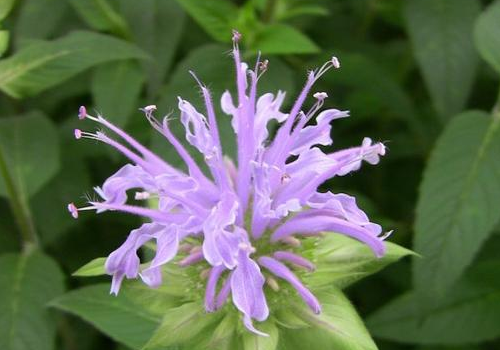
The stem is upright and four-angled. The leaves are thin, opposite, ovate or ovate-lanceolate, with soft hairs on the underside and serrated margins. The flowers grow at the top of the stem, slender, with a tubular corolla 5 cm long, light purplish-red, and the leaves are aromatic.
3. Growth habits
Bee balm likes cool, moist, sunny environments, and can also tolerate partial shade. Bee balm has strong adaptability and is not very particular about soil choice.
Bee balm seeds can be scattered casually by the roadside or in flower pots and will grow. It is not cold-tolerant and not drought-tolerant, and grows well in moist environments.
4. Flower language
The flower language of bee balm is a person of virtue, so bee balm has also become an ideal flower for giving to others.
Like ordinary mint, bee balm can repel mosquitoes to a certain extent. In fact, the main value of bee balm lies in ornamentation and medicine. It belongs to a kind of ornamental flowering plant. Grown at home, it can decorate the home, and it can also be eaten, whether pan-fried or boiled.