How to plant white clover seeds? A detailed explanation of the difference from shamrock
White clover is one of those plants that a huge number of people love; simply put, it is shamrock. So how do you plant white clover seeds? And the difference from shamrock:
How to plant white clover seeds:
1. Sowing time
Both spring and autumn work for sowing; you can sow it alone or in a mix, in rows or by broadcasting. Sowing depth
2. Planting method
The planting depth is about 1-2 cm; don't make it too deep, otherwise the seedlings will struggle to emerge. Of course, you should also adjust it appropriately according to the soil texture and how dry or moist it is.
3. Soil choice
White clover seeds are not demanding about soil, but it is still best to choose soil rich in calcium and humus with good drainage, so that it can provide the seeds with more nutrients and a good growing environment.
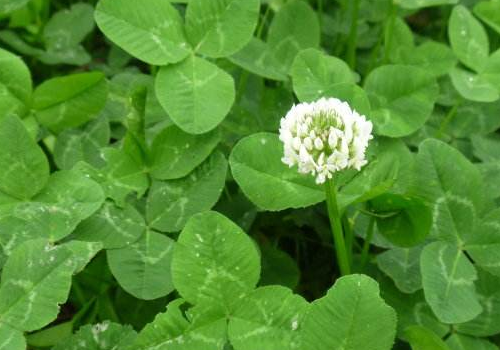
The difference between white clover and shamrock:
Shamrock is a general term for many kinds of herbaceous plants with trifoliate palmate compound leaves, mainly including three groups: the genus Trifolium in the Fabaceae (regarded as the most authentic shamrock) and the genus Medicago, plus certain species in the genus Oxalis of the Oxalidaceae.
White clover, however, is one variety of shamrock. White clover is also known as white trefoil, white-flowered shamrock, white three-leaf, clover, Dutch clover and so on. It is a perennial herb; a short-lived perennial herb, a cultivated plant that sometimes escapes as a weed, invading dry crop fields, though the harm is not serious; it is harmful to vegetables and young forests in certain areas. Its growth period reaches 6 years, and it grows 10-30 cm tall.
The main root is short, while the lateral roots and fibrous roots are well developed. The stems are creeping and trailing, slightly rising at the upper part, rooting at the nodes, and the whole plant is hairless. Palmate trifoliate compound leaves; stipules are ovate-lanceolate, membranous, sheathing and clasping the stem at the base, with the free part sharply pointed.
That covers the planting methods for white clover seeds. Now you know the difference from shamrock, right!
How to plant white clover seeds
Before planting white clover seeds
Soil preparation and fertilizing
Because white clover seeds are rather small and fine and inherently weak in competitiveness, and because weeds are present in the surrounding environment, their growth is bound to be rather slow. Before sowing the seeds, prepare the soil and clear away those weeds completely. At the same time, apply a base fertilizer; you can apply about 25 kg per mu of calcium, magnesium and phosphate fertilizer. For some soils, such as those lacking organic matter, also apply barnyard manure, and for overly acidic soil you can add 50 kg of lime.
Seed treatment
Before sowing, treat the seeds by mechanical means or by soaking and corroding them in concentrated sulfuric acid. When soaking in sulfuric acid, 20-30 minutes is enough; take them out, rinse them clean with water, let them dry, and then sow. In addition, before sowing you can inoculate the seeds with clover rhizobia, which helps seed germination and plant growth.
Planting white clover seeds
Sowing time and method
Both spring and autumn work for sowing; you can sow it alone or in a mix, in rows or by broadcasting.
Sowing depth
The planting depth is about 1-2 cm; don't make it too deep, otherwise the seedlings will struggle to emerge. Of course, you should also adjust it appropriately according to the soil texture and how dry or moist it is.
Soil choice
White clover seeds are not demanding about soil, but it is still best to choose soil rich in calcium and humus with good drainage, so that it can provide the seeds with more nutrients and a good growing environment.
Those are the planting methods for white clover seeds; I hope they can be of help to everyone.
What is the difference between white clover and shamrock? Common shamrock varieties
Speaking of shamrock, I believe everyone is very familiar with it; as the name suggests, it is a grass with three leaves. And anyone who has seen white clover should be very puzzled, since white clover also has three leaves, and the leaves are very similar to shamrock, making it hard to tell the difference between the two. So what exactly is the connection between shamrock and white clover?
What is the difference between white clover and shamrock
Shamrock is a general term for many kinds of herbaceous plants with trifoliate palmate compound leaves, mainly including three groups: the genus Trifolium in the Fabaceae (regarded as the most authentic shamrock) and the genus Medicago, plus certain species in the genus Oxalis of the Oxalidaceae.
White clover, however, is one variety of shamrock. White clover is also known as white trefoil, white-flowered shamrock, white three-leaf, clover, Dutch clover and so on. It is a perennial herb; a short-lived perennial herb, a cultivated plant that sometimes escapes as a weed, invading dry crop fields, though the harm is not serious; it is harmful to vegetables and young forests in certain areas. Its growth period reaches 6 years, and it grows 10-30 cm tall.
The main root is short, while the lateral roots and fibrous roots are well developed. The stems are creeping and trailing, slightly rising at the upper part, rooting at the nodes, and the whole plant is hairless. Palmate trifoliate compound leaves; stipules are ovate-lanceolate, membranous, sheathing and clasping the stem at the base, with the free part sharply pointed.
Common shamrock varieties
Shamrock mainly has three types, namely white-flowered shamrock, crimson-flowered shamrock and red-flowered shamrock.
1. White-flowered shamrock. Also known as white clover. The Netherlands first cultivated it in the late 16th century, and it is now widely distributed in temperate regions. It is cultivated south of the Huai River and in the southwest region of China. A perennial herb that roots where it touches the ground. The stems are slender and soft, creeping along the ground, and the plant grows 30-60 cm tall. The leaf stalks are long, the leaflets are obovate or nearly obcordate, and the leaf margins have fine serrations. The flower heads are capitula with 10-80 flowers, white or pale purplish red. The pods are obovate-oblong, with 3-4 seeds per pod. The seeds are nearly round and yellow, with a 1000-grain weight of 0.5-0.7 g.
2. Crimson-flowered shamrock. Also known as crimson clover. Native to Europe, it is distributed in northeastern Europe, North America and other places. It has been widely introduced and cultivated north of the Huai River and south of the Yangtze River in China. It can be used as forage, ground cover vegetation or green manure, and also as a catch crop. An annual or overwintering herb. The stems are round and hollow, about 70 cm tall. The leaves are nearly round, with short hairs on both sides; the leaf stalks are large, and the stipules are round and large, membranous. The flower heads are cylindrical capitula, and the flowers are deep red. The pods are obovate and contain 1 seed. The seeds are round, yellow or brown, with a 1000-grain weight of 3.2 g.
3. Red-flowered shamrock. Also known as red clover. It is distributed in Europe, the United States, New Zealand and other regions, and is also cultivated south of the Huai River in China. The stems are upright or ascending, round with uneven longitudinal ridges, and 60-100 cm tall. The leaflets have pale white V-shaped markings, the leaf surface is hairy, and the margins are entire. The flower heads are capitula with more than 100 flowers, red-purple, and self-sterile. The pods are obovate, the pericarp is membranous, and each pod contains 1 seed. The seeds are kidney-shaped or nearly triangular, yellow-brown, with a 1000-grain weight of about 1.5 g.
The flower language of white clover
We often give certain flowers special meanings, but usually it is one flower language per flower. White clover, that is, shamrock, however, has a flower language for each leaf.
For shamrock, one leaf represents prayer, one leaf represents hope, one leaf represents love, and the last leaf of the hardest-to-find four-leaf clover symbolizes happiness. Legend has it that whoever finds a four-leaf clover is the luckiest person and can obtain happiness.
The main value of white clover
White clover is rich in various nutrients and mineral elements and has high value for forage, greening, genetic breeding and medicinal use; it can be used as green manure, a grass species for embankment protection, lawn decoration, as well as a nectar source and medicinal material.
White clover has strong invasiveness and competitiveness and can effectively suppress weed growth. It does not need long-term pruning, is extensively managed and has a long service life. It improves the soil and conserves soil and moisture, and can be used for establishing greening lawns in gardens, parks, golf courses and so on.
The above is a summary of some subtle connections between white clover and shamrock. In fact, white clover is shamrock; shamrock simply has several varieties, such as those with white flowers and red flowers, and white clover is the shamrock with white flowers!