Why does Alocasia macrorrhizos get root rot and how is it different from Spathiphyllum
Alocasia macrorrhizos, many people have seen it, they just don't know its name. Why does Alocasia macrorrhizos get root rot? How is it different from Spathiphyllum?
Why does Alocasia macrorrhizos get root rot:
1. Root rot in soil-grown Alocasia macrorrhizos is mainly caused by the potting soil being too wet. When the potting soil is too wet, the rhizomes of Alocasia macrorrhizos easily rot. The cause of overly wet potting soil may be that you watered too much, leading to water accumulation in the pot, or it may be that the soil is highly clayey, has poor aeration, and easily retains water on its own.
2. Root rot often occurs in water-grown Alocasia macrorrhizos mainly because the stem tissue of Alocasia macrorrhizos is relatively loose. If the water quality is poor, it may cause root rot and stem rot. Also, when growing Alocasia macrorrhizos hydroponically, do not put the rhizome in the water; instead, put the roots in the water. In addition, some roots should be left so they can contact the air, which helps the roots breathe. With the rhizome of Alocasia macrorrhizos outside, half of the grown roots are in the water and half in the air, which is beneficial for root respiration.
Differences between Alocasia macrorrhizos and Spathiphyllum:
I. Differences in family and genus
1. Spathiphyllum: Spathiphyllum is a perennial herbaceous plant in the plant kingdom, Angiosperms, Monocotyledons, Alismatidae, Arales, Araceae, Spathiphyllum genus.
2. Alocasia macrorrhizos: Alocasia macrorrhizos is a large evergreen herbaceous plant in the plant kingdom, Angiosperms, Monocotyledons, Alismatidae, Arales, Araceae, Colocasieae, Alocasia genus.
II. Differences in morphology
1. Spathiphyllum: Spathiphyllum has a short rhizome, leaves are oblong-lanceolate, tapering at both ends, with obvious veins, long petioles, and sheathing bases. The scape is erect, taller than the leaf cluster. The spathe is erect and upward, slightly rolled, white. The spadix is cylindrical, white.
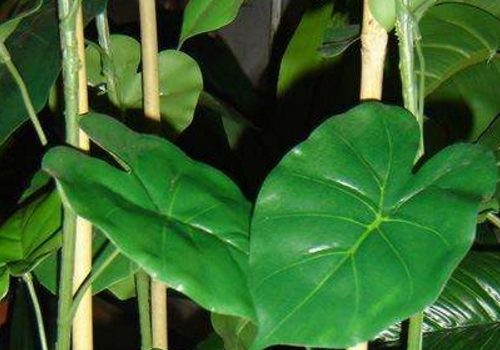
2. Alocasia macrorrhizos: Alocasia macrorrhizos has creeping rhizomes and erect aboveground stems. It has many leaves, and the petioles are green or dirty purple, arranged in a spiral. The leaf blades are subleathery. The petioles and midribs turn black, brown, or white. The peduncles are clustered in 2-3. The tube of the spathe is green, the limb is green in bud, yellow-green or green-white at flowering, turning yellow or white when withering, boat-shaped. The berries are red.
III. Differences in alternative names
1. Spathiphyllum: Spathiphyllum is also called white sail, spathe lily, peace lily, lily of intent, white flag, etc. It is native to Colombia and is one of the most popular indoor foliage plants in Europe.
2. Alocasia macrorrhizos: Alocasia macrorrhizos is also called hen taro, langdu, wild taro, mountain taro, big-root taro, big worm taro, tian taro, tianmeng, etc. When used as an ornamental plant, it is called Alocasia macrorrhizos. It is native to South America and is a common ornamental plant in tropical and subtropical regions.
IV. Differences in flower meaning
1. Spathiphyllum: The flower meaning of Spathiphyllum is smooth sailing. Its flowers and leaves are beautiful, light and graceful, it grows vigorously, and it is also shade-tolerant, so it is deeply favored by people and often used for indoor beautification and decoration.
2. Alocasia macrorrhizos: The flower meaning of Alocasia macrorrhizos is like-mindedness, sincerity, interest, and inner elegance. Under conditions of warm, humid air and sufficient soil moisture, it will drip water downward from the leaf tips or leaf edges, and its flowers resemble Guanyin, so it is called Alocasia macrorrhizos.
Alright, that's all for the introduction to the causes of root rot in Alocasia macrorrhizos. Friends, you all understand now, right?
Spathiphyllum leaves turning yellow, how to grow Alocasia macrorrhizos, what to do if Alocasia macrorrhizos leaves turn yellow and root rot occurs
The corms and leaves of Alocasia macrorrhizos can be used medicinally, but they are highly toxic. The leaf sap is poisonous if ingested, so if there are pets or children at home, it is not suitable to grow Alocasia macrorrhizos, to avoid tragedy. This is a point requiring extra attention when growing Alocasia macrorrhizos. Now let's learn about how to grow Alocasia macrorrhizos.
How to grow Alocasia macrorrhizos, what to do if Alocasia macrorrhizos leaves turn yellow and root rot occurs
Alocasia macrorrhizos corms and leaves can be used medicinally, but they are highly toxic. The leaf sap is poisonous if ingested, so if there are pets or children at home, it is not suitable to grow Alocasia macrorrhizos, to avoid tragedy. This is a point requiring extra attention when growing Alocasia macrorrhizos. Now let's learn about how to grow Alocasia macrorrhizos.
How to grow Alocasia macrorrhizos, what to do if Alocasia macrorrhizos leaves turn yellow and root rot occurs
——————————————————————————————————————————————
[Plant profile]
——————————————————————————————————————————————
Chinese name:Alocasia macrorrhizos (originally named taro or giant taro)
Scientific name:Alocasia macrorrhizos
Alternative names:Hen taro, langdu (Guangdong), wild taro, mountain taro, big-root taro, big worm taro, tian taro, tianmeng
Family:Araceae
Genus:Alocasia
Origin and distribution:Native to South America; abroad it is distributed in Bangladesh, northeastern India, Laos, Cambodia, Vietnam, Thailand to the Philippines. In China it is also found in central-southern, western to southeastern Yunnan, Sichuan, Guizhou, Hunan, Jiangxi, Guangxi, Guangdong and coastal islands, Fujian, and Taiwan.
Morphological characteristics:Perennial herb, with broad leaves. If the environmental humidity is too high, water will drip downward from its broad leaves. Its flowers are spadixes, with a large green spathe outside, opening into a boat shape, like a seated image of Guanyin.
How to grow Alocasia macrorrhizos
——————————————————————————————————————————————
Alocasia macrorrhizos is an ornamental flowering plant that likes warmth, moisture, and sufficient sunlight. Its peak flowering period is from February to April, and the dormant flowering period is from November to May or June of the following year.
The growth temperature for Alocasia macrorrhizos is 20-30°C, and it can tolerate a minimum low temperature of 8°C. Alocasia macrorrhizos likes a semi-shaded environment and should be placed in an environment that is both shaded and ventilated.
Alocasia macrorrhizos especially likes moisture. During the growing season, not only should the potting soil be moist, but the air humidity should also be no less than 60%. During high summer temperatures, spraying water should be increased. In winter, watering should be controlled. Spraying warm water once a week can keep its leaves dark green; otherwise, it easily leads to root rot in Alocasia macrorrhizos.
Alocasia macrorrhizos can be cultivated in nutrient soil mixed with leaf mold, peat soil, river sand, and a small amount of thoroughly decomposed cake fertilizer, and it can also be grown hydroponically. Alocasia macrorrhizos likes fertilizer. From March to October, liquid fertilizer should be applied once every half month, and the proportion of nitrogen can be appropriately increased. Fertilization should stop when the temperature is below 15°C.
What to do if Alocasia macrorrhizos leaves turn yellow
——————————————————————————————————————————————
If Alocasia macrorrhizos is not handled properly, it will cause the leaves to turn yellow. To summarize, the reasons for Alocasia macrorrhizos leaves turning yellow are mainly the following, and they can be dealt with separately according to the cause.
Alocasia macrorrhizos likes scattered light. If the sunlight is too strong, the leaves will be sunburned and turn yellow;
If Alocasia macrorrhizos is placed in the living room, bedroom, etc. for a long time, due to insufficient or no light, the leaves lack chlorophyll and appear yellow;
If Alocasia macrorrhizos is too dry or too wet for a long time, or is often given "half-watering," the leaves may also droop and turn yellow;
If the leaves are not cleaned for a long time and dust hinders normal photosynthesis, the leaves of Alocasia macrorrhizos will also droop and turn yellow.
What to do if Alocasia macrorrhizos has root rot
——————————————————————————————————————————————
Although Alocasia macrorrhizos is not strict about potting soil, clayey soil with poor aeration easily retains water, and root and stem rot easily occurs, so potting soil that drains well, is fertile, and is slightly acidic should be chosen.
Root rot often occurs in hydroponic Alocasia macrorrhizos because the stem tissue of Alocasia macrorrhizos is relatively loose. If the water quality is poor, it easily causes root rot and stem rot. The solution is to keep the bottle water clean, clean the slime on the tubers and root system when changing the water or nutrient solution, and cut off the rotten roots. Some netizens also suggest that putting the fibrous roots of Alocasia macrorrhizos in water while keeping the bulbous part of the roots separated from the water is a fairly good way to prevent root rot in Alocasia macrorrhizos. Once root rot is found in the bulbous part, cut it off as soon as possible and wash it clean, and continue to keep it separated from the water.
" Conclusion:The above content is mainly divided into three parts, specifically answering netizens' questions about how to grow Alocasia macrorrhizos, Alocasia macrorrhizos leaves turning yellow, and Alocasia macrorrhizos root rot, and providing solutions. I hope everyone can find the information they need from it, so that their Alocasia macrorrhizos grows healthily and luxuriantly.
【Related recommendations】
Poppy night-blooming jasmine rose azalea lavender pothos asparagus fern Peperomia obtusifolia hyacinth anthurium cherry blossom calla lily
African jasmine rose Spring Festival flowers succulents tropical plants Rosa rubus agave canna Lycoris radiata forget-me-not dandelion
Dendrobium officinale yew kapok osmanthus begonia hydroponic plants feng shui plants for the home feng shui plants for the bedroom plum blossom aloe
jasmine radiation-absorbing plants Centella asiatica potted plants bonsai making drug plants mistletoe indoor flowers money tree lucky bamboo lucky bamboo
Potted plant making Anthurium mint Lithops geranium garden Christmas cactus Spathiphyllum snake plant Kunlun snow chrysanthemum water lily