How many times a year does a carnation bloom? A detailed guide to water cultivation
Carnations are very beautiful, and quite a few people grow them. How many times a year can a carnation bloom? How do you grow it in water?
How many times a year does a carnation bloom:
Carnations are perennial herbaceous plants with rhizomes, one flower per plant, and the flowering period is from April to September. If cultivated in a protected environment, they can bloom in all four seasons. This is because the flower buds of carnations differentiate multiple times over the course of a year. As long as the temperature is suitable, once the new shoots grow to a certain length, the apical vegetative growth stops, the leaf color turns dark green, and the nutrients concentrate at the tip of the shoot, flower buds will differentiate and bloom.
In addition, a preference for strong light and dryness is an important characteristic of carnations. Whether it is indoor overwintering, potted plants overwintering in summer, or greenhouse forcing cultivation, they all need sufficient light and should be placed in a sunny position with direct light. As long as there is plenty of sunlight and good ventilation, carnations will bloom all year round.
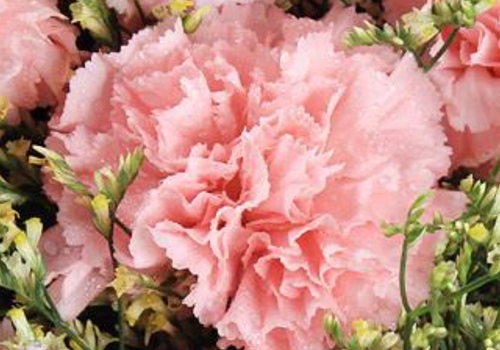
How to grow carnations in water:
For hydroponic carnations, just take a bottle and insert the carnation. Every year from December to February of the following year is the mass propagation period, and rooting takes about 30 days; from March to April it takes 25 days, and from May to July about 20 days.
They prefer a cool, dry ecological environment with plenty of sunlight and good ventilation. They have good cold tolerance but poor heat tolerance, with an optimal growth temperature of 14-21°C. When the temperature exceeds 27°C or falls below 14°C, the plants grow slowly. They are best planted in calcareous soil rich in humus and well-drained. They like fertilizer.
Well, that is all for the introduction to growing carnations in water. I hope everyone understands now.
16 kinds of flowers and plants that foretell good fortune!
Goodbye, 2015!
Hello, 2016!
What can be expressed with flowers and plants
We try not to use words
I hope these 16 plants that carry good fortune
Can bring you good luck for the new year
Guzmania (Scarlet Star)
If you want "good fortune to come your way," you must have a Guzmania. Bromeliaceae, a perennial herbaceous plant. Its most striking feature is the vivid red flower core at the top.
Suitable for placing in the living room; it carries the meaning of gathering wealth and bringing prosperity. It likes moisture, so it can also be placed in the bathroom. At night it absorbs a large amount of carbon dioxide and releases oxygen, so having it gives you a home oxygen bar.
Clivia (Kaffir Lily)
There is a kind of nobility that comes from the soul. People love Clivia because of its "gentlemanly manner." Amaryllidaceae, Clivia genus, native to Africa.
It likes semi-shade and humid environments, can absorb dust, purify the air, and has medicinal uses. It can be placed in front of the door, in the study, or by the dining table. New Year's Day and Spring Festival are exactly its peak flowering season.
Cyclamen
Is it not a joy to have friends come from afar? Using cyclamen to welcome honored guests may also bring good luck. Primulaceae, Cyclamen genus, a perennial herbaceous plant. Native to Greece, Syria, Lebanon, and other places.
It has a strong ability to absorb sulfur dioxide, and placing it at home has a humidifying effect, which can invisibly protect the skin. It can be grown in water and is suitable for placing on a sunny desk, where it has a calming effect; it can also be placed in the living room.
Orchid
It is the flower that best fits Eastern aesthetics, can be used to express the sincerity of friendship, and is also a witness to pure love. Cymbidium genus, epiphytic or terrestrial herbaceous plants. It blooms all year round and has a particularly delicate fragrance.
They like humid climates and are best placed outdoors in open surroundings, as well as indoors with plenty of sunlight. If the air at home is dry, one way to increase humidity is to grow more orchids.
Narcissus
Narcissus blooms during the Chinese New Year period and symbolizes longing and reunion. Before blooming, narcissus looks like onions and garlic; after blooming, it is mainly about its elegance. To grow narcissus well, you must first learn to select narcissus bulbs, as they determine how many flowers bloom and how rich the fragrance is.
They like warmth and moisture; they can be grown hydroponically or in soil. Brightly colored narcissus can be placed in the living room, while more delicate and elegant ones can be chosen for the study and bedroom. It will absorb noise and waste gases in the home and release fresh air.
Lucky Bamboo
The name of lucky bamboo is directly pleasing, representing "flowers blooming in wealth and splendor, bamboo reporting peace." A perennial evergreen herbaceous plant, native to the Canary Islands and the tropical regions of Africa and Asia. Placing 4 stalks of lucky bamboo in the Wenchang position is usually called "Wenchang Bamboo."
It likes shade and moisture and can purify indoor air. It can be potted or grown hydroponically; potted plants live longer and grow more vigorously than hydroponic ones. Before using tap water to grow it, leave it to sit for a day to oxidize. Its stems can be cut for bottle arrangements, or processed into "lucky bamboo" or "curved bamboo" and placed on office desks, in living rooms, and bedrooms.
Money Tree
The name "Money Tree" was created to make it "sell well." It is also known as Malabar chestnut, Guiana chestnut, Chinese and American kapok, and goose-foot money. At a glance, you can tell it is native to Costa Rica in Latin America, Australia, and some small islands in the Pacific.
A small evergreen tree of the Bombacaceae family, it is distributed in the tropical regions of southern China and avoids direct sun exposure. Its favorite environment is a sunny place with dappled shade. It can regulate indoor temperature and air and acts as a natural humidifier. It is suitable for placing beside the TV in the living room, where it looks very lively.
Schefflera (Seven-leaf Lotus)
It is a precious plant native to the deep mountain forests of Yunnan and Hubei, and it is a nationally third-class protected rare and endangered plant. Its leaf shape is very special, with seven oval-shaped leaves. It is generally called "Dragon Claw Leaf" and has great medicinal value.
It has strong environmental adaptability and can grow whether in direct light or in indoor settings with insufficient light; it is relatively cold-tolerant and stops growing after high temperatures of 30°C.
Lysimachia (Moneywort)
A plant of the Primulaceae family. It likes warmth, avoids high temperatures, and tolerates low temperatures. Placed indoors, it can keep the air fresh and make people feel cheerful. Its medicinal value is also high, and it can be put into dishes and eaten directly.
ZZ Plant (Money Tree)
The ZZ plant is named entirely because its leaves look like strings of coins. Its true scientific name is "Zamioculcas zamiifolia." Native to tropical Africa, it is a perennial evergreen herbaceous plant and a very rare foliage plant with underground tubers.
It likes warmth, fears cold, tolerates drought, and is afraid of water accumulating in the pot. Because it looks like a woody plant, it is called a "tree." It is suitable for placing in the office or at the wealth position in the living room; it can regulate humidity and also carries the meaning of gathering wealth and bringing prosperity.
Mangosteen Flower
Mangosteen flower has no relationship at all with mangosteen. It is a perennial herbaceous plant. It is generally placed in the study and has the effect of promoting literary fortune. Its branches and leaves resemble bamboo, and when it blooms, the flowers appear in clusters, in colors such as white, pink, red, and purple.
Its most important effect is that after being dried in the sun it can be used as medicine, especially possessing the functions of clearing heat and detoxifying and relaxing muscles and promoting blood circulation.
Yellow Rose
In the new year, I hope you can have this good fortune and use a yellow rose to wait for your love. As the yellow strain among roses, the yellow rose has all the characteristics of shrubs in the Rosaceae, Rosa genus.
It likes coolness and fears heat, loves sunlight and avoids shade, and likes to grow in soil with plenty of water and fertilizer. Yellow roses are especially suitable for the dining room, where they can promote a harmonious family atmosphere.
Yellow Carnation
Carnations are native to the Mediterranean region, southern Europe, and western Asia. They like mild conditions, cannot tolerate severe heat or cold, and love sunlight. Each color of carnation has its own unique meaning, and yellow carnations represent gratitude toward mothers.
Like yellow roses, the most suitable place for yellow carnations is also the dining room. When you are eating the delicious food your mother made, what could be warmer than placing a yellow carnation beside her and spending time with her in the kitchen?
Asparagus Fern
Asparagus fern is not bamboo; its stems simply resemble bamboo. It represents eternity, and in weddings asparagus fern represents lasting love. Its most distinctive feature is its leaves, which are dense like cloud layers.
Native to South Africa, it likes warm, humid, semi-shaded, and ventilated environments. In winter it can tolerate neither severe cold nor drought. In summer, direct sunlight must be prevented. It loves clean and airy environments. Placed in the living room and study, it adds a touch of literary elegance and can also purify the air.
Asparagus Densiflorus (Sprenger's Asparagus)
Asparagus densiflorus symbolizes "longevity" and is generally used as a backing leaf for flower arrangements such as chrysanthemums and carnations. Asparagaceae, Asparagus genus, a perennial shrub-like herb. Native to southern Africa.
It likes warm, semi-shaded environments. It is not cold-tolerant and fears exposure to strong sun and high temperatures; it tolerates neither drought nor waterlogging, so it takes some care. In winter it should be placed on a windowsill to receive full sun; it also needs less watering, with the potting soil kept slightly dry. When the room is dry, spray water on the canopy more often so that it looks more lush and green.
Kumquat
Kumquat symbolizes "wealth" and represents attracting fortune; it is a gift of the first lunar month. Holding a kumquat means good luck and everything going as wished. Rutaceae, Fortunella genus, an evergreen shrub that blooms in early summer and ripens its fruit in late autumn.
It likes sunny, warm, and humid environments and is not cold-tolerant. 80% of its vitamin C is found in the fruit peel, and eating kumquats has the effects of reducing phlegm, stopping cough, sobering one up, and aiding digestion.
Seasonal flowers suitable for display during New Year's Day and Spring Festival
At the New Year, buying and cultivating a few pots of seasonal flowers and plants to place in the home not only beautifies the environment but also adds a joyful atmosphere to the holiday. Here are several seasonal flowers suitable for display during New Year's Day and Spring Festival.
Because there are not many flower species that bloom naturally in winter, people are mostly accustomed to using spring plum, wintersweet, and narcissus, whose flowering periods fall around the Spring Festival, to decorate their homes. Narcissus is a traditional famous flower of China, with a cultivation history of more than 1000 years. Its flower colors are elegant and its fragrance pleasant, and it has long enjoyed reputations such as "Fairy of the Waves" and "Jade Exquisite." If you want to enjoy the graceful beauty of narcissus blooming during the Spring Festival, you only need to carve the narcissus one month in advance and ensure a sufficient water supply.
With the development of horticultural technology, people can now use methods of artificially controlling the flowering period to make many flowers bloom out of season during the Spring Festival, such as chrysanthemums, gladioli, and carnations. If you want to choose decorative flowers for the home, large-flowered cymbidium is the first choice, because its flowers are large and numerous and its leaves are long and green; using it to decorate a room gives a luxurious and grand feeling. There are many varieties of large-flowered cymbidium with rich colors, including yellow, pink, red, and others. They also have a relatively large plant shape, with a height of about 1.3 m, neat flower shapes, and long-lasting blooms. They are suitable for placing in larger spaces or on flower stands, appearing generous and warm.
Kumquat symbolizes a bright future and prosperous fortune. During the Spring Festival, placing a pot of kumquat in the living room is undoubtedly a good omen. If cared for properly, kumquat can also bloom and bear fruit, accompanying its owner to welcome the next Spring Festival. It should be noted that although golden kumquats are very beautiful, they taste very sour and are not easy to enjoy.
Since ancient times, China has regarded the lily as an auspicious flower, with the meaning of "all matters going as one wishes." In recent years, many merchants have also cultivated lilies as potted flowers, and they have a very good beautifying and fragrance-enhancing effect on rooms, balconies, and courtyards. Lily flowers have relatively large corollas and a rich fragrance. If a pot is placed in a corner of a room, its scent can be smelled throughout the whole room. However, although lilies are elegant in style, they should not be displayed in excessive numbers, otherwise the effect will be counterproductive. Generally, a combination of 5 plants per pot can be chosen and placed near upper-air openings such as doors and windows to help the fragrance spread.
Bromeliad flowers include many varieties such as Denisse, Red Star, Pink Star, Pinecone, Yingge, and Red Arrow, among which Pinecone is a flower that very much embodies the "New Year flavor." Pinecone bromeliad is an indoor ornamental flower for winter and spring. It is evergreen in all four seasons, with beautiful flower forms and rich colors; the common ones are bright red, pink, golden yellow, and rose red. Pinecone bromeliad has relatively long leaves, but they can stand straight upright. Up close, the flower bud in the middle looks like a string of red pinecones; from a distance, it looks like a burning torch, which can bring the warmth of spring to a winter room. Bromeliad flowers also have many auspicious names depending on the combination method, such as "Three Stars Shining High" and "Five Blessings Arriving at the Door."
Cyclamen, commonly known as radish begonia, rabbit flower, or rabbit-ear flower, is a perennial evergreen herbaceous bulbous flower. The word "cyclamen" comes from the transliteration of the scientific name Cyclamen. Because the transliteration is clever, the flower name carries the meaning of "immortal guests arriving gracefully." Because of its peculiar flower shape, it is a rare ornamental flower in winter. Flower colors include white, snow blue, light red, crimson, and rose red. When purchasing, choose ones with abundant flowers and lush leaves.
Cyclamen has a relatively strong resistance to the toxic gas sulfur dioxide in the air. Its leaves can absorb sulfur dioxide and, through oxidation, convert it into non-toxic or low-toxicity substances such as sulfate.
Camellia
New Year's Day to Spring Festival is exactly the season when camellias are in full bloom. The tree form is graceful and the colors are colorful, with high ornamental value. Generally, it is best to choose plants with tender green and glossy leaves. Camellia flowers are full and dignified and elegant. They are one of China's traditional top ten famous flowers and also one of the world's famous flowers.
Narcissus
Narcissus, also known as the Fairy of the Waves. In the cold winter season when all flowers wither, narcissus can still take root, sprout, bloom, and announce spring with just a spoonful of clear water and a few pebbles, bringing people abundant spring feeling with its graceful posture and refreshing fragrance.
Narcissus is mostly grown in water. Its production areas are mainly distributed in the warm, humid coastal areas of southeast China, with those from Zhangzhou and Xiamen in Fujian and Chongming Island in Shanghai being the most famous. Every Spring Festival, skilled craftsmen create narcissus bonsai carving art in various forms, and they can bloom at a predetermined time according to people's wishes, adding much brilliance to festivals such as New Year's Day and Spring Festival.
Poinsettia
Poinsettia, also known as Christmas flower, Christmas red, or ivory red. In deep winter, when all flowers fade, poinsettia is dazzling and colorful, and using it to beautify a room makes it full of vitality. When purchasing, it is generally best to choose healthy ones that retain 4-5 branches. The flowering period is relatively long, and it can be enjoyed at Christmas, New Year's Day, and Spring Festival. In the cold winter, placing a pot of bright red poinsettia at home feels like lighting a warm stove.
The red parts of the poinsettia that people think are flowers are actually leaves, while the true flowers are the small yellow granular parts in the middle of the leaf cluster. Poinsettias are usually 60 cm to 3 m tall, and their dark green leaves are about 7 to 16 cm long. The topmost leaves are fiery red, red, or white, so they are often mistaken for flowers.
This is a flower suitable for any blessing. Especially the red and large leaves, with a joyful appearance, look as if they are clasping their hands to congratulate people. It is the best flower to represent Christmas and the New Year. In addition, in some weddings, red and white poinsettias can also be seen as decorations. The flower language of poinsettia is "my heart is burning," and it can also be used for courtship.
Wintersweet
Blooming in the cold, with a clear fragrance and cold elegance, a long flowering period, and beautiful flower posture, it is a very good cut flower variety. A branch of yellow flower without leaves placed in a bottle is antique and uniquely elegant.
Because wintersweet has both color and fragrance and blooms for a long time in winter, it is a winter feature of Jiangnan gardens. It is also suitable as a bonsai for indoor viewing and is even a top-grade indoor cut flower in winter. It can last a very long time in a vase, up to dozens of days. It is a precious flower unique to China.
Lucky Lily (Evergreen)
A perennial herbaceous flower of the Liliaceae family, it has a long cultivation history in China and is often regarded by people as a symbol of auspiciousness, expressing the beautiful wish of lasting youth. Its leaves are green and its fruits red, elegant and plain. Because its leaves are thick and its photosynthesis is strong, it also has the function of purifying indoor air.
Lucky Lily is suitable for accenting the living room and study. Decorative uses: small potted young plants can be placed on a desk or windowsill for viewing. Medium-sized potted plants can be placed in the corner of the living room or beside the sofa as decoration, filling the room with natural vitality.
Lucky Lily is also famous for its unique air-purifying ability. It can remove nicotine, formaldehyde, and others. Moreover, the higher the concentration of pollutants in the air, the more it can exert its purifying ability.
Monstera (Swiss Cheese Plant)
Monstera has large oval leaves reaching dozens of centimeters long, with the sides of the main vein often split into a turtle-shell shape. It is green all year round and extremely shade-tolerant. It can be potted and placed in halls, rooms, or on tables. It is generally best to display plants with 4-6 leaves.
Because the leaf shape of monstera is very similar to a turtle shell, and it is also a relatively hardy indoor plant variety, and at the same time it has the peculiar ability to absorb carbon dioxide, which is beneficial to human health, its flower language is: health and longevity.
Pothos
Pothos is one of the very excellent indoor decorative plants. It is a perennial trailing plant with slender, soft stems and delicate leaves. There are irregular golden-yellow spots in the middle of the leaves, and the leaf texture is thick, crystal-clear, and deep green. Because it is smooth and upright, elegant and graceful, it is an outstanding choice for indoor greenery decoration.
It can be potted and hung, or wound into flower baskets, flower balls, or flower columns to enhance its ornamental effect. You can also place a pothos cachepot high on the top of a furniture cabinet and let its trailing stems hang down calmly, or after the trailing stems hang too long, loop and hang them into a ring, just like an emerald relief. This not only makes full use of space and purifies the air, but also adds a lively-lined, bright-colored green decoration to a rigid cabinet surface, extremely full of vitality, adding a harmonious touch of charm to the New Year room.
Geranium
Also known as stone wax red, hydrangea flower, and others. The small flowers gather together, and the large inflorescence resembles a hydrangea. Flower colors include pure white, rose red, peach red, and bright red. The leaves are large and green, making it an indoor ornamental plant with both beautiful flowers and foliage. The flowering period is very long, starting in early winter and lasting until early summer of the following year. It is just right for display during the New Year and Spring Festival.
Through the detailed introduction in this article, I hope everyone can gain something! Thank you all for your support and attention to Duorou Huapu (Succulent Garden)!