When to sow Orychophragmus violaceus? A full analysis of its flower meaning
Orychophragmus violaceus is very beautiful, and many people want to grow it. What is the flower meaning of Orychophragmus violaceus? When should it be sown?
What is the flower meaning of Orychophragmus violaceus:
It opens quietly all on its own. When the flowers bloom into a sea, they have a momentum that reaches straight to the clouds, and even then they are not proud, still blooming on, not taking their final bow until late spring. The late Mr. Ji Xianlin once praised Orychophragmus violaceus this way in "Orychophragmus Violaceus": “When it is time to bloom, they bloom; when it is time to disappear, they disappear. They drift through the great transformations, letting everything follow nature, indifferent to sorrow or joy of their own.”
Yes, that is just how Orychophragmus violaceus is, following nature, low-key and plain. Therefore, the flower meaning of Orychophragmus violaceus is: modest and unadorned, selfless dedication.
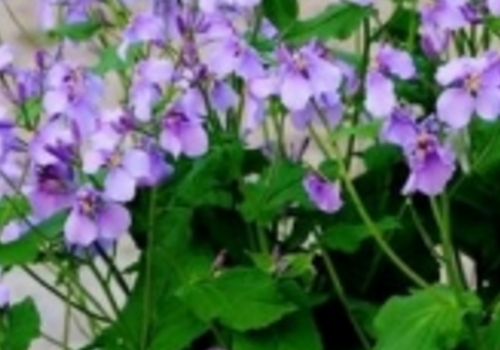
When to sow Orychophragmus violaceus:
1. Sowing time
The most common way to obtain Orychophragmus violaceus is by sowing. It is very resistant to drought and cold, and sowing is simple. It is usually sown in August to September each year, and after the long winter, it can bloom in late spring!
2. Sowing method
First prepare the potting soil, and try to choose a medium-deep and wide flower pot, so the result will be better. Fill the pot with soil mixed from garden soil, perlite, and plant ash, and add a small amount of base fertilizer.
Evenly scatter the prepared seeds into the pot, cover with a thin layer of soil, water thoroughly, cover the pot with glass or plastic film to ensure a certain temperature and humidity, and then just manage it normally. When the seedlings emerge, supplement sunlight in time.
Well, that is all for the introduction to the flower meaning of Orychophragmus violaceus. Friends, you all understand now, right?
Orychophragmus violaceus cultivation, Orychophragmus violaceus flower meaning, Orychophragmus violaceus flowering period, when to sow Orychophragmus violaceus, how to eat Orychophragmus violaceus
Orychophragmus violaceus
Orychophragmus violaceus (Zhuge cai), of the genus Orychophragmus in the family Brassicaceae, is an annual or biennial herb. Because it begins to bloom with blue-purple flowers around the second lunar month, it is called February blue. It grows in plains, mountains, roadsides, and field edges. It has low requirements for soil, light, and other conditions, is tolerant of cold and drought, and has strong vitality.Orychophragmus violaceus cultivation
1. Soil: Orychophragmus violaceus is not strict about soil. It is best to choose loose, fertile, and well-drained sandy soil. For potted Orychophragmus violaceus, the requirements for potting soil are relatively high. Here you can consider evenly mixing 6 parts garden soil, 2 parts perlite, and 1 part plant ash, and sufficient base fertilizer should be placed in the pot.
2. Light: Because Orychophragmus violaceus is a short-day plant, it does not need too long a daily sunlight exposure, and indoor scattered light is sufficient.
3. Temperature: Because Orychophragmus violaceus is cold-tolerant, temperature control can be extensive. The most suitable temperature for growth and flowering is between 15°C and 25°C.
4. Fertilization: Orychophragmus violaceus likes fertilizer. Sufficient fertility will not only make Orychophragmus violaceus grow faster, but also promote its flowering and fruiting. Fertilize 4 times a year. Flower bud fertilizer in early spring, vigorous-growth fertilizer after flowers fade, fruit-strengthening fertilizer after fruit set, and seedling-strengthening fertilizer before winter. If a 0.2% potassium dihydrogen phosphate solution is sprayed on the leaves once each during the bud stage and young fruit stage, the flower color will be more brilliant and the fruit will be fuller.
5. Pests and diseases: Common pests in Orychophragmus violaceus cultivation include aphids, cabbage caterpillars, snails, leaf miners, and so on. If pests are found, chemical control should be carried out in time.
6. Pruning: To maintain a good ornamental effect of Orychophragmus violaceus, it must be controlled so that it does not set seed. Generally, during the seed-setting period, use a lawn mower to trim it to a height of 10 ~ 15 cm .
Orychophragmus violaceus flower meaning
The flower meaning of Orychophragmus violaceus: modest and unadorned, selfless dedication. It is an annual or biennial herb. Because it begins to bloom with blue-purple flowers around the second lunar month, it is called February orchid. Also, because legend says Zhuge Liang once picked its tender tips as a vegetable when leading troops on a campaign, it is also named Zhuge cai.
Legends related to Orychophragmus violaceus
According to legend, Zhuge Liang became Liu Bei's military commander and oversaw military grain and taxes. Because Liu Bei had a large number of troops, the demand for grain and forage was relatively great, and the burden on the common people was even heavier. For example, if the people could not eat their fill or dress warmly, people's hearts would be unsettled. Once, Zhuge Liang went on an incognito inspection tour and saw a vegetable called "turnip". From an old farmer he learned that this vegetable was a treasure all over: its leaves and stems could both be eaten, what was left could be made into pickles, and when the old grain was gone and the new had not yet come in, this vegetable could become the main vegetable.
Zhuge Liang was very interested in this vegetable. He asked the old farmer about the yield per mu of "turnip" and how to grow it, then ordered soldiers to open wasteland and plant this vegetable, so as to supplement military grain on the one hand and use it as livestock feed on the other, both economical and practical, achieving two goals at once. So Zhuge Liang ordered the soldiers to plant "turnip" widely, and military grain became plentiful. Later generations called this vegetable Zhuge cai.
Orychophragmus violaceus flowering period
Orychophragmus violaceus blooms from April to May, and the fruiting period is from May to June.
Orychophragmus violaceus is 20-70 cm tall, generally mostly 30-50 cm. The stem is upright and only a single stem. The basal leaves and lower stem leaves are pinnately deeply lobed, with a heart-shaped leaf base and blunt teeth on the leaf margin; the upper stem leaves are oblong or narrowly ovate, with an ear-shaped clasping leaf base and an irregularly serrated leaf margin structure. The raceme is terminal, bearing 5-20 flowers, with fine vein lines in the petals. The flowers are mostly blue-purple or pale red, and as the flowering period continues, the flower color gradually fades, finally becoming white. The flowering period is April to May, and the fruiting period is May to June. There are 4 petals, long ovate, with a long claw about 3-6 mm long, and the petal length is about 1-2 cm; there are 6 stamens, with white filaments and yellow anthers; the calyx is slender and tubular, blue-purple in color, with sepals about 3 mm long. The fruit is a cylindrical silique, 6-9 cm long, with a slender beak at the tip of the silique. The fruit has four ridges and contains a large number of tiny dark brown seeds, and the seeds are ovate to oblong. After the fruit matures, it splits open naturally and expels the seeds.
When to sow Orychophragmus violaceus
Some freshly harvested new seeds have a post-ripening physiological phenomenon. Early sowing has a low germination rate, and germination may continue for 1~2 months or even longer. Seeds that have been stored and treated have already passed dormancy, so Orychophragmus violaceus can be sown directly. Sowing time can be in summer or autumn, but August to September is most suitable. The sowing rate is 2~3 g per sq m. If the spray-sowing method is used, the sowing rate should correspondingly increase by 15%~20%, with 300~400 seeds per gram. The flowering period of Orychophragmus violaceus begins between February and March each year and can continue until June of that year, during which it blooms continuously, and the fruit matures successively from May to June. After the fruit of Orychophragmus violaceus matures, it automatically pops open and widely disperses the seeds inside. Orychophragmus violaceus cultivation and management are relatively simple; water in time and fertilize 1~2 times.
How to eat Orychophragmus violaceus
1. The wild vegetable Orychophragmus violaceus can be served cold
The wild vegetable Orychophragmus violaceus can be eaten after being served cold. When serving it cold, soak the collected wild vegetable Orychophragmus violaceus in clean water for fifteen minutes, take it out and wash it, blanch it in boiling water briefly, remove it and cool it in cold water, then cut it into sections, add seasonings such as edible salt, vinegar, and sesame oil, and mix well. In addition, friends who like garlic can also add an appropriate amount of minced garlic to season it.
2. The wild vegetable Orychophragmus violaceus can be used as filling
Using the wild vegetable Orychophragmus violaceus as filling is also a good way to eat it. You can blanch fresh Orychophragmus violaceus in boiling water, remove the water, then chop it together with beef or mutton, add light soy sauce, salt, sesame oil, five-spice powder, and so on to make a filling, and then make it into steamed buns or dumplings, both of which are good choices.
3. The wild vegetable Orychophragmus violaceus can be stir-fried
Stir-frying the wild vegetable Orychophragmus violaceus is a very common way to eat it. It is just that when cleaning it, it needs to be soaked in clean water to avoid residual harmful components. After soaking and washing, cut it into sections, and according to your own taste, directly stir-fry it into various dishes.
Related encyclopedia
Tourmaline mattress, Christmas decorations, stamp album, splash-ink landscape painting, abstract painting, paper rattan flowers, warp-knitted fabric, wheat straw painting, crystal flower, Alxa agate, water-heating blanket, Franz porcelain, golden toad, bedding, Ming Dynasty blue-and-white porcelain, Jingdezhen blue-and-white porcelain, Song Dynasty Ge ware porcelain, crystal vase, Shu embroidery, Aimon mattress
The flower meaning and legends of Orychophragmus violaceus
The flower meaning of Orychophragmus violaceus
The flower meaning of Orychophragmus violaceus is modest and unadorned, selfless dedication.
Just like its flower meaning, it is beautiful in appearance and blooms into a sea, but still guards nature and never forgets its original intention. Perhaps because it blooms in spring, its purple light enriches the whole spring, and once summer arrives, it renews life again. Some people say that Orychophragmus violaceus is very great, for it both blooms with beauty and shines through its own nutritional value.
The legend of Orychophragmus violaceus
This legend is about another name of Orychophragmus violaceus - Zhuge cai. Zhuge "Crouching Dragon", entrusted with the heavy responsibility of a regent, strenuously assisted the later ruler and sent troops to attack Wei.
According to legend, Zhuge Liang became Liu Bei's military commander and was in overall charge of military grain and taxes. Because Liu Bei had a mighty army, the demand for grain and forage was relatively large, and the burden on the common people was also relatively heavy. The people could not eat their fill or dress warmly, and people were anxious. Once again, when Zhuge Liang went out on a secret inspection, he saw a wild vegetable called "turnip". From an old farmer he learned that this vegetable was a treasure all over: its leaves and stems could both be eaten, what was left could be made into pickles, and when the old grain was gone and the new had not yet come in, this vegetable could become the main vegetable.
Zhuge Liang was very interested in this vegetable. He asked the old farmer about the method of planting "turnip", then ordered officers and soldiers to plant it widely in the army, so that on the one hand it could supplement military grain, and on the other hand it could serve as livestock feed, economical and practical, achieving two goals at once. From then on, military grain was plentiful, and the pressure on the common people was also relieved quite a bit. The vegetable Zhuge Liang planted was later called Zhuge cai.