Amaryllis: Flower Language and Propagation Methods Explained
Amaryllis is a fairly common plant, but many people do not know its name. What is the flower language of amaryllis? How do you propagate it?
What is the flower language of amaryllis:
Amaryllis is a rather delicate bulbous plant. To grow amaryllis in the UK, you must put up protective covers against cold damage, and sunlight must be sufficient, otherwise the plant will struggle to survive. In short, this plant has a very frail constitution. Anyone born under the blessing of this flower is a standard Lin Daiyu. Their frail, delicate appearance easily stirs sympathy in the opposite sex, which in turn breeds the seeds of love and begins a romance.
Therefore, the flower language of amaryllis is longing to be loved and pursuing love; it also carries the meaning of a frail body.
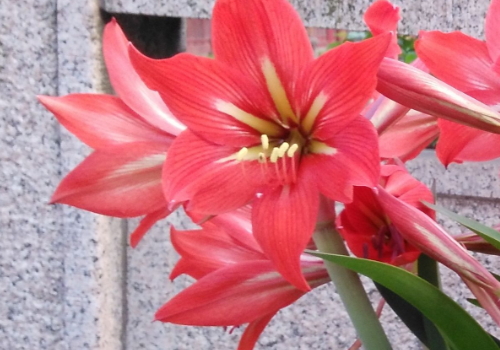
How to propagate amaryllis:
Amaryllis is commonly propagated by sowing, bulb division and cuttings.
1. Sowing method
Sow immediately after harvest; the germination rate is high. The sowing soil is a mix of 2 parts peat soil and 1 part river sand. The seeds are fairly large, so dibbling is best, with a spacing of 2-3 cm. The suitable germination temperature is 15-20°C, seedlings emerge in 10-15 days, and they are pricked out when they have 2 true leaves. From sowing to flowering takes 2-3 years.
2. Bulb division method
An old bulb can produce 2-3 small bulblets each year; simply remove them and plant them separately. Be careful not to damage the roots of the small bulbs, and let their tops emerge above the soil surface. The small bulbs take about 2 years to flower.
Artificial scoring of the bulb is often used to propagate bulblets in large numbers, that is, cutting the mother bulb lengthwise into several portions, then splitting each in half in the middle so that the lower end of each retains part of the basal plate as a rooting site, then inserting them into a cutting bed of peat soil mixed with sand, watering appropriately; after 6 weeks, 1-2 small bulbs can form between the scales and roots develop at the bottom. In this way, nearly a hundred bulblets can be obtained from one mother bulb.
Amaryllis sets seed easily; hand pollination can be done during the flowering period, and the seeds mature after 2 months, with each capsule containing about 100 seeds. Sow immediately after harvest; the germination rate is high. After sowing, place in partial shade and keep moist at a temperature of 15-18°C; they will germinate in half a month. If the temperature reaches 18-20°C, they germinate in 10 days. Seed propagation takes 3-4 years to flower. Bulb division propagation is carried out in March-April; remove the small bulbs around the mother bulb and plant them, and when planting, let the top of the small bulb emerge above the soil surface.
3. Cutting method
Cut the mother bulb lengthwise into several portions, then cut the scales further and insert them obliquely into vermiculite or sand. Plant out when 2 true leaves have grown. When planting the pseudobulb, if the potting soil is too loose, flowering may be delayed or the number of flowers reduced; you can use a mix of 5 parts sandy loam, 2 parts peat soil and 1 part sand, and the planting depth should be such that 1/3 of the bulb is exposed above the soil surface.
Well, that is all for the introduction to the flower language of amaryllis; I trust everyone understands now.
What Is the Flower Language of Amaryllis? An Introduction to Amaryllis Cultivation Methods
An introduction to amaryllis cultivation methods: Amaryllis not only has a great many varieties, its flower colors are also extremely complete, even surpassing those of hyacinths. The flower shape of amaryllis is also very unusual, even lilies are outshone by it; therefore, amaryllis is very suitable for potted display in the living room, study and on windowsills, creating a good decorative effect.
Amaryllis cultivation methods
Amaryllis flower language:
The flower language of amaryllis is longing to be loved and pursuing love. It also carries the meaning of a frail body.
Common cultivated amaryllis varieties include Red Lion, Hercules, Rilona, Crown of Flowers, La Paz and Minerva, among others; their flowers are mostly deep red or orange. They mainly prefer a warm, humid climate, and the suitable growing temperature is 18-25°C. They dislike scorching sun, so when cultivating, take care not to expose them to direct sunlight.
Amaryllis cultivation methods:
Amaryllis cultivation methods
In cultivation, what requires special attention is still temperature and light. Amaryllis is not cold-tolerant and does not like high temperatures, so when cultivating it you should observe temperature changes carefully; the temperature should not be lower than 5°C at minimum. Keep it humid but avoid direct sunlight, otherwise the plant will be harmed.
Amaryllis has no special requirements for soil when growing; what it needs is fairly fertile, loose soil, and you can choose well-drained sandy soil. Because in winter amaryllis is mostly in a dormant state, we need to note that after autumn the soil in the amaryllis pot can be kept as dry as possible, but not too dry, which would cause the roots and bulb to wither.
Amaryllis cultivation methods
Amaryllis grows very fast, so during its vigorous growing season you should pay attention to repotting and changing the soil. Generally, amaryllis should be repotted after one year of growth; to promote flowering in the new year, you can change the soil for amaryllis in spring after 2 years of cultivation. Another problem that easily arises from amaryllis's fast growth is that after about 2 years of growth, many small bulbs will grow; at this point you can divide them when repotting.
Fertilizing and pruning amaryllis: Amaryllis likes fertile soil; you can water it with an appropriate amount of phosphorus and potassium fertilizer once a month, or apply fertilizer at the bottom of the pot when repotting. The main principle of fertilizing is small amounts, many times, to promote the growth and flowering of amaryllis. Pruning amaryllis should be done at the same time as repotting and changing the soil; the pruning of amaryllis mainly consists of cutting away withered leaves, dead roots and pest-damaged parts, leaving only the vigorously growing leaves.
Amaryllis cultivation methods
When amaryllis is dormant, note that watering must be strictly controlled, that is, just enough moisture to keep it from withering; watch the temperature closely, since plants generally have no resistance during dormancy, so at this time keep the indoor temperature at around 10°C; the newly born small bulbs can be buried in sand. The dormant state of amaryllis can end around January, at which point you can water the plant thoroughly once to wake it from dormancy.
Cultivating flowers mostly requires us to care for them carefully and observe their changes. Amaryllis cultivation requires close attention to temperature and light, because these two have an important influence on its growth.
What is the flower language of amaryllis? What legends are there?
The flower shape of amaryllis is very like a lily, but it lacks a bit of purity and adds a bit of delicate charm. Amaryllis has many varieties and complete flower colors, and its two leaves growing opposite each other is very rare among bulbous plants. So, what is the flower language of amaryllis? What legends are there?
What the flower language of amaryllis is, and an introduction to the beautiful legend of amaryllis.
What is the flower language of amaryllis
Amaryllis, also known as amaryllis, is native to the Peru and Brazil region. It is now widely cultivated. Amaryllis not only has a great many varieties, its flower colors are also extremely complete, even surpassing those of hyacinths. The flower shape of amaryllis is also very unusual, even lilies are outshone by it; therefore, amaryllis is very suitable for potted display in the living room, study and on windowsills, creating a good decorative effect.
Common cultivated amaryllis varieties include Red Lion, Hercules, Rilona, Crown of Flowers, La Paz and Minerva, among others; their flowers are mostly deep red or orange. They mainly prefer a warm, humid climate, and the suitable growing temperature is 18-25°C. They dislike scorching sun, so when cultivating, take care not to expose them to direct sunlight.
Amaryllis flower language
Amaryllis is a rather delicate bulbous plant. To grow amaryllis in the UK, you must put up protective covers against cold damage, and sunlight must be sufficient, otherwise the plant will struggle to survive. In short, this plant has a very frail constitution. Anyone born under the blessing of this flower is a standard Lin Daiyu. Their frail, delicate appearance easily stirs sympathy in the opposite sex, which in turn breeds the seeds of love and begins a romance.
Therefore, the flower language of amaryllis is longing to be loved and pursuing love; it also carries the meaning of a frail body.
The beautiful legend of amaryllis
In Greek legend, a beautiful shepherdess fell in love with a handsome shepherd, but all the shepherdesses in the village had fallen in love with him, and the shepherd's eyes were fixed only on the flowers in the garden. Who could win the shepherd's love? The beautiful shepherdess then sought help from the priestess, and the advice she received was: pierce your own heart with a golden arrow, and every day walk the same road to visit the shepherd.
The shepherdess did as she was told. Sure enough, the road to the shepherd's hut was covered with red flowers, like heart's blood. Excitedly, the shepherdess picked a big armful and knocked on the door of the wooden hut: in that instant, the red flowers and the rosy face moved the proud shepherd. This blood-bathed love dyed such gorgeous flowers, and it also lets us understand why every time we see it we feel a stirring in our hearts. So the shepherd named this bright red flower after his beloved - amaryllis.
In addition, in some legends amaryllis comes from a constellation in the sky; this can perhaps be glimpsed from its English name, "amaryllis" comes from the Greek word for "to sparkle", and some also call it the "Knight's Star" or "Belladonna Lily", while in Taiwan, China the name more often used is "Gutinghua" (lone-stem flower).
In the messages of flower language she conveys, amaryllis represents "in any circumstance, you must persist on the correct path", just as when we are lost on life's journey, whenever we look up and see the stars, there is always one star pointing you the right way; amaryllis also has this power to make people rebuild their faith and stand firm when they hesitate.
Further reading:
Is amaryllis poisonous? Reasons it does not bloom, flower language, how to grow it, hydroponic cultivation methods and precautions