Reasons Why Hydrangeas Don't Bloom and an Introduction to Varieties
Hydrangeas, which many people have surely seen, are very beautiful. Why don't hydrangeas bloom? What varieties are there?
Why hydrangeas don't bloom:
1. Potted hydrangeas have not been pruned
Usually after the flowers fade, the branch tips need to be cut short promptly to encourage new branches to grow. When the new branches reach 8-10 cm, they can be cut back again, which encourages the lateral buds on them to develop and fill out early, and only in this way can flower branches grow the following year; that is, by pinching the plant you suppress vegetative growth, which encourages it to produce more lateral branches and form flower buds.
2. The fertilization ratio for hydrangeas is unbalanced
There may be too much nitrogen fertilizer and too little phosphorus and potassium fertilizer, causing excessive vegetative growth, which is unfavorable for flower bud formation and prevents the plant from blooming normally in the second and third years.
3. It may be because of too much watering
After the plant's new shoots have grown to a certain length, they should be appropriately subjected to "water withholding" to suppress vegetative growth and promote flower bud differentiation.
4. Inappropriate control of light duration
Hydrangea is a short-day plant. Maintaining darkness for more than 10 hours per day for about 6 weeks is required to form flower buds. For forcing cultivation, the plant needs to go through a 6-8 week cool period (5-7°C), after which the plant is placed under 20°C conditions to force flowering. When the inflorescence becomes visible, the temperature is lowered to about 16°C, and after maintaining this for about 2 weeks, it will bloom.
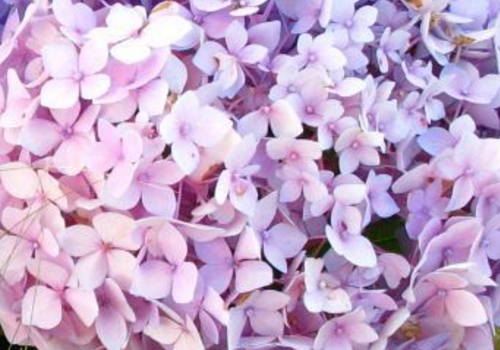
What varieties of hydrangea are there:
Flambeau: Small leaves, large magenta flowers, flower diameter 5 cm.
Snowball: Small leaves, serrated edges, normally rose-red flowers, can turn blue. Treatment with aluminum sulfate can turn them sky blue with cream-colored centers.
French Hydrangea: Flowers are magenta or rose-red, can change to blue or light purple.
Otaksa: An old variety with more than 100 years of history, a dwarf variety bred in Japan, flowers pink or blue.
Regula: Small, dense leaves, flowers pale greenish-white, a variety selected and bred in Germany.
Pink Beauty: Large inflorescence, magenta or rose-red, flower diameter 20-25 cm.
Stratford Hydrangea: Small, dark green leaves, rose-red flowers.
German Hydrangea: Pink flowers, can turn purple when treated with aluminum sulfate.
Big-leaf Hydrangea: One of the varieties of hydrangea, large leaves up to 7-4 cm, all sterile flowers, initially white, later turning light blue or pink. And so on.
Alright, that's the introduction to hydrangea varieties. Everyone understands now, right?
Why don't geraniums bloom? What factors affect geranium blooming?
Geranium, also known as zonal geranium, is native to South Africa and is a perennial herbaceous flower. The leaves are palmate with long petioles, the leaf margins are mostly serrated, and the leaf surface has fairly deep ring-shaped markings. The corolla usually has five petals, and the inflorescence is umbel-shaped, growing at the top of upright peduncles. Because the clustered flowers are as dense as a ball, it is also called "foreign hydrangea." Flower colors vary greatly among red, white, pink, and purple. The flowering period begins in early winter and lasts until early summer of the following year. Potted plants are suitable for indoor and outdoor decoration; they can also be used as spring flowerbed flowers. Previously, some flower enthusiasts reported that the geraniums they grew did not bloom. What exactly causes this?Generally speaking, the flowering period of geraniums is around April to July each year. Of course, there are differences among individual varieties and different regions, and it can also be said broadly that the flowering period of geraniums is mainly in spring, autumn, and winter in some regions.
The reasons geraniums don't bloom include insufficient light. Geraniums require plenty of sunlight. Sometimes flower buds or growth points are blocked by leaves, which can also lead to no blooming or few blooms. Next is the watering issue; irregular watering, whether too little or too much, can lead to no blooming. Then there is lack of fertilizer. Generally speaking, potted flowering plants all have fertilizer needs, and appropriate topdressing should be given. Finally, there is pruning. In autumn, the mother plant should be heavily pruned to about 10 cm tall, so that overwintering brings vigorous flowering potential for the coming year. If you want it to bloom indoors in winter, you can move the repeated pruning to spring, giving it a short rest period in spring.
The main factors affecting geranium blooming are the following:
(1) Too much watering or exposure to rain, with long-term water accumulation in the pot, causes root rot, yellow leaf edges, or leggy plant growth, all of which affect blooming.
(2) Excessive fertilization, especially excessive nitrogen fertilizer, easily causes leggy branches and leaves, no blooming or sparse blooming, and poor flower quality. However, insufficient fertilization or no fertilization will also affect the plant's normal growth and blooming. Therefore, in early spring or early autumn, appropriately more phosphorus and potassium fertilizer should be applied.
(3) Too high or too low temperature. If the indoor temperature in winter is above 20°C, combined with poor ventilation, branches and leaves easily become leggy, affecting blooming the following year. But if the overwintering temperature is below 0°C, it is prone to cold damage, and leaf edges turn yellow and soft. Geraniums are also relatively sensitive to temperature differences; if these change abruptly, it will cause flowers to drop.
(4) Too much light. In summer, direct sunlight can easily cause sunburn on leaf edges, poor growth, or dropping of flowers and leaves.
(5) Too severe pinching and pruning, with very few leaves for a long time, will also delay the growth period and result in fewer flower buds and fewer blooms. In addition, when kept indoors in winter and spring, if light is insufficient for a long time, it easily causes leggy growth without blooming, and even flower buds that have already formed will shrivel and dry up due to insufficient light. Therefore, in winter, attention should be paid to providing relatively sufficient light.
Summary: The above is an introduction to knowledge about geranium blooming. We hope it is helpful to flower enthusiasts growing geraniums.
What are the steps in the cultivation method for hydrangeas?
Hydrangea, also known as eight immortals flower and ziyang flower, is a plant in the genus Hydrangea of the family Saxifragaceae. Hydrangea flowers are pure white and full, large and beautiful, and their flower color can be red or blue, making them delightful to the eye. They are a common potted ornamental flowering shrub. Modern parks and scenic areas plant them in masses to form beautiful landscapes. Many people want to grow hydrangeas at home, so what are the cultivation methods and functions of hydrangeas? Let's take a look.
Step one of hydrangea cultivation
The first step in hydrangea cultivation is choosing the right soil. Hydrangeas prefer humus-rich, well-drained, slightly acidic soil. Because it contains organic fertilizer, it is very beneficial to hydrangea growth. Therefore, when choosing soil, it is better to choose humus-rich soil.
Step two of hydrangea cultivation
Hydrangea cultivation requires suitable temperature. So what growing temperature do hydrangeas need? Generally, the suitable growing temperature for hydrangeas is 18-28°C, and the winter temperature must not be lower than 5°C. A temperature of 20°C can promote flowering and growth. So we also need to meet its temperature requirements, which can benefit hydrangea growth.
Step three of hydrangea cultivation
The third step in hydrangea cultivation is sufficient water. Hydrangeas growing in an environment with sufficient fertilizer and water can grow faster. Although hydrangeas do relatively like sufficient moisture, care should still be taken not to overwater. In summer, when the weather is relatively hot, you can spray a little water on the leaves and the ground, which helps maintain air humidity.
Step four of hydrangea cultivation
The fourth step in hydrangea cultivation requires an appropriate amount of fertilizer. During the stage of vigorous hydrangea growth, hydrangeas need sufficient nutrients. You can apply dilute fertilizer water once every half month, which can promote hydrangea growth, make the hydrangea flowers bloom large, and benefit growth.
Step five of hydrangea cultivation
The fifth step in hydrangea cultivation requires an appropriate amount of light duration. Hydrangeas grow relatively slowly in winter, so in winter an appropriate amount of light duration is needed. It is recommended to place hydrangeas on a balcony and give them an appropriate amount of light to promote growth, but in summer, sunlight exposure becomes too strong, so they can be placed indoors for cultivation.
Conclusion:The above is the hydrangea cultivation method introduced by the editor. Friends who like hydrangeas can try growing some themselves and turn their balcony or garden into a landscape too.
More links:
|Red rose flower language|Formaldehyde-removing plants|Functions of pothos flowers|Effects and functions of Hangzhou white chrysanthemum|When does the lotus bloom|
|Effects and functions of jasmine tea|Radermachera sinica pictures|Functions of lavender|Language of daisies|Effects of Kunlun snow chrysanthemum|
|Cultivation method of Guzmania|Cultivation method of clivia|Cultivation method of ivy|Ginkgo tree planting|Orchid varieties|
|Are carnations easy to grow|Cultivation method of bougainvillea|Effects and functions of yellow chrysanthemum|Language of Gesang flowers|Is calla lily toxic|
|What plants absorb formaldehyde|Potted flower pictures|Effects of jasmine tea|Effects and functions of costus root|Hydroponic lucky bamboo|