How do you grow Madagascar periwinkle (Catharanthus roseus) so it bursts into a full pot? Solve yellowing leaves this way
Many people grow Madagascar periwinkle in their daily lives, and they run into some problems. How do you grow Madagascar periwinkle so it bursts into a full pot? What should you do about yellowing leaves?
How to grow Madagascar periwinkle so it bursts into a full pot:
1. Soil: when planting Madagascar periwinkle, you must never choose saline-alkaline soil, and the soil must have good drainage and air permeability.
2. Light: Madagascar periwinkle rather likes sunlight; keeping it in an environment with suitable, ample sunlight is very good for flowering and can also effectively prevent leggy growth.
3. Temperature: the most suitable temperature for Madagascar periwinkle growth is between 20°C and 33°C. After the temperature drops to 15°C, Madagascar periwinkle will stop growing; if the temperature is below 5°C, Madagascar periwinkle will be damaged by cold.
4. Fertilizing: if base fertilizer was not properly applied at planting time, then during the growing season apply water-soluble fertilizer once every 10 days. But in winter, reduce fertilizer application appropriately.
5. Watering: Madagascar periwinkle is very afraid of waterlogging and flooding, which will make its roots rot. So when watering, be sure to pay attention: do not water until dry, and when you water, water thoroughly.
6. Propagation: you can use propagation methods to make Madagascar periwinkle burst into a full pot; both seed propagation and cutting propagation work, but Madagascar periwinkle grown from seed propagation has more robust growth than that from cuttings.
As an ornamental flower, Madagascar periwinkle is very good; after it bursts into a full pot it is very pleasing to look at, and it can remain in its flowering period all year round. Besides its ornamental value, Madagascar periwinkle also has high medicinal effects. But a reminder to friends: when placing it indoors, be sure to keep it away from children, and it absolutely must not be eaten; after accidental ingestion it will cause adverse reactions in the body.
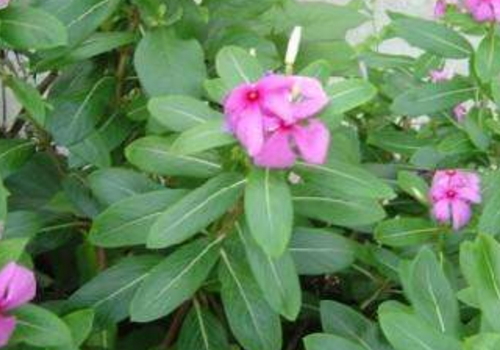
What should you do about yellowing Madagascar periwinkle leaves:
1. Soil on the alkaline side
Madagascar periwinkle does not have very high soil requirements, but it is suitable for growing in slightly acidic soil. Alkaline soil will cause poor growth of Madagascar periwinkle, causing yellowing leaves and no flowering.
Solution: test the pH of the soil being used for planting; if the soil is on the alkaline side, it must be treated.
2. Poor soil air permeability
Poor soil air permeability is also a cause of yellowing Madagascar periwinkle leaves. The soil many people use for planting flowers is fairly sticky and has poor water permeability. This kind of soil may not show any problems in the short term, but over time, soil with poor water and air permeability causes poor breathing of the lower roots of Madagascar periwinkle, leading to frequent yellow leaves and leaf drop.
Solution: choose sandy soil with good drainage for planting, and also be careful not to water too much.
3. Overwatering
Madagascar periwinkle dislikes moisture and fears waterlogging; the potting soil should not be watered too much, otherwise it will affect root breathing and cause old leaves to turn yellow and new leaves to be tender yellow.
Solution: strictly control watering, with dryness being preferable, and pay attention to drainage during the rainy season.
4. Overfertilizing
Many flower lovers worry that Madagascar periwinkle does not have enough nutrients and will not flower well, so occasionally they put a little fertilizer or something into the potting soil, hoping it will absorb more and bloom more. This approach is correct, but the mistake lies in the frequency of fertilizing. If fertilizer is applied frequently, it is very difficult for Madagascar periwinkle to absorb it completely; the fertilizer remains in the soil, always surrounding the roots, causing the whole Madagascar periwinkle plant to become listless, grow slowly, bloom less, and have smaller petals.
Solution: for Madagascar periwinkle, you can adopt a method of alternately applying a compound fertilizer and a liquid fertilizer once each, and at other times do not fertilize casually. Water the next day after fertilizing to promote nutrient absorption.
5. Too little watering
For Madagascar periwinkle, too much watering is no good, and too little is also no good. If watering is too little or the water does not penetrate thoroughly for a long time, the plant cannot absorb enough water; new leaves will wilt, while old leaves will turn yellow and fall off.
Solution: pay attention to watering; once the potting soil has dried out thoroughly, you can water, and watering should be thorough.
Alright, that is all for the introduction to the causes of yellowing Madagascar periwinkle leaves and the solutions. Friends, you all understand now, right?
What should you do about yellowing leaves on potted Madagascar periwinkle?
Madagascar periwinkle, also known by the aliases jinzhan cao, sishi chun, ri ri xin, yantou hong, and san wan hua. Taiwan, China has bred multiple cultivars, with breeding trending toward larger flowers. In terms of Chinese herbal medicine use, the whole plant can be used as medicine to relieve pain, reduce inflammation, aid sleep, promote bowel movements, and promote urination, etc. Some doctors also combine it into compound prescriptions for treating cancer, using it as one of the medicinal ingredients, possibly because of the anti-tumor components it contains. The whole plant is toxic and must be used with caution. After accidental ingestion, it can cause symptoms such as decreased white blood cells, decreased platelets, muscle weakness, and paralysis of the limbs. The alkaloids contained in its milky sap, such as vinblastine and vincristine, have been extracted for use as chemotherapy drugs for various cancers such as leukemia and Hodgkin's disease.
The main reasons yellowing leaves appear on potted Madagascar periwinkle:
① Insufficient light. Madagascar periwinkle likes a warm environment with ample sunlight. If a potted plant is placed in a shaded spot for a long time, it will develop yellow leaves due to insufficient light.
② Poor potting soil aeration. Madagascar periwinkle requires a loose substrate with relatively good aeration. If planted in sticky, slightly alkaline soil, the soil becomes compacted, causing poor root development and affecting the growth of the aboveground part, making the leaves turn yellow.
③ Lack of fertilizer and water accumulation or excessive moisture. During the growing season, if potted Madagascar periwinkle is underfertilized and overwatered, or has poor drainage, it will cause the leaf color to turn yellow. In response to the above causes, promptly strengthening care can avoid yellowing leaves.
What should you do about yellowing leaves on Madagascar periwinkle (siji mei)
Cause of yellowing Madagascar periwinkle leaves: soil on the alkaline side
Madagascar periwinkle does not have very high soil requirements, but it is suitable for growing in slightly acidic soil. Alkaline soil will cause poor growth of Madagascar periwinkle, causing yellowing leaves and no flowering.
Solution: test the pH of the soil being used for planting; if the soil is on the alkaline side, it must be treated.
Cause of yellowing Madagascar periwinkle leaves: poor soil air permeability
Poor soil air permeability is also a cause of yellowing Madagascar periwinkle leaves. The soil many people use for planting flowers is fairly sticky and has poor water permeability. This kind of soil may not show any problems in the short term, but over time, soil with poor water and air permeability causes poor breathing of the lower roots of Madagascar periwinkle, leading to frequent yellow leaves and leaf drop.
Solution: choose sandy soil with good drainage for planting, and also be careful not to water too much.
Cause of yellowing Madagascar periwinkle leaves: overwatering
Madagascar periwinkle dislikes moisture and fears waterlogging; the potting soil should not be watered too much, otherwise it will affect root breathing and cause old leaves to turn yellow and new leaves to be tender yellow.
Solution: strictly control watering, with dryness being preferable, and pay attention to drainage during the rainy season.
Cause of yellowing Madagascar periwinkle leaves: overfertilizing
Many flower lovers worry that Madagascar periwinkle does not have enough nutrients and will not flower well, so occasionally they put a little fertilizer or something into the potting soil, hoping it will absorb more and bloom more. This approach is correct, but the mistake lies in the frequency of fertilizing. If fertilizer is applied frequently, it is very difficult for Madagascar periwinkle to absorb it completely; the fertilizer remains in the soil, always surrounding the roots, causing the whole Madagascar periwinkle plant to become listless, grow slowly, bloom less, and have smaller petals.
Solution: for Madagascar periwinkle, you can adopt a method of alternately applying a compound fertilizer and a liquid fertilizer once each, and at other times do not fertilize casually. Water the next day after fertilizing to promote nutrient absorption.
Cause of yellowing Madagascar periwinkle leaves: too little watering
For Madagascar periwinkle, too much watering is no good, and too little is also no good. If watering is too little or the water does not penetrate thoroughly for a long time, the plant cannot absorb enough water; new leaves will wilt, while old leaves will turn yellow and fall off.
Solution: pay attention to watering; once the potting soil has dried out thoroughly, you can water, and watering should be thorough.