Why do loofah leaves turn yellow, and how should it be prevented and treated?
Loofah is also super delicious and tasty, really likable, very delicious, so why do loofah leaves turn yellow? What to do:
Why loofah leaves turn yellow:
1. Yellowing of new leaves caused by unreasonable fertilization. Data shows that the ratio of nitrogen, phosphorus and potassium required for loofah growth can generally be considered as 1.68:1:1.53. Due to the large-scale promotion of protected cultivation in recent years and favorable market conditions, the yield per unit area of loofah has continued to increase, and the phenomenon of excessive nitrogen fertilizer application and insufficient potassium fertilizer is also relatively common, especially after entering the flowering and fruiting stage, potassium deficiency occurs more often. The main symptoms are: the leaf tips and leaf margins turn yellow, then gradually spread to the mesophyll between the veins, and in severe cases the leaves become scorched and curled, fruit development is hindered, and deformed fruits such as big-headed, narrow-waisted and bent fruits occur from time to time.
At the same time, excessive nitrogen fertilizer, especially excessive ammonium nitrogen, can also directly affect the absorption of calcium fertilizer by loofah, causing calcium deficiency. The main manifestations are: new leaf growth is hindered, leaf margins are incomplete, leaf surfaces are wrinkled, and there are yellow or yellow-brown patches. The yellowing of new leaves reported by netizens should be related to some of these causes.
2. Small yellow spots on old leaves caused by brown spot disease. Loofah brown spot disease mainly damages leaves. The lesions are round, elongated or irregular, brown to grayish brown, 0.5 to 13 mm in diameter. The lesion edges are obvious or not obvious, and show chlorotic to yellow halos, with mold layers rarely seen. The pathogen is called Cercospora citrullina, a fungus of the Deuteromycotina. The pathogen overwinters as mycelium or conidial clusters on diseased residues in the soil. In the following spring, conidia carry out primary infection and reinfection, and spread by airflow. Warm and humid conditions, excessive nitrogen fertilizer, and continuous cropping all easily lead to more severe occurrence of the disease.
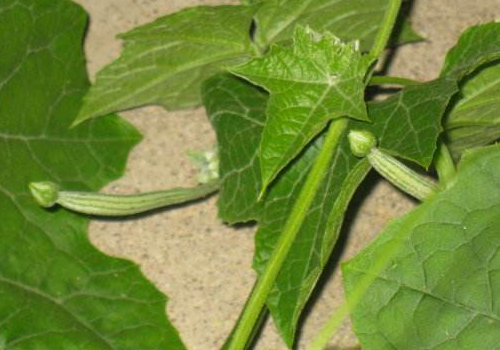
What to do when loofah leaves turn yellow:
1. Practice crop rotation with non-cucurbit vegetables for more than 2 to 3 years, apply fully fermented and decomposed organic fertilizer, formulate fertilization according to the ratio of nitrogen, phosphorus and potassium required for loofah growth, and appropriately increase the application of calcium nitrate and borax by 1 to 2 kg per mu to enhance the disease resistance of the plants.
2. Chemical spray control:
(1) 80% zoxamide · kasugamycin wettable powder 750 times liquid + 60% Caluli calcium 750 times liquid + 21% Caluli boron 750 times liquid.
(2) 41.4% benzi · trifloxystrobin 1+1 combination (25 ml aqueous solution + 10 g powder) 428 times liquid + 10% high-boron active potassium calcium aqueous solution 300 times liquid.
(3) 25% azoxystrobin suspension concentrate 1500 times liquid + 60% pyraclostrobin · metiram water-dispersible granules 750 times liquid + 10% special zinc calcium boron powder 300 times liquid.
The causes and treatment methods of loofah leaves turning yellow are introduced here. Now you have gained some knowledge!
Why do loofah leaves turn yellow? What to do when loofah leaves turn yellow?
Loofah is a common fruit vegetable, delicious in taste and rich in nutrients, and is therefore loved by people. However, during the growth of loofah, there is an inconspicuous phenomenon, and that is loofah leaves turning yellow. Why do loofah leaves turn yellow? How should it be prevented and treated?
What causes loofah leaves to turn yellow
1. Yellowing of new leaves caused by unreasonable fertilization. Data shows that the ratio of nitrogen, phosphorus and potassium required for loofah growth can generally be considered as 1.68:1:1.53. Due to the large-scale promotion of protected cultivation in recent years and favorable market conditions, the yield per unit area of loofah has continued to increase, and the phenomenon of excessive nitrogen fertilizer application and insufficient potassium fertilizer is also relatively common, especially after entering the flowering and fruiting stage, potassium deficiency occurs more often. The main symptoms are: the leaf tips and leaf margins turn yellow, then gradually spread to the mesophyll between the veins, and in severe cases the leaves become scorched and curled, fruit development is hindered, and deformed fruits such as big-headed, narrow-waisted and bent fruits occur from time to time.
At the same time, excessive nitrogen fertilizer, especially excessive ammonium nitrogen, can also directly affect the absorption of calcium fertilizer by loofah, causing calcium deficiency. The main manifestations are: new leaf growth is hindered, leaf margins are incomplete, leaf surfaces are wrinkled, and there are yellow or yellow-brown patches. The yellowing of new leaves reported by netizens should be related to some of these causes.
2. Small yellow spots on old leaves caused by brown spot disease. Loofah brown spot disease mainly damages leaves. The lesions are round, elongated or irregular, brown to grayish brown, 0.5-13 mm in diameter. The lesion edges are obvious or not obvious, and show chlorotic to yellow halos, with mold layers rarely seen. The pathogen is called Cercospora citrullina, a fungus of the Deuteromycotina. The pathogen overwinters as mycelium or conidial clusters on diseased residues in the soil. In the following spring, conidia carry out primary infection and reinfection, and spread by airflow. Warm and humid conditions, excessive nitrogen fertilizer, and continuous cropping all easily lead to more severe occurrence of the disease.
What to do when loofah leaves turn yellow
1. Practice crop rotation with non-cucurbit vegetables for more than 2-3 years, apply fully fermented and decomposed organic fertilizer, formulate fertilization according to the ratio of nitrogen, phosphorus and potassium required for loofah growth, and appropriately increase the application of calcium nitrate and borax by 1-2 kg per mu to enhance the disease resistance of the plants.
2. Chemical spray control:
(1) 80% zoxamide · kasugamycin wettable powder 750 times liquid + 60% Caluli calcium 750 times liquid + 21% Caluli boron 750 times liquid.
(2) 41.4% benzi · trifloxystrobin 1+1 combination (25 ml aqueous solution + 10 g powder) 428 times liquid + 10% high-boron active potassium calcium aqueous solution 300 times liquid.
(3) 25% azoxystrobin suspension concentrate 1500 times liquid + 60% pyraclostrobin · metiram water-dispersible granules 750 times liquid + 10% special zinc calcium boron powder 300 times liquid.
What to do when Daphne odora gets insects, pest and disease control of Daphne odora / 4 insects and 2 diseases treated by spraying
Daphne odora, a beautiful ornamental flower, is not only good-looking but also relatively disease-resistant. It is very suitable for growing indoors and is deeply loved by flower lovers. However, during cultivation, for certain reasons, Daphne odora can still get insects and diseases, affecting plant growth. So what to do when Daphne odora gets insects? Below is the pest and disease control of Daphne odora. Let's take a look!
I. What to do when Daphne odora gets insects, spray with chemicals
Although Daphne odora is highly disease-resistant, under poor growing conditions and improper care, it can also suffer from insect pests and occasionally diseases. The main insect pests include: aphids, red spider mites, scale insects, earthworms, etc.; diseases include: mosaic disease, root rot, etc. So what to do when Daphne odora gets insects? It is very simple. You only need to identify the pest and then spray accordingly to solve it.
II. Pest and disease control of Daphne odora
1. Aphids
Although Daphne odora is not prone to insects, in hot summer weather, if the environment is not ventilated, it is also susceptible to aphid damage. These insects generally parasitize leaves and suck sap. Symptoms of damage: Daphne odora leaves turn yellow and dry up, and in severe cases the flowers lose their color and wither quickly.
Control method: After discovering aphids, if there are very few, manual control can be adopted by brushing off the aphids with a writing brush or brush and burying them in the potting soil; when there are many aphids, 40% Kuailing wettable powder 2000-3000 times liquid can be sprayed, with particularly good results.
2. Red spider mites
When it comes to Daphne odora getting insects, red spider mites are also something everyone needs to pay attention to. They pierce their mouthparts into Daphne odora leaves to suck sap, damaging the plant's chlorophyll, causing the leaves to show grayish-yellow spots or patches, and the leaves become withered and yellow, or even fall off.
Control method: Usually pay attention to observing the flowers, and when the above symptoms are found, promptly check the underside of the leaves. When individual leaves are damaged, the infested leaves can be removed; when more leaves are damaged, early spraying with propargite, dicofol, dimethoate, Huachongjing, fenvalerate and other chemicals should be carried out for control.
3. Scale insects
Scale insects are one of the insects that all flowers hate. When Daphne odora gets insects, it may also be them. These insects often gather on branches, leaves and fruits. The mouthparts of adults and nymphs are inserted into the leaf and branch tissues of the peace lily to suck sap, causing the leaves to wilt and inducing sooty mold, causing great harm.
Control method: When there are few scale insects, gently brush them off with a soft brush or wipe them clean with a cotton ball or loofah stem; when there are many scale insects, 40% omethoate, 50% malathion, 80% dichlorvos emulsifiable concentrate 800-1000 times liquid can be selected, spraying once every 7-10 days for 2-3 consecutive times, which can effectively prevent scale insect damage.
4. Earthworms
Because the root system of Daphne odora has a sweet taste, it is relatively easy to attract earthworms. These insects will coil around Daphne odora roots, thereby affecting the normal absorption of water and nutrients by the root system and causing various poor growth conditions in the plant.
Control method: Repot frequently, and when earthworms hidden in the potting soil are found, remove them; during daily care, place flower pots less often on bare soil to avoid earthworms entering from the bottom of the pot.
5. Mosaic disease
In addition to insects, Daphne odora also occasionally has diseases, one of which is mosaic disease, the most common disease of flowers. Symptoms: the affected leaves of Daphne odora show colored spots and become deformed, leading to poor flowering and causing plant growth to stagnate.
Control method: When diseased plants are found, they should be removed promptly to reduce the source of disease. In severe cases, 50% thiophanate-methyl 1200 times liquid can be sprayed on the leaves for disinfection to prevent spread.
6. Root rot
In winter, if watering is excessive or the potting soil drains poorly, causing the potting soil to be too wet, or when undecomposed organic fertilizer is applied, Daphne odora is often prone to root rot. Symptoms: the roots and stems of Daphne odora turn black and rot.
Control method: After discovering the above symptoms, cut off the rotten parts of Daphne odora, apply sulfur powder, then replace with fresh culture soil and replant. After that, move the potted plant to a ventilated and sunny place, and before long, Daphne odora will recover its health.