Grafting Methods for Amygdalus triloba and How to Distinguish It from Ornamental Peach
Amygdalus triloba is very beautiful, and many people mistake it for ornamental peach. How do you graft Amygdalus triloba? What is the difference from ornamental peach?
How to graft Amygdalus triloba:
1. Methods and timing for grafting Amygdalus triloba
There are two grafting methods for Amygdalus triloba: bud grafting and scion grafting, and bud grafting is generally chosen more often.
Bud grafting is best carried out in mid-to-late August, while scion grafting should be carried out in spring from February to March.
2. Selection of materials for bud grafting Amygdalus triloba
The rootstock for bud grafting can be one-year-old Amygdalus triloba seedlings, or seedlings of wild rose species, hairy peach, or mountain peach.
For the bud, you can select and cut plump leaf buds from one-year-old branches of an Amygdalus triloba plant with excellent variety, robust growth, and no pests or diseases, and keep them ready for use.
3. Selection of materials for scion grafting Amygdalus triloba
The scion for scion grafting should be cut before the plant buds, and the scion can also be cut in winter, stored in sandy soil, and kept for use in spring.
4. Precautions for grafting Amygdalus triloba
If you want to graft and train it into a small tree form, you can perform high grafting on the main trunk of rootstocks such as mountain apricot, so as to raise the position of the crown.
After bud grafting in August in autumn, do not let it sprout that same year; the following spring, cut off the rootstock 2-3 cm or more above the upper end of the grafted bud, so that the grafted bud sprouts into a branch.
Scion grafting generally uses cut grafting or cleft grafting, carried out in early spring in mid-to-late March when the winter buds begin to swell. After grafting, mound soil or cover the scion together with the graft union with a plastic bag, and it can survive in about 20 days.
After survival, promptly remove the tiller buds on the rootstock, and later as the temperature rises, gradually remove the plastic bag or open up the mounded soil.
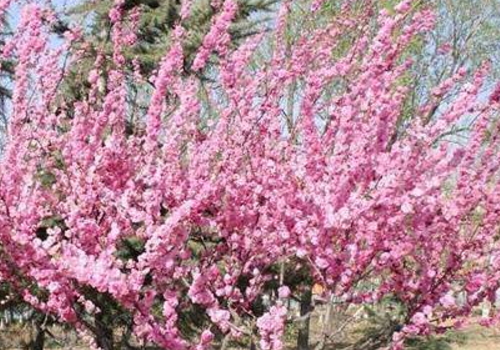
Differences between Amygdalus triloba and ornamental peach:
1. Different family and genus
Amygdalus triloba is a plant of the genus Prunus in the rose family, while ornamental peach is a plant of the genus Prunus in the rose family.
Amygdalus triloba has a cultivation history of several hundred years in China, and it is planted in most parks across the country. This species flowers early and is mainly for ornamental use. A common cultivated type is the double-flowered Amygdalus triloba, also called small peach red, named because its leaves resemble elm leaves and its flowers closely resemble plum blossoms.
Ornamental peach, also known as thousand-petal peach blossom, is a variety of peach tree, belonging to the semi-double and double-flowered cultivars of ornamental peach blossoms, collectively called ornamental peach. Common cultivars include red-flower green-leaf ornamental peach, red-flower red-leaf ornamental peach, white-and-red bicolor sprinkled-gold ornamental peach, and many other varieties. Ornamental peach has high ornamental value and is a beautiful plant seen everywhere in residential communities, parks, and streets.
2. Different branches
The branches of Amygdalus triloba are brown and rather rough, while the small branches of ornamental peach are red-brown and hairless. The posture of the branches and trunk of ornamental peach is more vigorous and forceful compared with Amygdalus triloba.
3. Different leaves
The leaves of Amygdalus triloba are broadly elliptical to obovate, with a pointed tip or 3-lobed shape, a broadly wedge-shaped base, and uneven coarse double serrations along the margin.
The leaves of ornamental peach are elliptical-lanceolate, 7—15 cm long, with an acuminate tip.
4. Different flowers
The flowers of Amygdalus triloba are only pink, with no white, while the flowers of ornamental peach are richer in color, including red, pink, purple, and white, etc.
The flowering period of Amygdalus triloba is slightly earlier than that of ornamental peach.
5. Different growth habits
Amygdalus triloba is a temperate tree species, cold-resistant and drought-resistant, fond of sunlight, and not strict about soil requirements, but Amygdalus triloba is not tolerant of waterlogging and prefers neutral to slightly alkaline soil.
Ornamental peach also likes sunlight and is drought-resistant, but its cold resistance is not as good as that of Amygdalus triloba. The soil for growth should be fertile, loose, and well-drained.
Well, that is all for the introduction to the differences between Amygdalus triloba and ornamental peach. I hope it is helpful to everyone.
Amygdalus triloba - Cultivation methods of Amygdalus triloba | Amygdalus triloba pictures | How to grow Amygdalus triloba
Amygdalus triloba
Amygdalus triloba (Latin scientific name: Amygdalus triloba), also known as elm plum, small peach red, and elm-leaf luan branch. Because its leaves resemble elm and its flowers resemble plum, it is named "Amygdalus triloba." Also, because its variety has short branches and dense flowers, with flowers covering the whole branch, it is also called "luan branch." Amygdalus triloba has dense branches and leaves and abundant, brilliantly colored flowers, and is an important ornamental flowering shrub in northern Chinese spring gardens. It has strong saline-alkali resistance, and is most suitable for extensive use in Beijing gardens, to reflect the bright spring scene and the flourishing sight of clustered flowers.Cultivation methods of Amygdalus triloba
1. Soil: It is not strict about soil requirements, but it is not tolerant of waterlogging and prefers neutral to slightly alkaline, fertile, loose sandy loam.
2. Watering: It dislikes waterlogging. When planted in spring, if the weather is dry, water 2-3 times; at ordinary times no watering is needed, and at the same time pay attention to drainage during the rainy season.
3. Sunlight: In autumn, winter, and spring, sufficient sunlight can be given. When maintaining it indoors, place it in a place with bright light as much as possible, such as a well-lit living room, bedroom, study, and similar places.
Propagation methods of Amygdalus triloba
1. Grafting propagation of Amygdalus triloba
There are two grafting methods: bud grafting and scion grafting, and bud grafting is generally used more. Bud grafting is best carried out in mid-to-late August. The rootstock can be one-year-old Amygdalus triloba seedlings, or seedlings of wild rose species, hairy peach, or mountain peach. For bud grafting, you can select and cut plump leaf buds from one-year-old branches of an Amygdalus triloba plant of an excellent variety and keep them ready for use. Scion grafting should be carried out in spring from February to March. The scion should be cut before the plant buds. The scion can also be cut in winter, stored in sandy soil, and kept for use in spring.
When does Amygdalus triloba bloom
Amygdalus triloba is named because its leaves resemble elm leaves, and it is an early-spring flowering tree species commonly cultivated in northern China. Deciduous shrub, 3-5 m tall, with slender branchlets, hairless or slightly pubescent when young. Leaves elliptical to obovate. The plant, in a hemispherical shape, is entirely covered with brightly colored flowers, very beautiful and spectacular. Amygdalus triloba has extremely rich varieties. According to surveys, Beijing has more than 40 varieties, and some have more than 100 petals, as well as long-stalked types. Flowering period April; fruit ripening period August.
Flower language of Amygdalus triloba
Flower language of Amygdalus triloba: bright spring scene, clustered flowers, and flourishing prosperity, and also the meeting of hearts.
Price of Amygdalus triloba
Amygdalus triloba is cheap, has good greening effects, and has the advantages of a high transplant survival rate, easy sourcing, simple planting, and low maintenance cost. At present, the market price for Amygdalus triloba with a height of 180 cm is 35-90 yuan per plant.
Grafting of Amygdalus triloba
1. Cleft grafting method: Cut the trunk at 5 cm above the ground, cut off the small side branches and useless branches around the roots, and make the cut and saw cuts smooth. Then use a grafting knife to cut vertically into 1/3 of the rootstock cross-section, with a depth slightly less than the large cut surface of the scion. Cut the scion into a scion with 3-5 plump buds, cut the lower end into a large cut surface 3 cm long, and the cut surface must be flat. Quickly place the scion with the large slant facing inward, align the cambium of the rootstock and the scion, then wrap tightly with film, and keep the topmost bud outside the film to improve the survival rate.
Differences between Amygdalus triloba and ornamental peach
Ornamental peach: Deciduous small tree, up to 8 m tall, generally controlled at 3-4 m after shaping, with red-brown branchlets, hairless; leaves elliptical-lanceolate, 7-15 cm long, with an acuminate tip. Flowers solitary or two born in leaf axils, double, pink. Other varieties include white, deep red, sprinkled gold (variegated), etc.
Amygdalus triloba: Deciduous shrub or small tree. Branches brown, rough. Leaves broadly elliptical to obovate, with a pointed tip or 3-lobed shape, a broadly wedge-shaped base, and uneven coarse double serrations along the margin. Flowers pink, usually 1-2 born in leaf axils. Flowering period April. Drupe red, nearly spherical, hairy.
In fact, a conclusion can be drawn based on leaf shape: the one that is elliptical-lanceolate is ornamental peach; the one that is broadly elliptical to obovate, with serrated leaf margins (very much like elm leaves), is Amygdalus triloba.
Related encyclopedia
Pocket scale non-woven bag rush pith bamboo shoot crab leg redmi note3 ykk zipper ybs zipper large mountain cherry wall-climbing plum wild senna winter plum green pine wristwatch Omega Longines famous watch children's building blocks flint dendrobium orchid curling iron soursop
The key to survival in grafting propagation
Grafting is the method of artificially grafting the branch or bud of the ornamental plant to be grown onto the stem or root of another ornamental plant. The grafted part is called the scion, and the ornamental plant being grafted onto is called the rootstock. Grafting is divided into two major categories: scion grafting and bud grafting. This method can both maintain the characteristics of the original variety, overcome the difficulty of being hard to propagate by other methods, and improve resistance to adverse environmental conditions, promote or inhibit the growth and development of the ornamental plant, and enable earlier flowering and fruiting. This method is mostly used for woody ornamental plants, and a few herbaceous ornamental plants can also use grafting.
(1) Compatibility: The key to survival in grafting propagation depends on the compatibility between the scion and the rootstock. That is, the ability of the scion and rootstock to heal after grafting. It depends on the kinship relationship between the two. Those with high compatibility are generally those in which the differences between the rootstock and scion in physiology, morphology, structure, heredity, and other aspects are relatively small. Therefore, when grafting, ornamental plants of the same family and same genus, or the same family and closely related genera with the same species but different varieties, are generally selected, and they heal easily after grafting. Conversely, it is difficult to survive after grafting. For example, when rose is grafted onto rose, because both belong to the genus Rosa in the rose family, the survival rate after grafting is relatively high. When osmanthus is grafted onto privet, they both belong to the olive family; privet is of the genus Ligustrum, and osmanthus is of the genus Osmanthus. They are ornamental plants of the same family but different genera. Although there are certain differences between them, they have a certain compatibility, and they can survive after grafting. Another example is using mountain peach and apricot of the rose family as rootstocks to graft plum blossom, ornamental peach, and Amygdalus triloba; sowing crabapple seedlings to graft Xifu crabapple, weeping crabapple, etc., all are feasible. But if rose is grafted onto willow, it will not survive, because the two have not the slightest kinship relationship, no compatibility, and cannot produce healing tissue.
(2) Grafting time: Besides considering whether the rootstock and scion have compatibility, the grafting time and method are also crucial. The closer the sap flow period and germination period of the scion and rootstock are, the higher the survival rate after grafting. If the scion has already begun to sprout while the rootstock is still in a dormant state, the scion cannot obtain water and nutrient supply on the rootstock, and the scion will soon die. In northern China, grafting is generally carried out in spring from March to April. Bud grafting is carried out in summer from June to August. Buds for bud grafting are collected from fully mature buds on new shoots of the current year. If collected too early, the buds are small and not mature enough, or if collected too late, the bark will not slip, both of which will affect the grafting survival rate.