Can Zephyranthes carinata be kept indoors? A guide to growing methods
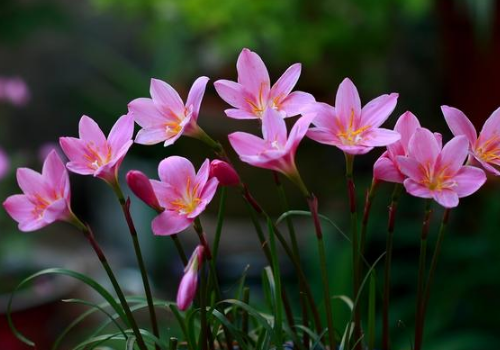
Zephyranthes carinata has emerald green leaves, and when it blooms, the flowers are pink; the color combination is very eye-catching and dazzling, beautiful and distinctive, keeping you in a good mood every day. How do you grow Zephyranthes carinata? Can it be placed indoors?
How to grow Zephyranthes carinata:
1. Key points for soil culture: the growing medium is best a fertile sandy loam. For border planting in flower beds, plant 3-5 bulbs per hole, with a hole spacing of about 15 cm; for pot planting, plant 5-7 bulbs per 17 cm pot, and after planting be sure to water to maintain moisture. The growing site must have ample sunlight; in shady spots it is not easy for offset bulbs to form, nor is it easy for it to bloom. When the plants grow in clumps and appear crowded, they must be forcibly divided. It is robust by nature, tolerant of drought and high temperatures, and easy to grow.
2. Propagation methods: division or bulb planting can be used, and it can be done all year round, but spring is best. Simply dig up the bulbs, plant 3-5 bulbs at each spot, and water to maintain appropriate moisture; they will readily take root. When digging up the bulbs, be careful not to damage them. If there are too many leaves and flower stems, cut off the upper parts and plant while keeping the intact bulbs and 6-8 cm of leaves. If the bulbs have already sprouted flower buds, water thoroughly after dividing and they can still bloom.
3. Key points for fertilizing: organic fertilizers such as oil cake, compost, or nitrogen, phosphorus, and potassium fertilizers can be used, applied once every 2-3 months; increasing phosphorus and potassium fertilizers proportionally can promote bulb enlargement and good blooming.
4. Key points for watering: potted Zephyranthes carinata needs ample sunlight, fertilizer, and water. After one batch of flowers fades, watering should be withheld for 50-60 days, then normal watering resumed. This alternating dry and wet cycle can promote multiple bloomings, and it can bloom 2-3 times a year.
Can Zephyranthes carinata be placed indoors:
Actually, Zephyranthes carinata is not toxic, so growing it indoors is also fine, and it will not cause any major harm.
However, when growing Zephyranthes carinata indoors, you need to pay attention: Zephyranthes carinata itself prefers a growing environment with ample light, and can tolerate partial shade. Indoor light is sometimes not sufficient, and if the light is insufficient, it may grow poorly.
Therefore, when Zephyranthes carinata is grown indoors, attention must be paid to good care and management.
Now you know how to grow Zephyranthes carinata.
Is Zephyranthes carinata toxic, and can it be placed in the bedroom? Non-toxic, with many benefits to growing it indoors
Gardeners should be familiar with Zephyranthes carinata; its leaves are emerald green, its flower form is elegant, and its flower colors are vivid. It is an ornamental flower of extremely high value. In daily life, many people want to grow Zephyranthes carinata, but when growing it indoors, there are a few issues everyone needs to pay attention to: first, is Zephyranthes carinata toxic? Second, can Zephyranthes carinata be placed in the bedroom? For everyone's health, today the editor will answer these questions for you.
1. Is Zephyranthes carinata toxic? Non-toxic
The beauty of Zephyranthes carinata makes people's hearts flutter at a glance; those emerald green leaves and pink flowers are loved by all. However, because the flowers of Zephyranthes carinata are too gorgeous, many gardeners worry that it is toxic. So is Zephyranthes carinata toxic? On this point, the editor can clearly tell everyone that Zephyranthes carinata is not only non-toxic, but also has certain medicinal value; it can be used as medicine and has a detoxifying effect.
Note: Although Zephyranthes carinata is non-toxic and can be used medicinally, it is not suitable for everyone to use in excess, because excessive Zephyranthes carinata can cause relatively serious negative effects on the human body. Therefore, friends who want to take Zephyranthes carinata should best use it under the guidance of a professional doctor, which is safe and reliable.
2. Can Zephyranthes carinata be placed in the bedroom? Not recommended
Zephyranthes carinata is not toxic, so can it be placed in the bedroom? For this question, everyone should consider the size and ventilation of the bedroom, because the bedroom is where people sleep, and generally plants cannot be placed there casually. If the bedroom is large enough, or relatively well ventilated, growing a pot of Zephyranthes carinata is obviously very good; smelling its faint floral fragrance, a person will sleep very well.
However, ordinary household bedrooms are generally not ventilated and are relatively narrow. At night, Zephyranthes carinata performs respiration, absorbing oxygen and releasing carbon dioxide, which creates a situation of competing for oxygen with people, thereby affecting sleep. So can Zephyranthes carinata be placed in the bedroom? This depends on the condition of the bedroom.
3. Can Zephyranthes carinata be grown indoors? Yes, with many benefits
Although Zephyranthes carinata is not very suitable for growing in the bedroom, in a spacious, ventilated indoor space, growing a pot of Zephyranthes carinata is definitely a good choice. Not only that, Zephyranthes carinata tolerates partial shade, so it is very suitable for growing indoors, and it also has many benefits for people, such as:
1. Highly ornamental
When it comes to the benefits of growing Zephyranthes carinata indoors, the first is naturally its ornamental value. As shown in the picture, set off by clumps of green leaves, the pink flowers of Zephyranthes carinata rise above the leaf tips and look exceptionally beautiful. Getting up in the morning and looking at the beautiful scene of Zephyranthes carinata, a person's mood will be very happy all day.
2. Purifies the air
As a beautiful potted plant, Zephyranthes carinata has the common nature of plants: during photosynthesis, it can absorb carbon dioxide and release fresh oxygen. Not only that, Zephyranthes carinata can also absorb harmful gases such as carbon monoxide and formaldehyde. Although the effect is not as strong as that of pothos, aloe, and Cuban oregano, its air-purifying effect is still very obvious.
3. Beautifies the home
Growing a pot of Zephyranthes carinata at home, besides being ornamental, its beauty can also match indoor home decor, creating for us an indoor environment full of greenery and vitality. At the moment of opening the door, looking at several pots of blooming Zephyranthes carinata, it feels as if you have entered a beautiful garden. Living in such an environment, a person will be very relaxed, and sleep will be much better.
4. Increases vitality
The benefits of growing Zephyranthes carinata indoors, besides purifying the air and beautifying the home, also include cultivating our character and improving our temperament. Not only that, growing Zephyranthes carinata for a long time can also regulate mood, relieve stress, and increase vitality. It can be said that by growing Zephyranthes carinata, you can avoid an environment that is too dull, which will help prolong the life of the grower.
Summary: If the bedroom is large or ventilated, growing a pot of Zephyranthes carinata is very good, but if the bedroom is not large, the editor suggests everyone not grow it. As for whether Zephyranthes carinata is toxic, the editor has introduced that here. Friends who are tempted might as well try growing a pot; those who do not know how to grow it can also look at the growing methods for Zephyranthes carinata, and I hope it can help everyone.
Is Zephyranthes carinata toxic? How to grow Zephyranthes carinata
Is Zephyranthes carinata toxic?
Zephyranthes carinata is also called rain lily; its leaves somewhat resemble chives, and its flowers are rather beautiful. So, is Zephyranthes carinata toxic? Can it be grown indoors? Can Zephyranthes carinata be eaten?
Is Zephyranthes carinata toxic?
Is Zephyranthes carinata toxic? The answer is no. Zephyranthes carinata itself is not toxic and also has certain medicinal value; it can be used as medicine and has a detoxifying effect.
Can Zephyranthes carinata be grown indoors?
Actually, Zephyranthes carinata is not toxic, so growing it indoors is also fine, and it will not cause any major harm.
However, when growing Zephyranthes carinata indoors, you need to pay attention: Zephyranthes carinata itself prefers a growing environment with ample light, and can tolerate partial shade. Indoor light is sometimes not sufficient, and if the light is insufficient, it may grow poorly.
Therefore, when Zephyranthes carinata is grown indoors, attention must be paid to good care and management.
Can Zephyranthes carinata be eaten?
Zephyranthes carinata is not toxic, so some people will want to know whether this Zephyranthes carinata can be eaten. So, can Zephyranthes carinata be eaten?
On this point, there is actually no relatively clear answer; most people lean toward the idea that Zephyranthes carinata can be eaten, but believe that its taste is actually not very good, unlike chives, and suggest not eating much of it.
Everyone who wants to try Zephyranthes carinata should best ask a doctor or experienced people first, to avoid causing adverse reactions.
What to do if Zephyranthes carinata leaves turn yellow and withered
"Editor, editor, what should we do if our Zephyranthes carinata leaves have turned yellow and withered?" Facing such an urgent question, the editor also quickly typed up this short article. Without further ado, let's take a look together.
Reasons for yellowing leaves of Zephyranthes carinata
Too much water
Zephyranthes carinata tolerates dryness but fears waterlogging and prohibits standing water. If watered too much, it will damage the root system of Zephyranthes carinata through waterlogging, causing the leaves to turn yellow and withered.
Poor ventilation
Zephyranthes carinata likes a relatively cool environment and needs a certain level of humidity.
If the weather is stuffy and hot, the indoor air is too dry, and ventilation conditions are poor, it may very likely affect its normal healthy development.
Too much or too little fertilizer
Although Zephyranthes carinata is "tough-skinned and thick-fleshed," as a plant its healthy growth still requires a certain amount of fertilizer nutrients. If there is too little or too much fertilizer, it may lead to the appearance of yellow leaves.
Solutions for yellowing and withered leaves of Zephyranthes carinata
Ensure a certain amount of water
Newly transplanted Zephyranthes carinata needs to be watered thoroughly once, while normally growing Zephyranthes carinata should be watered by the principle of dry-wet alternation; do not water too much.
Fertilize moderately
Just like human growth and development, too much or too little nutrient intake will affect growth.
More natural humus should be added to the soil, rather than chemical fertilizers.
Now everyone should generally know why their own Zephyranthes carinata has yellowing leaves. Then hurry up and "rescue" this beautiful little plant!
Home growing methods for Zephyranthes carinata
Zephyranthes carinata is a plant with many uses and a tough character. So here is the question: how should this "easygoing" Zephyranthes carinata be grown at home? Let's take a look together!
The growing habits of Zephyranthes carinata generally show a preference for warm, humid environments with abundant sunlight. It is not afraid of severe heat and has strong cold tolerance. It is very convenient for home cultivation.
Temperature requirements for growing Zephyranthes carinata
Zephyranthes carinata likes a warm environment. Generally, June to September each year is its flowering period.
The most suitable temperature for the growth of Zephyranthes carinata is 16-28°C; it is not cold-tolerant, and the wintering temperature should not be lower than 5°C.
If the indoor temperature can be kept above 15°C in winter, Zephyranthes carinata can also continue to grow healthily. It may even bloom.
Light requirements for growing Zephyranthes carinata
Zephyranthes carinata likes an environment with ample sunlight; if the growing environment is shaded, the quality of the bulbs obtained will be relatively poor.
In partial shade it can still bloom, but the amount of flowers is small and the flowering period is short.
In excessively dark places, it may result in no blooming.
Water requirements for growing Zephyranthes carinata
Zephyranthes carinata likes a slightly moist but somewhat dry soil environment, and tolerates drought but fears waterlogging.
During the growing period, the soil should be kept alternately dry and wet, and there must be no standing water. After September, reduce the amount of watering; from November to the following spring in February, keeping it slightly dry and slightly moist is enough.
Soil requirements for growing Zephyranthes carinata
The most suitable soil for Zephyranthes carinata should be a well-drained sandy soil rich in humus.
However, Zephyranthes carinata has a tenacious nature, and in home cultivation it does not have high requirements for soil. From slightly acidic to weakly alkaline soil, from sandy soil to light clay, it can adapt.
You can place a layer of crushed hard plastic foam blocks or broken bricks and tiles at the bottom of the pot to allow air and water drainage.
Hydroponic method for Zephyranthes carinata
As a typical bulb plant, Zephyranthes carinata can grow as long as its roots have sufficient water. Although it fears waterlogging, hydroponics is a completely different planting method, so as long as you pay more attention, Zephyranthes carinata can also be grown hydroponically. Below is an explanation of the hydroponic method for Zephyranthes carinata!
Zephyranthes carinata itself has small pink or pure white flowers interspersed among emerald green leaves, giving an overall fresh and elegantly simple feeling. If grown hydroponically, the spherical roots of Zephyranthes carinata can be seen through a transparent container, and the leaves will also be even clearer and brighter.
One hydroponic method for Zephyranthes carinata
Prepare a relatively elongated transparent container, preferably with a somewhat beautiful appearance. A layer of colored stones or pebbles can be spread at the bottom of the container to increase the sense of beauty.
In spring, first plant the prepared Zephyranthes carinata bulbs in a pot. Ensure that the root system of Zephyranthes carinata can spread out completely. Then press the soil firmly around the roots to ensure the surface is level.
After that, sink the pot into a water basin, shake it gently, rinse off the surface soil, and then place it into the previously selected container.
Do not put too much water in the container; three-quarters is enough.
Another hydroponic method for Zephyranthes carinata
In order to achieve a better ornamental effect, it is best to choose suitable utensils according to the plant's variety, form, and so on. For Zephyranthes carinata, a transparent glass container is a good choice.
First do the work of removing soil and washing the roots of Zephyranthes carinata; gently shake the dug-out plant with your hands, shake off the soil around the roots, and expose all the roots. Then wash them clean with clear water. You must make sure not a bit of soil remains.
After pruning the roots, stems, and leaves, soak them in a 0.1% potassium permanganate solution for 10-15 minutes, then rinse with clear water, and they can be planted in the bottle.
This hydroponic method requires the use of a special nutrient solution.