Is the Calliandra haematocephala poisonous? Detailed explanation of propagation methods
Calliandra haematocephala is not suitable for indoor placement; it grows best and has the highest ornamental value in a place with sufficient light. Is Calliandra haematocephala poisonous? What are the propagation methods:
Is Calliandra haematocephala poisonous:
Calliandra haematocephala is non-toxic, so everyone need not worry too much.
It is a deciduous shrub or small tree of the genus Calliandra in the Fabaceae family, fond of growing in warm and humid tropical climates, and is often cultivated as an ornamental flower with very high ornamental value.
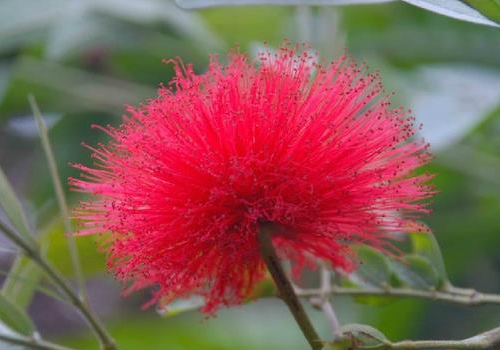
What are the propagation methods of Calliandra haematocephala:
1. Seed propagation
The flowering period of Calliandra haematocephala is in August and September each summer, and the best seed collection period is in October. Select plump, intact, healthy seeds and store them in a dry, ventilated environment. Wait until the following spring to sow.
Before sowing, the seeds need to be soaked in clean water at a temperature of 60 degrees, changing the water once a day for three consecutive days, then removed. Keep them moist for germination. Sow the seeds in moist soil, and they will sprout in about one week.
2. Cutting propagation
In the cultivation of Calliandra haematocephala, cutting propagation is generally chosen; in spring, cut healthy branches about 20 cm long, remove dead leaves, and insert them into a moist sandy soil substrate. It is best to keep the temperature between 15——30°, and simply pay attention to shading and moisture retention.
Calliandra haematocephala must also be protected from pest troubles.
Cultivation methods and precautions for Syneilesis aconitifolia
Chinese scientific name: Syneilesis aconitifoliaBinomial name: Syneilesis aconitifoliaKingdom: PlantaePhylum: MagnoliophytaClass: MagnoliopsidaOrder: AsteralesFamily: AsteraceaeGenus: SyneilesisSpecies: Syneilesis aconitifoliaDistribution area: Northeast China, North China, East China and other placesOther names of Syneilesis aconitifolia: Qilima (Nanjing Folk Herbal Medicine), Yibasan (Guizhou Folk Medicine), Nantianshan, Sanbacao (Hunan Medicinal Records), Tiegusan (Shaanxi Chinese Herbal Medicine), Poyangsan, Tieliangsan, Yusanacao (Zhejiang Folk Commonly Used Herbal Medicine), Yusancai, Maotoucai (Northern Commonly Used Chinese Herbal Medicine Manual), Longtouqi (Shaanxi Herbal Medicine). It is the root or whole plant of Syneilesis aconitifolia, a plant of the Asteraceae family. Collected in autumn, cleaned of soil, and dried in the sun. Indications: dispel wind and remove dampness; detoxify and invigorate blood; reduce swelling and relieve pain. Mainly for rheumatic numbness; limb pain; traumatic injuries; irregular menstruation; dysmenorrhea; carbuncles, abscesses and swellings; scrofula; hemorrhoids.1. Original plant morphology
Syneilesis aconitifolia is a perennial herb, 70-120 cm tall. Rhizome creeping. Stem erect, single, hairless, slightly brownish. One basal leaf, umbrella-shaped when young, drooping. Cauline leaves alternate; petiole 2-16 cm long; leaf blade peltate, palmately divided, reaching to the center, the lobes further pinnately divided, lobes 4-9, margins with irregular sharp teeth, hairless, green above, grayish-white below. Lower leaves 20-30 cm in diameter, petiole 10-16 cm long; lobes 7-9. Upper leaves smaller, 12-24 cm in diameter, petiole 2-6 cm long, lobes 4-6. Capitula numerous, densely aggregated into a compound corymb, terminal, pedicel 5-16 mm long, with linear bracts at the base; involucral bracts in 1 layer, 5, hairless, oblong, apex obtuse, margin membranous, 9-12 mm long; involucre cylindrical; flowers bisexual, 8-11, corolla tubular about 1 cm long, apex 5-lobed, stamens 5, inserted on the corolla tube; ovary inferior, 1-locular; style slender, stigma 2-lobed. Achene cylindrical, 5-6 mm long, with longitudinal striations; pappus grayish-white or with a pale reddish-brown tinge. Flowering period July-September, fruiting period September-October.2. Growth habits:
Fond of warm, humid and sunny environments, tolerant of partial shade, cold and barren conditions. Optimum growth temperature 15°C-22°C. Not particular about soil, but loose, fertile loam is best.3. Basic information
Source:"Herbs for Famine Relief".
Pinyin name:TùérSǎn。
Habitat and distribution:Grows on hillside wasteland. Distributed in Northeast China, North China, East China and other places. Produced in Jiangsu, Guizhou, Hunan, Shaanxi, Hebei, Jilin and other places.
Characters:The dried root is nearly cylindrical, slender, mostly numerous, irregularly curved, with a light brown surface and fine longitudinal wrinkles; the broken surface is yellowish-white, with brownish-yellow oil dots in the middle. Those that are dry and free of impurities are best.
Nature and flavor:Bitter and pungent, warm, toxic.
① "Herbs for Famine Relief": taste bitter and slightly pungent.
② "Guizhou Folk Medicine": nature slightly warm, taste pungent, non-toxic.
③ "Shaanxi Chinese Herbal Medicine": slightly toxic.
Usage and dosage:Oral administration: decoct in water, 10-25 grams; or soak in wine. External use: pound and apply.
Note:
① "Guizhou Folk Medicine": contraindicated for pregnant women.
② "Shaanxi Chinese Herbal Medicine": incompatible with ginger.
Excerpt:"*Dictionary" It is the root or whole plant of Syneilesis aconitifolia, a plant of the Asteraceae family. Collected in autumn, cleaned of soil, and dried in the sun. Indications: dispel wind and remove dampness; detoxify and invigorate blood; reduce swelling and relieve pain. Mainly for rheumatic numbness; limb pain; traumatic injuries; irregular menstruation; dysmenorrhea; carbuncles, abscesses and swellings; scrofula; hemorrhoids.
4. Family and genus introduction
Asteraceae Compositae, AsteraceaeThe largest family of the Asteridae subclass of Magnoliopsida. It has a consistent floret structure. Florets tubular and radially symmetrical, or ligulate and bilaterally symmetrical, or corolla tubular with corolla lobes bilabiate. Many florets are densely arranged, covered externally by involucral bracts to form a consistent capitulum. A total of 13 tribes, over 1300 genera, nearly 220,000 species, distributed globally except Antarctica. China has about 220 genera and nearly 3000 species, distributed throughout the country, among which 15 genera are endemic to China, including Heterosperma, Diplazoptilon, Taihangia, Penicillium, Diplophyllum, Xanthopappus, Dolomiaea, Bolocephalus, Cavea, Pertya, Myripnois, Sinacalia, Sinosenecio, Formania, and Jurinea. The tribe Vernonieae is concentrated in northern and central South America, with greater development in Africa. The tribe Eupatorieae is concentrated in Central America. The tribe Astereae is globally distributed. The tribe Anthemideae is mainly a group of the Eastern Hemisphere, with very few species in North America. The tribe Inuleae is mainly distributed in Africa and Oceania. The tribe Cichorieae is mainly distributed in Europe, with great genus and species diversity also in North America. Among the 13 tribes of Asteraceae, the tribe Heliantheae is the largest, with 221 genera, mainly distributed in South America and North America; the smallest tribe is Tageteae, with only 11 genera, mainly distributed in South America; both tribes are entirely introduced and cultivated or naturalized in China.
5. Chemical composition
The roots and leaves contain D-α-terpineol β-D-glucopyranoside-3,4-diangelicate. The aerial parts contain the above compound as well as linalool β-D-O-glucoside-3,4-diangelicate and glurmaceren D.6. Functions and indications
Dispel wind and remove dampness, detoxify and invigorate blood, reduce swelling and relieve pain. Treats rheumatic numbness, joint pain, carbuncles, abscesses and sores, traumatic injuries. ① "Nanjing Folk Herbal Medicine": Root: decoct in water for oral administration or apply externally to the affected area, treats traumatic injuries.② "Guizhou Folk Medicine": relaxes tendons and invigorates blood.
③ "Shaanxi Chinese Herbal Medicine": dispel wind and remove dampness, reduce swelling and relieve pain. Treats rheumatic numbness, rheumatoid arthritis, waist and leg pain, fractures, irregular menstruation, dysmenorrhea.
④ "Zhejiang Folk Commonly Used Herbal Medicine": reduce swelling and detoxify. Treats cervical lymphadenitis, venomous snake bites.
7. Prescriptions
① For rheumatic numbness, whole-body bone pain: Syneilesis aconitifolia 20 grams, Acanthopanax root 20 grams, Bainingxu 15 grams, Xiaoxueteng 15 grams, papaya root 15 grams. Soak in 1000 mL of wine. Take twice daily, 50-75 grams each time. ("Guizhou Folk Medicine")② For limb numbness, waist and leg pain: Syneilesis aconitifolia root 100 grams, soaked in 200 mL of baijiu, taken in three doses. ("Northern Commonly Used Chinese Herbal Medicine Manual")
③ For kidney-deficiency waist pain: Yibasan root, soaked in wine and taken. ("Guizhou Folk Medicine")
④ For carbuncles: Syneilesis aconitifolia whole plant, pounded, mixed with egg white and applied. ("Hunan Medicinal Records")
⑤ For cervical lymphadenitis: Syneilesis aconitifolia root 10-20 grams. Decoct in water and take.
⑥ For traumatic injuries: Syneilesis aconitifolia whole plant or root pounded into a paste, add an appropriate amount of baijiu or 75% alcohol, apply externally to the injured area.
⑦ For venomous snake bites: Syneilesis aconitifolia root pounded into a paste, add an appropriate amount of yellow wine, apply externally to the injured area. (Prescriptions ⑤ and below are from "Zhejiang Folk Commonly Used Herbal Medicine")
8. Identification of Chinese medicinal materials
Macroscopic identificationThe rhizome of this product is flat-cylindrical, mostly curved, 1-4 cm long, 0.3-0.8 cm in diameter; surface brown, rough, with irregular nodes and longitudinal wrinkles, with multiple roots growing downward on both sides. The roots are cylindrical, curved, 5-15 cm long, 0.1-0.3 cm in diameter; surface grayish-brown or pale brownish-yellow, densely covered with grayish-white root hairs, with fine longitudinal wrinkles; texture brittle, easily broken, broken surface slightly flat, cortex white, xylem brownish-yellow. Odor slightly characteristic, taste pungent and cool.
Microscopic identification
Root cross-section with root hairs 200-500 μm. Cortex broad, cells subrounded, walls thickened, with several large secretory cavities on the inner side of the cortex. Vascular bundles collateral, arranged in a ring, with parenchyma cells inside. The thin-layer cells of this product contain starch grains, occasionally with small calcium oxalate needle crystals.
Powder characteristics
① Non-glandular hairs on the outer epidermis are unicellular, with pointed ends.
② Inulin crystals numerous, fan-shaped or irregular.
③ Epidermal cells rectangular, thin-walled.
④ Fibers long and narrow, with oblique pits.
⑤ Vessels are pitted vessels.
⑥ Xylem parenchyma cells have pits.
⑦ Secretory canals large, containing numerous inclusions.
9. Plant cultivation
1. Land preparation and fertilization: It is advisable to choose a high-lying, well-drained, loose and fertile sandy loam or loam for planting. Before sowing, apply 75,000 kg of farmyard manure per hectare, deep plow more than 30 cm, rake fine and level, and make beds 100 cm wide, ready for sowing.2. Propagation methods:Use seed propagation, divided into autumn sowing and spring sowing. Autumn sowing is from after seed harvest until the ground freezes in early November; autumn-sown seeds begin to germinate in early April of the second year, and full seedlings emerge from late April to early May. Spring sowing is carried out from March to early April, with seedlings emerging from late April to early May. Spring-sown seeds must undergo low-temperature treatment to allow the embryo to develop and mature; if the seeds are sown dry, they will not emerge that year. Sowing methods are divided into drilling and broadcasting. Seed treatment: from late October to early November, mix the seeds evenly with moist sand at 1:3, then store in a pit; dig a soil pit 45 cm deep and 30 cm long and wide on a sunny slope, place a small amount of branches at the bottom of the pit, spread a layer of leaves on top, put the seeds in, then cover with 10 cm of soil; during sand storage of the seeds, pay attention to preventing rodent damage. Around Qingming of the following year, when most of the seeds have sprouted, sow again. Drilling: open shallow furrows 3 cm deep at a row spacing of 15-20 cm, sow the seeds evenly, cover with 3 cm of soil after sowing, and press down after sowing. The amount used per hectare is 22.5-30 kg. Broadcasting: spread the seeds evenly on the bed surface, cover with 2-3 cm of soil, after sowing make the seeds contact the soil, and press lightly. The sowing amount per hectare is 30 kg. After treatment, spring-sown seeds, with sufficient temperature and humidity, begin to emerge in about 10 days.
3. Field management
(1) Cultivation and weeding: carry out loosening of soil and weeding in time to prevent weeds from overwhelming the seedlings.
(2) Replanting and thinning: check and replant seedlings in time during the seedling stage; if too dense, thin appropriately; when gaps are found, replant in time on rainy days or in the evening, and water and preserve soil moisture after replanting. When the seedlings are 10 cm tall, thin to a final spacing of 15 cm * 10 cm.
(3) Topdressing: after final thinning, apply 150 kg of urea per hectare; after flowering, apply 225 kg of superphosphate per hectare; apply on rainy days or water after application.
(4) Drainage and irrigation: Arnebia is most afraid of waterlogging; pay attention to drainage during the rainy season to avoid root rot. If drought is severe, water appropriately.
4. Pest and disease control
(1) Root rot: occurs in high temperature or rainy seasons. Roots rot, and aboveground stems and leaves wither.
Control methods:
① Drain promptly after rain.
② Remove diseased plants and burn them, and disinfect the diseased holes with lime powder.
③ Irrigate the diseased holes with 1% ferrous sulfate for disinfection.
(2) Leaf spot: harms leaves, forming irregular lesions on the leaves.
Control methods:
① Pull out diseased plants promptly.
② Control with 1:1:100 Bordeaux mixture.
(3) The pests of Syneilesis aconitifolia include white grubs, mole crickets, cutworms, and weevils, which can be captured manually or poisoned with bait.