Can Calliandra be grown indoors? Detailed care guide
Calliandra loves light, so at home it is best placed on a balcony with plenty of sunlight. How to grow Calliandra? Can it be kept indoors:
How to grow Calliandra:
1. Potting: For home potting, choose garden soil mixed with some river sand as the potting medium, and place it on a south-facing balcony for growing and viewing. The optimum growth temperature is 23°C to 30°C; during winter keep the temperature at 15°C to 18°C and shelter it from wind, which can reduce leaf drop.
Normally, water when the top 1 cm of the potting soil is dry; in winter, water when half of the potting soil is dry. Apply a compound fertilizer once a month from spring to autumn.
2. Water and fertilizer: Young Calliandra plants need more water, so pay attention to irrigation during the growing season. Potted plants are more prone to drought and water shortage, with leaves showing a wilting appearance, so attention should be paid to replenishing water. How to grow Calliandra_ Calliandra cultivation methods How to grow Calliandra Calliandra cultivation methods.
For fertilization, natural organic fertilizer or compound fertilizer can be used, applied once a month; during the flowering period, apply more phosphorus and potassium fertilizer. The cultivation site needs sufficient sunlight; in shaded places flowering is poor.
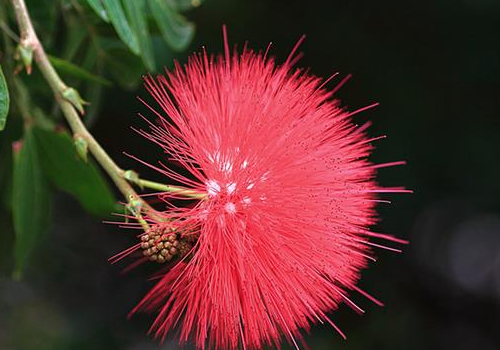
Can Calliandra be kept indoors:
Calliandra is suitable for home growing, but it is best not to place it indoors. Calliandra's appearance is very cute; its red flower filaments are like down, giving a constantly cute impression.
However, considering Calliandra's growth habits. Because it has high requirements for light and temperature, it is best not to place it indoors for care; it can be placed on a balcony or windowsill and other such places.
You can rest assured, Calliandra is not toxic, so it can be grown with peace of mind.
Peony Paeonia lactiflora Peony illustrated guide: How to grow peony / How to propagate peony
Peony profilePeony Paeonia lactiflora
Peony cultivation methods and precautions Peony introduction
Peony, also known by the aliases Jiangli and Licao, is a famous herbaceous flower of the genus Paeonia in the family Paeoniaceae. Its cultivation history in China exceeds 4900 years, and it is one of the earliest flowers cultivated in China. Peonies can be divided into many varieties such as herbaceous peony, beautiful peony, and many-flowered peony. The peony petals are obovate, and the floral disc is shallowly cup-shaped; its roots made into traditional Chinese medicine have antispasmodic and analgesic medicinal value. It ranks first among herbaceous flowers, and it is praised by people as the "Flower Fairy" and "Flower Minister," and is listed as one of the "Six Famous Flowers"; it is also called the "Flower God of May." Because it has been regarded as the flower of love since ancient times, it is now honored as the representative flower of Qixi Festival. In addition, peony is an important flower in Dream of the Red Chamber; Shi Xiangyun sleeping drunk on a peony cushion is one of the most beautiful scenes in Dream of the Red Chamber.
The origin of the name peony (sháo yào), according to the Bencao: "Peony is just like chuo yue, a beautiful appearance. This plant's flowers are graceful, hence the name." Peony has many aliases. In China's brilliant hundred-flower garden, the ancients elevated peony to "Flower Minister" (minister among flowers), and because peony is herbaceous, it is also called herbaceous peony (Cui Bao, Gujin Zhu). Its flowers are large and brightly colored, charming and graceful, so it is named "Jiaorong" and "Yurong" (Mingyi Bielu). In ancient times, when people parted, they gave peony flowers to express the feeling of reluctant farewell, so it was also named "Jiangli" and "Licao" (Gujin Zhu). Tang and Song literati called peony "Luanwei Chun"; luanwei means the last cup, and peony blooms in late spring, meaning the last cup of fine wine of spring. Peony is a herbaceous flower, without a hard woody stem, like a delicate young woman as slender as a willow swaying in the wind, so it has the name "Meigu Hua" (Zheng Qian Hu Bencao). Because its flowers are fragrant, it has the names "Luanyi" (also called "Hei Qianyi"), "Liuyi" (Guangya Shuzheng), and "Xinyi" (Wang Yi's commentary on Chuci Jiuge). In addition, ancient names also include "Jiecang," "Baizhu," "Lishi," and "Ting" (Mingyi Bielu). Abroad, peony is also highly favored, with the laudatory name "Queen of Flowers." Representative meaning: Peony has been China's flower of love since ancient times, and is now also honored as the representative flower of Qixi Festival. The rose of the West is thorny; China's love flower peony is not only beautiful but can also cure illness. It reflects the Chinese nation's virtue and character, like jade and like peony: diligent, practical, as light as peony fragrance, as gentle and beautiful as jade. Pink peonies are like rosy clouds at the horizon, and also like a shy young girl in love; romance and reserve are the peony reddening spring's face. The custom of Shangsi Festival and the love song "give her a peony" have continued from the singing of the Book of Songs all the way to Han, Tang, Ming, and Qing. In ancient China, peony was always the melody of love, a romantic mountain song.
It is "charming and touching," "hard to part." In ancient times, when men and women interacted, they gave peonies to each other to express a promise of love or the feeling of reluctant farewell; peony is also called "Jiangli Cao."
Peony morphological characteristics Roots
The root consists of 3 parts: root crown, tuberous roots, and fibrous roots. The root crown head (different from "rhizome"; the root crown is a root, while a rhizome is a stem) is the uppermost part of the root, darker in color, and bears buds; tuberous roots arise below the root crown, are fleshy, thick and strong, spindle-shaped or long columnar, 0.6-3.5 cm thick, with an outer surface light yellowish brown or grayish purple, white inside, and rich in nutrients. Tuberous roots generally do not directly produce buds, but after breaking they can sprout smaller new buds; therefore, collecting broken roots over 5 cm in autumn can also be used for propagation; fibrous roots mainly arise from the tuberous roots, are the main organs for absorbing water and nutrients, and can gradually develop into tuberous roots. According to differences in external shape, peony roots can generally be divided into three types: thick-root type, sloping-root type, and even-root type. Thick-root type: roots are relatively sparse, thick and large, extending straight; sloping-root type: roots extend in all directions, uneven in thickness; even-root type: root strips are suitably dense, uniform in thickness, etc. The roots can be used as medicine.
Buds
Clustered on the root crown, fleshy, overwintering underground in winter; in early spring as the temperature rises, they sprout and emerge from the soil. When newly born they are water-red to light purplish red, and some are yellow; after emerging from the ground, the color deepens, generally becoming dark purplish red, with scales outside for protection. Peony buds are mixed buds, developing both into reproductive organs - flowers - and into vegetative organs - stems and leaves. Before sprouting, buds are 2.5-4 cm long. After buds emerge from the ground, their color and form also differ by variety, with colors ranging from dark purplish red to yellowish brown, and bud shapes can be divided into 3 types: short-round type, bamboo-shoot type, and brush-tip type. Short-round type: the bud body is shorter, with a bluntly rounded tip; bamboo-shoot type: the bud body is longer, with an acute tip, shaped like a bamboo shoot; brush-tip type: the bud body is longer, with a gradually pointed tip, shaped like the tip of a writing brush. Peony sprouting is one of the most spectacular scenes, because it embodies the germination and vitality of life, and therefore has high ornamental value.
Stems
Clustered from the root, about 50-110 cm tall, herbaceous; the base of the stem is cylindrical, the upper part is mostly angular, some twisted, some straight, and the sun-facing parts mostly show a purplish red blush.
Leaves
The lower leaves are bipinnately trifoliolate compound leaves, that is, the end of the leaf consists of 3 leaflets forming one cluster, with one cluster on each side; each cluster on the two sides usually consists of 4 leaflets. In the middle compound leaves, the 3 terminal leaflets remain unchanged, while the number of leaflets on the two sides begins to decrease, gradually reducing from the original 4 to 3, 2, or 1, or even disappearing; when they disappear, only 3 leaflets remain at the end, and this is called a tripinnate compound leaf. The upper leaves are simple leaves. Leaves are 20-24 cm long; leaflets are elliptical, narrowly ovate, needle-shaped, etc.; leaf tips are long and pointed, margins are entire with slight waves, and the leaf margins are densely set with white bony fine teeth. The leaf surface may be yellow-green, green, or dark green, and the leaf underside is mostly powdery green, hairy or hairless. Peony leaves also have ornamental value; in "red lanterns glittering, green coiled dragon," "green coiled dragon" is praise for the leaves, so it can also be used as a foliage plant.
Flower buds
Shapes include round peach, flat round peach, oblate round peach, pointed round peach, long round peach, pointed peach, crooked pointed peach, long pointed peach, flat peach, and several others. Outer whorl sepals 5, leaf-like lanceolate, green, decreasing in size from bottom to top; inner sepals 3 (sometimes increasing to 7), green or yellow-green, sometimes interspersed with yellow-white stripes or purplish red stripes, obovate, broadly ovate, circular, elliptical, or irregular.
Flowers
Generally borne singly at the top of the stem or near the top in leaf axils, and some rare varieties even produce 2 or 3 flowers together. The original species has white flowers, flower diameter 8-11 cm, petals 5-13, obovate, stamens numerous, filaments yellow, floral disc shallowly cup-shaped, wrapping the base of the carpels, apex bluntly rounded, carpels 3-5, hairless or hairy, with a beak at the tip; horticultural varieties are rich in flower color, including white, pink, red, purple, yellow, green, black, and bicolor, etc., flower diameter 10-30 cm, petals can reach over a hundred, and some varieties even have 880 petals, with highly variable flower forms. Flowering period May-June.
Fruit
Follicles, spindle-shaped, elliptical, bottle-shaped, etc., smooth, or with fine down, with a small pointed tip. 2-8 follicles, free, composed of a single carpel, ovary 1-loculed, containing 5-7 seeds.
Seeds
Black or blackish brown, seeds large, round, oblong, or pointed-round.
Phenological periods
In peony, the periods during the year when various organs undergo corresponding changes under the constraints of climatic conditions are called phenological periods. For example, in the Beijing area, peony buds sprout and emerge from the soil from late March to early April. The buds formed at the underground root crown in June-July of the previous year, after growth and flower bud differentiation, sprout and emerge after spring temperatures rise. The buds are mostly beautiful purplish red, with a few varieties delicate yellow-green, and have high ornamental value. After more than 20 days of rapid growth, the new stems can reach about 2/3 of the height of a mature plant, the lower compound leaves spread flat, and the young leaves are also purplish red or yellow-green; after the lower leaves spread flat, growth is again rapid, and in early April flower buds appear at the stem tips; after budding, as stems and leaves fill out and the flower buds develop, flowers begin to open in early to mid-May; the flowering period ends in early June. A single flower remains open 5-7 days; single-petaled varieties remain open for a shorter time, and double-petaled varieties for longer. The population flowering period (from the opening of early-flowering varieties to the fading of late-flowering varieties) is about 25 days; after flowering, mixed buds are again differentiated and developed at the underground root crown; seeds mature in August, the aboveground part dies from late October to early November, and the mixed buds borne on the root crown overwinter in the soil, then sprout and grow again the following spring. This annual periodic change process mainly has the following rules: first, sequence, each phenological period can proceed only after the previous phenological period is completed, and at the same time it lays the foundation for the next phenological period; second, changes in all phenological periods occur under the combined action of certain external conditions, among which temperature is often the leading influencing factor; third, because phenological periods change with the climate of the four seasons, phenological changes have annual periodicity; fourth, phenological periods have repeatability under certain conditions, etc.
Main factors affecting flowering phenology
(1) Temperature: In the same region, the timing of peony flowering is closely related to spring temperature changes. Temperature can affect the entire flowering process. With a warm spring versus a cold spring, the flowering period can differ by 4-5 days or even 10-20 days.
(2) Moisture and rainfall: Moisture and rainfall have little effect on the flowering period. Sufficient irrigation before flowering or encountering rainfall helps peony flowering, making flowers large and flower color brilliant; but if there is relatively heavy rainfall, flowers are damaged and fade early. If soil moisture content is low before flowering, flowers become smaller, flower color is not brilliant, and the flowering period is shortened.
(3) Altitude: Altitude can affect changes in temperature, light, and humidity, thereby affecting the flowering period. Under normal circumstances, as altitude increases, the flowering period is delayed. For example, peony flowering in Luoyang ends on May 14, while on Baiyun Mountain in nearby Manxian, peonies are just beginning to color. When the peony flowering period in Pengzhou City, Sichuan, ends, peonies nearby on Danjing Mountain are just beginning to open. Different altitude changes in cultivation sites can be used to prolong the viewing period.
(4) Light: Light often accompanies temperature and has a major impact on plant growth and development and the flowering period. Insufficient light before flowering can affect flower color, making it insufficiently rich; strong light during the flowering period, accompanied by rising temperature, can shorten the flowering period or scorch the flowers. Therefore, setting up a shade canopy during the flowering period can prolong the peony flowering period.
Growth and development characteristics
1、Life cycle and annual cycle
Peony is a perennial herbaceous plant with persistent roots. From seed germination to death, in its lifetime of life activities it undergoes life processes such as growth, flowering, fruiting, aging, and death; this entire process is called the life cycle, also called the large development cycle. For seedling plants, the life cycle can be divided into 3 developmental stages. Seedlings generally flower in about 4 years; before flowering is the juvenile stage. In the first year after sowing and emergence, the plant is 3-4 cm tall, grows 1-2 leaves, and the root is 8-10 cm long, with the upper part of the root relatively thick, about 0.4-0.5 cm in diameter; in the second spring, the plant height reaches 7-8 cm, and better-growing plants can reach 15-29 cm, with a plant spread of about 30 cm; in the third spring, a few plants already flower, with plant height 15-60 cm, and only one main root well developed; plant spread 30-40 cm; in the fourth year all plants can flower. After entering the adult stage, growth is vigorous and flowering is abundant, at the best ornamental stage. As long as the environment is suitable, the adult stage can last twenty or thirty years, then enter the aging stage until death. Division-propagated plants directly enter the adult stage and gradually age after twenty or thirty years.
The annual cycle, also called the small development cycle, refers to the staged developmental changes produced by peony plants during the year as the climatic rhythm changes. It is mainly manifested as alternating changes between the growth period and the dormant period. Among these, the vernalization stage of the dormant period and the photoperiod stage of the growth period are the most critical. The vernalization stage of peony requires about 40 days at a low temperature of 0°C to be completed; only then can the mixed buds begin to sprout and grow. Peony is a long-day plant; flower buds need to develop and flower under long days. After the mixed buds germinate, if light duration is insufficient, or under short-day conditions, they usually only grow leaves without flowering or flower abnormally.
2、Growth and development characteristics
(1) Flower bud structure and life cycle: Peony buds are mixed buds, belonging to the underground bud type; after germination they extend above ground and both produce stems and leaves and unfold buds to flower. The mixed bud is a complex of multiple primordia, composed of the apical growing point, bud scales, axillary bud primordia in the axils of bud scales, leaf primordia, axillary bud primordia in the axils of leaf primordia, bract primordia, sepal primordia, petal primordia, stamen primordia, pistil primordia, etc. This bud is called the maternal-generation bud, so the axillary bud primordia in the axils of the bud scales and leaf primordia are the original bodies of the daughter-generation buds. The axillary bud primordia in the axils of leaf primordia and their axillary bud primordia do not produce bud scales and are naked buds; while the axillary bud primordia in the axils of scales have bud scales, forming scaly buds. In spring the scaly buds germinate, and the daughter-generation naked buds extend above ground as the internodes of the maternal-generation mixed bud elongate, forming flower branches or branches on the main stem; their daughter-generation scaly buds do not emerge above ground. After the aboveground part withers in autumn, the daughter-generation scaly bud located at the uppermost end of the peony root crown becomes the "terminal bud." In fact, peony has only one terminal bud, namely the terminal bud of the seedling after seed germination. The next year, this daughter-generation scaly bud germinates and emerges, extends branches, unfolds leaves, and flowers. Therefore, the life cycle of naked buds is 2 years, while the life cycle of scaly buds is 3 years.
(2) Flower bud differentiation: After peony flowering, the axillary buds of its underground scaly buds appear around August, and their apical growing points gradually produce bud scale primordia from outside to inside; by May of the following year, a growing point covered by 4 bud scales has formed, and by late June bud scale differentiation is complete. Then, the apical growing point begins to produce leaf primordia; leaf primordia have multiple finger-like protrusions, while bud scale primordia have only 1-3. Leaf primordium differentiation ends from early August to early September.
Peony ecological habits
1.Temperature
Peony is a typical temperate plant, liking warmth and tolerating cold, with a relatively broad ecological adaptation range. In northern China it can be cultivated in the open field and has strong cold tolerance. In the Nenjiang County area of northern Heilongjiang Province, where the annual growth period is only 120 days and the extreme minimum temperature is -46.5°C, it can still grow and flower normally and overwinter in the open field. In summer it prefers a cool climate, but is also quite heat-tolerant; for example, in Bozhou, Anhui Province, and where the extreme maximum summer temperature reaches 42.1°C, it can also safely pass the summer.
2.Light
Only with sufficient light during the growth period can peony grow luxuriantly and have brilliant flower color; however, it can also grow and develop normally under light shade, and during the flowering period light shade can appropriately lower temperature and increase humidity, avoiding scorching by strong sunlight and thereby prolonging the viewing period. But if shaded too much, it will cause leggy growth, weak growth, and failure to flower or sparse flowering.
Peony is a long-day plant; it differentiates flower buds in the short-day seasons of autumn and winter and flowers under long days in spring. Flower bud development and flowering both need to proceed under long days. If light duration is too short (8-9 hours), it will cause delayed flower bud development, accelerated leaf growth, poor flowering, or even failure to flower.
3.Soil
Peony is a deep-rooted plant, so it requires deep soil layers, and it also has thick fleshy roots, making loose, well-drained sandy loam suitable. It grows poorly in clay and sandy soil; high soil moisture content and poor drainage easily cause root rot. Neutral or slightly acidic soil is suitable, and saline-alkali land is not suitable for planting; fertile soil gives better growth, but note that nitrogen content must not be too high, to prevent leggy branches and leaves. During the growth period, appropriately increase phosphorus and potassium fertilizer to promote robust branch and leaf growth and beautiful flowering. Peony avoids continuous cropping. In traditional concentrated peony production areas, continuously planting peonies in the same plot for many years is a very common phenomenon and has already caused serious losses: not only severe pests and diseases, but also decreased yield and quality, and even large-scale death. Therefore, a scientific and reasonable crop rotation system must be implemented.
4.Water
Peony prefers high, open terrain and a relatively dry environment, and does not need frequent irrigation. Because peony has fleshy roots, it is especially intolerant of waterlogging; standing water for 6-10 hours often causes root rot. Low-lying wet areas are not suitable as peony production areas in China. Every flood is almost devastating to peonies; only peonies in high, open places not submerged by water remain.
Peony cultivation techniques
Peony cultivation includes ornamental cultivation, medicinal cultivation, soilless cultivation, forcing and retarding cultivation, cut flower cultivation, etc., described below.
1.Land requirements
Choose a planting site with high, dry terrain and good drainage, requiring deep, loose, fertile sandy loam. When planting in sections with relatively heavy salinity and alkalinity, soil replacement is needed; when planting in lower terrain, build raised beds, and there should be sufficient clean irrigation water sources. Peony avoids continuous cropping. Field cultivation generally rotates once every 3-4 years; otherwise growth weakens and pest and disease damage becomes severe. When land limitations prevent timely rotation, deep plowing should be carried out 1-2 months before planting. The depth is 60-100 cm, and for every 666.7 sq m, 1500-2000 kg of decomposed manure or 200-250 kg of cake fertilizer can be applied; remember not to apply undecomposed raw fertilizer.
2.Suitable planting time
Whether for sowing seedlings or division seedlings, planting in Heze is from late August (End of Heat) to late September (Autumn Equinox), and in Yangzhou from late September (Autumn Equinox) to early November (Start of Winter). It is generally combined with division.
3.Planting specifications
For garden ornamental cultivation, the plant and row spacing can be 1 m x 1 m, and planting points can be arranged in a "pin-shaped" pattern; this planting can use the land evenly and reasonably, helping the plants grow symmetrically, but field operations are sometimes inconvenient. For convenience in field management and observation records, the "square" arrangement with horizontal and vertical rows is often used. For the specifications of planting holes, the depth is about 35 cm, the upper opening diameter is 18 cm, and the hole should be dug narrower at the top and wider at the bottom. For ornamental cultivation and propagation, thick roots are not removed; for medicinal cultivation, root-promoted seedlings after root removal are used (Zhejiang Dongyang method), with holes about 25 cm. If peony heads after root removal are used directly for planting, the depth can be shallower.
4.Planting method
Apply decomposed manure or cake fertilizer at the bottom of the hole. Mix evenly with the subsoil. Before planting, treat peony seedlings with a mixture of 700 times methyl thiophanate solution plus 1000 times methyl isofenphos solution to prevent pest and disease damage. Hold the peony seedling by hand and place it in the hole with the roots spread out; when filling soil to half the hole, shake and lift the seedling so that the root system combines tightly with the soil. The lifting height of the seedling is based on the buds being level with the ground surface; after watering causes the planting hole to settle, this will be exactly the suitable planting depth. If planted too deep, buds are not easy to sprout and emerge, and even if they emerge, growth and development are not vigorous; if planted too shallow, the root crown is exposed above ground and is prone to death from sun exposure in summer. Finally fill the soil to the top of the hole, firm it, and pile about 10 cm of soil on top to prevent cold and preserve soil moisture, and also as a marker and protection. Depending on soil moisture, if the soil is moist, watering after planting may be omitted; generally water immediately after planting.
5.Field management
(1) Remove soil and level the bed: The soil pile made at planting in the previous autumn must be promptly removed and leveled before peony tender buds emerge, and the bed surface leveled, to facilitate watering and field management. If done too late, removing soil will damage tender buds; if not removed, the base of tender buds will weaken, affecting growth.
(2) Cultivation and weeding: Throughout the growing season, frequently cultivate and weed. Before the leaf canopy completely covers the ground and around the flowering period, deep cultivation is needed; after flowering, shallow cultivation is needed. Under normal circumstances, cultivation and weeding should be done about 10 times per year.
(3) Fertilization: Peony likes fertilizer, and there is rarely harm from over-fertilization. Especially when flower buds color and when buds are pregnant, the demand for nutrients is even more urgent. In addition to applying base fertilizer at planting, according to peony's nutrient requirements at different developmental stages, topdressing can be applied 3 times per year. In spring after seedlings emerge and unfold leaves, "flower fertilizer" can be applied, with the purpose of promoting robust plant growth and supplementing large amounts of nutrients for flower bud development and flowering. To supplement fertilizer in time, quick-acting fertilizer is mostly used; note to appropriately increase the phosphorus and potassium fertilizer components. After flowering, a large amount of nutrients in the plant is consumed, and flower bud differentiation and bud body development must still proceed, so "bud fertilizer" can be applied. Whether sufficient nutrients are supplied in time at this time directly relates to the quality of flowering and growth the next year; still apply quick-acting fertilizer. Before winter, combined with winter soil mounding, "winter fertilizer" can be applied, mainly long-acting fertilizer, mostly fully decomposed compost, barnyard manure, or decomposed cake fertilizer and compound fertilizer. Topdressing application methods include hole application, trench application, and broadcasting. For one- and two-year-old seedlings, because the root system is not developed, hole application between plants or trench application between rows is often used, with holes and trenches about 15 cm deep; fertilizer is applied in them and covered with soil. For plants three years or older, broadcasting is mostly used: spread fertilizer evenly, then combine with cultivation and weeding, deep hoeing and loosening the soil, and mix it evenly with the soil. For one- and two-year-old seedlings, for every 666.7 sq m, 150-200 kg of cake fertilizer or sesame paste residue (the paste liquid after making sesame paste) can be applied as topdressing, or 1500 kg of manure; for plants three years or older, for every 666.7 sq m, 200-250 kg of cake fertilizer or sesame paste residue can be used, or 2000-2500 kg of manure.
(4) Watering: Peony has a developed root system and penetrates deep into the soil, and can absorb water from deep soil layers; the roots are fleshy and intolerant of waterlogging, so it does not need frequent watering like open-field herbaceous flowers. However, excessive dryness is also unfavorable for growth, making flowers small and sparse and flower color not brilliant. It can be seen that moderate moisture is an ecological condition necessary for normal peony growth; therefore, in drought it still needs timely watering, especially before and after flowering and before winter soil mounding, sufficient irrigation must be ensured. When heavy rain falls, special attention must be paid to timely drainage to avoid root damage.
(5) Remove side buds: In addition to the main bud borne at the stem tip, peony has 3-4 side buds in the upper leaf axils of the stem. To concentrate nutrients and make the terminal bud flower large, remove the side buds shortly after the flower buds appear. To prevent damage to the terminal bud, first leave 1 side bud; after the terminal bud swells and normal development is no longer a problem, then remove the reserved side bud. Therefore, flower farmers have the saying, "Peony gets its head trimmed (remove side buds), tree peony gets its feet trimmed (remove basal buds)." Skillfully using the difference in flowering time between main and side buds can appropriately prolong the peony viewing period: among the same variety (a variety whose side buds can flower normally), select some plants, remove the main bud, and leave 1 side bud to flower; then the flowering period can be delayed by several days.
(6) Staking: Peony flower stalks are relatively soft. Except for a few short, sturdy plant types - and except for varieties with relatively few petals such as single-petal type, lotus type, and golden-stamen type - most varieties have flower heads drooping to the side when flowering, or even the whole plant leaning sideways. To maintain a good ornamental effect, after the flower buds color, set up supports so that the flower stalks extend straight, flower heads stand upright, and flower posture is beautiful. Two staking forms are commonly used: first, single-stake type, mostly used for varieties with especially large flowers and relatively soft stems. When tying, insert a thin bamboo into the soil behind the flower stem, then use plastic rope or hemp rope in a figure "8" shape to tie the upper part of the flower stem 6-8 cm from the flower head to the support; do not tie tightly at the top of the flower stem, to avoid making the flower head stiff and losing beauty. Second, bamboo-ring type, used for general varieties: enclose the loose plant clump with a bamboo ring; then the enclosed flower stems support each other and stand upright. The size of the bamboo ring can be adjusted according to the size of the plant clump. Generally two layers of bamboo rings are used, smaller on the lower layer and larger on the upper layer. Each bamboo ring is fixed by tying with 3 or 4 small bamboo poles inserted into the soil. The above two forms can be used in combination according to circumstances.
(7) Set up shade and rain shelter: The peony flowering period coincides with the hot and rainy season. During the flowering period, a shade and rain shelter can be set up to block strong light, lower humidity, and protect from rain invasion, so as to improve the ornamental effect and prolong the viewing period. The shed height is 2.5 m, covered with shade net and plastic film. Setting up the shed can prolong the flowering period by 8-10 days.
(8) Remove faded flowers: After flowering, except for plants kept for seed, promptly remove faded flowers to avoid wasting nutrients.
(9) Prune aboveground parts, water with freezing water, mound soil for overwintering: After late October, the aboveground stems and leaves gradually turn yellow and dry. At this time, prune dead leaves, sweep up dead leaves, and concentrate them for deep burial, to avoid another spread of pests and diseases. Then, before the soil freezes in winter, water thoroughly, fertilize, and mound soil to preserve moisture and protect against cold for overwintering.
Medicinal cultivation
Peony is often used for medicinal cultivation; its root is a traditional Chinese medicinal material. The root bark is scraped off, and it is named "white peony"; some wild peony group plants, such as Sichuan red peony (P. vitchii) and herbaceous peony (P. obovata), etc., generally are not scraped of root bark when used medicinally, and are called "red peony." Both are used as medicine but have different medicinal effects. Medicinal cultivation is similar to ornamental cultivation, but also has differences. Its planting row spacing is 50 cm x 40 cm or 50 cm x 35 cm, that is, 3000-3500 plants per 666.7 sq m. It can be planted in holes or trenches. The planting seedlings are division seedlings or three-year-old sowing seedlings; if division seedlings, new plants should not carry too many buds, and those with 1-3 buds and 2 roots can be used; if using those with 1 bud and 1 root, 2 plants can be planted per hole.
Too many buds will cause leggy aboveground branches and leaves and affect root growth. The purpose of medicinal cultivation is to grow roots well, making roots develop quickly and grow solidly. When the plant shows buds, remove all of them and do not let them develop and flower, so that nutrients are concentrated on root growth. Bud removal is best done on sunny days when there is no dew; after bud removal, spray an equal-strength Bordeaux mixture once, which can reduce infection by pathogens.
After removing the peony roots from the peony plant, remove the fibrous roots, classify by thickness, boil and stir, then take out the roots and observe: if water marks dry completely in less than 1 minute, this is the suitable timing (another saying is that when the root epidermis does not have water droplets attached, this is the suitable timing); immediately take them out and soak in cold water for about half an hour or more, use a glass piece, small knife, etc. to scrape off the root bark, wash clean, and air-dry. It is best not to expose them to strong sunlight, to avoid the outer skin turning reddish brown. Air-drying should last about half a month; thick roots need more time, thin roots less. During root drying, dry for a few days, gather them together and let them sweat for one or two days to regain moisture, then dry again, until the roots break open showing powdery white and make a sound when tapped; then they can be graded, packaged, and sold. They are usually divided into 3 grades by root diameter: grade one, root diameter 4 cm or more; grade two, 2-4 cm; grade three, below 2 cm.
All require smooth outer skin, white with a pink tinge, and uniform thickness. Generally, 1 kg of fresh roots can yield 0.5 kg of dried white peony. After 3 years of continued cultivation, every 666.7 sq m yields about 900 kg of fresh roots, producing 450 kg of white peony (Heze). Zhejiang Dongyang's method of making white peony is to first remove the root bark, then boil it, a method with local characteristics, but the medicinal effect is the same. Soilless cultivation Soilless cultivation, also called water culture, is a technique of preparing a nutrient solution according to the nutrient elements necessary for plant growth and development, and using it to cultivate plants.
For the export of potted flowers, soilless cultivation must be used in the international flower market to prevent the spread of pests and diseases. Because it saves water and fertilizer, is clean and hygienic, has few pests and diseases, good product quality, and saves labor in management, it is increasingly widely used.
1. Variety selection Most peony varieties perform well under nutrient solution cultivation, all superior to ordinary soil cultivation.
Varieties suitable for soilless cultivation include: "Zi Die Xian Jin," "Wu Long Peng Sheng," "Zhu Sha Pan," "Yang Fei Chu Yu," and "Yan Chi Yang Bo," etc.
2. Substrate preparation Peony has a fleshy root system, and the requirements for the substrate are good air permeability, fertilizer retention, and water retention. Vermiculite, perlite, ceramsite, and bark, etc. can be used as substrate; using a mixed substrate gives better results. Examples of mixing ratios include vermiculite, perlite, and bark at 1:1:1; vermiculite, perlite, and ceramsite at 1:1:1; or vermiculite and perlite at 1:1, etc. In southern China, some local substrates can be added, such as carbonized rice husks, etc.
3. Cultivation forms There are two forms: pot cultivation and trough cultivation. For pot cultivation, choose flower pots of corresponding diameter according to the size of the peony plant. Clay pots can be used; they have good ventilation and benefit plant growth, but are heavy and inconvenient to manage and use; plastic pots are commonly used, with a beautiful appearance, light weight, and convenient use and management, but poor ventilation. When planting, spread a layer of ceramsite at the bottom of the pot to facilitate drainage, then plant the peony seedling, fill in the mixed substrate, and add a layer of ceramsite on the surface to prevent substrate from splashing out when watering. For trough cultivation, cement or bricks can be used to build a rectangular cultivation trough; the long axis of the trough surface should have a certain drainage slope, width about 80-120 cm, length 200-300 cm, depth 42 cm. Line the trough with plastic film, fill in 40 cm of cultivation substrate, and plant seedlings at a row spacing of 40 cm x 40 cm, with 2-3 rows possible. Planting time is the same as field planting time.
4. Nutrient solution preparation Wang Yueying and others at Beijing Forestry University, through analysis of the nutritional status of tree peony cultivation soil and determination of tree peony nutrient content at different growth stages, prepared nutrient solution formulas suitable for 3 different growth stages: first, used from summer to before winter, with the effect of promoting buds and protecting roots; second, used before flowering, with relatively high phosphorus, promoting beautiful and large flowers; third, used after flowering, playing a comprehensive fertilizer supplementation role. This has high reference value for preparing nutrient solutions for soilless peony cultivation. The mineral element content of the nutrient solution should be between 0.1% and 0.4%.
5.Irrigation system:
(1) Gravity irrigation facilities: often used for general production cultivation, relatively simple to set up, low investment, convenient management, and good use effect. The cultivation trough width is 200 cm, and 4 drip irrigation belts can be installed. The size of the nutrient solution storage tank depends on the area of the cultivation trough; generally, the storage tank being 150-200 cm higher than the cultivation trough surface is sufficient. Through the gravity effect produced by the liquid's height difference, the nutrient solution is delivered to the plant roots through the drip irrigation pipe.
(2) Power irrigation facilities: mostly used for large-area soilless cultivation. The delivery of nutrient solution in the above facilities is changed from gravity delivery to power delivery. An electric pump is added as the delivery power.
(3) Micro-tube sprinkler irrigation facilities: lay plastic pipes with many micropores on the bed surface, and spray the nutrient solution onto the cultivation bed.
(4) Seepage pipe irrigation facilities: bury specially made seepage pipes in 2-10 cm of substrate, so that the nutrient solution continuously seeps outward; this not only saves water but also irrigates evenly, and operation is also very convenient. Forcing and retarding cultivation Using artificial measures to promote early germination of peony flower buds and flowering earlier than the natural flowering period is called forcing cultivation. Conversely, using artificial measures to delay bud germination and make the flowering period later than the natural flowering period is called retarding cultivation. The two are also often called flower-period forcing and delaying. On the basis of the natural open-field flowering period, reasonably using forcing and retarding cultivation methods to regulate the flowering period can make peony flower year-round. Peony flower bud differentiation begins later than that of tree peony; its early-flowering varieties begin flower bud differentiation at the end of August, while late-flowering varieties delay until mid-to-late September. Most varieties form petal primordia from mid-November and stop developing, overwintering in this state. They sprout and grow in spring of the following year, and the flower buds continue to develop until flowering.
To achieve year-round supply of peony cut flowers and potted flowers, a combination of forcing and retarding cultivation is often used to regulate the flowering period. Selecting suitable varieties, choosing robust seedlings with fully developed flower buds and pure variety, adopting scientific treatment measures and careful cultivation management are the guarantees for success in forcing and retarding cultivation.
1、Forcing cultivation
(1) Variety selection: To cultivate peony, first select varieties suitable for forcing cultivation. Generally, early-flowering varieties are mostly chosen, which can shorten the time to forced flowering, such as "Qiao Ling," "Mo Zi Lou," "Yin He," "Fen Rong Lian," "Da Fu Gui," "Feng Yu Luo Jin Chi," and "Mei Ju," etc.
(2) Cold storage treatment: To make peony flower before the natural flowering period, select robust three- or four-year-old plants for cold storage treatment. In the cold storage room, use the soil-burial cold storage method, with buds slightly exposed. During cold storage, check soil moisture once every half month. If sandy loam is used, it should be just right when held in the hand and forming a ball. Too dry is unfavorable for forcing flowers, and too wet easily causes mold and root rot. The cold storage room humidity should be kept at 3°C. Different varieties have certain differences in treatment humidity and treatment time. For example, if plants are cold-stored in early September, then planted, under 15°C conditions they will flower in 60-70 days, that is, they can be marketed in December; if flowering is needed in January-February of the following year, cold storage in October-November is sufficient.
(3) Nutrient soil planting: Plants that have undergone cold storage treatment need to be planted in nutrient soil, with regular spraying or irrigation of nutrient solution, supplemented by hormone management, and special attention should be paid to fertilizer spraying in the later stage. Nutrient soil can be prepared from decomposed leaf mold, garden soil, and sandy soil at a ratio of 2:3:1, with an appropriate amount of cake fertilizer and phosphorus-potassium fertilizer added; nitrogen fertilizer is applied as topdressing after potting. After plants are taken out of the cold storage, first place them in a cool place to adapt to room temperature. When potting, cover with soil 1 cm above the buds; after watering, the buds are slightly exposed.
(4) Regulation of temperature and humidity: After forcing plants enter the greenhouse, gradually increase the temperature. The optimum growth temperature for peony is 20-25°C; above 30°C is unfavorable for growth. The following temperature control methods can be used: early stage 15-20°C for about 10 days; middle stage 15-25°C for about 15 days; late stage 20-25°C for about 20-25 days. High temperature should not exceed 28°C, low temperature should not be lower than 12°C, and avoid drastic temperature changes. Relative air humidity should be kept at 70%-80%, which can be regulated by watering, spraying, ventilation, etc.
(5) Supplemental light: Peony likes warmth and light. During forcing cultivation in winter and spring, it is the short-day season, so supplemental light is especially important. Light duration should be increased to 13-15 hours per day, so that flower buds fully develop and flowers are beautiful and large.
(6) Application of hormones: Generally gibberellin (GA3) is used for treatment. When watering after potting, 2000 mg/L GA3 can be used to further break bud dormancy. When flower bud diameter is 0.4 cm and 0.8 cm, use 600 mg/L GA3 to smear the flower buds 2 times; when flower bud diameter is 1.2 cm, use 1000 mg/L GA3 to smear once more.
(7) Other management: When sprouts grow to 5-10 cm, remove buds without flower buds, to avoid wasting nutrients. Afterward, pay attention to removing lateral flower buds, leaving 6-8 flowers per plant. When flower buds are about to open, control watering, for sale or rental display. After flowering, do not water the flowers; place them indoors at 15-20°C, and the flowering period can reach 20-30 days. After flowers fade, put them back in the greenhouse, and after the temperature is suitable, plant them back in the open field. If used as cut flowers, after harvesting conventionally, continue careful management, nourish the roots and promote buds, in preparation for later use. 2. Retarding cultivation Retarding cultivation mostly uses late-flowering varieties. The following varieties can be considered: such as "Yang Fei Chu Yu," "Ling Long Yu," "Bing Qing," "Zhao Yuan Fen," "Yan Chi Yang Bo," "Hong Yan Fei Xiang," "Hua Hong Chong Lou," and "Yin Zhen Xiu Hong Pao," etc.
To make peony flower later than the natural flowering period, two measures can be used
(1) Cold storage during dormancy: In early spring, dig up plants that have not yet sprouted, store them in a 0°C cold storage for later use, and keep the plants moist. According to the time of flower use, depending on the season, take them out 30-45 days in advance, carry out normal cultivation, and they will flower at the required time.
(2) Cold storage during the growth period: Cold storage can be carried out when flower buds are about to open; the cold storage temperature should be higher, 3-5°C. Take them out 2-3 days before flower use, then cultivate conventionally. The latter method can only be used for short-term cold storage in the storage, and can be used to prolong the normal viewing period; long-term cold storage will cause leggy growth and reduce ornamental value. With the former method, if taken out and planted from April to August, they flower in 30-35 days; if planted in March or September, they flower in about 45 days. When summer temperatures are too high, shade treatment can be carried out, supplemented by spraying water to cool down, to avoid flower bud shrinkage and leaf scorch caused by high temperature. Cut flower cultivation At present, in the total sales of the world flower market, cut flowers account for about 60%. Peony cut flowers, because of their large, brightly colored flowers, long stems, tolerance to water culture, and convenience for storage and transport, have become highly popular goods in the world flower market. A certain batch of peony cut flowers is exported every year, and the development prospects are very promising.
For cut flower cultivation, the following measures should be taken:
1. Select varieties suitable for cut flower use
China's existing varieties were all bred for garden cultivation, and no varieties have been specially bred for cut flower production. However, from existing varieties, some suitable for cut flower use can still be selected. Varieties suitable for cut flower production should meet the following conditions:
(1) High flower formation rate, floriferous type, hard and upright flower stalks and petioles, long branches, relatively small leaves.
(2) Regular flower shape, brilliant flower color, fragrant scent, round and neat flower buds, top not easily splitting.
(3) Petals hard in texture, clearly layered, medium flower diameter, flowers opening upward, few sugary secretions on flower buds.
(4) Good water-holding quality as cut flowers, long water-holding period.
(5) Plants grow robustly, with strong growth vigor, strong tillering ability, strong stress resistance, and few pests and diseases. Tolerant of storage and transport. When selecting cut flower varieties, pay attention to the combination of flower color and flowering period, to ensure year-round or multi-season supply to the market.
2、Field management
3、Postharvest management
(1) Timely cutting: When flower buds color, keep the lower 2-3 compound leaves and cut the flower branch. The best cutting time is from early morning to 10 a.m.; if the cutting task is large, it can also be done in the evening. After cutting, immediately place the flower branches in a bucket of clean water to prevent water loss.
(2) Grading and packaging: In a low-temperature room, remove leaves and grade the flower stems. Remove the upper 2 compound leaves and the single leaf near the flower bud, and cut off the remaining compound leaves from the base of the petiole. Wash off the sugary fluid secreted on the flower buds with clean water, and divide them into five grades according to stem length: 50 cm, 55 cm, 60 cm, 65 cm, and 70 cm. First wrap each flower bud in soft paper, then put on a corrugated paper tube. According to variety and different stem lengths, tie 10 stems into 1 bunch, then trim the bases evenly according to length requirements, and immerse the bases in a 4 mmol/L STS (silver thiosulfate) solution for 10 minutes as pretreatment; then dip quickly in fungicide solution, and when dried until no water droplets remain on the leaf surface, pack the bunches of peony cut flowers into boxes for transport.
(3) Storage and freshness preservation: According to research on the postharvest physiology and preservation techniques of cut flowers, in order to extend the vase life of cut flowers, 3 main problems must be solved well, namely supplying necessary nutrients, preventing vessel blockage, and inhibiting ethylene synthesis. Peony cut flowers cut at the bud stage, treated with STS for 24 hours, then stored dry in a cold storage at 0-2°C for 3 months, and after removal treated with preservative solution, still have a vase life and ornamental value similar to fresh cut flowers.
Key points for peony cultivation
Mix thoroughly in a ratio of 30 jin of fertilizer plus 2-3 jin of superphosphate per 100 jin of sandy loam, then spray with water and pile to compost for 1-2 months. Courtyard planting must also have holes dug in winter in advance.
"Divide peonies at the Spring Equinox, and they will never bloom until old age" has been proven by many years of practice. The best period for planting and division propagation of peonies is from late September to early October; during this period, do not do it earlier, and even less later. Peony is a deep-rooted flower, so deep pots should be chosen for planting. For home flower growing, generally a deep pot with a diameter of 30 cm and a depth of 40 cm-50 cm is best, and 2-3 plants per pot is suitable. Attention should be paid to cultivation techniques: first spread 3 cm-5 cm of coal cinders as a drainage layer, then fill with 15 cm-20 cm of prepared potting soil, then place the seedlings upright and spread out in the pot, straighten the root system, then fill with potting soil, pressing lightly while filling so that the roots fully combine with the soil. The filling height should preferably exceed the top of the root buds by 4 cm-5 cm. Water thoroughly to settle the roots, and place in a ventilated, sunny place for care.
When the root buds emerge in early spring, combine with watering and lightly apply once a dilute liquid fertilizer mainly based on nitrogen fertilizer to accelerate vegetative growth. By mid-April, peonies enter the bud stage, when growth shifts from mainly vegetative growth to mainly reproductive growth. From bud appearance to flowering takes about one month. During this period, apply 1-2 times of compound fertilizer (2 jin fertilizer mixed with 100 jin water), and spray 2-3 times with 0.2% potassium dihydrogen phosphate fertilizer solution to promote large flowers and bright colors. After the flowering period, promptly cut off faded flowers to reduce nutrient consumption in the plant. At the same time, apply once a liquid fertilizer mainly based on nitrogen fertilizer to accelerate the growth of young root buds. In winter, peonies enter a dormant state, and their water demand decreases; as long as the soil maintains some moisture, it is enough, but appropriate fully decomposed cake fertilizer or barnyard manure must be buried with intertillage and loosening of the soil to supplement nutrients consumed in the soil and lay a foundation for strong seedlings the following spring.
Peony propagation methods
The traditional propagation methods for peonies are: division, sowing, cuttings, layering, and other methods, among which division is the easiest and most widely used. The sowing method is only used to cultivate new varieties, produce rootstocks for grafting tree peonies, and for medicinal material production. Rapid propagation of ornamental varieties is an urgent issue to be solved, and hope has long been placed on tissue culture. Much work has been done both domestically and abroad, and although progress has been made so far, there is still a considerable distance from practical application.
Division method
Division is the most commonly used propagation method for peonies, and seedling production in peony-producing areas basically uses this method. It has three advantages: first, it flowers earlier than the sowing method; sown seedlings flower in 4-5 years, while divided seedlings can flower the next year; second, division is simple and easy to perform, saves labor in management, and is conducive to wide application; third, it can maintain the excellent traits of the original variety. The disadvantage is that the propagation coefficient is low; a three-year-old mother plant can only be divided into 3-5 daughter plants, which makes it difficult to adapt to and meet the needs of modern large-scale production and the rapidly growing domestic and international flower market. This has always been a major problem troubling peony seedling production.
1. Division time
In theory, peony division can be carried out from when the overwintering buds are full until before the ground freezes. However, timely division and planting while the ground temperature is still high is conducive to the healing of root wounds, can promote new root germination, enhance cold and drought resistance, and lay a foundation for sprouting and growth the following year. Do not divide too early, to avoid autumn sprouting, which affects growth and development the next year; nor should division be too late, when the ground temperature can no longer meet the needs of peony root formation, resulting in poor growth of new plants the following year. If delayed until spring for division and planting, the buds sprout and emerge from the soil. Because spring temperatures gradually rise, air humidity is low, and transpiration is high, the root system is injured after division and cannot normally absorb water and nutrients, causing the divided plants to grow very weakly, or even die. Therefore, the Chinese agricultural proverb says, "Divide peonies at the Spring Equinox, and they will never bloom until old age." The suitable period for peony division is generally earlier than that for tree peonies. The agricultural proverb of Heze, "July for peonies, August for tree peonies (referring to lunar months)," means that in Heze, peonies can be divided from the end of August until late September (End of Heat to Autumn Equinox). In Yangzhou, division is from late September to early November. Divided seedlings can be divided again after growing for three to four years. If not divided for many years, the root system becomes old and decayed, the plant grows weakly, and flowering is poor.
2. Division method
When dividing, carefully dig up the fleshy roots, minimizing root damage as much as possible. After digging up, remove the old soil, cut away old hard and decayed parts, and split by hand or with a sharp knife along natural gaps. Generally, each plant can be divided into 3-5 daughter plants, each with 3-5 or 2-3 buds; when there are few mother plants and the planting task is large, each daughter plant can also have 1-2 buds, though recovery growth will be slower. When dividing, thick roots should be retained. If the soil is moist, peony roots are brittle and easily broken, so they can be left to dry for one day before division. After division, dry them slightly in the shade and dip them in nutrient-containing mud before planting. In garden green spaces, peonies that have been planted for many years and are gradually weakening urgently need division and replanting, but when the flowering period and visitors' viewing cannot be affected by propagation, the in-situ division method can be used: dig a deep hole beside the peony plant with a shovel, expose part of the peony roots, then use a sharp spade to cut and divide the peony plant, minimizing disturbance to the original plant, take out the divided portion, and carry out division planting as above. Generally, cutting off half of the original plant is appropriate. The deep hole dug out can be filled with an appropriate amount of fertilizer mixed with soil and compacted. Alternate-row division or alternate-plant division can also be used. In this way, division and rejuvenation can be carried out without affecting the landscape, except that division must be continued for 2-3 years. However, because peonies are intolerant of continuous cropping, the alternate-row or alternate-plant division method cannot be applied continuously; otherwise, pests and diseases occur severely, growth is poor, and even the mortality rate greatly increases.
When peonies are cultivated for medicinal use, peony-producing areas mostly use peony heads for division propagation. In autumn, dig out the mother plant, cut off all thick roots for medicinal use, and use the bud-bearing peony heads as propagation material. First remove peony heads without buds and with diseased sections, cut the peony heads into blocks, each block with 2-3 strong buds, and the peony head 2 cm thick. If too thick, the main root is not strong and branches too much; if too thin, nutrients are insufficient. It is best to plant as soon as they are cut. If they cannot be planted in time, do not cut them; the peony heads can be stored in sand for later use. Planting is suitable from early August to late September.
3. Management after division
The planting depth should preferably be about 2 cm of the bud entering the soil. Too deep is not conducive to sprouting and easily causes root rot, yellowing leaves, and poor growth; too shallow is not conducive to flowering and is prone to freezing damage, and even the root crown may be exposed above the ground, leading to death under the scorching summer sun. If the divided root clump is relatively large (with 3-5 buds), it may have flowers the second year, but they will be small; it is better to remove them so the plant grows well. If the root clump is small (2-3 buds), growth the second year will be poor or it will not flower, and generally 2-5 years of cultivation are required.
Sowing method
The fruit of peony is a follicle, and each follicle contains 1-7 seeds. When the seeds mature, the follicles split open and release the seeds. Fruit ripening periods vary by location; for example, Mudanjiang in Heilongjiang Province in early September, Heze in Shandong in late August, Luoyang in Henan in early to mid-August, and Yangzhou in Jiangsu around late August. Seeds should preferably be sown immediately after collection; as sowing time is delayed, seed moisture content decreases and germination rate declines. Seeds have the characteristic of double dormancy of the epicotyl and hypocotyl. After sowing, the autumn soil temperature causes the seeds' hypocotyl to break dormancy, and the radicle develops and roots. The better the rooting in the current year, the more vigorous the growth the following year; if sowing is too late, the ground temperature cannot break hypocotyl dormancy, rooting cannot occur, and the germination rate the following spring is greatly reduced. After sowing and rooting in autumn, undergoing a long period of low temperature in winter can break epicotyl dormancy. When temperatures rise the following spring and humidity is suitable, the embryo bud emerges from the soil.
Because the offspring produced by sowing horticultural peony varieties will segregate in traits and cannot maintain the excellent traits of the original variety, the sowing method cannot be used for propagating variety seedlings.
1. Seed collection
The seeds can be collected when the follicles turn yellow. If too early, the seeds are not mature; if too late, the seed coat turns black and hard, making emergence difficult. Fruits mature early or late, so they should be collected in batches. When the fruit skin splits and releases seeds, they can be sown immediately. Never expose the seeds to the sun, as this hardens the seed coat and affects emergence. If they cannot be sown in time, sand storage with moisture retention can be used, but they must be taken out and sown before the seeds root.
2. Sowing time
Peonies must be sown promptly with seeds collected the same year. For example, in the Heze area, sowing is from late August to late September. If later than late September, they cannot root that year, and the germination rate the following spring will be greatly reduced; moreover, even if seedlings emerge, because the seedling root system is underdeveloped, it is difficult for them to resist spring drought and they easily die. Therefore, several spring sowing trials in Heze all failed.
3. Sowing method
Seed treatment: Before sowing, remove shriveled seeds and impurities from the seeds to be sown, then use water selection to remove unfilled seeds. Although the seed coat of peony seeds is thinner than that of tree peony and more easily absorbs water and germinates, if seeds are treated before sowing, germination is more uniform and the germination rate is greatly increased, often reaching more than 80%. The method is to soak the seeds in 50°C warm water for 24 hours, then take them out and sow immediately.
Bed preparation and sowing: The land used for sowing and raising seedlings should be given sufficient base fertilizer and deeply plowed and leveled. If the soil is relatively moist and suitable for sowing, beds can be made directly for sowing; if the moisture condition is poor, irrigate fully first, then make beds and sow. The bed width is about 50 cm, and the distance between beds is 30 cm. Seeds are sown in holes at a row spacing of 6 cm and a seed spacing of 3 cm; if seeds are sufficient, broadcast sowing can be used, with a seed spacing of not less than 3 cm; after sowing, cover with moist soil to a thickness of about 2 cm. About 50 kg of seed is used per 666.7 sq m, or about 100 kg for broadcast sowing. After sowing, cover with plastic film, and remove it after sprouting and emergence the following spring. Drilling can also be used, with a row spacing of 40 cm and a seed spacing of 3 cm, covering with 5-6 cm of soil; or hole sowing, with a hole spacing of 20-30 cm, placing 4-5 seeds per hole, and after sowing piling 10-20 cm of soil to help prevent cold and preserve moisture. Rake level before sprouting the following spring.
Other propagation methods
1. Cutting method: Choose nursery land with higher terrain and good drainage for the cutting bed. After loosening the bed soil, spread 15 cm of river sand, and disinfect the river sand with 0.5% potassium permanganate. Vermiculite or perlite can also be used as the cutting medium. Build a shade shed 1.5 m high over the bed. According to experience in Changchun and other places, cuttings taken in mid-July have the best rooting effect. Cuttings are 10-15 cm long, with two nodes, one upper compound leaf, keeping a few leaflets; the lower compound leaf is cut off together with the petiole. After quickly dipping in a 500×10-1000×10 naphthaleneacetic acid or indoleacetic acid solution, insert the cuttings to a depth of about 5 cm, with spacing such that leaves do not overlap. After insertion, water thoroughly, then cover with a plastic tunnel. According to observation, the rooting effect is best when the medium temperature is 28-30°C and humidity is 50%. Maintain the temperature in the cutting shed at 20-25°C and humidity at 80%-90%, and roots can form 20-30 days after insertion, along with dormant buds. After rooting, reduce spraying and watering, and gradually remove the plastic tunnel and shade shed. Cutting seedlings grow slowly and need to be covered with soil in the bed to overwinter, then moved to open-field planting the following spring.
2. Root cutting method: Use broken roots from autumn division of peonies, cut them into 5-10 cm root segments, insert them into deeply plowed and leveled furrows 10-15 cm deep, cover with 5-10 cm of fine soil, and water thoroughly.
3. Layering method: In spring, pass young buds that have just emerged through the drainage hole of a flower pot and lead them into a flower pot with a diameter of 15-20 cm. As they grow, gradually fill with soil and keep the potting soil moist. By summer they can root, and before winter cut off the stem below the pot, forming a potted peony.
4. Modern tissue culture method: Plant tissue culture, namely aseptic plant culture technology, is based on the theory that plant cells have totipotency. It uses isolated peony organs, tissues, or cells (such as roots, stems, leaves, etc.) under aseptic conditions and suitable artificial culture media, light, temperature, and other conditions to induce callus, adventitious buds, and adventitious roots, finally forming complete plants with the same heredity as the mother plant. This technology is also called cloning technology, achieves the purpose of rapid propagation, and has broad application value.
Peony disease control
The main peony diseases are peony gray mold, peony brown spot, and peony red spot.
1. Scarab beetles
Pest species and damage: There are several kinds of scarab beetles that harm peonies, such as the black velvet chafer, apple chafer, and yellow-haired chafer. Their adults harm peony leaves and flowers; the larvae, white grubs, have a body nearly cylindrical, curved into a "C" shape, milky white, with a yellow-brown head, 3 pairs of thoracic legs, and no abdominal legs. They feed on peony roots, and the wounds created also create conditions for Fusarium infection, leading to root rot.
2. Scale insects
(1) Pests and damage: Scale insects are also called scale. There are several species of scale insects that harm peonies, such as the cottony cushion scale, Japanese wax scale, long white scale, mulberry white scale, peony round scale, and arrowhead scale.
Scale insects suck the body fluids of peonies, making the plants grow weakly and the branches and leaves turn yellow.
(2) Control methods
① Strengthen quarantine and strictly prevent the introduction of insect-infested seedlings.
② Protect and utilize natural enemies.
③ Seize the peak hatching period of eggs for spraying. Newly hatched insects have not yet developed a wax layer on the surface and are easy to kill. Spray 40% omethoate 1000-1500 times solution, or 50% malathion emulsion 800-1000 times solution, or 50% phoxim emulsion 1000-2000 times solution. Spray evenly and cover the whole plant. Spraying is ineffective after the wax shell forms.
④ Pour carbofuran solution around the root zone; the plant absorbs the pesticide, and the insects are killed after sucking the plant body fluids.
⑤ If individual branches are found to be harmed by scale insects, they can be brushed off with a soft brush, or the infested branches can be cut off and burned.
3. Aphids
(1) Damage situation: Aphid damage is commonly seen in peonies. After peonies sprout in spring, aphids fly in to cause damage, sucking the sap of leaves, causing damaged leaves to curl and turn yellow. After the seedlings grow larger, aphids often gather on tender shoots, pedicels, and leaf backs, causing the stems and leaves of the flower seedlings to curl and shrivel, and even the whole plant to wither and die.
(2) Occurrence pattern: Under high temperature and dry conditions, aphids reproduce quickly and cause severe damage. Aphids can reproduce several generations or even twenty to thirty generations in 1 year. Aphids secrete honeydew, which can block the physiological activities of the stems and leaves of damaged plants; at the same time, their honeydew is also a good culture medium for pathogens, often causing sooty mold and other diseases; aphids can also transmit viral diseases.
(3) Control methods
① Remove overwintering weeds.
② Protect and utilize natural enemies. The main natural enemies include the multicolored ladybird, seven-spotted ladybird, yellow-spotted ladybird, tortoise-shell ladybird, hoverflies, and green lacewings.
③ Spray 40% dimethoate emulsion 1000-1500 times solution, or 80% dichlorvos 1500-2000 times solution, or 50% menazon emulsion 1000-1500 times solution.
Peony variety classification
The genus Paeonia has about 35 species, distributed in the temperate regions of Europe and Asia. According to their growth habits and flower disc shape, they are divided into two groups. The first is the tree peony group, which are deciduous shrubs or subshrubs, with a cup-shaped or disc-shaped flower disc, leathery or fleshy, completely enclosing the carpels or enclosing the base of the carpels. China produces three species (excluding varieties), namely tree peony, yellow tree peony, and purple tree peony. The second is the peony group, which are perennial herbs, with the flower disc not developed, enclosing the base of the carpels, and not very obvious. The peony group has about 30 species, mainly distributed in the temperate regions of Europe and Asia. Another two species are produced in America, and some list them separately as a group called the American peony group.
The foreign-produced plants of the peony group are all important flower species, among which the four most important are: fernleaf peony, with blood-red flowers, native to Bulgaria and the Caucasus; pale yellow peony, with pale yellow flowers, or with light green to white, native to the region between the Black Sea and the Caspian Sea; yellow peony, yellow, native to the region between the Black Sea and the Caspian Sea; red-hearted peony, with white to deep red flowers, native to southern Europe.
China produces eight species and six varieties of plants in the peony group, among which the one usually directly called peony is the main original species of the modern peony variety group. The eight peony species are: grassy peony, beautiful peony, peony, many-flowered peony, white-flowered peony, Sichuan red peony, ** peony, and narrow-leaved peony.
Classification characteristics of peony flower types
1. Single-flower type: The flower is composed of a single flower.
1.1 Thousand-layer subtype: Petals increase naturally in a centripetal manner, arranged neatly, similar in shape, gradually becoming smaller from outside to inside; stamens only arise around the ovary, correspondingly decreasing as petals increase until they disappear. Flower shape flat.
① Single-petal type: Petals in 2-3 whorls, broad and large, with normally developed stamens and pistils, usually referring to the original species type.
② Lotus type: Petals in 4-5 whorls, broad and large, similar in shape and size, stamens normal or individual stamens petaloid into fragmented petals, lanceolate petals, or filamentous petals scattered among the stamen group; pistils normal.
③ Chrysanthemum type: Petals in more than 6 whorls, gradually becoming smaller from outside to inside, stamens normal, fewer in number; pistils normal, increased in number or
decreased.
④ Rose type: Petals extremely increased, gradually smaller from outside to inside, stamens all disappeared; pistils normal, degenerated and smaller, or completely disappeared.
1.2 Tower subtype: Outer petals broad and large, 2-3 whorls; stamens petaloid in a centrifugal manner, pistils normal, petaloid, or degenerated. Flower shape raised or towering (except for the golden-stamen type).
① Golden-stamen type: Outer petals broad and large, 2-3 whorls, stamen anthers enlarged, filaments thickened, stamen group showing bright golden yellow; pistils normal.
② Anemone type: Outer petals broad and large, 2-3 whorls, stamens completely petaloid into filamentous petals, needle-like petals, or lanceolate petals, slightly larger from outside to inside, standing upright within the outer petals; pistils normal or petaloid into ligulate petals, and the color of the ligulate petals or petal tips is often the original color of the stigma.
③ Golden-ring type: Outer petals broad and large, 2-3 whorls, most stamens petaloid, the petaloid petals towering, but a ring of normal stamens remains between the petaloid stamens and the outer petals; pistils normal or petaloid.
④ Crown type: Outer petals broad, large, and flat-spreading, 2-3 whorls, with a small number of filamentous petals, needle-like petals, lanceolate petals, or fragmented petals growing in a ring close to the inner side of the outer petals, above which are ligulate petals or lanceolate petals formed by petaloid stamens, upright, raised, clustered within the outer petals, with a small number of stamens in the center, or degenerated into a short small state; pistils normal or petaloid, degenerated.
⑤ Hydrangea type: Most stamens petaloid into ligulate petals, resembling secondary outer petals; when fully open the whole flower is full, shaped like a hydrangea, with very few or degenerated central stamens; pistils smaller or degenerated.
2. Proliferate type: Refers to the phenomenon in which, when the plant blooms, the growth point in the center of the flower (or inflorescence) or between flowers differentiates flower buds again and blooms. In the center of the flower (lower flower), another flower (upper flower) forms, and the upper flower overlaps with the lower flower, thereby increasing the degree of double flowering. Some varieties are even formed by the overlap of 3 or even 4 flowers.
2.1 Thousand-layer subtype: The basal single flower (lower flower) has the basic characteristics of the single-flower thousand-layer subtype. Thousand-layer proliferate type (primary proliferate type): The pistils of the lower flower are normal or slightly petaloid; the upper flower generally has normal pistils and stamens. The whole flower is relatively flat.
2.2 Tower subtype: The lower flower has 2-3 whorls of petals, stamens petaloid, pistils petaloid or degenerated. The whole flower is towering.
① Colored-petal proliferate type: The pistils of the lower flower are petaloid, and many stamens are petaloid; the pistils and stamens of the upper flower are normal or slightly petaloid.
② Layered proliferate type: The petaloid pistils of the lower flower become no different from normal petals, and the petaloid stamens are shorter and smaller than normal petals; many stamens of the upper flower are also petaloid into short petals, and the pistils are petaloid or degenerated. The whole flower has an obvious layered structure.
③ Ball-flower proliferate type: The petaloid stamens of the lower flower elongate and widen to become no different from normal petals, and the petaloid pistils also become normal petals; the petaloid stamens of the upper flower are also mostly difficult to distinguish from normal petals, and the pistils are petaloid or degenerated. The whole flower is spherical.
Medicinal or dietary therapeutic value of peony
The medical information and health dietary therapy information on Huhua Web are for reference only and cannot be used as a basis for diagnosis or medical treatment. For any health problems, consult professional medical personnel, and for the treatment of any disease, follow medical advice.
Ultimate flower-protecting task: Love yourself, and start from reality by strictly following medical advice. Toward illness, do not be careless, do not delay, do not give up hope; face it bravely, use love to warm the silent world, and use your heart to care for the flower field within.
Medicinal value
Peony is not only a famous flower, but its root can also be used medicinally. The root is fresh, crisp, and juicy. When used as medicine, red peony and white peony are processed by different methods. According to analysis, peony root contains paeoniflorin and benzoic acid, and the uses vary by species. White peony in traditional Chinese medicine mainly refers to the root of peony. It is an antispasmodic, analgesic, and emmenagogue medicine. It is effective for women's abdominal pain, gastric spasms, dizziness, gout, diuresis, and other conditions. Generally, the roots of cultivated peony species are used as white peony because their roots are thick, large, and straight, and the processed finished product is of good quality. Wild peony, because its roots are thin and small, is only sold as red peony. Red peony in traditional Chinese medicine is the root of grassy peony, and has the effects of dissipating blood stasis, activating blood circulation, relieving pain, and purging liver fire. It mainly treats irregular menstruation, abdominal pain due to phlegm stagnation, joint swelling and pain, chest pain, hypochondriac pain, and other conditions.
In ancient prescriptions, there are hundreds using white peony as the main medicine, such as "Guizhi Tang," which uses peony to harmonize the nutritive and defensive qi of the flesh and exterior; "Huangqin Tang," which uses peony to harmonize the nutritive qi in the abdomen; and "Zhigancao Tang," which uses peony to tonify the yin fluids of the blood vessels. In obstetrics and gynecology clinical practice, peony is even more widely used.
[Nature and flavor] Bitter in taste, neutral in nature, non-toxic.
Uses and functions of peony: Ornamental value
Peony flowers are large and gorgeous, with rich varieties. They are often planted in large patches in gardens, and when in bloom they are very spectacular. They are a main flower in modern parks or flower beds. Or
planted in bands along paths and roadsides, or cultivated at the edges of woodlands, and paired with low-growing, creeping flowers. Sometimes single plants or two or three plants are planted to appreciate their special type and flower color. There are even specialized gardens composed entirely of peonies, called peony gardens. Peony is also an important cut flower, either for vases or for flower baskets. If cut when the buds are about to open and placed in cold storage, they can be stored for several months. Those used as cut flowers are mainly double-flowered varieties; single-flowered ones placed in vases fade and lose their flowers within a few days. The ancients judged flowers: peony first, tree peony second, saying that tree peony calls itself the king of flowers, and peony is the minister of flowers. Because it blooms relatively late, it is also called "late spring."
Other values
Peony seeds can be pressed for oil for making soap and mixed with paint as a coating. The roots and leaves are rich in tannins, and can be extracted to make tannin extract. They can also be used as a crude pesticide, can kill soybean aphids, and can prevent and control wheat stem rust, etc.
Cultural background of peony: Flower story
The main flower story is Four Ministers Wearing Flowers.
Ornamental destinations
China's main peony ornamental destinations include: Zhongjiang, Sichuan (China's Hometown of Peony, China Peony Valley 4A Scenic Area), Bozhou (the country's largest traditional Chinese medicinal materials trading market), and Yangzhou. In addition, there are: Heze (Caozhou Hundred Flower Garden), Luoyang (National Tree Peony Garden), and Beijing (Jingshan Park).
Literary classics
Peony is an important flower in Dream of the Red Chamber. In the sixty-second chapter, Shi Xiangyun drunkenly sleeping in the peony garden should be one of the most beautiful scenes in Dream of the Red Chamber.
Poetic works
1. "Moved by Peony Flowers, Sent to Monk Zhengyi"
Bai Juyi (Tang)
Today before the steps, the red peonies, how many flowers are about to fade, how many are new.
When blooming, they do not understand comparing forms and appearances; after falling, one begins to know the body is like an illusion.
How far is it from here to the gate of emptiness? I want to ask the monk about the fallen flowers.
"Peonies Bloom Before the Hall of the Late Right Minister Wang Wei, I Feel Sorrowful" by Qian Qi (Tang)
Peony flowers bloom beyond the old railing; in spring clothes, hiding tears, I come to look again.
The master is gone but the flowers remain, better than the green pine guarding the cold of the year.
2. "Song of Peony"
Han Yu (Tang)
In the elder's courtyard, fine flowers bloom, and no ordinary tree contends for spring splendor. Emerald stems and red stamens are endowed by the power of heaven,
This grace does not belong to the Huangzhong family. Warm, fragrant, ripe, and beautiful, fresh scent rises, as if smiling without words and practicing the gentleman's way.
The frost knife cuts you, the heavenly maiden toils; why lower your head and learn from peach and plum? The pampered, silly maidservant has no spiritual nature,
Yet they pull their spring clothes to come here together. Wanting to make both cheeks red with a glance, they polish the bronze mirror all over by the green window.
A cup of spring wine is sweet as syrup; the elder's joy here is known by no one. Who is the singer drunk and fallen before the flowers,
The wild mad young man of Chu, Han Tuizhi.
3. "Playfully Inscribed on the Peonies Before the Steps"
Liu Zongyuan (Tang)
Ordinary plants fade with the season, but your beauty flourishes this morning. Leaning red, drunk with thick dew, graceful, retaining the remaining spring.
Enjoying alone until the white day turns to dusk, the warm wind sways you frequently. At the night window, fragrant air gathers; lying in seclusion, I know you are close.
I wish to send a gift like those by the Zhen and Wei rivers, to the distant people of the south.
4. "After Finishing Drafting the Edict, Encountering Peonies Newly Blooming"
Chinese painting of peony
Chinese painting of peony (14 images) Bai Juyi (Tang)
Having finished drafting the purple mud edict, I rise and chant a poem on red peony. After the word head is sealed and sent, when the flower mouth splits open.
Sitting facing the hooked curtain for a long time, watching the slow steps as they walk. Two or three clusters in full bloom, twelve leaves uneven.
Facing away from the sun the blooms slightly close, by the steps the flowers lean aslant. Hairpin-like stems put out green stalks, powdery stamens dust the yellow filaments.
Swaying with boundless feeling, drooping and leaning, strength failing. Looking around again and again is not enough, hard to express in simile.
In the cinnabar of Goulou, the flame banners of the dwarfs. Red clouds left with root and stem, crimson headbands lacking tassels.
Moreover there is the clear breeze passing, and still the overnight dew hanging. One might suspect fragrance perfumes the painted screen, like tears touching rouge.
Deliberately lingering for me, wordless, resenting whom? One should worry they will fall tomorrow, as if grieving over a year's separation.
The lotus's mud connects the calyx, the rose's thorns wrap the branches. Weighing them equally there is no victor, only the eyes and heart know.
5, "Peony" (Shaoyao)
Zhang Bi (Tang)
Fragrance clear, powder pale, resenting the late spring, butterfly wings and bee whiskers linger on the pollen dust. Leaning idly in the evening breeze, a wistful longing arises,
Quietly lingering in the slow sun, learning to dawdle. Do not treat the climbing fig as a green gate, better to be a close neighbor to the rose.
If scattered and left to follow the evening rain, it would again grieve to death the one parting.
6, "Qingping Yue: Zhang Xiushi's Peony (Shaoyao) Lyric"
Liu Minzhong (Yuan)
Peony flowers fall. In dreams the east wind is fierce.
I hear your household has red peonies (shaoyao). Completely forget the sorrow of spring.
Across the wall a hundred paces, fragrance comes. Several clusters fully open for me.
Willing to plunge into the pile of colored clouds, when drunk lie together on the green moss.
7, "Matching the Rhyme of Xu Zida's Poem on Peonies and Shaoyao at Prime Minister Li's Residence"
Hong Yan (Song)
The mountain lily's lovely nature crowns the years, still with surplus beauty it closes the ranks of a hundred flowers.
See how the three spring months pass like a shifting shadow, plucking one with a smile is a whole life.
Silk gauze does not envy the city-toppling color, bees and butterflies find it hard to spy on the prime minister's house.
Ten years in the capital with dim sick eyes, pitiful that wind and rain scatter the morning clouds.
8, "Red Peony" (Hong Shaoyao)
Wang Zhe (Yuan)
This Wang Zhe knows clarity, seeing the chrysanthemum's firm integrity. So he took Chongyangzi as his name.
Just right to lean on each other. Often he wants to compose it into poetry, and with no pause of the brush it naturally comes.
The heart's incense rises, printing out immortal scriptures, and then penetrates and overturns. And then penetrates and overturns.
Early obtaining the good cause, quickly pushing and pushing the profound mysteries. The dark and wondrous, let it be exhaustively examined.
And further eat the magic mushrooms. White vapor causes, above and below, fullness, the golden elixir congeals, refined into a treasure.
Relying on the season, forever dwelling in eternal life, residing in the Ten Isles and Three Mountains.
9, "Red Peony" (Hong Shaoyao)
Yuan Zhen (Tang)
The peony (shaoyao) bursts open red gauze, the Ba hedge weaves a green gate. Dense filaments pucker the golden stamens, high flames face the stove fire.
Cut and carved red cloud pieces, opened and spread wrapped in red haze. Smoke lightly veils the glass-like leaves, wind presses down the coral blooms.
Receiving dew, the color is low and dim, toward people, delicate and graceful. A flushed face weeping after drink, a little girl sitting fully adorned.
So brilliant brocade cannot compare, so tender the peach cannot match. The clear dawn cloud fears it will scatter, the late sun grieves it will fall.
For whom was it planted, the joy of appreciation expected in me. To pick it surely brings much thought, how could a secret gift bear fruit.
10. Five Poems of a Spring Day
Qin Guan (Song)
One evening a light thunder drops ten thousand threads, the clearing light floats on the tiles, green and uneven.
The Charm of Shaoyao
The Charm of Shaoyao (8 pictures)
The feeling peony (shaoyao) holds spring tears, the powerless rose lies on the morning branch.
11, "Ode to the Peony Flower" (Yong Shaoyao Hua)
The peonies (shaoyao) in profusion nurture their buds, the warm wind urgently acts as matchmaker.
The flower fairy wishes to leave her chamber, not knowing whom she will marry.
-- Zhang Zhizhen
12, Yangzhou Slow: The Famous City on the Left of the Huai
[Southern Song] Jiang Kui
In the winter solstice of the bing-shen year of Chunxi, I passed through Weiyang. The night snow had just cleared, and shepherd's purse and wheat filled the view. Entering the city, I looked around and found it desolate; the cold water was of itself blue-green, dusk gradually rose, and the garrison horn moaned sadly. My heart was stricken, moved by past and present, and so I composed this tune myself. The old man of a thousand cliffs thought it had the sorrow of "Shu Li."
The famous city on the left of the Huai, the fine spot at Zhuxi, I unstrapped my saddle and briefly halted at the start of my journey. Passing the spring breeze for ten li, all was green shepherd's purse and wheat. Since the barbarian horses spied on the river and went, the ruined ponds and tall trees still loathe to speak of war. Gradually dusk falls, the clear horn blows cold, all in the empty city.
Du the youth was a fine connoisseur, yet reckoning now, if he came again he would be startled. Even with cardamom lyrics skilled, and green-bower dreams fair, it is hard to render deep feeling. The twenty-four bridges still remain, the waves' heart ripples, the cold moon is silent. Thinking of the red peony (hongyao) by the bridge, year after year, for whom does it know to bloom.
Red Peony (Hong Shaoyao)
In a life of a hundred years, seventy is rare. Subtract ten years of childhood, and ten years of dull old age. Altogether fifty years come, half of it divided off by the sleep demon. Among those twenty-five years, how could there be no troubles at all.
Thinking carefully, better to pursue joy early. Meeting wine and encountering flowers, one can laugh and be proud. Let the jade mountain topple. Facing the scene, just get deeply drunk; life is like dew on fragrant grass. Fortunately lately there is wine like the River Mian, wanting to form a thousand-autumn bond of song and laughter.
Allusions of Shaoyao
It is said that neither the tree peony nor the herbaceous peony (shaoyao) is an ordinary flower species; in a certain year when plague struck the human world, the Jade Maiden or the Flower God stole the Queen Mother of the West's immortal elixir and scattered it over the world. As a result, some became the woody tree peony, and others became the herbaceous peony (shaoyao), and to this day shaoyao still carries the word "medicine." Laughably, the flowers, leaves, roots and stems of both the tree peony and shaoyao can indeed be used as medicine; Danpi is most famous, and Hangbaishao is even a top-grade tonic for nourishing yin and enriching the blood. Therefore shaoyao is also called "the flower of the women's discipline."
In ancient times the West also had a similar legend, saying that the famous ancient Greek physician Asclepius had a clever student Paeon who surpassed his master, and even healed the wound of Hades, god of the underworld. In jealousy Asclepius killed young Paeon. Fortunately the King of the Underworld, mindful of the debt of gratitude, turned young Paeon into a healing flower, namely the peony (shaoyao). Westerners have also always believed that the peony (shaoyao) possesses a certain magic; wherever peonies (shaoyao) grow, demons vanish without a trace, and it can even stand against a most poisonous flower like the mandrake.
The difference between shaoyao and the tree peony
1, The most fundamental difference: the tree peony is a woody plant that can grow to 2 m tall, while shaoyao is a short (perennial tuberous) herbaceous plant no taller than 1 m.
2, The tree peony blooms earlier than shaoyao. The tree peony generally blooms in mid-to-late April, while shaoyao blooms in early-to-mid May. The difference in their flowering periods is about 15 days.
3, The tree peony's leaves are broad, green on the upper side and slightly yellow-green, while shaoyao's leaves are narrow, dark green on both sides;
4, The tree peony's flowers are borne at the tips of the flowering branches, mostly solitary. The flower diameter is generally around 20 cm; while shaoyao's flowers are mostly clustered at the branch tips. The flower diameter is around 15 cm.
5, The tree peony is called the king of flowers. Shaoyao is called the minister of flowers.
6, The tree peony's leaves tend to be grayish green, while shaoyao's leaves are more glossy.
7, The tree peony has richer flower colors than shaoyao.
Shaoyao pictures
Introduction to the Rhododendron
Rhododendron -- the Western Beauty among flowers, scientific name Rhododendron simsii & R.spp. Also known as yingshanhong, shanshiliu, shanzhizhu, hongzhizhu, shanjuan, etc. Family and genus: Ericaceae, Rhododendron genus. The rhododendron is one of China's top ten famous flowers.
Among all ornamental flowering trees and shrubs, the one that can be called beautiful in both flower and leaf, suitable for both ground planting and pot culture, and most widely used, must be the rhododendron. In the natural distribution of rhododendrons in the world, none can match China in the number of species and the vastness of quantity; China is a treasure house of the world's rhododendron resources! The rhododendron is a large genus, with about 900 or more species worldwide, distributed in Europe, Asia and North America, with the most in Asia, 850 species, of which China has 530 or more species, accounting for 59% of the world's species, especially concentrated in the Hengduan Mountains area of the three provinces and regions of Yunnan, Tibet and Sichuan, which is the world's birthplace and distribution center of rhododendrons.
In different natural environments, rhododendrons form different morphological characteristics, with extremely great differences: there are evergreen large trees, small trees, evergreen shrubs, deciduous shrubs; some have thick, large trunks reaching more than 20 m tall, and some are prostrate, cushion-like or epiphytic types, only 10-20 cm tall.
The basic form is: trunk erect, solitary or clustered; branches alternate or falsely whorled. Branches and leaves hairy or not; branches, leaves and pedicels scaly or not; leaves varied in shape, but not linear, entire, rarely finely serrate, leathery or papery, evergreen, semi-evergreen or deciduous, fragrant or not; flowers terminal, lateral or axillary, single-flowered, few-flowered or more than 20 gathered into racemose umbels, flowering before the leaves or after them, corolla conspicuous, funnel-shaped, bell-shaped, radiate salverform bell-shaped, dish-shaped to bowl-shaped or tubular, 4-5 lobed, also 6-10 lobed; flower colors rich and varied; throat with dark spots or light-colored halo; base with nectary or not; fragrant or odorless; calyx cup-shaped, 4-5 lobed, persistent; stamens 5-10, rarely 10-25, unequal in length, filaments hairy or not, dorsifixed anthers, dehiscing by apical pores, ovary superior, 5-10 locular, style and ovary hairy or not, glandular or not; capsule dehiscing into 5-10 valves, seeds numerous, mostly powdery or chaff-like.
Classification of original species. The whole genus is divided into 5 subgenera and 8 sections, of which 3 sections are further divided into 58 subsections, and beneath the sections are species. Namely:
I. Subgenus Evergreen Scaly-less Rhododendron: 1. Section Evergreen Scaly-less Rhododendron, below which are divided 24 subsections.
II. Subgenus Evergreen Scaly Rhododendron: 1. Section Evergreen Scaly Rhododendron, below which are divided 27 subsections. 2. Section Beard-flowered Rhododendron 3. Section Bilberry Rhododendron, below which are divided 7 subsections.
III. Subgenus Sheep Azalea, China has only 1 species.
IV. Subgenus Yingshanhong, 1. Section Short-calyx 2. Section Yingshanhong
V. Subgenus Horse-silver-flower, 1. Section Horse-silver-flower 2. Section Long-stamened Rhododendron
The above three subgenera I, II and V are customarily called evergreen rhododendrons, and the two subgenera III and IV are called deciduous rhododendrons.
Now several kinds of evergreen rhododendrons are introduced below:
Rhododendron delavayi: also known as mayinghua, mabiyang, niuxuehua, gouxuehua, hongshanchai, mitonghua. Evergreen shrub to tree, tree height 2-15 m, diameter at breast height up to 40 cm, bark grayish brown, thick, peeling in irregular flakes. Leaves leathery, oblong-lanceolate, the underside densely covered with grayish white to light brown spongy thin woolly hairs. Flowering February to May, terminal spherical umbels, with 10-20 flowers, corolla bell-shaped, 3.5-5 cm long, fleshy, deep rose red, stamens 10, ovary 10-locular. Fruit ripens October to November. Produced in Yunnan, Guizhou, Guangxi and other provinces and regions, also distributed in Myanmar.
Rhododendron fortunei: also known as Tianmu rhododendron, yunjinhua. Evergreen shrub, 2-4 m tall, branchlets sturdy, pale green. Leaves thickly leathery, oblong to oblong-elliptic or obovate, upper surface dark green, underside pale green, hairless. Flowering May, terminal racemose umbels, with 6-12 flowers, fragrant, corolla funnel-shaped bell-shaped, 4-5 cm long, 7-9 cm in diameter, pale pink, 7 lobes, rounded, stamens 14, ovary 10-locular, pedicels, calyx, base of corolla, ovary and style all glandular. Fruit ripens October to November. Seeds numerous, chaff-like. Produced in mountain forests at 600-2000 m elevation in Zhejiang, Anhui, Jiangxi, Fujian, Guangdong, Guangxi, Hunan, Sichuan and other places; in recent years Hangzhou, Wuxi, Shanghai and other places have successfully introduced it into garden planting.
Rhododendron giganteum: also known as dashangouquanhua. Evergreen large tree, up to 25 m tall, diameter at breast height 60-*0 cm, the largest basal diameter reaching 3 m. Bark pale dark brown, peeling in flakes; branchlets sturdy, covered with pale gray felted hairs. Leaves leathery, oblong to oblanceolate, 24-34 cm long, apex obtuse, base broadly cuneate, upper surface dark green, underside pale green. In February to March it puts out terminal racemose umbels, with 24 flowers, corolla bell-shaped, 5.5-8 cm long, 6-8 cm in diameter, water-red, 8 lobes, rounded, base with 8 nectary sacs, stamens 16, ovary 16-locular, densely covered with woolly hairs. Fruiting period October to November. Produced in the mountain evergreen broad-leaved monsoon rainforest at 2400-**** m elevation on Gaoligong Mountain in Tengchong County, Yunnan; in 1915 the Englishman G. Forrest first collected it at Hetou in Tengchong, sawed off a wood disc 2.6 m in circumference and 280 years in annual rings, now kept in the British Museum in London, and published it as a new species in 1926; it was long unfound in China until 1983 when Professor Feng Guolv and others rediscovered it in Tengchong, and the following year found a large tree with a basal diameter of 3.07 m. This is the tallest rhododendron tree in the world, known as the "king of rhododendrons."
Rhododendron ovatum: also known as ovate-leaved rhododendron, qingminghua. Evergreen shrub, 2-4 m tall. Leaves leathery, broadly ovate, 3-3.5 cm long, apex acute to obtuse, with a protruding tip, base rounded. Flowering March to May, flowers solitary in leaf axils, pink, rose red, pale purple or purple-white, 5-lobed, 3 cm in diameter, throat with soft hairs, stamens 5, ovary 5-locular. Fruiting period August to October. Produced in hillside shady sparse forests or ravine thickets at 500-1200 m elevation in Jiangsu, Zhejiang, Anhui, Jiangxi, Hubei, Hunan, Fujian, Guangdong, Guangxi, Sichuan, Guizhou and other provinces and regions. Horticultural varieties: at present about two to three hundred horticultural varieties are widely cultivated in China; because their main bloodline is yingshanhong, although they do not shed leaves in winter, they are still classified as deciduous rhododendrons. Now, according to morphology, traits, parentage and origin, they are divided into 4 types: East Azalea, Hairy Azalea, West Azalea, Summer Azalea.
East Azalea: namely the Oriental azalea, because it comes from Japan. Also called shiyan, cinnabar rhododendron, spring azalea small-flowered type, etc. This category includes Rhododendron obtusum and its varieties, with very many cultivars. Its main features: small stature, 1-2 m tall, branches loose and scattered, leaves thin and pale, hairs few and somewhat glossy, blooming in April, flowers dense, the smallest flowers, generally 2-4 cm in diameter, at most 6 cm, single or hose-in-hose formed by calyx petalization, rarely double, flower colors various. Traditional cultivars include 'Xintiandi', 'Xueyue', 'Bizhi', 'Rizhichu', and 'Sijizhiyu' which can bloom twice in spring and autumn, etc.
Hairy Azalea: commonly known as hairy-leaved rhododendron, large-leaved rhododendron, spring azalea large-leaved type, etc. This category includes Rhododendron pulchrum, Rhododendron mucronatum and their varieties and hybrids, tall in stature, reaching 2-3 m, robust in growth, strong in adaptability, can be planted in the open, and is an excellent rootstock for grafting West Azaleas. Young branches densely covered with brown bristles. Leaves up to 10 cm long, rough and hairy. Flowers large, single, broadly funnel-shaped, rarely double, flower colors red, purple, pink, white and blended, etc. There are more than 10 cultivars, the most cultivated being 'Yuhudie', 'Zihudie', 'Liuqiuhong', 'Yuling', etc.
West Azalea: first bred in the Netherlands and Belgium in Western Europe, hence called Western azalea, abbreviated West Azalea; it is formed by complex repeated crossing of Rhododendron indicum, yingshanhong and Rhododendron mucronatum, etc., and is the type with the most and most beautiful flower colors and flower forms. Its main features are short and sturdy stature, compact crown, delicate habits, fearing sun and cold. Leaves thick, dark green, few hairs, leaf shapes divided into glossy-leaf, pointed-leaf, twisted-leaf, long-leaf and broad-leaf. Flowering April to May, flower colors diverse, including solid color, feibai, edged, dotted red, bright blotches, sprayed sand, sprinkled brocade, etc., most being double or semi-double, rarely single; petals have narrow-long, rounded, flat, back-turned, wavy, flying, crinkled-edge, rolled-edge, etc., 6-8 cm in diameter, the largest can exceed 10 cm; traditional cultivars include 'Huangquan', 'Jinpao', 'Tiannvwu', 'SihaiBo', etc., and in recent years a large number of new hybrid cultivars have appeared.
Summer Azalea: native to India and Japan, called gaoyue rhododendron in Japan. It sends out branches first and blooms latest, generally from late May to June, hence the name. Main features are slender branches and leaves, dense branching, full and neat crown, about 1 m tall. Leaves narrow and small, closely arranged. Flowers broadly funnel-shaped, 6-8 cm in diameter, flower colors and petals as rich and varied as the West Azalea; flowers single, semi-double, double; it is a good material for making bonsai. Traditional cultivars include 'Changhua', 'Dahongpao', 'Chenjiayinhong', 'Wubaolvzhu', 'Zichendian', etc. Among them, 'Wubaolvzhu' has a small flower within the flower, in a terrace-like form, and is the most double-flowered of the rhododendrons.
The main producing areas of rhododendrons in China are the Hengduan Mountains of the three provinces and regions of Yunnan, Tibet and Sichuan; their intricate terrain and topography form a special climate, with extremely uneven rainfall distribution, dry winter and spring, rainy summer and autumn, and obvious vertical distribution.
In the low flat valleys at 1000-2000 m, there are pointed-leaved rhododendron, giant rhododendron, etc. At 2000-2800 m, the climate is cool, with bright-haired rhododendron, thick-stalked rhododendron, Yunnan rhododendron, axillary-flowered rhododendron, etc. At 2800-**** m in ravine sunny slopes, there are mixed forests of evergreen broad-leaved and deciduous broad-leaved trees; at their forest edges or grassy slopes, yellow-cup rhododendron, white-snow rhododendron, clustered-flowered rhododendron, hairy-throated rhododendron, grassland rhododendron, etc. form impenetrable rhododendron forests or thickets; here the rhododendron species are most numerous, flowering April to July, in five colors and six hues, brilliant as brocade, sometimes covering an entire hilltop for ten to twenty sq km. In the 4000-**** m zone, trees and shrubs are few, and the 10-20 cm tall multi-branched rhododendron, prostrate rhododendron, golden rhododendron, etc. become cushion plants, multiplying on gravelly graves or scree slopes. Above 4500 m there is no rhododendron distribution. Alpine evergreen rhododendrons have long grown in moist, cold high-altitude mountain areas; introduction must create similar environmental conditions, such as no water accumulation on the ground, soil pH 5-6, good permeability, rich in organic matter, and equipment for shading, spraying water and cooling.
Yingshanhong is the representative of deciduous rhododendrons, the most widely distributed, north to Henan and Shandong, south to the Pearl River basin, east to Fujian and Taiwan, China, west to Sichuan, Yunnan and Guizhou; in high mountains, low hills, shady and sunny slopes, stream valleys and mountain rocks, in forests and forest edges, in wild grass and thickets, it is found everywhere. In Jiangnan it blooms in March to April, a brilliant red expanse. Mountain villagers use it as firewood, and it sprouts again and again after repeated cutting, showing how strong its adaptability and vitality are. In the past, transplanting it was hard to keep alive, which was related to not having pruned it heavily. Although horticultural varieties have been improved by humans, they still reflect the basic habits of the original species: cold-tolerant and heat-fearing, and they require fertile acidic, loose and permeable soil. Some rhododendrons live very long, such as the large tree rhododendron over 500 years old in Yunnan, and the Rhododendron pulchrum planted in the open for over 50 years in Wuxi.
Rhododendrons set seed abundantly, have many seeds and a high germination rate; saving seeds can obtain a large number of offspring, and the seedlings' plasticity and vitality are strong, making it an important means of introduction and breeding.
(1) Seed collection: in autumn, when the capsules turn green-brown or yellow-brown, they can be harvested, placed indoors to dry, and when they split, the seeds are shaken out and stored in a dry place indoors. Sow the next spring.
(2) Sowing: use a shallow pot, wooden box or ground bed, with well-drained coarse-grained soil spread at the bottom, and the surface layer of 2 cm using orchid soil or leaf mold (both need disinfection). After the seeds are evenly scattered, thinly cover with a layer of fine soil. Or spread 0.5-1 cm of chopped sphagnum on top of the orchid soil, sow the seeds directly into the sphagnum without covering. Then water to moisten the pot soil, cover with plastic film or a glass plate, and place in a shady place.
(3) Management: before emergence, keep the pot soil moist. Generally at 15-20°C, emergence occurs in about 20 days, with a germination rate of 75-85%. After that the cover can be removed, taking care to ventilate and improve the seedlings' resistance. When dry, spray moist with a fine nozzle, and do not wash down the seedlings.
(4) Seedling separation: deciduous rhododendrons grow relatively fast; when 2-3 true leaves have grown, the first transplanting can be done, with a plant spacing of 2-3 cm. After autumn, when they grow to 2-3 cm tall, dig them up again and transplant into 3-cun small pots, 3 plants per pot. The following year, divide and plant again according to growth; generally after 3-4 years they can bloom. Evergreen rhododendrons are first transplanted after autumn, and transplanted again the next autumn. During the seedling stage, avoid strong light, heavy rain and strong wind; the soil should not be too wet, and watering is still done by spraying.
Cuttage: this is the most widely used method; its advantages are simple operation, high survival rate, fast growth and stable traits.
(1) Cuttings: take current-year young shoots that have just lignified, break them off with a heel, trim the frayed end smooth, cut off the lower leaves, leaving 4-5 leaves at the top; if the shoot is too long, the tip can be cut off. If they cannot be inserted immediately after collection, wrap the base with a wet cloth or moss, cover with plastic film, and place in a shady place, where they can be kept for several days.
(2) Time: in Jiangnan, cuttings are taken before the plum rain season, giving the highest survival rate; West Azalea from late May to early June, Hairy Azalea from early to mid-June, East Azalea and Summer Azalea from mid-to-late June. At this time the cuttings are moderately tender, the weather warm and humid, and the survival rate reaches over 90%.
(3) Method: for a small number, pot cuttings can be used; for a large number, bed cuttings can be used. The medium can be orchid soil, Huangshan soil, river sand or pumice, perlite, etc., requiring few pathogens, no weeds, and no fertilizer mixed in. Insert the cuttings 1/3 to 1/2 deep, and after inserting, spray with a fine-hole pot and place under a shade shed. The pot bottom needs to be raised one brick; the cutting bed is 20 cm deep, with a 7-8 cm thick drainage layer filled at the bed bottom to facilitate drainage.
(4) Management: within one month after cutting, the focus is on shading and spraying water, so that the cuttings remain fresh throughout. During heavy rain, avoid rainwater impact; during consecutive overcast and rainy days, pay attention to drainage; spray 1/1000 thiophanate to control black spot disease; in the high-temperature season, increase spraying on the ground and leaf surfaces, and pay attention to ventilation and cooling. Hairy Azalea, East Azalea and Summer Azalea root quickly, about 1 month or so; West Azalea needs 60-70 days. After rooting, the top puts out shoots; if flower buds form, they should be removed. After September, reduce shading so the seedlings gradually become sturdy, and in October a thin fertilizer can be applied. In late October they can be potted. If an electronic leaf automatic misting device is installed on the cutting bed, and the medium is vermiculite or perlite, then no shading is needed. Under full sun, roots form in more than 20 days, the survival rate is over 95%, and they can be transplanted in 2 months.
Grafting: this is used more when cultivating West Azaleas. Its advantages are: the scion needs only a section of young shoot; the young shoot can be grafted at any time, without restriction; several cultivars can be grafted onto the same plant; it grows faster than cuttings and has a high survival rate. There are many grafting methods; the most commonly used is the young-branch terminal cleft graft, best in May-June, with a survival rate of 90%.
(1) Rootstock: choose 2-year-old single-trunk Hairy Azalea, requiring the new shoot and the scion to be similar in thickness. Among Hairy Azalea cultivars, 'Yuhudie' and 'Zihudie' are best; generally the original species Rhododendron mucronatum is not used.
(2) Scion: from the mother West Azalea plant, cut a 3-4 cm long young shoot, remove the lower leaves, leave 3-4 small leaves at the top, and cut the base into a wedge shape, with the cut surface 0.5-1 cm long.
(3) Method: cut off the current-year new shoot of the Hairy Azalea at 2-3 cm, remove the leaves of that section, make a 1 cm vertical cut, insert the scion, align the cambium, bind with plastic film tape, and put the joint together with the scion into a plastic film bag, tying the bag mouth tightly.
(4) Management: place under a shade shed, avoiding direct sunlight. Check whether there are water droplets in the bag; if not, open it and spray the scion moist, then tie it tightly again. If the scion does not wilt for 7 days, there is confidence of success; after 2 months remove the bag, and the next spring untie the binding.
Site: cultivating West Azaleas requires two environments, indoor and outdoor: indoor is for winter cold protection, with the coldest not below -2-3°C. Outdoor is for getting through the hot summer; in the Jiangnan region they are kept outdoors from mid-April to early November, requiring the natural shade of deciduous trees, or artificially set shade sheds, to create a semi-shady and cool growing environment. The ground must have a drainage slope, and the flower pots are placed on battens.
Pot selection: in production, clay pots with good permeability and low price are all used. Rhododendrons have shallow roots and slow expansion, so cultivation should use small pots as much as possible, to avoid uncontrolled watering that is unfavorable to growth. Regarding plant age and pot mouth size, refer to the following table: 1-2 years old: use 3-cun pots; 3-4 years old: use 4-cun pots; 5-7 years old: use 5-cun pots; 8-10 years old: use 6-cun pots; 11-15 years old: use 7-8 cun pots; 16-20 years old: use 9-cun pots; over 20 years: use 10-cun pots.
Soil: commonly used is black mountain soil (orchid soil), black in color and light in texture being best. When using, spread it out to sun for several days, pick out debris, sieve out coarse and fine, and fill the pot in layers to ensure smooth drainage. In addition, peat soil, Huangshan soil, leaf mold, pine needle soil, and even mixed soil prepared with coal cinders, sawdust, etc., as long as the pH is between 5.5-7, permeable and draining, and rich in humus, are all acceptable.
Potting: generally carried out in spring when they leave the house or in autumn when they enter the house; fill the pot bottom with a drainage layer of coarse-grained soil, and after potting place in a bright place for several days to settle, then move to a suitable position. During the seedling stage, repotting is more frequent, once every 2-3 years. After 10 years, they can be repotted once every 3-5 years. Old plants, as long as there are no problems, can go many years without repotting.
Watering: must be flexibly controlled according to weather conditions, plant size, pot soil dryness and wetness, and growth and development needs. The water quality must not contain alkalinity and must be clean and hygienic. If tap water is used to water flowers, it is best to store it in a vat for 1-2 days, and the water temperature should be close to the pot soil temperature. After November the temperature drops, growth is slow, and water demand is small; when the room is not heated, not watering for 3-5 days is no problem; in late February growth gradually rises, and the water amount should be appropriately increased; from March to June, flowering and shooting, the water demand is large, once a day on sunny days, and if insufficient, supplementary water is needed in the evening; in the plum rain season, with consecutive overcast and rainy days, promptly tilt the pot to pour out water. In the high-temperature season of July-August, water as it dries, and at noon and dusk spray water on the ground and leaf surfaces to cool and increase humidity; in September-October the weather is still hot, and watering cannot be neglected.
Fertilizing: West Azaleas require thin fertilizer applied frequently; commonly used fertilizers are grass juice water, fishy water and rapeseed cake. Grass juice water is made by composting tender grass and leaves, is the thinnest nitrogen fertilizer, and can be used as water for watering. Fishy water is made from fish offal, heads and tails, and stinking fish and shrimp, etc., adding 10 times water, stored in a vat, sealed and fermented for more than half a year; when using, take the stock solution and add water, applying at 3-5% concentration. This fertilizer is rich in phosphorus, can make leaves glossy and flowers bright, but the next day it should be rinsed once with clean water. Rapeseed cake is a comprehensive fertilizer, also needing to be crushed and composted for several months, then diluted with water for application.
Shading: West Azaleas must be shaded from May to November, with the shed about 2 m high, and reed curtains with 20-30% light transmittance; the west side should also have curtains hung for shading. The daily shading time can refer to the following table: May 9:00-15:00; June 8:30-16:30; July-August 8:30-17:00, hang curtains at the southeast corner in the morning and the southwest corner in the afternoon; September 8:00-16:00; October 9:00-15:30; November cover curtains appropriately at noon, and after mid-to-late November do not cover; December-April, if the flowering period needs to be delayed, then cover. In this way, West Azaleas can bloom as late as late April and reach full bloom at "May Day."
Pruning: for seedlings within 2-4 years, in order to accelerate the formation of the framework, flower buds are often removed, or when the new shoot grows to 4-5 cm it is pinched to prompt lateral branches to sprout. Some cultivars have short and numerous new shoots, so pinching is not suitable; instead, branches should be appropriately thinned. Plants 5-10 years old should not bloom too much, and some flower buds should also be removed. After growing into large plants, the main task is to cut off diseased branches, weak branches and branches that disrupt the tree shape, all mainly by thinning cuts.
Flowering management: when West Azaleas bloom, place them indoors, free from sun and rain, and they can last 1 month. If indoor ventilation is poor, they should not be kept long; after one or two weeks they should be moved. West Azaleas form flower buds in July-August; after autumn, bring them into the house, maintain 20°C, and after half a month they can bloom. Accordingly, they can be made to bloom at New Year's Day and Spring Festival. If kept all along in a low-temperature cold room at 3-4°C, and taken out in mid-September, they will bloom at National Day. After flowering, promptly remove the spent flowers, and add pruning, and carefully maintain them.
Pest and disease control: the most common pests are red spider mites and lace bugs. Red spider mites are seriously harmful in the high-temperature dry period of June-August, often turning leaves yellow and causing them to fall; they can be killed by spraying 1/1000 dicofol, once a week, 3 times in succession. From May to October there is harm from lace bugs, spreading faster in dry climates; they can be killed by spraying 1/1500 dimethoate or dichlorvos. Brown spot disease is the most common disease, mainly occurring in the plum rain season; brown patches appear on the leaves, infecting in cycles, causing great harm, and it is the main cause of leaf fall. The control method is: spray 1/800 thiophanate or Bordeaux mixture of equal amounts before and after flowering, pay attention to improving light conditions, strengthen ventilation, and burn diseased leaves at any time.
Artificial pollination and hybridization is a conventional breeding means; cultivars with well-developed pistils and high fruit-set should be selected as the female parent, and pollen should be collected from cultivars with special ornamental value in flower color and flower type. Pollen can be refrigerated in an ice bottle for long-distance transport. Pollination is best chosen when the stigma secretes mucus; to increase the success rate, pollination should be repeated 2-3 times. Because self-pollination fruit-set is very low, emasculation beforehand is unnecessary, and in cold climates with no insect interference, bagging is also unnecessary.
After the seeds are sown, deciduous rhododendrons bloom after 3 years; selection must be carried out, and after another 2-3 years of cultivation, when traits are stable, selection is carried out again; those that meet the ideal are only a few percent. Hybridization, selection and cultivation are long-term work. Domestically, in terms of horticultural cultivars, the new varieties obtained by hybridization already number in the hundreds, with very rich flower colors and flower types. But the growth and development process of evergreen rhododendrons is even longer, and hybridization and breeding work has just begun. Horticultural cultivars themselves are complexes of multiple genes, and various variations often appear in flower color and flower type; new cultivars can also be obtained by using the bud sport phenomenon of branches. Among West Azaleas, 'Qingnv', 'Xinhong', 'Fengbei', 'Qiushuibo', etc. were all obtained by bud sport selection. The rhododendron is an excellent bonsai material. It has the advantages of slender branches and leaves, evergreen in all four seasons, tolerance to pruning, strong sprouting ability, unusual roots and branches, few pests and diseases, abundant and colorful flowers, and long life. If techniques such as bending branches, braiding and tying, trimming and raising roots are used, and artistic forms such as straight trunk, curved trunk, double trunk, multiple trunk, forest, connected-root, cliff-hanging, raised-root and rock-attached are carried out, it can be made into a stump bonsai beautiful in form, branches and leaves, and flowers alike.
Besides being grown in pots for ornamental display, Rhododendron mucronatum, Rhododendron obtusum (East Asian azalea), and Rhododendron indicum (summer azalea) can all be used to decorate courtyards. Whether a single plant or a few plants are used to accent a small patio or a corner by a wall, or they are planted in clumps and drifts across hillsides winding through woods, along streams and roadsides, or beside rocks on lawns, they can all form beautiful landscapes. Rhododendrons can also be used to create flower-tube green screens and ground-cover plants. In late spring they are ablaze with profuse blooms, in summer they are dense and verdant, and in autumn and winter they still have colorful foliage, so they can be enjoyed in all four seasons.
In addition, rhododendrons also have edible and medicinal value. The flowers of Rhododendron simsii (mountain azalea) taste sour and are non-toxic, and can be eaten raw; the flowers of Rhododendron decorum and Rhododendron crassipes are still a fine vegetable for the people of central Yunnan; the branches, leaves, and flowers of Rhododendron molle (yellow azalea) can be soaked and composted to make insecticidal pesticide; Rhododendron dauricum and others can be used to make medicine. The bark and leaves of some species are rich in tannins and can be used to extract tannin extract; the wood and root burls of rhododendrons are fine-grained and tough, and can be made into bowls, chopsticks, basins, alms bowls, tobacco pipes, root carvings, and other daily-use crafts and art pieces.