How much does a jin of Flamboyant tree seeds cost and how to plant them
The Flamboyant tree is praised as one of the most colorful trees in the world thanks to its bright red or orange flowers paired with bright green bipinnate compound leaves. So how much does a jin of Flamboyant tree seeds cost? And how do you plant them?
How much does a jin of Flamboyant tree seeds cost:
The market price of Flamboyant tree seeds is around 65-140 yuan/jin. There may be some variation depending on the germination rate and how plump the seeds are.
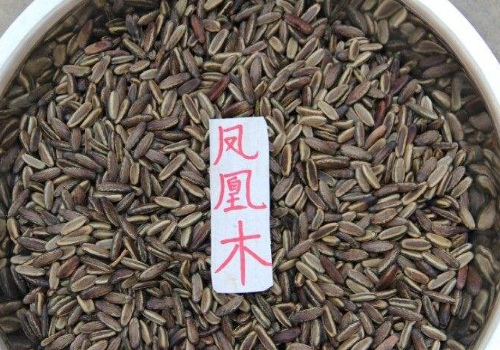
How to plant Flamboyant tree seeds:
Flamboyant tree seeds are generally sown in February-March. During this period the ground warms up and is fairly moist, making it a very suitable time for seeds to sprout. However, because climates vary from place to place, the growing period will also differ somewhat. Therefore, for the specific sowing time, please choose an appropriate time based on your local climate.
1. Seed selection: choose top-quality seeds, because only good seeds can produce healthy seedlings. Seed quality determines the seedling emergence rate; plump seeds with intact shells and a healthy color are the top-quality seeds we should choose.
2. Sprouting and awakening the seeds: Flamboyant tree seeds are generally first disinfected with a chemical solution, a process that allows the seeds to grow without pests and diseases. Before sowing, soak the seeds for 24 hours; once the seeds have fully absorbed water, scoop them out and let them dry, ready for sowing.
3. Planting soil: the Flamboyant tree is extremely adaptable, and its seeds have low soil requirements. Deep, fertile sandy loam is most suitable, though loess and clay will also do. Before sowing, dig over the seedbed once so the soil particles are uniform, allowing the seeds to breathe well during growth.
4. Sowing method: the Flamboyant tree is generally suited to drilling. Scatter the seeds in soil that has had furrows opened in it, with a row spacing of 20 cm. After sowing, cover with a layer of soil; do not bury them too deep. Then spread a layer of rice straw and spray the seedbed with water to keep it moist.
5. Tending and care: after the seeds go into the ground, do the basic watering, topdressing and thinning management. Flamboyant tree seeds like warmth and moisture; before the seeds germinate, keep the soil irrigated and moist. After the seedlings emerge, water frequently and weed promptly; later, pest and disease control is also needed. Insects in particular like to bite the seeds and seedlings, so observe frequently and act promptly.
Do you know the Flamboyant tree?
Flamboyant tree Delonix regia (Boj.) Raf. Flamboyant tree illustrated guide: how to grow the Flamboyant tree / how to propagate the Flamboyant tree
Flamboyant tree profileFlamboyant tree Delonix regia (Boj.) Raf.
How to grow the Flamboyant tree and points to note; an introduction to the Flamboyant tree
The Flamboyant tree gets its name from "leaves like the feathers of a flying phoenix, flowers like the crown of a red phoenix." Also known as golden phoenix flower, red-flowered phoenix tree, fire tree, foreign phoenix tree and so on, the Flamboyant tree is praised as one of the most colorful trees in the world thanks to its bright red or orange flowers paired with bright green bipinnate compound leaves. It is the national tree of the Republic of Madagascar in Africa, the city tree of Xiamen, Tainan City in Taiwan, China and Panzhihua in Sichuan, the city flower of Shantou in Guangdong Province, the city flower of Zhanjiang in Guangdong during the Republic of China period, and the campus flower of Shantou University and Xiamen University.
The Flamboyant tree is a tall plant, reaching over 20 m. Because its crown spreads horizontally and droops, dense, broad and wind-catching, it plays the role of a shade tree in tropical regions. It likes high temperatures and sunny days, and can only grow luxuriantly in a spot with ample sunlight. It is distributed in southern and southwestern China, in its native Madagascar and in tropical places around the world.
The Flamboyant tree is a plant of the genus Delonix in the Fabaceae family. Native to Madagascar in Africa. In the wild it is an endangered species. It has now been introduced and cultivated by humans and is widely planted as an ornamental tree. In Hong Kong, China it is a common introduced variety of deciduous tree; in Taiwan, China it was introduced in 1897, and Tainan City even designated it as its city flower, to match its alternative name "Phoenix City." The Flamboyant tree is also the city tree of Xiamen.
The Flamboyant tree is praised as one of the most colorful trees in the world thanks to its bright red or orange flowers paired with bright green bipinnate compound leaves. Because its crown spreads horizontally and droops, dense, broad and wind-catching, it plays the role of a shade tree in tropical regions. It is distributed in southern and southwestern China, in its native Madagascar and in tropical places around the world. In the United States, the Flamboyant tree grows only in Florida, the Rio Grande Valley in southern Texas, the desert areas of Arizona and California, Hawaii, Puerto Rico, the U.S. Virgin Islands and Guam. The Flamboyant tree also grows widely in the Caribbean region.
The Flamboyant tree is a tall plant, reaching over 20 m. It likes high temperatures and sunny days, and can only grow luxuriantly in a spot with ample sunlight. The flowers are large and red, with even the inner side of the calyx blood-red; four petals spread out about 8 cm long, and the fifth petal is upright, slightly larger and has yellow and white spots; the stamens are red, the ventral side of the calyx is dark red and the back is green. The inflorescence is a raceme, arranged in corymb-like fashion; the calyx and corolla each have 5 segments, clustered together. After flowering it produces long pod fruits one after another, up to 60 cm long, dark brown when mature, woody, containing 40-50 tiny seeds, each weighing on average only 0.4 g; the seed coat is mottled and toxic, and must not be eaten by mistake. The leaves are bipinnate compound leaves, with pinnae opposite, 15-30 pairs, and each pinna has 20-40 pairs of leaflets. The leaflets are oblong-elliptic, with a slanted base, entire margins and a rounded-blunt tip. The leaves are thin and papery, with a smooth, thin surface, blue-green, and only the midrib is obvious among the veins. The tree form is a broad umbrella shape, and when it sheds its leaves in winter, countless leaflets fall like snowflakes. Like many plants in the Fabaceae family, the roots of the Flamboyant tree also have rhizobia. To adapt to the rainy climate, buttress roots grow at the base of the trunk. The Flamboyant tree adapts to tropical climates, is drought-tolerant and can grow in salty environments.
In many places where it currently grows, the Flamboyant tree is regarded as an introduced variety, and in Australia it is even treated as an invasive species, partly because its broad crown and dense roots prevent other species from growing beneath it. In India the Flamboyant tree is called Gulmohar. The pods of the Flamboyant tree are used in the Caribbean region as a percussion instrument, called shak-shak or maracas.
Morphological characteristics of the Flamboyant tree
The Flamboyant tree is a tall deciduous tree, thornless, over 20 m tall, with a diameter at breast height of up to 1 m; the bark is rough and grayish-brown; the crown is flat-rounded, with many spreading branches; the branchlets are often covered with short soft hairs and have obvious lenticels.
The leaves are bipinnate compound leaves, 20-60 cm long, with stipules; the lower stipules are obviously pinnately divided, the upper ones bristle-like; the petiole is 7-12 cm long, smooth to covered with short soft hairs, grooved on top, with a swollen, cushion-like base; the pinnae are opposite, 15-20 pairs, up to 5-10 cm long; the leaflets number 25 pairs, densely opposite, oblong, 4-8 mm long and 3-4 mm wide, covered with silky hairs on both sides, with a blunt tip, slanted base and entire margin; the midrib is obvious; the leaflet stalks are short.
The corymbose raceme is terminal or axillary; the flowers are large and beautiful, 7-10 cm in diameter, bright red to orange-red, with a 4-10 cm long pedicel; the receptacle is saucer-shaped or short top-shaped; the calyx has 5 segments, red inside with greenish-yellow edges; the corolla has 5 segments, spoon-shaped, red, with yellow and white blotches, 5-7 cm long and 3.7-4 cm wide, curling back toward the calyx after flowering, with a slender claw about 2 cm long; there are 10 stamens, red, of unequal length, 3-6 cm long, curving upward, with thick filaments covered with cottony hairs in the lower half, and red anthers about 5 mm long; the ovary is about 1.3 cm long, yellow, covered with soft hairs, sessile or with a short stalk, and the style is 3-4 cm long with a small, truncate stigma.
The diameter at breast height can reach 1 m; the bark is rough and grayish-brown; the tree form is a broad umbrella shape, with many spreading branches; the branchlets are often covered with short downy hairs and have obvious lenticels. When it sheds its leaves in winter, countless leaflets fall like snowflakes. It likes high temperatures and sunny days, and can only grow luxuriantly in a spot with ample sunlight.
The leaves are bipinnate compound leaves, with pinnae opposite, 15-30 pairs, and each pinna has 20-40 pairs of leaflets. The leaflets are oblong-elliptic, with a slanted base, entire margins and a rounded-blunt tip. The leaves are thin and papery, with a smooth, thin surface, blue-green, and only the midrib is obvious among the veins.
After flowering it produces long pod fruits one after another, up to 60 cm long, dark brown when mature, woody, containing 40-50 tiny seeds, each weighing on average only 0.4 g; the seed coat is mottled and toxic, and must not be eaten by mistake.
Like many plants in the Fabaceae family, the roots of the Flamboyant tree also have rhizobia. To adapt to the rainy climate, buttress roots grow at the base of the trunk. The Flamboyant tree adapts to tropical climates, is drought-tolerant and can grow in salty environments.
The pod is strap-shaped, flat, 30-60 cm long and 3.5-5 cm wide, slightly curved, dark reddish-brown, blackish-brown when mature, with a persistent style at the tip; the seeds number 20-40, transversely oblong, smooth, hard, yellow stained with brown spots, about 15 mm long and about 7 mm wide.
The Flamboyant tree is praised as one of the most colorful trees in the world thanks to its bright red or orange flowers paired with bright green bipinnate compound leaves. Because its crown spreads horizontally and droops, dense, broad and wind-catching, it plays the role of a shade tree in tropical regions.
The flowering period is June-July, and the fruiting period is August-October.
Ecological habits of the Flamboyant tree
The Flamboyant tree is a tropical tree species and begins to flower 6-8 years after planting. It likes high temperatures, high humidity and ample sunlight, with an optimum growing temperature of 20-30 degC, is not cold-tolerant, and the winter temperature should not be below 10 degC. Deep, fertile sandy loam rich in organic matter is ideal; it fears waterlogging, so drainage must be good, and it is relatively drought-tolerant; it tolerates poor soil. It is shallow-rooted, but its root system is well developed and its wind resistance is strong. It resists air pollution. Its sprouting ability is strong and it grows rapidly. Generally, a 1-year-old plant can reach 1.5-2 m tall, a 2-year-old plant can reach 3-4 m tall, and it begins to flower 6-8 years after planting. In South China, the winter buds sprout in early February each year, growth peaks from April to July, growth declines in late July because the temperature is too high, growth speeds up after the temperature drops in mid-to-late August, slows down after October, and leaves fall from December to January of the following year.
The Flamboyant tree begins to flower 6-8 years after planting. It likes high temperatures and sunny days, and can only grow luxuriantly in a spot with ample sunlight, so it grows faster in the tropics of the south. Generally, a 1-year-old plant can reach 1.5-2 m tall, a 2-year-old plant can reach 3-4 m tall, with a tall trunk and a large crown. The Flamboyant tree likes light and is shallow-rooted, with an average optimum temperature of 20-24 degC. The winter buds sprout in early February each year, growth peaks from April to July, growth declines in late July because the temperature is too high, growth speeds up as the temperature drops in mid-to-late August, slows down after October, and leaves fall from December to January.
It likes light and a hot, humid climate. The planting site can be in full sun or partial sun. The soil must be fertile sandy loam rich in organic matter, and drainage must be good. It is not drought-tolerant or tolerant of poor soil, is not cold-tolerant, and resists wind and air pollution. It is used as a garden landscape tree, shade tree and street tree. The Flamboyant tree is suitable for planting in sandy soil with ample sunlight, some shelter and good drainage. The flowering period is June to July. For propagation and cultivation, seed propagation requires soaking first in 90 degC hot water for 5-10 minutes for a higher germination rate.
Cultivation techniques for the Flamboyant tree
It should be planted in a sunny spot with fertile, deep soil and good drainage. Seedlings need to be transplanted once after growing for 1-2 years, and transplanting is best done in early spring. The plant and row spacing is about 60 cm, and 3-year-old seedlings can be used for field planting.
The planting site should be an open, sunny spot, and during dry weather it should be watered thoroughly. The Flamboyant tree has low soil requirements and can grow well even in relatively poor soil, because its roots have rhizobia that can fix nitrogen and increase soil fertility, but waterlogging will kill the rhizobia and affect plant growth. The trunk of the Flamboyant tree will sprout branches and leaves at any time, and if left to grow naturally its shape will vary greatly, so it needs frequent pruning. The Flamboyant tree is not cold-tolerant, and in northern regions it can only be cultivated and cared for in a greenhouse.
For transplanting, the survival rate is higher before sprouting in spring; it can also be planted in the rainy season, but some branches and leaves must be pruned to ensure survival. The plant has strong sprouting ability, so the trunk-cutting method can be used to grow large seedlings. After field planting, loosen the soil and weed 2-3 times each year, water in good time, apply topdressing once each in spring and autumn, and promptly remove root suckers to ensure good tree growth.
Propagation methods for the Flamboyant tree
Seed sowing is commonly used to raise seedlings. The thousand-seed weight is about 400 g. The seed coat absorbs water with difficulty, so the seeds need to be scalded with 80 degC warm water to promote sprouting; after cooling naturally, continue soaking for 24 hours, then drain and set aside. Sow by the strip-dibbling method. Seedlings are relatively sensitive to frost; early on, a compound fertilizer can be applied, with little nitrogen fertilizer, and fertilization should stop after autumn to encourage early lignification. In winter, if the leaves have not yet fallen, they can be cut off by hand, and plastic film can be used for covering or individual plants can be wrapped to prevent frost. 1-year-old seedlings can be lifted from the nursery for field planting.
Sowing propagation
The Flamboyant tree is mainly propagated by sowing.
The seeds mature in December; collect the pods, take out the seeds and store them dry, then sow in spring the following year. Before sowing, soak the seeds in boiling water, and after it cools continue soaking for 1-2 days, changing to clean water 1-2 times in between. After sowing, germination begins in 6-7 days, and all seedlings can emerge in just over 20 days; 1-year-old seedlings can reach about 1.5 m.
The thousand-seed weight is about 400 g. The seed coat absorbs water with difficulty, so the seeds need to be scalded with 80 degC warm water to promote sprouting; after cooling naturally, continue soaking for 24 hours, then drain and set aside. Sow by the strip-dibbling method. Seedlings are relatively sensitive to frost; early on, a compound fertilizer can be applied, with little nitrogen fertilizer, and fertilization should stop after autumn to encourage early lignification. In winter, if the leaves have not yet fallen, they can be cut off by hand, and plastic film can be used for covering or individual plants can be wrapped to prevent frost. 1-year-old seedlings can be lifted from the nursery for field planting.
Pest and disease control for the Flamboyant tree; common pests
The pest found on the Flamboyant tree is an insect of the "night moth" type. Its larvae feed on plant leaves, often stripping the host's leaves bare and seriously affecting the tree's growth and ornamental value. Pest damage to the Flamboyant tree is most severe in July, August and September. The Flamboyant tree night moth is not harmful to humans, but some people will develop allergic symptoms because of it.
Control methods
Seize the period when the larvae cluster and cause damage, and dust with powder in the early morning before the dew has dried. You can dust with 2.5% trichlorfon powder, 1.5% parathion (1605) powder or 1.5% dimethoate powder, at 1.5-2 kg per mu.
Distribution range of the Flamboyant tree
Distribution range: southern and southwestern China, its native Madagascar and tropical places around the world; native to Madagascar in Africa. It has been widely introduced and planted in tropical and warm subtropical regions around the world. It has been introduced and cultivated in Taiwan, China, Hainan, Fujian, Guangdong, Guangxi, Yunnan and other provinces and regions. In the United States, the Flamboyant tree can grow in Florida, the Rio Grande Valley in southern Texas, the desert areas of Arizona and California, Hawaii, Puerto Rico, the U.S. Virgin Islands and Guam, and also grows widely in the Caribbean region.
Madagascar; widely cultivated in tropical regions around the world. It has been introduced and cultivated in Taiwan, China, Hainan, Fujian, Guangdong, Guangxi, Yunnan and other provinces and regions. It is native to Madagascar and tropical places around the world. In the United States, the Flamboyant tree grows only in Florida, the Rio Grande Valley in southern Texas, the desert areas of Arizona and California, Hawaii, Puerto Rico, the U.S. Virgin Islands and Guam. The Flamboyant tree also grows widely in the Caribbean region.
It is distributed in southern and southwestern China, in its native Madagascar and in tropical places around the world. In the United States, the Flamboyant tree grows only in Florida, the Rio Grande Valley in southern Texas, the desert areas of Arizona and California, Hawaii, Puerto Rico, the U.S. Virgin Islands and Guam. The Flamboyant tree also grows widely in the Caribbean region.
Native to Madagascar in Africa, it is also distributed in Taiwan, China, Hainan, Yunnan, Guangdong, Guangxi, Fujian and other places [1]. In the wild it is an endangered species [2], and it has now been introduced and cultivated by humans and is widely planted as an ornamental tree. In Hong Kong, China it is a common introduced variety of deciduous tree.
In many places where it currently grows, the Flamboyant tree is regarded as an introduced variety, and in Australia it is even treated as an invasive species, partly because its broad crown and dense roots prevent other species from growing beneath it. In India the Flamboyant tree is called Gulmohar. The pods of the Flamboyant tree are used in the Caribbean region as a percussion instrument, called shak-shak or maracas.
In Malaysia, you can also see yellow Flamboyant trees, which are truly beautiful.
Medicinal or dietary value of the Flamboyant tree
The medical information and health dietary information on Hugflower.com is for reference only and cannot be used as a basis for diagnosis or medical treatment. Any health problem should be consulted with a professional medical practitioner, and the treatment of any disease should follow a doctor's advice.
The ultimate flower-protecting mission: love yourself, and start from reality by strictly following your doctor's advice. For illness, do not be careless, do not delay, do not give up hope; face it bravely, warm the silent world with love, and tend the flower field in your heart with care.
Medicinal value
Nature and flavor: bark: sweet, bland, cold.
Effects: bark: calms the liver and subdues yang, clears heat. Treats dizziness, restlessness and unease; root: treats rheumatic pain.
Dosage and use: oral: decocted in water, 3-10 g; or wash the eyes with boiled water.
Toxicity: the flowers and seeds are toxic. After a child eats the seeds by mistake and is poisoned, there are digestive tract symptoms such as dizziness, salivation, abdominal bloating, abdominal pain and diarrhea. The water extract of the stem bark has an emetic effect and an inhibitory effect on the central nervous system in cats and monkeys. The alcohol and water extracts of the flowers have an effect against roundworms. The toxic components are unknown. The flowers contain carotenoids. The seeds contain phospholipid compounds such as lysolecithin. The stem bark contains erythritol and leucocyanidin. Eating it by mistake will cause symptoms such as abdominal pain, abdominal bloating, diarrhea, dizziness and salivation.
Toxicity
The flowers and seeds are toxic. After a child eats the seeds by mistake and is poisoned, there are digestive tract symptoms such as dizziness, salivation, abdominal bloating, abdominal pain and diarrhea. The water extract of the stem bark has an emetic effect and an inhibitory effect on the central nervous system in cats and monkeys. The alcohol and water extracts of the flowers have an effect against roundworms. The toxic components are unknown. The flowers contain carotenoids. The seeds contain phospholipid compounds such as lysolecithin. The stem bark contains erythritol and leucocyanidin.
Uses and purposes of the Flamboyant tree; ornamental value
The Flamboyant tree has a tall crown, and in its flowering season the flowers are red and the leaves green, the whole tree like fire, magnificent. Because "the leaves are like the feathers of a flying phoenix, and the flowers are like the crown of a red phoenix," it is named the Flamboyant tree. It is a famous tropical ornamental tree species.
Garden uses of the Flamboyant tree
It is planted quite extensively in botanical gardens and parks in southern Chinese cities, as an ornamental tree or street tree.
Street tree
As a street greening tree, it has a microclimate effect of cooling and humidifying in summer, and is a landscape tree for greening, beautifying and scenting the environment.
Shade tree
In midsummer, a Flamboyant tree with a diameter at breast height of 7-8 cm can have a maximum crown width of 8-10 m, and its shading rate is between 50% and 70%. The Flamboyant tree has many branches, and the difference between the middle and the edge of the crown is not great, so the shading effect is relatively even and ventilation conditions are relatively good. The relative temperature inside the crown is 3 degC lower than in exposed places outside, and up to 6 degC lower at most. In summer the planting site generally stays at around 23-28 degC, and the relative humidity inside the crown is 10%-20% higher than in exposed ground outside.
Cultural background of the Flamboyant tree; plant culture
The Flamboyant tree (Delonix regia) is named from "leaves like the feathers of a flying phoenix, flowers like the crown of a red phoenix."
The Flamboyant tree is the national tree of the Republic of Madagascar in Africa, the city flower of Shantou in Guangdong, China, and the city tree of Xiamen in Fujian, Tainan City in Taiwan, China and Panzhihua in Sichuan.
In Taiwan, China, it was introduced in 1897, and because the Flamboyant tree blooms abundantly in June, it is often listed together with the chirping of cicadas as a symbol of graduation.
The phoenix flower is the city flower of Tainan City in Taiwan, China, to match its alternative name "Phoenix City"; National Cheng Kung University uses the phoenix as its campus flower.
The Flamboyant tree is the city tree of Xiamen in Fujian Province, mainland China. Xiamen University uses the phoenix as its campus flower.
In Shantou, the Flamboyant tree is also called "golden phoenix flower," and it is also the city flower of Shantou.
The Flamboyant tree was once the city tree of Panzhihua in Sichuan Province, but because the Flamboyant tree suffered severe inchworm infestations for many consecutive years in the mid-to-late 1990s and was cut down in large numbers, its place as city tree was later replaced by the kapok tree.
Related literary works
The Flamboyant Tree - Aili
I met you in the winter of Lingnan.
Beside you the acacia trees are lush and verdant,
Burying themselves in writing densely woven thoughts.
You, with open and upright branches, hold the clear sky still.
Nobility needs no words.
In March I made a special trip to see you.
Goose-yellow and pale green, a young phoenix newly crying.
Thread by thread, drop by drop.
With a slender brass pen,
I depict them one by one, remember them one by one.
In June, your red, abundant flowers
Turn into butterflies piece by piece in the sunlight.
The cuckoo cries blood, calling until the southern scenery breaks off.
I stand on the other side of the mountain, gazing far away;
Spring is at its fullest.
In the dusty lanes and alleys, how many return roads have been lost.
Now, Cold Dew has arrived.
How much fragrance has faded, how much jade has been worn away.
The memories of spring
Have long since fallen and turned to mud.
I will choose a chilly, quiet day
To sit quietly beside you.
To listen to the sound of a drifting heart;
To watch the late-autumn sunset depart,
Washing over the riverbed of the seasons.
National flower and city flower of the Flamboyant tree
The Flamboyant tree is the national tree of Madagascar.
The phoenix flower is the city flower of Tainan City in Taiwan, China.
The Flamboyant tree is the city tree of Xiamen in Fujian Province, mainland China. Xiamen University uses the phoenix as its campus flower.
In Shantou, the Flamboyant tree is also called "golden phoenix flower," and it is also the city flower of Shantou.
The flower language of the Flamboyant tree
The flower language of the phoenix flower: parting, longing, fiery youth
The phoenix flower is the flower of the Flamboyant tree. The phoenix flower tree has a tall crown and blooms from May to the end of summer. The flower has five petals, is large and beautiful, and in its flowering season the flowers are red and the leaves green, the whole tree like fire, magnificent. It is praised as one of the most brilliantly colored trees. Because "the leaves are like the feathers of a flying phoenix, and the flowers are like the crown of a red phoenix," it is named the Flamboyant tree, and it is a famous tropical ornamental tree species.
Flamboyant tree pictures
What are the common pests of the flamboyant tree and how to control them? How is it different from the silk tree?
Because of its bright red or orange flowers combined with bright green bipinnate leaves, the flamboyant tree is praised as one of the most colorful trees in the world. What are the common pests of the flamboyant tree and how to control them? How is it different from the silk tree?
What are the common pests of the flamboyant tree and how to control them:
1. Common pests: the pest found on the flamboyant tree is an insect of the “noctuid moth” type. This insect damages plants by having its larvae feed on the leaves, often eating all the leaves of the host plant, seriously affecting the tree's growth and ornamental value. Pests on the flamboyant tree are most severe in July, August and September. The flamboyant tree noctuid moth is not harmful to humans, but some people will develop allergic symptoms because of it.
2. Control method: seize the period when the larvae gather and cause damage, and dust with powder in the early morning before the dew has dried. You can dust with 2.5% trichlorfon powder, or 1.5% parathion (1605) powder, or 1.5% dimethoate powder, at 1.5-2 kg per mu.
How is the flamboyant tree different from the silk tree:
I. Flamboyant tree
1. The plant is tall, reaching more than 20 m.
2. It likes high temperatures and sunny days, and must be in a spot with ample sunlight to grow luxuriantly.
3. The flowers are large and red; even the inner side of the calyx is blood-red. Four petals spread out about 8 cm long, and the fifth petal is upright, slightly larger, and has yellow and white spots. The stamens are red; the ventral side of the calyx is dark red and the dorsal side is green.
4. The inflorescence is a raceme, arranged in a corymb-like form; both the calyx and the corolla have 5 segments, gathered into clusters.
5. After flowering it produces long pod fruits one after another, up to 60 cm long, dark brown when mature and woody, containing 40-50 tiny seeds, each weighing on average only 0.4 g; the seed coat is mottled and toxic, and must not be eaten by mistake.
6. The leaves are bipinnately compound, with pinnae opposite, 15-30 pairs, and each pinna has 20-40 pairs of leaflets. The leaflets are long-elliptic, with a slanted base, entire margins and a rounded-obtuse tip. The leaves are thin and papery, smooth and thin on the surface, blue-green, and only the midrib of the veins is obvious.
II. Silk tree
1. It is a deciduous tree with an umbrella-shaped crown. The leaves are alternate, and the inflorescence is corymbose; the stamen filaments are thread-like, half white and half red, hence the names “horse mane flower” and “velvet flower”.
2. The trunk is light grayish-brown, and the bark is slightly longitudinally fissured. The branches are thick and sparsely growing, and the young branches are angular.
3. The leaves are evenly bipinnately compound on both sides, with 10-30 pairs of leaflets, sickle-shaped and round, opening by day and closing at night.
4. The inflorescence is a corymbose head; the calyx and corolla are both yellow-green, five-lobed, and the upper part of the filaments is red or pink thread-like, clustered into balls. The flowering period is June-July.
5. The fruit is a pod, and the ripening period is October.
Do you like the flamboyant tree?