Why does a peace lily turn green after being grown in water?
The peace lily (Spathiphyllum) is very attractive, with white flowers. How do you grow a peace lily in water? Why does it turn green?
How to grow a peace lily in water:
1. Steps:
1. Removing from the pot
Take the soil-grown plant out of its pot, clear away the old soil around the roots, and rinse clean with water. Cut off the aged and rotten roots.
2. Planting
Fix the plant in a planting basket to hold it steady. Then add a small amount of stones to the hydroponic container. For ordinary hydroponics, if you choose a narrow-necked bottle, you can simply use stones to hold the plant steady, and there is no need to use a planting basket.
3. Adding water
Make sure the hydroponic container has plenty of water. Converting from soil culture to water culture requires a period of adjustment, so there should be some distance between the roots and the water to let the roots breathe; just make sure 1/3 of the roots are in the water.
2. Care
1. Temperature
The growing temperature for hydroponic peace lilies is 5°C—30°C, and they can grow normally within this range. Place the plant in a spot with bright light and no direct sunlight for care. Do not expose it to strong direct sun.
2. Changing the water
Over time, the inner walls of the container easily grow algae, which affects the appearance of the roots and also consumes oxygen in the water. So change the water often and clean the inner walls.
When changing the water, first wash away the mucus on the flower's roots with clean water, and cut off old roots and rotten roots. Also scrub the algae off the container and the roots. Each time you change the water, the water level should be enough to submerge 1/2—2/3 of the root system, and let the remaining root sections stay exposed to the air.
3. Fertilizing
To prevent the leaves from drying out, in daily care spray the leaf surfaces with clean water to keep them moist. It is best to spray a foliar fertilizer once a week, which not only provides nutrients to the leaves and increases their gloss, but also helps resist low temperatures in winter.
When the peace lily is in the bud stage, use a nutrient solution for foliage plants; the leaves need to be sprayed 2 to 3 times, which can encourage it to bloom.
Why does a peace lily turn green:
1. A natural phenomenon
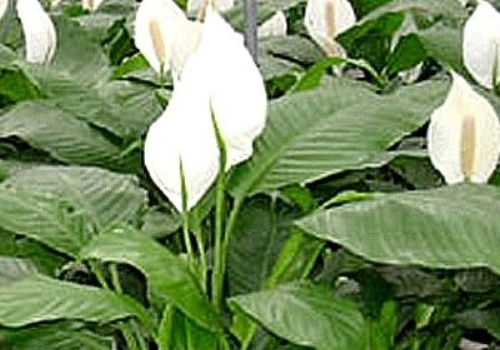
Everyone knows that during the flowering process of a peace lily, the flower is first as white as snow, then slowly turns green, and finally becomes the same green as the stems and leaves, while the yellow spadix also turns black. This is not a mutation, but a normal phenomenon of flower metabolism. The petals of the peace lily contain a small amount of chlorophyll. When the flower reaches its late stage and is about to fade, trace elements remain in the plant body, carotene is largely broken down, and only chlorophyll is broken down last, so the petal color turns green, and after a few more days the flower fades. At this time, you may consider cutting off the entire inflorescence from the base, so as to avoid consuming too many nutrients and harming the next bloom.
So after a peace lily has been blooming for a period, turning from white to green and becoming a “green lily” is a natural phenomenon; there is no need to be too surprised. The color of the “green lily” is so emerald green it seems to drip, like a perfect piece of craftsmanship, and it is also very ornamental.
2. Light-related causes
In addition, if the spathe bud turns green just a few days after opening, then it is not a natural phenomenon. This is mainly caused by light that is too weak; the flower color of any white variety will show a greenish tint under weak light conditions. At this time, simply increasing the light intensity a little will turn it back to white. Then apply a little special fertilizer, so as to ensure the quality of the peace lily and make its bloom last longer.
So everyone, do not worry. When a peace lily turns green, just supplement as much light as possible, and once it has accumulated enough nutrients, it will turn back to white on its own!
Well, that is all for the introduction on peace lilies turning green. Everyone understands now, right?
How to grow a hydroponic peace lily: cultivation methods for hydroponic peace lilies
The peace lily, also known as spathe lily, sailboat flower, lily intent, and so on, is a perennial herbaceous plant of the genus Spathiphyllum in the Araceae family, with emerald green leaves and white spathes. It is very fresh and elegant, has good ornamental value, and can also filter indoor exhaust air, with a certain purifying effect on ammonia, acetone, benzene and formaldehyde. Now let us take a look at the cultivation methods for hydroponic peace lilies!
The growth habits of the peace lily
The peace lily likes high temperatures, high humidity and a semi-shaded environment. It is relatively sensitive to humidity, fears strong direct sun, and needs 60-70% shade in summer, but long-term insufficient light makes it difficult to bloom. The soil is best if it is fertile loam rich in humus. The optimum growing temperature is 22-28°C, with 24-30°C from March to September, and 18-21°C from September to March of the following year. The winter temperature should not be lower than 14°C; below 10°C the plant's growth is hindered and the leaves are prone to cold damage. During storage and transport, the temperature should be controlled at 13-16°C, with a relative humidity of 80-90%, and it can endure a dark environment for 30 days.
Propagation methods for the peace lily
1. Division: Division propagation of the peace lily is best done in May-June. Take the whole plant out of the pot, cut the rhizome apart from the base of the clump, with each clump having at least 4 leaves; after potting them separately, place them in a semi-shaded spot to recover.
2. Sowing: After the peace lily blooms, seeds can be obtained through artificial pollination. After collecting the seeds, they must be sown immediately. The germination temperature is 30°C, and they sprout 10-15 days after sowing. If the temperature is too low during germination, the seeds easily rot.
3. Tissue culture: Using young inflorescences and lateral buds of the peace lily as explants, after disinfection they are inoculated onto MS medium supplemented with 10 mg/L 6-benzylaminopurine and 2 mg/L indoleacetic acid. After 40-45 days, callus tissue and adventitious buds grow. The adventitious buds are then transferred to MS medium supplemented with 2 mg/L indoleacetic acid, and after 30-40 days roots are induced, forming complete plants.
How to grow a hydroponic peace lily?
1. Container: Hydroponic peace lilies are usually kept at home, so of course you should choose a very nice, beautiful container; the specific choice depends on personal preference.
2. Temperature: The best growing temperature for peace lilies is 20-28°C, so when growing hydroponic peace lilies indoors, pay attention to controlling the room temperature well.
3. Light: Hydroponic peace lilies mainly need scattered light, and do not necessarily have to be exposed to the sun; in summer, try to avoid direct sunlight.
4. Changing the water: For hydroponic peace lilies, change the water about once every 7 days in summer and about once every 10-15 days in winter. Add a few drops of special nutrient solution for hydroponic flowers.
5. Fertilizing: In daily care of hydroponic peace lilies, spray the leaf surfaces with clean water to keep them moist; it is best to spray a foliar fertilizer once a week.
Precautions for hydroponic peace lilies
1. Peace lilies need good light in winter and early spring; do not keep them in shade. When the light gradually strengthens, shade them gradually. If they have been enjoyed in a shaded place, do not place them directly in the sun to bake, otherwise they will show discomfort due to the abrupt change in environment, manifested as wilting, yellow leaves, and even death.
2. Peace lilies need relatively high growing humidity. If the air is too dry, it will cause the leaves to wilt. This can be solved by increasing misting or sprinkling water on the floor around them. Covering them with a transparent plastic bag also works, but when the light is good, ventilate slightly or cut an opening at the top of the plastic bag for ventilation, otherwise the temperature inside the bag will rise sharply.
3. To prevent the leaves of peace lilies from drying out, in daily care spray the leaf surfaces with clean water to keep them moist. It is best to spray a foliar fertilizer once a week, which not only provides nutrients to the leaves and increases their gloss, but also helps resist low temperatures in winter. Use a nutrient solution for foliage plants; during the bud stage, the leaves need to be sprayed 2 to 3 times with a 0.3% potassium dihydrogen phosphate solution, which can encourage it to bloom.
4. If peace lilies are harmed by pest mites, the leaves will show poor symptoms such as wilting, faded gloss, and yellowing and withering. Miticides can be sprayed for prevention and control, such as dicofol, hexythiazox, pyridaben, and so on. Common bacterial leaf spot, brown spot and anthracnose harm the leaves, and can be sprayed with a 50% carbendazim wettable powder 500-fold solution.
Is it better to grow a peace lily in water or in soil? How to safely get a hydroponic peace lily through winter
I believe many friends know about peace lilies, but maybe everyone is not clear about it, so is it better to grow a peace lily in water or in soil, and what to do if the leaves of a hydroponic peace lily turn yellow? Below, the editor will take everyone to take a look!
1. Is it better to grow a peace lily in water or in soil?
For beautifying the indoor environment, hydroponic peace lilies are the simplest and most eco-friendly cultivation method. It can keep the plant's roots white and clean and attractive, and greatly enhances the overall ornamental value of the plant.
For the peace lily's own growth, soil culture is somewhat better than water culture. This is because the nutrients in soil are more complete and also rich in many trace elements, which can promote the growth of the peace lily's root system, while hydroponic peace lilies cannot easily meet these conditions, and it is also hard to make peace lilies bloom.
2. What to do if the leaves of a hydroponic peace lily turn yellow
First, promptly cut off the yellowed leaves.
Next, find the factors causing the leaves to turn yellow. Generally speaking, frequent water changes for the peace lily, excessive fertilizing, insufficient light, too low temperature and other factors can all cause leaves to turn yellow. You should suit the remedy to the case according to the actual situation and correct improper care methods.
3. How to safely get a hydroponic peace lily through winter
1. Control the temperature. The growing temperature for hydroponic peace lilies is 5°C-30°C, and they can grow normally within this range, so the winter room temperature must absolutely not be lower than 5°C.
2. Ensure light. Light decreases in winter, but peace lilies do not necessarily have to be exposed to the sun. Placing the peace lily in a spot with plenty of scattered light can also ensure its healthy growth.
3. Change the water correctly. In winter, change the water once every 10-15 days. While changing the water, add a few drops of special nutrient solution for hydroponic flowers to the pot, which helps the peace lily absorb nutrients.