A Detailed Guide to the Benefits, Uses and Propagation Methods of Tillandsia
Tillandsia is a relatively uncommon plant in everyday life. What are the benefits and uses of Tillandsia? How do you propagate it?
Benefits and uses of Tillandsia:
1. Ornamental value
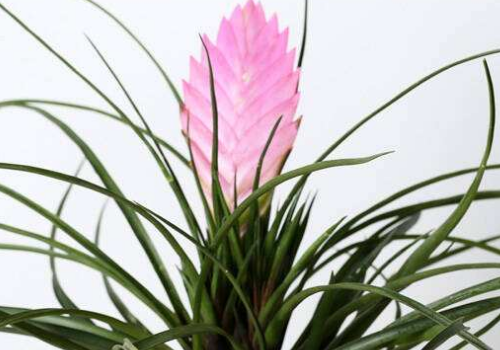
Tillandsia belongs to the Bromeliaceae family, and these plants usually have a novel and elegant form. As an important variety within the Bromeliaceae family, Tillandsia also has quite high ornamental value. In everyday life, Tillandsia can often be seen, along with many Tillandsia enthusiasts, all of which shows people's fondness for Tillandsia. Tillandsia is a plant with very high ornamental value, and there are also a great many varieties of Tillandsia, giving it very high ornamental value.
2. Decorative value
As a potted plant placed indoors, Tillandsia has very high decorative value. It can be placed on a balcony, windowsill or desk, or used as an accompanying material hung in the living room, or made into a flower-arrangement artwork; all of these can fully display Tillandsia's beautiful form and add a scenic touch to your home.
3. Air purification ability
Tillandsia has a strong air purification ability. With pollution being quite serious nowadays, Tillandsia, with its role in beautifying the environment and improving the air, is sure to be loved by more and more people.
How to propagate Tillandsia:
1. Propagation by seed
Tillandsia seeds are generally obtained by artificial pollination. Once the seeds are obtained, they should be sown immediately. The sowing soil can be a mix of peat soil + perlite + river sand. Before sowing, the soil needs to be sterilized first, then the seeds are evenly scattered on the soil and covered with plastic film; no soil cover is needed. The optimal temperature for germination is between 24°C and 26°C, and seedlings will emerge in one to two weeks. When the young seedlings grow 3 to 4 leaves, they can be transplanted into other flower pots for final planting.
2. Propagation by division
The best time for division is from April to June. When the offsets have grown 3 to 5 leaves and reached a height of 10 cm, first pull the whole plant out of the pot, clean off the soil, then break off the offsets. After breaking them off, disinfect the wounds first and let them dry naturally in the sun, then insert them into suitable soil. At this time, make sure the soil and air are moist; just do not let direct sunlight hit them. After 1 to 2 months, when new roots have grown, they can be cared for according to normal maintenance methods.
3. Propagation by cuttings
Propagation by cuttings is also a common propagation method among flower lovers. Wait until the tiller buds of Tillandsia grow to a height of 10 cm and produce 3 to 5 leaves, then they can be cut off directly. The wounds should be disinfected and dried in the sun, then inserted into coarse sand or perlite. As with division, make sure the soil and air have appropriate moisture; just do not let direct sunlight hit them. After 1 to 2 months, when new roots have grown, they can be cared for according to normal maintenance methods; the selection of tiller buds is very important: they must not be too large, and also must not be too small.
Well, that is all for the introduction to Tillandsia propagation methods. Everyone understands now, right?
Benefits and Uses of Tillandsia, and How to Grow Tillandsia
If you have never grown Tillandsia, hearing its name might make you think it certainly is not very beautiful, but quite the opposite: Tillandsia flowers are surprisingly beautiful. The beautiful Tillandsia has vivid flower colors and a unique shape, and is deeply loved by people. But it differs somewhat from other plants. So what exactly are the benefits and uses of Tillandsia? What are the methods for growing Tillandsia? Let's take a look together.
Benefits and uses of Tillandsia:
When it comes to the benefits and uses of Tillandsia, like other plants, it has quite good ornamental value, decorative value, air purification ability and so on. For specifics, let's look at the detailed introduction below:
1. The ornamental value of Tillandsia:
Tillandsia belongs to the Bromeliaceae family, and these plants usually have a novel and elegant form. As an important variety within the Bromeliaceae family, Tillandsia also has quite high ornamental value. In everyday life, Tillandsia can often be seen, along with many Tillandsia enthusiasts, all of which shows people's fondness for Tillandsia. Tillandsia is a plant with very high ornamental value, and there are also a great many varieties of Tillandsia, giving it very high ornamental value.
2. The decorative value of Tillandsia:
As a potted plant placed indoors, Tillandsia has very high decorative value. It can be placed on a balcony, windowsill or desk, or used as an accompanying material hung in the living room, or made into a flower-arrangement artwork; all of these can fully display Tillandsia's beautiful form and add a scenic touch to your home.
3. The air purification ability of Tillandsia:
Tillandsia has a strong air purification ability. With pollution being quite serious nowadays, Tillandsia, with its role in beautifying the environment and improving the air, is sure to be loved by more and more people.
The above is a brief introduction to the benefits and uses of Tillandsia. It is believed that after the above introduction, everyone will have a further understanding and knowledge of this plant. Of course, growing Tillandsia at home is not easy; you must master its growing methods to grow it well. So what exactly are the methods for growing Tillandsia? Let's take a look at the introduction below:
Methods for growing Tillandsia:
1. Temperature:
Tillandsia must grow in an environment above 16°C, regardless of spring, summer, autumn or winter. In winter it can be moved to a greenhouse or indoors, but the lowest nighttime temperature must not be below 10°C.
2. Water:
Tillandsia needs a large amount of water during its growth period, so sufficient moisture must be maintained. In summer during high temperatures, keep watering twice a day; in winter, just keep the potting soil moist.
3. Fertilizing:
Fertilize once a month, using a half-concentration standard liquid fertilizer. Pay special attention that some varieties of Tillandsia do not need fertilizing.
4. Propagation method:
Generally, propagation is done by the method of separating basal offsets. When the basal offsets grow to 8 cm long, detach them and plant them.
5. Placement:
Tillandsia flowers like a bright, semi-shaded, warm and relatively humid environment, and need to be placed in a spot with bright light but no direct sunlight.
6. Precautions:
The winter temperature must not be too low, and attention should be paid to temperature changes; in summer, avoid direct sunlight, but do not place it in a dark corner, and pay attention to preventing pests and diseases.
Benefits and Uses of Tillandsia
The plant Tillandsia is, to be precise, one type of the Bromeliaceae family. Generally, we call it by its other names, such as purple-flowered Tillandsia, fine-leaved Tillandsia and so on. As a member of the Bromeliaceae family, Tillandsia clearly inherits the graceful form of bromeliads and is a relatively outstanding bromeliad plant. To understand a plant, we certainly need to go a bit deeper to understand it more comprehensively. So next, let's learn about the benefits and uses of Tillandsia together.
Benefits and uses of Tillandsia1. The ornamental value of Tillandsia
Tillandsia is a plant of the Bromeliaceae family. Most bromeliads have novel and elegant forms. As one of the relatively important varieties among them, Tillandsia naturally has extremely high ornamental value. In our everyday life, we will also find some Tillandsia enthusiasts, all of which shows that in people's eyes, Tillandsia is a plant with very high ornamental value, and as varieties become more diverse, everyone will surely like Tillandsia more and more.
2. The decorative value of Tillandsia
Tillandsia can also be grown as a potted plant and placed in an indoor environment. For example, it can be placed on a balcony, windowsill or desk, or used as an accompanying material, such as hung in the living room, or as a flower-arrangement artwork. These are all ways to make use of Tillandsia. The presence of Tillandsia will surely bring more and more wonderful things to your life.
3. The air purification ability of Tillandsia
As a plant, Tillandsia has a strong ability to purify the air. In today's situation where pollution is quite serious, Tillandsia, with its ability to beautify the environment and improve the home environment, is sure to be favored by more people, so the editor strongly recommends it.