Watering Methods and Propagation Techniques for Calceolaria
Calceolaria, with its unique appearance, has considerable ornamental value. How do you water Calceolaria? How do you propagate it?
How to water Calceolaria:
1. Watering time
It is often said that Calceolaria is like a shy maiden, so watering Calceolaria must be done very gently, and you must be careful to get the amount right when watering. It is suited to growing in relatively moist conditions, so watering needs to be adjusted reasonably according to the moisture level of the growing medium.
If the medium is fairly dry, you can water the Calceolaria to replenish moisture; if the medium is already fairly moist, you can hold off on watering for the time being. In short, keep Calceolaria growing in a medium with a suitable, consistent moisture level.
2. Watering volume
Besides watering time, you also need to control the amount of water given each time. Each time, simply water an appropriate amount according to the actual situation. As mentioned earlier, it is very delicate, so be careful to get the watering amount right when watering: avoid watering too much and damaging its roots, and do not water too little either, otherwise it will fail to replenish moisture.
In short, when to water and how much to water should both be based on actual conditions; just keep the soil relatively moist at all times.
How to propagate Calceolaria:
I. Propagation by seed
1. Planting time
Generally, the propagation method it most often uses is sowing seed. The specific time is from late August to early September, because by then the weather has gradually turned cooler and is no longer as hot as summer, so sowing at this time gives better results.
2. Planting method
Before sowing, we first need to prepare the growing soil, usually made by mixing some leaf mold and river sand. Once the soil is ready, you can take the seeds and begin broadcasting them. Because its seeds are very small, you must not let the seeds be too crowded together when sowing, otherwise the seedlings that grow later will be thin and weak. After sowing, we can sprinkle some fine soil over the seeds to cover them; when covering, the soil layer must not be too thick, or you can leave them uncovered. Then you can cover the pot with glass or stretch plastic film over it to maintain humidity and temperature, and also place it in a cool, ventilated spot. Before long, the seedlings will come up.
3. Later care
After sowing the seeds, we need to maintain a temperature of around 20°C. Generally, seedlings will emerge in 7 to 10 days, but during this period, if the soil becomes very dry, you should promptly soak the pot in water to keep the soil moist. Once the seedlings have emerged, we should remove the covering above, and then keep the temperature at 15°C.
II. Cuttage method
Besides the sowing method above, a small number of plants need to use the cuttage method to achieve propagation. First, we can find a relatively thick rhizome from the plant, cut it off together, and then insert them together into a prepared pot of soil. After inserting, we should give it appropriate shading and moisture retention. Basically, before long it will begin to root, and once the roots have grown, we can transplant it. However, because the survival rate of cuttage is very low, it is rarely used.
Alright, that is all for the introduction to Calceolaria propagation. I trust everyone understands now.
Calceolaria Calceolaria herbeohybrida Calceolaria illustrated guide: how to grow Calceolaria / how to propagate Calceolaria
Calceolaria profileCalceolaria Calceolaria herbeohybrida
How to grow Calceolaria and points to note: an introduction to Calceolaria
Calceolaria (also called purse flower) originally meant "tiny flower shoe" in Latin. When it first originated in the Andes region of South America, the local villagers did not much like it, considering it a "puff bag" unwilling to communicate with people; apart from children picking it in the wild to play with, most adults looked down on it. Who would have thought that after someone described it as a "purse," the local people's perception completely changed. Indeed, ever since Calceolaria appeared, it has been unbeatable in the international flower market, quickly spreading to countries around the world and becoming a rising star among indoor potted flowers for the home.
The French botanist Bapalos once wrote an article praising that Dutch flower merchant who vigorously promoted Calceolaria, calling him "an entrepreneur with considerable insight into horticultural culture and new contributions to opening up the flower industry."
Among various herbaceous flowers, Calceolaria has relatively high requirements for cultivation environmental conditions and is quite "delicate," harder to care for than many flowers and plants: it fears cold, fears heat, and also fears moisture. The suitable growing temperature is 13-17°C; if it exceeds 25°C, flowering will be unfavorable. It also often needs long-day exposure; during the flower bud gestation period, it requires 16-18 hours of light per day. If fluorescent lights are installed in the greenhouse and lighting is given day and night, growth and development will be more robust and the flowers will be much larger. If light is insufficient, the flowering period will be delayed.
The cultivation method for Calceolaria is similar to that for African violets; it also requires loose planting material and dilute topdressing. When watering, do not wet the leaf surface, otherwise it very easily causes rot. If the growing environment is poor, or if it suffers pathogen infection, damping-off disease may sometimes occur suddenly, so at the seedling stage it is necessary to spray repeatedly with a 500-fold solution of 65% zineb to prevent this disease from developing. Calceolaria's flowers open at different times; often the ones that open first wither first, and those that open later wither later. When it is displayed indoors for decoration, promptly remove withered flowers so as not to affect the ornamental effect. If lighting is given at night, growth and development will be more robust and the flowers will be much larger. If light is insufficient, the flowering period will be delayed. Although Calceolaria is beautiful in appearance, after flowering it has completed its life's historical task; one could say it flourishes and withers within a year, and youth is hard to preserve forever. In response to this situation, Guangdong, located in the southern subtropical zone, in order to let people appreciate Calceolaria during the Spring Festival, airlifts medium seedlings that have already been cultivated for sixty to seventy days from areas along the Yangtze River basin that abundantly produce Calceolaria to Guangzhou in late November, then continues relay cultivation to avoid the scorching weather between summer and autumn, until they bloom in late January or early February, exactly meeting the Spring Festival and going on the market in time. If one wants to sow and raise seedlings on one's own in southern Guangdong, one must also go to cool high mountain areas to raise seedlings in order to achieve flowering. Because varieties differ, flowering periods vary in earliness, and because the weather changes from year to year, to make Calceolaria bloom exactly at the Spring Festival requires accumulated experience and careful regulation, striving to enrich one's own purse in the business of producing Calceolaria, which requires paying the price of arduous labor.
Ornamental uses: usually planted in flower beds or courtyards as a flowering ornamental plant. There are potted-flower types and cut-flower types. Suitable for halls, meeting venues, and indoor arrangement and decoration.
Stem: The plant is short; there are potted-flower types and cut-flower types. Potted-flower types are about 20-30 cm tall, and cut-flower types are 60 cm or more tall; potted-flower types have relatively larger flowers, while cut-flower types have relatively smaller flowers, each with its own characteristics.
Leaves: The leaf blades are large and much wrinkled, about 10-15 cm long, opposite, ovate, with fine hairs, and short petioles.
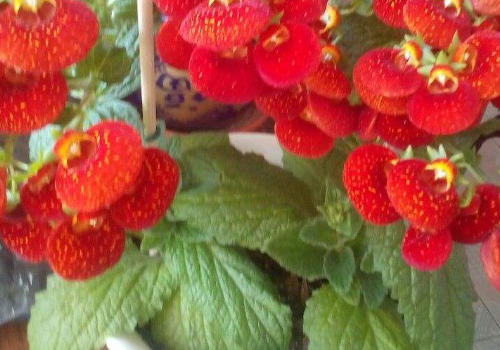
Flowers: The flower stems are drawn out from the clustered leaves. The flowers belong to umbel inflorescences and have a special flower shape. The flowers come in red, orange-red, orange, and yellow, in single colors, spots, and bicolors... various colors; the corolla is lip-shaped, divided into upper and lower lips. The upper lip is small and cap-shaped, while the lower lip is enlarged and pouch-shaped. The stamens are located inside the upper lip, and the lower lip is just an air sac. The appearance is very rare and precious.
Fruit: A capsule, with many small seeds.
Characteristics: Calceolaria is an annual or perennial herbaceous plant of the genus Calceolaria in the Scrophulariaceae family (because it is a native species). The plant is short; there are potted-flower types and cut-flower types. Potted-flower types are about 20-30 cm tall, and cut-flower types are 60 cm or more tall; potted-flower types have relatively larger flowers, while cut-flower types have relatively smaller flowers, each with its own characteristics. The leaf blades are large and much wrinkled, about 10-15 cm long, opposite, ovate, with fine hairs, and short petioles. The flower stems are drawn out from the clustered leaves. The flowers belong to umbel inflorescences and have a special flower shape. The flowers come in red, orange-red, orange, and yellow, in single colors, spots, and bicolors... various colors; the corolla is lip-shaped, divided into upper and lower lips. The upper lip is small and cap-shaped, while the lower lip is enlarged and pouch-shaped. The stamens are located inside the upper lip, and the lower lip is just an air sac. The appearance is very rare and precious. The fruit is a capsule, with many small seeds. Because its pouch-shaped flower resembles a purse embroidered with colored thread by a girl, it is called Calceolaria.
The cultural background of Calceolaria
The cultivated Calceolaria is an interspecific hybrid. The original species was introduced to Europe in 1822. In 1830, Britain bred many hybrid Calceolaria, in the 20th century Britain bred large-flowered Calceolaria, and later Germany bred multiflora dwarf Calceolaria.
Related legends
Calceolaria - Assistance
Once upon a time there was a girl who was very good at dancing and always performed at celebrations. But one time there was an accident and the girl lost both legs, and every day she was in great pain. The girl begged the gods to help her. The flower goddess took pity on her and turned her into a beautiful flower. Later, people liked to place this flower at celebrations. The girl achieved her wish and forever danced in the wind at celebrations.
Orange Calceolaria - Wealth and honor
It is said that in ancient times there was a village where drought had lasted for a long time, and the crops in the fields were almost withered to death. The village chief's daughter wept every night because of this. Inadvertently, her tears fell on a spirit. The spirit asked the reason and said to her: Are you willing to sacrifice yourself for everyone? The girl nodded without even thinking. So the spirit turned her into an orange Calceolaria by the well. The next day, the well water of the whole village was full, and the villagers used the well water to revive the crops in the fields. From then on, the village had favorable weather and bountiful harvests.
White Calceolaria - Loss
In ancient times, there was a poor scholar who studied diligently and delved deeply into his studies, hoping that one day he could pass the imperial examinations and change his fate. But things went contrary to his wishes, and he repeatedly failed. Gradually he became disheartened, and accumulated worries turned into illness, and before long he died. On his grave grew an unknown small white flower, and between its petals it gave off a faint, resentful fragrance.
Purple Calceolaria - Parting
Long ago, the princess of ancient Rome fell in love at the hunting ground with the brave warrior Luni. After the hunt ended, the princess received Luni. Luni felt her love from the princess's eyes, and the two quickly fell in love. But the good times did not last long, and Luni was sent to the battlefield. At the moment of parting, Luni picked a purple flower by the roadside and placed it in the princess's hair, kissed the princess's tear-streaked face, mounted his horse, and rode away without looking back.
Variety classification of Calceolaria
Common varieties include the Anytime series, with a plant height of 12-15 cm and compact flower branches; it is the earliest-blooming variety among Calceolaria, with flower colors including yellow, red, rose red, bronze, and rose red and white bicolor, etc. It is also the most heat-resistant series variety, requiring 120-140 days from sowing to flowering.
The GoldFever series, with a plant height of 15 cm, is famous for its yellow flowers. Among them, the GoldBunch and DwarfSunshine varieties are even more famous, with the purest lemon yellow.
The DwarfDainty series, with a plant height of 12-15 cm and small leaves only 2.5-5 cm, has large flowers, and flower colors include bright red, yellow, and red horizontal bicolor, yellow spots, etc.
The Bikini series, with a plant height of 20 cm, is multiflorous, and flower colors include red, yellow, and other varieties.
Among ornamental species in the same genus is Chile, among which Goldcrest has large golden-yellow flowers and robust flower stems. The wrinkled-leaved Calceolaria has already been used abroad for outdoor annual cultivation. Its plant height is 30-35 cm, with 6 flower colors, among which LittleSweeties is the most famous. Pavon Calceolaria has deep yellow flowers, 3-4 cm in diameter. Mexican Calceolaria has small, pale yellow flowers.
Morphological characteristics of Calceolaria
It is a perennial herbaceous plant, mostly cultivated as an annual flowering plant in gardens. The plant height is mostly 30 cm. The entire plant's stems, branches, and leaves have fine downy hairs, and the leaf blades are ovate and opposite. The flower shape is distinctive, with a two-lipped corolla. The upper lip is upright and relatively small, while the lower lip is enlarged like a purse, forming an empty chamber in the middle, with the stigma borne between the two sac-like structures. Flower color varies richly. Single-color varieties include yellow, white, red, and other shades; bicolor forms have orange, pink, brownish-red, and other spots on various base colors. The fruit is a capsule, with small seeds in many grains. After cultivation, this species is mostly divided into three types: large-flowered Calceolaria has a flower diameter of 3-4 cm and rich flower colors, mostly bicolor flowers with colored spots; multiflora dwarf Calceolaria has a flower diameter of 2-3 cm, a low plant, and cold resistance; there is also multiflora dwarf large-flowered Calceolaria, whose traits fall between the previous two and which is a common variety. In addition, there are many fixed hybrid F1 generations.
The flower language of Calceolaria
Assistance, wealth, wealth and honor
Flower divination: You are a devoted and single-minded person, prudent in your attitude toward love, and will not easily fall in love. Once you have met the right one, you will love to the death without wavering. If you discover that your lover is not loyal to you, you cannot forgive him, so you need to make more friends.
Flower motto: The value of marriage is to make people become more mature.
Ecological habits of Calceolaria
It likes cool, moist, and ventilated climatic conditions. It fears high heat, avoids cold, and likes light, but during cultivation it must avoid the scorching sun in summer and needs shade. It grows well at 7-15°C. It has strict requirements for soil, preferring sandy soil rich in humus, avoiding wet soil, and requiring good aeration and drainage conditions, with slightly acidic soil being best. Vegetative growth occurs above 15°C, and flower bud differentiation can occur after 4-6 weeks below 10°C.
Distribution range of Calceolaria
Native to Mexico, Chile, and other areas of South America, now distributed throughout the world.
Propagation methods of Calceolaria
Generally, seed propagation is the main method, with a small amount of cuttage. Sowing is mostly carried out in late August to early September, when the climate gradually becomes cool. The growing soil is prepared with 6 parts leaf mold plus 4 parts river sand, and the seeds are directly broadcast in a "shallow pot" or "shallow seedling tray" without covering with soil. Water is supplied by the "pot-bottom soaking method." After sowing, cover with glass or plastic film to seal the opening and maintain 13-15°C. Seedlings emerge after one week. After emergence, promptly remove the glass or plastic film to allow ventilation and prevent damping-off disease. Gradually expose them to light so the seedlings grow sturdy, and keep the room temperature below 20°C. When the seedlings grow 2 true leaves, divide them into pots.
Seedling-raising method
Calceolaria likes a cool, moist, and well-ventilated environment, fears cold and heat, and its suitable growth temperature is 7°C-15°C. It avoids moisture and likes well-drained soil rich in humus. Calceolaria propagation is mainly by sowing. In the north, sowing in July-August is appropriate. However, this period happens to coincide with high-temperature weather, which brings great difficulties to seedling raising. Through practice, the author has summarized the following method:
I. Soil preparation and disinfection
Mix fully decomposed sawdust or other light loam rich in humus with fine sand at a ratio of 4:1. After passing through a fine sieve, put it into a relatively shallow sowing box. Spread 2 cm thick coarse sand or charcoal residue at the bottom of the box; in the middle is the coarse residue from sieving, about 2 cm thick; and on the top layer spread 2 to 3 cm of fine soil. After leveling, use 50% phoxim emulsifiable concentrate at 800 times mixed with 50% carbendazim wettable powder at 1000 times to water the growing soil thoroughly for soil disinfection. The growing soil, coarse sand, or charcoal residue can also be separately stir-fried for disinfection.
II. Sowing method
Three to five hours after chemical disinfection, rinse away the residual chemicals in the sowing box with clean water, and at the same time pour in 0.1% potassium dihydrogen phosphate solution. Broadcasting is the suitable sowing method, because the seeds are very small and should not be sown too densely, otherwise the seedlings will grow thin and weak. Mix the seeds with a small amount of fine soil or fine sand and evenly broadcast them into the sowing box. The covering soil must not be too thick, and it may even be left uncovered. After sowing, cover the sowing box with glass or film to maintain moisture, then place the box in a well-ventilated shade shed.
III. Management before and after seedling emergence
Keep the temperature at around 20°C, and seedlings can emerge in 7 to 10 days. During this period, if the soil becomes dry, water by the box-soaking method. After emergence, promptly remove the covering material, and it is best to control the temperature at around 15°C. Seedlings rot easily, so cooling and protecting seedlings is key to raising seedlings in summer.
The method of spraying water from the top and irrigating water from the bottom to increase humidity and lower temperature achieved good results. The specific method is to stretch plastic film with good light transmittance about 0.5 m below the shade net to prevent rainwater or sprayed water from splashing into the sowing box. Install an automatic misting device on the shade net (the automatic nozzle connected to the tap water pipe), and spray water to lower temperature from 11:00 to 15:00 on sunny days, forming something like a "Water Curtain Cave." At the same time, build a pool about 20 cm high on the ground of the shade shed (to save water, a relatively thick plastic film can be laid at the bottom). Place bricks in the pool to raise the sowing boxes, and usually irrigate to keep the water level below the bricks. Use the evaporation of water to carry away heat and achieve the purpose of cooling and humidifying.
During the seedling stage, management should especially be strengthened. When seedlings emerge too densely, thin them promptly to facilitate ventilation. When the young seedlings grow to 2 to 3 true leaves, transplant them promptly to prevent damping-off disease. During the seedling stage, also pay attention to pest and disease control. If damping-off disease occurs, spray 50% zineb at 800 times, promptly remove diseased plants, and keep the soil slightly dry. In summer, seedlings are often harmed by wild slugs; pay attention to trapping and killing them, and snail bait can also be used for control. Apply dilute liquid fertilizer once every 7 to 10 days, with chemical fertilizer concentration not exceeding 0.5%, and the overwintering temperature not lower than 8°C.
Cultivation techniques for Calceolaria Cultivation
Twenty days after sowing and emergence, when the seedlings are 2.5 cm tall, transplant once with soil. Thirty days after transplanting, when the seedlings are 5 cm tall, plant them in 10-15 cm pots. A room temperature of 10-12°C is best. If forcing cultivation, supplement light for 6-8 hours per day to advance flowering. During the growing period, pay attention to ventilation and shading to prevent pest outbreaks and scorching of leaves. Fertilize once every half month. Nitrogen fertilizer must not be excessive, otherwise it easily causes leggy stems and leaves and severe shrinkage. When flower branches are drawn out, apply 1-2 additional applications of phosphorus and potassium fertilizer. At the same time, side buds in the leaf axils should be promptly removed; otherwise, too many lateral flower branches will not only affect the development of the main flower branch but also cause the plant shape to be irregular and lacking commercial value. In large-scale production, when the main bud begins to shift from basal leaves to height growth, 0.2%-0.3% CCC can be sprayed on the leaf surface 1-2 times to control leggy growth and lower the plant shape.
During the full flowering period, strictly control watering, maintain the room temperature at 8-10°C, and carry out artificial pollination to increase the seed-setting rate. During the seed-setting period, as the temperature gradually rises, adopt cooling measures such as ventilation and shading so that the fruit fully matures; otherwise, under high temperature and high humidity, the plant will wither and die before the fruit matures. Potted Calceolaria is relatively sensitive to moisture, and the pot soil must remain moist. Especially during the stem and leaf growth period, if the pot soil is slightly dry, the leaves quickly wilt. However, if the pot soil is too wet and the room temperature is too low, the root system easily rots. When watering, never sprinkle water on the leaves, otherwise it very easily causes leaf rot. After flower branches are drawn out, the pot soil can be slightly dry, but must not be dehydrated, which helps prevent leggy stems and leaves.
Calceolaria is a long-day flower and is relatively sensitive to light. During the seedling stage, it needs bright light so the leaves develop robustly and have strong disease resistance, but under strong light it should be appropriately shaded for protection. If earlier flowering is desired, 14 hours of sunlight can promote flower bud formation, shorten the growing period, and advance flowering. The soil should preferably be fertile, loose, and well-drained sandy loam. A mixed substrate commonly used consists of growing soil, leaf mold, and fine sand, with a pH of 6.0-6.5.
Sowing and seedling raising: Seed propagation is the main method. Calceolaria seeds are tiny, with about 25,000 seeds per gram, and the suitable germination temperature is 18-21°C. Sow indoors in pots in August-September. Sowing too early tends to cause seedling collapse because of high temperatures, while sowing too late affects flowering.
The soil used for pot sowing must be disinfected at high temperature. When pot sowing, the pot soil should be pressed firm, the seeds gently broadcast in and pressed flat, without covering with soil. After soaking the bottom of the pot in water, cover with glass or film and place in partial shade. Germination occurs 7-10 days after sowing. After cotyledons appear, thin or transplant promptly, and pay attention to ventilation and maintaining humidity. Keep the room temperature at 16-18°C.
Care and management
Calceolaria is a perennial herbaceous plant, mostly grown as an annual potted flower. Its flower shape is strange and gorgeous, with a two-lipped corolla: the lower lip swells into a pouch shape and bends downward, while the upper lip extends forward. When the flowers are in full bloom, they look like countless small purses hanging from the tips of the branches. The colors include red, yellow, purple, orange, cream white, and various markings, very distinctive. Its plant height is 20-30 cm, and its flowering period falls right around the Spring Festival.
This flower is mostly propagated by sowing, usually sown in late August, with seedlings emerging in 7-10 days. When the seedlings grow 2-3 true leaves, transplant them; when they have 4-5 true leaves, plant them individually. It likes a cool, moist, and warm climatic environment and is suitable for growing in loose soil rich in humus; neither high temperature nor severe cold is suitable. In an unheated room, it can grow once the temperature reaches above 6°C. During the growing period, a certain air humidity must be maintained, and attention should be paid to ventilation. In winter, sufficient light is required, and 10-15°C is favorable for plant growth and flowering. If the temperature is too high during the growing season, it will cause excessive stems and leaves, and together with increased pot soil moisture and stuffiness, it easily causes rotting at the base of the plant. To lower the temperature, shading measures should be taken in early autumn and late spring to create a ventilated and cool environment for potted plants. Especially after flowering in spring and in October when the seeds mature, ventilation must be maintained and strong midday light shaded out to facilitate seed development and maturation.
During growth, avoid overly wet pot soil; generally water only when dry. In early autumn when temperatures are high, watering must be controlled even more; high temperature and high humidity will cause root rot and leaf mildew. If misting can be done frequently indoors to increase air humidity, growth will be good. When watering, be careful not to let water rush directly at the plant. If water frequently accumulates on the leaves and buds, it easily causes rot. During the growing season, apply decomposed liquid fertilizer once every 10 days. At the early flowering stage, apply fertilizer mainly based on phosphorus. When fertilizing, do not let the fertilizer water stain the leaves. With proper management, only 150-160 days are needed from seedling to flowering.
Calceolaria has a low natural pollination rate and needs artificial pollination, that is, after the flowers open, dip a brush in pollen and apply it to the stigma, repeating 2-3 times, and it can then be fertilized and set seed. After the seeds mature, cut off the flower branches and put them in a cloth bag to dry in the sun; after drying, store them in a ventilated, dry place.
Twenty days after sowing and emergence, when the seedlings are 2.5 cm tall, transplant once with soil. Thirty days after transplanting, when the seedlings are 5 cm tall, plant them in 10-15 cm pots. A room temperature of 10-12°C is best. If forcing cultivation, supplement light for 6-8 hours per day to advance flowering. During the growing period, pay attention to ventilation and shading to prevent pest outbreaks and scorching of leaves. Fertilize once every half month. Nitrogen fertilizer must not be excessive, otherwise it easily causes leggy stems and leaves and severe shrinkage. When flower branches are drawn out, apply 1-2 additional applications of phosphorus and potassium fertilizer. At the same time, side buds in the leaf axils should be promptly removed; otherwise, too many lateral flower branches will not only affect the development of the main flower branch but also cause the plant shape to be irregular and lacking commercial value. In large-scale production, when the main bud begins to shift from basal leaves to height growth, 0.2%-0.3% CCC can be sprayed on the leaf surface 1-2 times to control leggy growth and lower the plant shape. During the full flowering period, strictly control watering, maintain the room temperature at 8-10°C, and carry out artificial pollination to increase the seed-setting rate. During the seed-setting period, as the temperature gradually rises, adopt cooling measures such as ventilation and shading so that the fruit fully matures; otherwise, under high temperature and high humidity, the plant will wither and die before the fruit matures.
Cultivation techniques
Calceolaria is a herbaceous plant of the genus Calceolaria in the Scrophulariaceae family. Its flower colors include yellow, purple, red, cream white, orange-red, dark brown, etc., and the flowers are adorned with colored spots and markings, very lovely, and often used for indoor decorative display. It blooms from December to February of the following year, and under greenhouse cultivation the flowering period is March to April.
Calceolaria is native to the Mexico and Chile area. It likes cool and moist conditions, and indoors in winter it can grow at 3°C to 6°C. During the growing period, relatively high air humidity must be maintained. Pay attention to ventilation; sufficient light is favorable for plant flowering.
Ventilation and shading: Calceolaria likes cool conditions, and the suitable growth temperature is around 10°C. If during the growing period the stems and leaves develop luxuriantly, while the pot soil is too wet plus stuffy heat, it will cause rotting of the stems and leaves at the base. To lower the temperature, shading measures are often taken at noon to create a ventilated and cool environment. Especially after flowering in spring until May-June when the seeds mature, ventilation work must be done well, and shade at noon to facilitate seed development and maturation.
Watering and fertilizing: Calceolaria likes a warm and moist environment, but avoids overly wet pot soil and excessive watering during flowering. Generally, water only when the pot soil is dry. If indoors in a greenhouse, frequently spraying water to increase air humidity is even better. When watering, do not directly rush the plant. If water accumulates on the leaves and buds, it easily causes rot. During the pre-flowering growing season, apply decomposed cake fertilizer water once every 10 days (diluted 10 times). At the early flowering stage, apply additional fertilizer mainly based on phosphorus. When fertilizing, do not let fertilizer water contaminate the leaves, so as to avoid rotten hearts and leaves.
Propagation techniques: Calceolaria is generally propagated by sowing. When seeds are lacking, division can also be used. Sowing should be done after the high-temperature period when the weather turns cool, namely in August to September, because during high temperatures seedlings are prone to damping-off disease and rot. Use leaf mold or peat soil mixed with half sand, sift and disinfect it, then put it into a shallow pot, fill with water by the soaking method, and then sow. Calceolaria seeds are tiny, in the form of relatively coarse powder particles. When sowing, it is best to first fold thick paper into a small triangular funnel, place the seeds in it, then hold the lower part of the small funnel with the right hand so that the seeds fall evenly into the sowing pot. Do not make it too dense, otherwise the seedlings will grow thin and weak after emergence. For covering soil, simply use a fine sieve to cover with a thin layer of fine soil (it is also fine not to cover with soil). After sowing, cover the pot with glass to maintain humidity. Before emergence, place it in a cool place, keep the temperature at around 20°C, and seedlings can emerge in about 7 to 10 days. After emergence, remove the glass, thin the seedlings, and let them gradually receive sunlight, lowering the temperature to around 15°C.
When the young seedlings show 2 true leaves, they can be transplanted. After they grow 4 to 6 true leaves, they can be potted individually. For the growing soil, mix 2 parts leaf mold, 1 part barnyard manure, 1 part sand, and 6 parts garden soil, with a pH of 6.5. In November to December, they can be planted in large pots.
Pest and disease control for Calceolaria
For potted flower soil, leaf mold or mixed growing soil is best. From the first potting of sown seedlings to final planting, usually three repottings are needed, and the final planting pot diameter is 13-17 cm. During the growing period, apply diluted fertilizer once a week and maintain relatively high air humidity, but the water content in the pot soil should not be too great. When the air is too dry, it is better to spray more water and water less. Watering should follow the principle of alternating dry and wet to prevent root rot from excessive water. When watering and fertilizing, do not let fertilizer water touch the leaf surface and cause leaf rot. In winter, maintain the indoor temperature at 5-10°C, and pay attention to shading when the light is too strong. Calceolaria is a long-day plant, so using artificial light in the greenhouse to extend the daily sunshine time can advance flowering. Calceolaria blooms from December to May of the following year. Calceolaria has poor natural pollination ability and must be artificially pollinated. After pollination, remove the corolla to avoid the corolla becoming moldy and to increase the seed-setting rate. From May to June the seeds gradually mature. When the seeds have turned brown before the capsule splits, collect them promptly.
Calceolaria is prone to pests and diseases, and measures should be taken during planting. At the seedling stage, damping-off disease is likely to occur, so soil disinfection should be carried out, diseased plants removed, or the pot soil kept slightly dry. If the air is too dry and the temperature too high, red spiders, aphids, and other pests are likely to occur; spray chemicals, increase air humidity, or lower the temperature.
The role and uses of Calceolaria Ornamental applications
Because of its strange flower shape, bright colors, long flowering period, and high ornamental value, Calceolaria is one of the main ornamental flowers in early spring. It can supplement the shortage of ornamental flowers in winter and spring, can be used as an indoor decorative accent, and can be placed on a balcony or indoors for viewing. It can also be used for holiday flower bed displays.
Calceolaria's ornamental range is relatively narrow, and it is seldom used for garden landscapes or park flower bed cultivation, and very rarely used as a cut flower for vase arrangements. It is mostly suited to being grown as a small potted plant in greenhouses for home display. In this century it has been promoted fastest and most extensively in Europe and America. Today there are more than 530 varieties worldwide, which can be divided by flower type into three major categories: "large purse," "medium purse," and "small purse." The "large purse" has a flower head as large as an egg. Its interior is more inflated and appears very plump, and it is the most welcomed by consumers. In addition, there is also a "flat purse" variety in which individual petals do not swell; perhaps affected by an unlucky mentality, it is difficult to open up sales in the market.
Calceolaria's flowers open at different times; often the ones that open first wither first, and those that open later wither later. When displayed indoors for decoration, be careful to promptly remove withered flowers so as not to affect the ornamental effect.
Post-production handling
Calceolaria comes on the market right at the Spring Festival, and its strange flower shape makes it very likable. It is also a very good ceremonial flower. Giving a pot of bright red Calceolaria makes the festive atmosphere even stronger. If placed on a windowsill, balcony, or in a guest room, with red flowers and green leaves, the whole room is instantly brightened and extraordinarily lively. Decorating with several pots of Calceolaria in shopping mall display windows, hotel tea rooms, and airport VIP rooms makes them dazzling and uniquely fascinating.
During commercial transport, Calceolaria is susceptible to ethylene poisoning, causing a large number of flowers to drop and lose ornamental value. Half a month before transport, spray once with 0.2-0.5 mmol/L silver thiosulfate (STS) solution to ensure the commercial value of the potted flower.
Calceolaria pictures
How to grow Calceolaria: cultivation methods for Calceolaria
Calceolaria has rich color variation. Single-color varieties include yellow, white, red, and other flowers in different shades. Calceolaria is also a good choice as a home ornamental plant. So how do you grow Calceolaria? Let us take a look at the cultivation methods for Calceolaria.
I. How to grow Calceolaria
Calceolaria has relatively high requirements for cultivation environmental conditions and is quite "delicate," harder to care for than many flowers and plants: it fears cold, fears heat, and also fears moisture. The suitable growing temperature is 13-17°C; if it exceeds 25°C, flowering will be unfavorable. When watering, do not wet the leaf surface, otherwise it very easily causes rot. Always pay attention to Calceolaria's flowering period. The ones that open first will wither first, and those that open later wither later. When displayed indoors for decoration, promptly remove withered flowers so as not to affect the ornamental effect. If lighting is given at night, growth and development will be more robust and the flowers will be much larger. It also often needs long-day exposure; during the flower bud gestation period, it requires 16-18 hours of light per day. If fluorescent lights are installed in the greenhouse and lighting is given day and night, growth and development will be more robust and the flowers will be much larger. If light is insufficient, the flowering period will be delayed.
II. Cultivation methods for Calceolaria
1. Soil: Calceolaria has strict requirements for soil, requiring loose, well-aerated, well-drained sandy loam with much humus, plus a small amount of bone meal as base fertilizer. The soil should be disinfected before use; phoxim emulsifiable concentrate and carbendazim wettable powder can be used to disinfect the soil.
2. Temperature: The suitable growth temperature for Calceolaria is around 15°C. When the temperature is above 20°C, it affects growth, bud formation, and flowering. If the temperature can be lowered to around 10°C when Calceolaria is flowering, the flowering period can be extended. But during Calceolaria's growing period, the nighttime and overwintering temperature must not be lower than 10°C.
3. Light: Calceolaria likes light and avoids direct scorching sun. When the light is too strong at noon, it should be appropriately shaded and kept well ventilated, otherwise damping-off disease is easily caused. Increasing the light duration can make Calceolaria flower earlier. For example, if starting in November you increase light by 3 hours per day, it can bloom by the end of January the following year. For greenhouse cultivation of Calceolaria, note that before October shade 30%, from October to March of the following year do not shade, and after March, during the flowering period, shade about 50%.
4. Moisture: Calceolaria likes a moist environment. Drought will cause poor growth in Calceolaria. Watering should follow the principle of watering when dry and stopping when wet. You can often sprinkle water around the flower pot to keep air humidity above 80%. Being too moist easily causes root rot. When watering, do not contaminate the leaves, because the leaf surface has hairs and easily rots. Note that during the flowering period you must not spray water on the flowers, so as not to affect seed setting.
5. Fertilizer: Calceolaria likes fertilizer, but it should not be too concentrated. During Calceolaria's growing period, apply dilute decomposed cake fertilizer water or hoof and horn chip liquid fertilizer once every half month, which can make the flowers abundant and the leaves luxuriant, but never let fertilizer water contaminate the leaves. If you find leggy growth of stems and leaves in Calceolaria, stop fertilizing immediately.
The above isthe cultivation methods for Calceolariaintroduced. Calceolaria's auspicious meaning is deeply loved by people, and its strange appearance makes it even more outstanding, very suitable for home cultivation.