What are the methods for propagating and transplanting spiderwort (Tradescantia)?
Spiderwort is very attractive, with purple flowers. How do you propagate spiderwort by cuttings? How do you transplant it?
How to propagate spiderwort by cuttings:
1. Preparation before taking spiderwort cuttings
Spiderwort cuttings usually use healthy, pest-and disease-free stem tips as propagation material; cut the stems into sections 6-8 cm long, and each section should have more than three leaves. Young shoots from the tips can also be used as cuttings. When taking spiderwort cuttings, fine sand can be used as the propagation medium. Choose a suitable container; either a flower pot or a seedling bed will do.
2. The cutting operation for spiderwort
Insert the spiderwort cuttings diagonally into a flower pot filled with fine sand, with half of each cutting pushed into the soil; they will root after half a month.
After the spiderwort cuttings are taken, spray water every day to keep them moist; the air humidity must not be too low. Usually keep them in a relatively cool, shady place for care, and apply a topdressing once every 20-30 days. Only in this way can spiderwort propagate quickly.
Once the spiderwort root system is strong, it can be divided and transplanted.
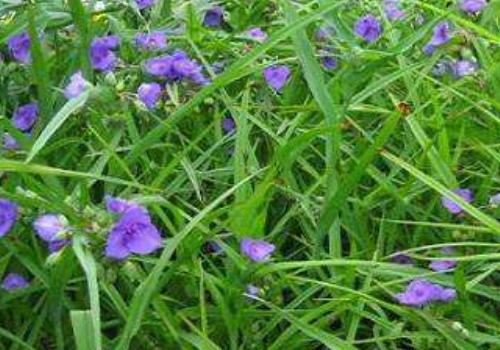
How to transplant spiderwort:
Spiderwort plants need to be potted and transplanted when repotting or when propagated by cuttings. The transplanting method is actually not difficult; the general process is to prepare the flower pot, fill it with soil, pot the plant, and do a good job of management and care after transplanting.
When transplanting spiderwort, choose suitable soil. You can use a mix of vegetable garden soil and furnace slag; garden soil, medium-coarse river sand, and sawdust in proportion; one of paddy soil, pond mud, or leaf mold; or a mix of peat, perlite, and expanded clay pellets. Just choose one of these and prepare it in a certain proportion.
Before transplanting spiderwort, first put a layer of coarse-grained medium or expanded clay pellets at the bottom of the pot as a drainage layer to let the soil breathe and improve its drainage. On top of this drainage layer, sprinkle a layer of fully decomposed organic fertilizer as a base fertilizer, and finally sprinkle on the medium. Fill in the soil well.
Next, place the spiderwort plant into the pot and plant it well. Dig a small hole in the middle of the soil, put the spiderwort roots in, and be careful to keep the fertilizer separate from the roots to avoid burning them. After potting, water thoroughly once first, then place the spiderwort in a shaded environment for care.
Alright, that is all for the introduction to transplanting spiderwort. Everyone understands now, right?
How to transplant spiderwort
Transplanting spiderwort
Spiderwort plants need to be potted and transplanted when repotting or when propagated by cuttings. The transplanting method is actually not difficult; the general process is to prepare the flower pot, fill it with soil, pot the plant, and do a good job of management and care after transplanting.
When transplanting spiderwort, choose suitable soil. You can use a mix of vegetable garden soil and furnace slag; garden soil, medium-coarse river sand, and sawdust in proportion; one of paddy soil, pond mud, or leaf mold; or a mix of peat, perlite, and expanded clay pellets. Just choose one of these and prepare it in a certain proportion.
Before transplanting spiderwort, first put a layer of coarse-grained medium or expanded clay pellets at the bottom of the pot as a drainage layer to let the soil breathe and improve its drainage. On top of this drainage layer, sprinkle a layer of fully decomposed organic fertilizer as a base fertilizer, and finally sprinkle on the medium. Fill in the soil well.
Next, place the spiderwort plant into the pot and plant it well. Dig a small hole in the middle of the soil, put the spiderwort roots in, and be careful to keep the fertilizer separate from the roots to avoid burning them. After potting, water thoroughly once first, then place the spiderwort in a shaded environment for care.
Points to note in the care of transplanted spiderwort
First, control watering. After transplanting spiderwort, put effort into watering. Usually keep the pot soil moist, but not overly wet, so as to avoid root rot in spiderwort; however, it must not be too dry either, because excessive dryness will cause spiderwort to grow fewer leaves, with leggy stems, weakened growth, and smaller leaves. Besides paying attention to watering, it is also necessary to frequently spray water on the leaf surface.
Second, fertilize reasonably. Spiderwort has a certain demand for fertilizer; only with plenty of fertilizer will it grow vigorously with large, plump leaves, so liquid fertilizer should be applied frequently.
Spiderwort Tradescantia reflexa spiderwort gallery: how to grow spiderwort / how to propagate spiderwort
Spiderwort profileSpiderwort Tradescantia reflexa
Spiderwort cultivation methods and precautions, an introduction to spiderwort
Spiderwort is a perennial herbaceous plant in the genus Tradescantia of the Commelinaceae family, native to Mexico, with aliases such as purple spiderwort, purple brocade grass, purple-leaf grass, and purple bamboo plum. Because of its long flowering period, upright stems, obvious nodes, leaf sheaths, and unusual, elegant plant shape, spiderwort has a full wild flavor; planted in groups under trees and combined with the long leaves of iris, its ornamental plant shape, flower buds, and inflorescences stand out with distinctive features and endless charm.
Because of its long flowering period, upright stems, obvious nodes, leaf sheaths, and unusual, elegant plant shape, spiderwort has a full wild flavor; planted in groups under trees and combined with the long leaves of iris, its ornamental plant shape, flower buds, and inflorescences stand out with distinctive features and endless charm. Planted in groups under trees and combined with iris long leaves, its plant shape, flower buds, and inflorescences are suitable for viewing.
Spiderwort has a better effect when planted in groups in flower beds and on both sides of roads; it can also be potted for indoor display, or grown as a hanging plant.
Spiderwort has beautiful leaf color and small pink flowers, with a strong decorative effect. It can also grow vigorously under extensive management conditions, so it is especially suitable for people lacking experience to plant, and is an ideal plant for decorating a balcony. The whole spiderwort plant can be used as medicine, mainly treating carbuncles, swellings, and toxic sores, scrofula and tuberculosis, gonorrhea, and other conditions.
Spiderwort blooms from May to July.
Morphological characteristics of spiderwort
Spiderwort is a perennial herbaceous plant, 30-50 cm tall, with the whole plant appearing violet-purple. The stems are soft and succulent. The stems are much branched, somewhat fleshy, purplish-red, prostrate in the lower part, often producing fibrous roots at the nodes, and nearly upright in the upper part. The leaves are alternate, lanceolate, with entire margins, clasping the stem at the base and forming a leaf sheath, purplish-red beneath. The flowers are densely borne on a forked inflorescence stalk, with linear-lanceolate bracts below.
Spiderwort has 3 sepals, green, ovate, persistent; 3 petals, blue-purple, broadly ovate; 6 stamens, 2 fertile, 3 degenerated, and another with a short, slender filament and no anther; 1 pistil, the ovary ovate, 3-locular, the style filiform and long, the stigma capitate; the capsule is elliptical, with 3 raised ridge lines; the seeds are triangular-semicircular, but brown. The flowers are small, pink. Capsule. The flowering period is June to September. Under cultivation conditions, it usually does not set fruit.
The stems of spiderwort are usually clustered, stout or nearly stout, and upright. The leaf blades are linear or linear-lanceolate, acuminate, slightly curved, nearly flat or folded downward.
The corolla is deep blue, the stamens yellow, about 3-4 cm wide, the petals nearly round, 1.4-2.0 cm in diameter. The capsule is 5-7 cm long, and the seeds are oblong, about 3 mm long. In North China the flowering period is May-October. In East China it is from mid-to-late April to October, among which May-June is the peak flowering period and July-October is the continuous flowering period; the flowers open in the early morning and close before noon. It likes a cool, humid climate and has strong cold resistance; it can overwinter in the open field in North China, East China, and Central China. It turns green in March in East China and in April in North China; flower buds appear in late March in East China and mid-April in North China; the petals unfold in the early morning, and the flowers bloom on cloudy and rainy days.
Spiderwort is suitable for planting on higher ground with good drainage or on gentle slopes. In North China the aboveground parts wither in November, while in East China the aboveground parts shrink in January-February, appearing black-green.
Spiderwort stems are much branched, somewhat fleshy, purplish-red, prostrate in the lower part, often producing fibrous roots at the nodes, and nearly upright in the upper part. The leaves are alternate, lanceolate, with entire margins, clasping the stem at the base and forming a leaf sheath, purplish-red beneath. The flowers are densely borne on a forked inflorescence stalk, with linear-lanceolate bracts below; 3 sepals, green, ovate, persistent; 3 petals, blue-purple, broadly ovate; 6 stamens, 2 fertile, 3 degenerated, and another with a short, slender filament and no anther; 1 pistil, the ovary ovate, 3-locular, the style filiform and long, the stigma capitate; the capsule is elliptical, with 3 raised ridge lines; the seeds are triangular-semicircular, pale brown.
Ecological habits of spiderwort
Spiderwort likes sufficient sunlight but can also tolerate partial shade. Spiderwort is robust by nature, cold-resistant, can overwinter in the open field in North China, and has no strict requirements for soil.
Spiderwort plants like sufficient light and require loose, moist, well-drained soil. They are afraid of waterlogging and grow well under neutral and slightly alkaline soil conditions. They are relatively tolerant of poor soil, and no pests or diseases have been observed.
Cultivation techniques for spiderwort: transplanting
When potting young seedlings, first put a 2-3 cm thick layer of coarse-grained medium or expanded clay pellets at the bottom of the pot as a drainage layer, sprinkle a layer of fully decomposed organic fertilizer on top as a base fertilizer about 1-2 cm thick, then cover with a layer of medium about 1-2 cm thick, and then put in the plant, so as to keep the fertilizer separate from the roots and avoid burning them. The medium used for potting can be one of the following.
Vegetable garden soil
Furnace slag = 3:1; or garden soil: medium-coarse river sand: sawdust (mushroom residue) = 4:1:2; or one of paddy soil, pond mud, or leaf mold. Or peat + perlite + expanded clay pellets = 2 parts + 2 parts + 1 part; vegetable garden soil + furnace slag = 3 parts + 1 part; peat + furnace slag + expanded clay pellets = 2 parts + 2 parts + 1 part; sawdust + vermiculite + medium-coarse river sand = 2 parts + 2 parts + 1 part. After potting, water thoroughly once and place in a shaded environment for care.
Management
Spiderwort likes a warm, humid, and partially shaded environment, is not cold-tolerant, and has no strict requirements for soil, but grows more vigorously when planted in loose, fertile sandy loam.
The following points should be noted when cultivating spiderwort:
Humidity
It likes a humid climate environment and requires the relative air humidity of the growing environment to be 60-75%.
Temperature
The optimum growth temperature is 18°C-30°C, and it fears cold and frost.
The overwintering temperature needs to be kept above 10°C. When the winter temperature drops below 4°C, it enters a dormant state. If the ambient temperature approaches 0°C, it will die from frost injury.
In summer
1. Strengthen air convection so that the temperature inside the plant can be dissipated;
2. Place it in partial shade, or give it 50% shade;
3. Give it appropriate misting, 2-3 times a day.
In winter
1. Move it indoors to a bright place for care;
2. Outdoors, it can be wrapped in plastic film to overwinter, but every two days at noon when the temperature is higher, the film should be opened to let it breathe;
Light management
Placing the flower pot in a dark place easily causes leggy branches, sparse stems, and few leaves, and loss of luster; exposure to direct strong light in summer will scorch the leaves. Therefore, in spring and autumn, the flower pot should be hung in the air on a balcony or under a corridor eave where it is not exposed to direct sunlight at noon, and the pot soil should be kept moist frequently. It is afraid of direct strong light and needs to be kept in partial shade for care, or given 70% shade. If kept indoors for care, place it in as bright a place as possible, and every one or two months move it outdoors to a partially shaded place or keep it under shade for a month, so that it can accumulate nutrients and recover its growth.
Fertilizer and water management
It has high requirements for fertilizer and water, but it is most afraid of random fertilization, concentrated fertilizer, and one-sided application of nitrogen, phosphorus, and potassium fertilizers. It is required to follow the fertilization (and watering) principle of "apply dilute fertilizer frequently, use small amounts but more often, and provide complete nutrition."
Spring, summer, and autumn
These two seasons are its peak growth periods. Fertilizer and water management follows the cycle of "Hua Bao" - "Hua Bao" - clear water - "Hua Bao" - "Hua Bao" - clear water (at least two "Hua Bao" applications per week must be guaranteed). The interval period is about: 1-4 days for outdoor care; shorter intervals on sunny days or during high temperatures, and longer intervals or no watering on cloudy and rainy days or during low temperatures; 2-6 days for indoor care. Watering should be done as much as possible in the early morning when the temperature is lower. In summer, water in the early morning or evening when the temperature is low, and also mist the plants frequently.
Winter
During the winter dormant period, the main task is to control fertilizer and water well. Fertilizer and water management follows the cycle of "Hua Bao" - clear water - clear water - "Hua Bao" - clear water - clear water, with an interval period of about 7-10 days. Watering should be done as much as possible at noon on sunny days when the temperature is higher.
Notes on fertilizer and water management: in dry weather, spray water on the branches and leaves 1-2 times a day to increase air humidity. During the peak growth period, apply a dilute liquid fertilizer mainly based on nitrogen fertilizer once every half a month. When kept indoors in summer, pay attention to ventilation and misting to lower the temperature. In winter, it can be hung in front of a window in a place with relatively sufficient light, with the room temperature kept at around 10°C, watering controlled, fertilization stopped, and the branches and leaves frequently washed with clear water close to room temperature to prevent dust from soiling the leaf surface and reducing the ornamental effect.
Spiderwort cultivation methods
1、What are the advantages of propagating spiderwort in autumn??
Spiderwort is best propagated in autumn, because autumn propagation has 3 advantages:
① It is easy to survive and grows quickly, and can fill the pot in a short time.
② The growing stems are not tall, and the growing leaves are relatively vigorous, making it easy to grow in winter.
③ It blooms more the following year, too beautiful to take in all at once. For autumn propagation, cuttings are preferable. Cut about 10 cm of old stems, trim them flat below a node, insert half of the cutting, and they will root after half a month, and sprout from the side.
Cultivation should adhere to:
① Plenty of water. Usually keep the pot soil moist; if too dry, it will grow fewer leaves, with leggy stems, and the stems will also be weak and the leaves small, and at the same time the leaves will fold and droop. Besides paying attention to watering, it is also necessary to frequently spray water on the leaf surface.
② Plenty of fertilizer. Spiderwort loves fertilizer; with plenty of fertilizer, the leaves will be numerous and large, so liquid fertilizer should be applied frequently.
2、What should be noted when cultivating spiderwort?
Spiderwort likes a warm, humid, and partially shaded environment, is not cold-tolerant, and has no strict requirements for soil, but grows more vigorously when planted in loose, fertile sandy loam. The following points should be noted when cultivating spiderwort:
1. Light
Placing the flower pot in a dark place easily causes leggy branches, sparse stems, and few leaves, and loss of luster; exposure to direct strong light in summer will scorch the leaves. Therefore, in spring and autumn, the flower pot should be hung in the air on a balcony or under a corridor eave where it is not exposed to direct sunlight at noon, and the pot soil should be kept moist frequently.
2. Fertilizer and water
In dry weather, spray water on the branches and leaves 1-2 times a day to increase air humidity. During the peak growth period, apply a dilute liquid fertilizer mainly based on nitrogen fertilizer once every half a month. When kept indoors in summer, pay attention to ventilation and misting to lower the temperature. In winter, it can be hung in front of a window in a place with relatively sufficient light, with the room temperature kept at around 10°C, watering controlled, fertilization stopped, and the branches and leaves frequently washed with clear water close to room temperature to prevent dust from soiling the leaf surface and reducing the ornamental effect.
Management measures
It is not choosy about soil, but grows best in loose, fertile sandy loam. If conditions permit, the potting soil used can be made from leaf mold, fine sand, and garden soil in a volume ratio of 1:1:2. Spiderwort plants are moderate in height, and a medium-sized flower pot is usually chosen for planting. Spiderwort likes a moist soil environment; apart from appropriately controlling watering during the low-temperature periods of winter and spring, the soil should be kept in a slightly moist state frequently.
Fertilizer
Spiderwort does not have a high fertilizer demand. Apart from applying about 10 grams of horseshoe slices and the like at the bottom of the flower pot as a base fertilizer when planting, it is enough to apply a dilute liquid fertilizer once every half a month during the vigorous growth stage. Spiderwort grows well under conditions of sufficient sunlight; if the environment is shaded and light is insufficient, the leaf color will be relatively dull. The environment should be kept properly ventilated. It likes warmth and fears severe cold, grows well within the temperature range of 15°C-25°C, and the overwintering temperature should not be lower than 2°C. In balcony cultivation, spiderwort usually does not easily contract diseases, and is also rarely attacked by harmful animals.
Hanging cultivation technique
Spiderwort, with pink flowers and purple leaves, is a perennial herbaceous plant that people love. A plastic flower pot can be used for hanging cultivation of spiderwort.
First line the inner wall of the pot with a piece of old cloth, then put in an appropriate amount of sandy loam, and evenly plant 3 spiderwort seedlings that have just rooted from cuttings and are about 10 cm tall into the pot. Water thoroughly once, then tie the flower pot securely with nylon rope or fine iron wire and hang it in a place with no less than 2 hours of sunlight each day. The bottom of the flower pot should preferably be about 2 m above the ground, so that not only is the ornamental effect good, but daily management is also relatively convenient.
Do not fertilize before the seedlings grow new leaves; other management is the same as general flower cultivation methods. It should be noted that after the plants begin to grow rapidly, pinch them back multiple times to promote new branches, so that the spiderwort looks full and beautiful. In addition, when watering, it is best to use a narrow-spout container, and the amount of water each time should be controlled to just soak through the pot soil. A saucer can be placed under the plastic flower pot to avoid wetting the floor when watering.
Planting years
Spiderwort is a perennial plant that grows quickly and is prone to aging. After spiderwort has been planted for 2-3 years, its root absorption capacity declines, specifically shown by slow emergence of new branches and yellowing and falling of old leaves. Therefore, in balcony cultivation, it is best to propagate it again every other year for renewal.
Routine management: humidity
It likes a humid climate environment and requires the relative air humidity of the growing environment to be 60-75%.
Temperature
The optimum growth temperature is 18°C-30°C, and it fears cold and frost. The overwintering temperature needs to be kept above 10°C. When the winter temperature drops below 4°C, it enters a dormant state. If the ambient temperature approaches 0°C, it will die from frost injury.
In summer
1. Strengthen air convection so that the temperature inside the plant can be dissipated;
2. Place it in partial shade, or give it 50% shade;
3. Give it appropriate misting, 2-3 times a day.
In winter
1. Move it indoors to a bright place for care;
2. Outdoors, it can be wrapped in plastic film to overwinter, but every two days at noon when the temperature is higher, the film should be opened to let it breathe;
Light
It is afraid of direct strong light and needs to be kept in partial shade for care, or given 70% shade. If kept indoors for care, place it in as bright a place as possible, and every one or two months move it outdoors to a partially shaded place or keep it under shade for a month, so that it can accumulate nutrients and recover its growth.
Fertilizer and water
It has high requirements for fertilizer and water, but it is most afraid of random fertilization, concentrated fertilizer, and one-sided application of nitrogen, phosphorus, and potassium fertilizers. It is required to follow the fertilization (and watering) principle of "apply dilute fertilizer frequently, use small amounts but more often, and provide complete nutrition."
Spring, summer, and autumn
These two seasons are its peak growth periods. Fertilizer and water management follows the cycle of "Hua Bao" - "Hua Bao" - clear water - "Hua Bao" - "Hua Bao" - clear water (at least two "Hua Bao" applications per week must be guaranteed). The interval period is about: 1-4 days for outdoor care; shorter intervals on sunny days or during high temperatures, and longer intervals or no watering on cloudy and rainy days or during low temperatures; 2-6 days for indoor care; shorter intervals on sunny days or during high temperatures, and longer intervals or no watering on cloudy and rainy days or during low temperatures. Watering should be done as much as possible in the early morning when the temperature is lower. In summer, water in the early morning or evening when the temperature is low, and also mist the plants frequently.
Winter
During the winter dormant period, the main task is to control fertilizer and water well. Fertilizer and water management follows the cycle of "Hua Bao" - clear water - clear water - "Hua Bao" - clear water - clear water, with an interval period of about 7-10 days; shorter intervals on sunny days or during high temperatures, and longer intervals or no watering on cloudy and rainy days or during low temperatures. Watering should be done as much as possible at noon on sunny days when the temperature is higher.
Propagation methods of spiderwort
Spiderwort is easy to propagate. Cuttings are often used for propagation, and the survival rate of cuttings is very high, reaching more than 95%.
Usually, stem tips 6-8 cm long are used as propagation material. Insert them in groups into a flower pot filled with fine sand, then spray water every day to keep them moist. After about 4 weeks, the cuttings will grow a luxuriant root system, and at this point they can be divided and planted. Because spiderwort can root very well under extensive management conditions, it is suitable as practice material for people lacking experience in flower propagation. It should be kept under a shade shed for care. Apply a dilute fertilizer once every 20-30 days, and the pot soil should be kept moist.
Propagation by cuttings
The branches used for cuttings are called cuttings. Cut the stem into sections 5-8 cm long, each with more than three leaf nodes; the tip can also be used as a cutting.
After cuttings are taken, attention should be paid to management
(1) Temperature
The optimum temperature for rooting of cuttings is 18°C-25°C. Below 18°C, rooting is difficult and slow; above 25°C, the cut end of the cutting is easily infected by pathogens and rots, and the higher the temperature, the greater the proportion of rot. When low temperatures occur after cuttings are taken, the main measure for keeping warm is to wrap the flower pot or container used for cuttings with plastic film; when the temperature is too high after cuttings are taken, the main cooling measure is to shade the cuttings, blocking 50-80% of sunlight, and at the same time mist the cuttings 3-5 times a day. On sunny days with higher temperatures, mist more often; on cloudy and rainy days with lower temperatures and higher humidity, mist less often or not at all.
(2) Humidity
After cuttings are taken, the relative humidity of the air must be kept at 75-85%. Humidity can be increased by misting the cuttings 1-3 times a day. On sunny days, the higher the temperature, the more often you mist; on cloudy and rainy days, the lower the temperature, the less often you mist or you do not mist at all. However, if you mist excessively, the cuttings are easily infected by pathogens and rot, because many kinds of pathogens exist in water.
(3) Light
Cutting propagation cannot do without sunlight, but the stronger the light, the higher the temperature inside the cuttings, the more active the transpiration of the cuttings, and the more water they consume, which is not good for the survival of the cuttings. Therefore, after cuttings are taken, 50-80% of sunlight must be blocked.
Tradescantia is best propagated in autumn. Advantages of autumn propagation:
① Easy to survive, grows quickly, and can fill a pot in a short time.
② The growing stems are not tall, the leaves grow vigorously, and it is easy to grow in winter.
③ It blooms abundantly the following year, a feast for the eyes.
For autumn propagation, cuttings are preferable. Cut about 10 cm of old stem, trim flat below a node, insert half of it, and it will root after half a month and sprout from the side.
Cultivation should adhere to
① Plenty of water
Usually keep the pot soil moist. If it is too dry, it will grow fewer leaves and leggy stems, the stems will be weak, and the leaves will be small; at the same time, leaves will bend and droop. In addition to watering, also mist the leaf surface regularly.
② Plenty of fertilizer
Tradescantia is fond of fertilizer. With plenty of fertilizer, the leaves are numerous and large, so apply liquid fertilizer regularly.
For Tradescantia, cutting propagation is used, mostly carried out from April to June each year. Fine sand can be used as the propagation substrate. The size of the pot used can be determined according to specific needs.
I.Cutting propagation
The branches used for cuttings are called cuttings. Cut the stem into sections 5-8 cm long, each with more than three leaf nodes; the tip can also be used as a cutting. After cuttings are taken, attention should be paid to management:
(1) Temperature
The optimum temperature for rooting of cuttings is 18°C-25°C. Below 18°C, rooting is difficult and slow; above 25°C, the cut end of the cutting is easily infected by pathogens and rots, and the higher the temperature, the greater the proportion of rot. When low temperatures occur after cuttings are taken, the main measure for keeping warm is to wrap the flower pot or container used for cuttings with plastic film; when the temperature is too high after cuttings are taken, the main cooling measure is to shade the cuttings, blocking 50-80% of sunlight, and at the same time mist the cuttings 3-5 times a day. On sunny days with higher temperatures, mist more often; on cloudy and rainy days with lower temperatures and higher humidity, mist less often or not at all.
(2) Humidity
After cuttings are taken, the relative humidity of the air must be kept at 75-85%. Humidity can be increased by misting the cuttings 1-3 times a day. On sunny days, the higher the temperature, the more often you mist; on cloudy and rainy days, the lower the temperature, the less often you mist or you do not mist at all. However, if you mist excessively, the cuttings are easily infected by pathogens and rot, because many kinds of pathogens exist in water.
(3) Light
Cutting propagation cannot do without sunlight, but the stronger the light, the higher the temperature inside the cuttings, the more active the transpiration of the cuttings, and the more water they consume, which is not good for the survival of the cuttings. Therefore, after cuttings are taken, 50-80% of sunlight must be blocked.
II.Transplanting
When potting young seedlings, first put a 2-3 cm thick layer of coarse-grained substrate or expanded clay pellets at the bottom of the pot as a drainage layer, sprinkle a layer of fully decomposed organic fertilizer on top as a base fertilizer, about 1-2 cm thick, then cover with a layer of substrate about 1-2 cm thick, and then place the plant in, so as to separate the fertilizer from the roots and avoid burning the roots. For the potting substrate, one of the following can be chosen. Garden soil: cinder = 3:1; or garden soil: medium-coarse river sand: sawdust (mushroom residue) = 4:1:2; or one of paddy soil, pond mud, or leaf mold. Or peat + perlite + expanded clay pellets = 2 parts + 2 parts + 1 part; garden soil + cinder = 3 parts + 1 part; peat + cinder + expanded clay pellets = 2 parts + 2 parts + 1 part; sawdust + vermiculite + medium-coarse river sand = 2 parts + 2 parts + 1 part. After potting, water thoroughly once and place in a shaded environment for care.
Pest and disease control of Tradescantia
Tradescantia has few pests and diseases, is easy to cultivate, and is also very easy to propagate.
Variety classification of Tradescantia
Tradescantia is native to Mexico, and in China it is mainly distributed in North China.
Medicinal or dietary therapeutic value of Tradescantia
The medical information and health dietary therapy information on Huahua Network is for reference only and cannot be used as a basis for diagnosis or medical treatment. For any health problem, consult professional medical staff, and for the treatment of any disease, follow a doctor's advice.
Ultimate flower-protecting mission: To love yourself, start from reality and strictly follow a doctor's advice. Toward illness, do not be careless, do not delay, do not give up hope; face it bravely, warm the silent world with love, and care for the flower field in your heart with your heart.
Medicinal value
Purple spiderwort (Guangxi Chinese Materia Medica)
[Alternative names] Xuejianchou (Guangxi Chinese Materia Medica), Yasheshecao, Benshan Jinxianlian, Yasheshehuang (Quanzhou Bencao).
[Source] The whole plant of Tradescantia, a plant of the Commelinaceae family.
[Collection] Harvested in summer and autumn, dried in the sun or used fresh.
[Nature and flavor] Guangxi Chinese Materia Medica: "Bland and sweet in taste, cool in nature, toxic."
[Meridian entry] ① Guangxi Chinese Materia Medica: "Enters the heart and liver meridians." ② Quanzhou Bencao: "Enters the liver, gallbladder, kidney, and bladder meridians."
[Functions and indications] Activates blood, promotes diuresis, reduces swelling, dissipates masses, and detoxifies. Treats carbuncles, swollen toxins, scrofula and tuberculosis, and gonorrhea.
① Guangxi Chinese Materia Medica: "Activates blood, stops bleeding, and neutralizes snake venom. Treats snake-blister sores, sores and ulcers, venomous snake bites, bruises, and rheumatism."
② Quanzhou Bencao: "Promotes diuresis and reduces inflammation, dissipates masses and eliminates toxins."
[Usage and dosage] Oral administration: decocted in water, 3-5 qian (1-2 liang if fresh). External use: mashed and applied, or decocted in water for washing.
[Cautions] Guangxi Chinese Materia Medica: "Pregnant women are forbidden to take it."
[Selected formulas]
① To treat carbuncles and swollen toxins: mash fresh Tradescantia and Xianzhangba and apply. (Quanzhou Bencao)
② To treat inguinal or axillary tuberculosis: 2 liang of fresh Tradescantia. Decoct in clean water and take. Or add Xianzhangba and decoct together. (Quanzhou Bencao)
③ To treat snake-blister sores: Tradescantia leaves, decoct and wash with the liquid. (Guangxi Chinese Materia Medica)
④ To treat various types of strangury: 1-2 liang of fresh Tradescantia. Decoct with rock sugar and take. (Quanzhou Bencao)
Uses and purposes of Tradescantia: indoor potted plants
Hairless Tradescantia has a long flowering period and brilliant flower color, and is suitable for pot cultivation. When potted, especially ensure sufficient light conditions, otherwise it easily closes its flowers or grows leggy and lodges. After blooming for more than a month, it can be cut back level. If light is insufficient, it should be moved in time.
Placement location
It can be placed on east-facing, south-facing, or west-facing balconies for care, and Tradescantia can grow normally very well on balconies with these orientations. Because it is moderate in height, it can be placed on balconies of different sizes. During its vigorous growth stage, place the plant where it receives no less than 2 hours of direct sunlight per day. In summer, keep the environment properly ventilated. Slightly low winter temperatures do no harm.
Landscape uses of Tradescantia: outdoor applications
Tradescantia has brilliant flowers and a very long flowering period, tolerates different types of soil, is relatively tolerant of poor soil, and does not require overly meticulous management. It has a high propagation coefficient and can overwinter in the open ground, with wide adaptability, so it can be vigorously promoted and applied in urban and rural greening in Northeast China, North China, Central China, and East China. In greening, it can be used to arrange flower beds, and can also be planted in patches or strips, enclosed into circles, squares, or other shapes, with shrubs, small trees, or other flowers planted in the center.
Landscape application
Tradescantia has wide adaptability and can be used in greening planning and design to arrange flower beds, such as planting in patches or strips, enclosed into circles, squares, or other shapes, with shrubs, low trees, or other flowers planted in the center. It can also be planted in strips, rings, or patches in urban garden squares, parks, roadsides, lakesides, hillsides, and among woods, with shrubs or hedges as a background to form a beautiful landscape picture.
Cultural background of Tradescantia: Tradescantia
When it comes to color, I do not want to leave out Tradescantia. I do not want to interrupt this connection between a vein of blue and the landscape. Your existence, perhaps because that vast seawater receded and the land emerged, remained, only to show how the waves retreat back into calm.
The memory of the deep sea is of course vivid and full of reefs fraught with danger; ocean trenches are also far steeper than land mountains. Only when standing on land far from the coast, telling how you walked out of encirclement, how you calmed desires that rose and fell like the tide, can you truly possess a tone of calm winds and quiet waves. As if you could be sure and deeply believe that those years lost in shadow will never cross back over the light above your head along the same path, blocking your view into the distance; never again chase the waves and rush into a contest that leaves you shattered and baffled.
Sometimes, a deep and vast story precisely needs the simplest retelling, laying a faint mist over the plot, shaking many dewdrops from memory; a plain tone suits the blue temperament you inherited from sea and sky. Seemingly simple few words are clearly different from the petty airs of lovebird-and-butterfly sentimentality.
Your calm comes from having witnessed too many things passing by covering their faces, covered in wounds, and from having watched more things die from monotony and exhaustion. You cannot call back those flocks of sheep that walk from arrogance toward prejudice, and you cannot dissuade those fish that carry sand and migrate toward the desert.
You can only, every morning, carefully open the seawater in your heart and let it settle finely. You only hope that every person who passes by slows their steps and reads this dewdrop-small thought, this ocean-deep love; only because I worry that you will be swept up by the waves, worry that you will be scorched by the sun. For this small worry, it stands here, waiting for ten thousand years.
The flower language of Tradescantia
Tradescantia flower language: reverence.
Note when giving flowers: when used as a cut flower, it can only be enjoyed for about half a day, so it is better to make pressed-flower works, pasting pressed flowers on card paper to make mini cards.
Tradescantia pictures