What is the flower language of clematis? Detailed explanation of cutting propagation methods
Clematis is very beautiful, and quite a few people grow it. What is the flower language of clematis? How do you propagate it by cuttings?
What is the flower language of clematis:
Flower language of clematis: noble and pure, a beautiful heart; forgive me, I am guilty because of you; deceit, poverty.
The appearance of clematis is very beautiful, always showing a noble and pure taste, with a kind of unboastful beauty. Beneath the beautiful appearance of clematis lies a beautiful heart, giving people an urge to protect it. White clematis is like a pure and innocent girl, while purple clematis looks like a noble lady.
Why does clematis carry the meaning of deceit and poverty? It is said that beggars, when asking for money, often deliberately injure themselves first and then rub clematis leaves on the wounds. This is not to heal them, but to make the wounds swell and appear more painful, so that people feel more pity for them. Therefore, clematis is also called the beggar's plant.
If you like this flower, you have a childlike, innocent love, honor your parents, and care for your loved one. Toward those who are fickle and like to play tricks, you feel fear and unease. Your pure and flawless heart has not attracted many good people. Please believe in your own standards for conducting yourself. Otherwise, you will eventually be bewitched by sweet words and compromise with someone who will do anything.
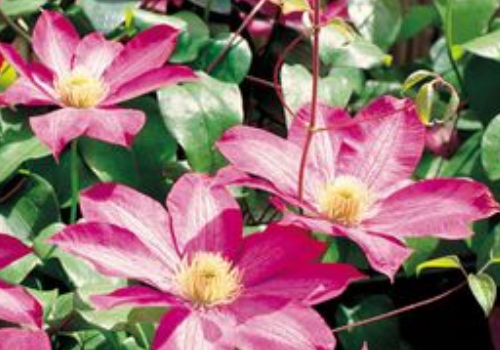
How to propagate clematis by cuttings:
1. Preparation for cuttings
Mentality: Before starting cuttings, you must be fully mentally prepared. Once you begin, you must take good care of them and persevere.
Mature plant: The success of the cuttings, as well as the later growth, is related to the mother plant you choose. You should choose a robust, disease-free plant, so that later care can save a lot of trouble.
Tools: Flower pots, water, and soil are all essential, as well as auxiliary tools such as scissors and bamboo sticks
2. Selection of cutting branches
Select healthy branches, preferably semi-lignified ones. Ones that are too tender or too old are unfavorable for rooting. Semi-lignified means that new branches of the current year show lignification about 1-2 months after flowering, which is the transition from tender shoots to lignified branches. Select branches with healthy leaves and no pests or diseases.
3. Cutting soil
Soil is equally important. With healthy branches, how can you do without a clean, sterile medium? If you want to just stick it into ordinary field mud and have it root, that possibility is not great.
Commonly used cutting media (for your reference): 1. Perlite + vermiculite 1:1 (when I used pure vermiculite, I don't know why the branches always tended to rot) 2. Akadama soil (just started using it this year, and it works quite well) 3. Water propagation (mineral water).
After choosing the soil, simply insert the branch directly into the soil.
4. Cutting position
After the cuttings are done, finding a good location is essential. It cannot be too sunny, nor too shady. You can appropriately block the sunlight. Before rooting, if the sunlight is too strong, the leaves will definitely wilt. Place it in a spot with scattered light, with appropriate ventilation, and pay attention to keeping the leaf surface moist. If the leaves dry out, the cuttings are basically hopeless.
5. Potting after cuttings
Rooting of clematis does not mean it has survived. If no bud points emerge, it is still useless. When you see many small tender buds appear, you can basically confirm survival, and it can be potted.
After potting, place the plant in a shaded position to recover for a week, then gradually increase light, and quietly wait for the branches to sprout.
Alright, that is all for the introduction to the flower language of clematis. Everyone understands now, right?
Flower language of clematis, how to identify clematis_how to propagate it
Clematis is also known as iron thread peony, passionflower, Weilingxian, etc. It is a plant of the Ranunculaceae family and the genus Clematis. Most are deciduous or evergreen herbaceous vines, with the flowering period from early spring to late autumn and the fruiting period in summer. They can be used as exhibition cut flowers, can be used to climb evergreen or deciduous trees and shrubs, and can be used as ground cover. Today we will briefly get to know this plant.
.....
How to identify clematis by morphology:
Clematis is a herbaceous vine, about 1-2 m long. The stem is brown or purplish red, with six longitudinal stripes, swollen at the nodes, and sparsely covered with short pubescence. The leaves are bipinnately trifoliolate, up to 12 cm long including the petiole; the leaflets are narrowly ovate to lanceolate, with a bluntly pointed apex, a rounded or broadly cuneate base, and entire margins, very rarely lobed, hairless on both sides, with inconspicuous veins; the petiolules are clearly visible. The flowers are solitary in the leaf axils; the pedicel is about 6-11 cm long, nearly hairless, with a pair of leaf-like bracts borne on the lower middle part; the bracts are broadly ovate or ovate-triangular.
Microscopic identification:
Root cross-section: the epidermis is a single layer of cells with thickened outer walls; the cortex has 10-odd layers of cells; the vascular bundles are collateral; fiber bundles can be seen in the phloem, especially abundant in old roots; the primary xylem is diarch; the vessels are relatively large in diameter; there is no pith in the center. The parenchyma cells contain starch grains.
.....
.....
Propagation methods of clematis
Clematis can be propagated by sowing, layering, grafting, division, or cuttings.
Sowing
Species can be propagated by sowing. For seeds of the epigeal germination type, if sown in spring, they can germinate in about 3-4 weeks. If sown in autumn, they will germinate when spring becomes warm. For seeds of the hypogeal germination type, they must go through a low-temperature vernalization stage before they can germinate, and the first pair of true leaves appears. Some species must go through two low-temperature stages before germination, such as Clematis patens. For vernalization treatment, if seeds are refrigerated at 0-3°C for 40 days, germination takes about 9-10 months. Treatment with a certain concentration of gibberellin can also be used.
Layering
In March, use mature branches from the previous year for layering. They usually root within 1 year.
Division
Clustered clematis plants can be divided.
Cuttings
For hybrid clematis cultivated varieties, cuttings are the main propagation method. From July to August, take semi-mature branches and cut them at the internode, that is, in the middle between the upper and lower nodes, with 2 buds on the node. Use a medium of half peat and half sand. The cutting depth is such that the buds on the node just show above the surface. The bottom temperature is 15-18°C. After rooting, pot them in 3-inch pots and overwinter them in a frost-proof hotbed or greenhouse. In spring, repot into 4-5 inch pots and move them outdoors. In summer, shade is needed to protect against rain showers. Plant out at the end of October.
.....
.....
Flower language of clematis
The flowering season of clematis runs from early spring to late autumn, so it can be said that the flowering period is especially long, clematis. The main ways of vertical greening include pergola green pavilions, pillars, walls, modeling, and hedge-fence styles. The pergola green pavilion style, used in flower stands, trellises, corridors, lamp posts, fences, arches, and other arrangements, forms an independent landscape in garden greening. It can satisfy visitors' viewing needs and also provide shade. So what is the flower language of this plant? The flower language of clematis is noble and pure, a beautiful heart. In addition, deceit, poverty, and forgive me, I am guilty because of you. These are also its flower languages.
.....
Editor's summary
Clematis has strong adaptability, and ornamental types with a certain shade tolerance can be used for greening various pillars. For hanging and trailing wall greening, ornamental clematis types with branch lengths of about 1 m can be used. That is the end of today's introduction to this plant. Thank you everyone for reading.
Clematis Clematis florida Thunb. Clematis illustrated guide: how to grow clematis / how to propagate clematis
Clematis profileClematis Clematis florida Thunb.
Cultivation methods and precautions for clematis Introduction to clematis
Clematis is a plant of the Ranunculaceae family (Ranunculaceae) and the genus Clematis. Most are deciduous or evergreen herbaceous vines, and a few are perennial upright herbs. Leaves are compound or simple, usually opposite. Flowers are solitary or in panicles, with large petal-like sepals. Flower colors include blue, purple, pink, rose red, purplish red, white, etc. There are many stamens and pistils. The flowering period runs from early spring to late autumn (there are also a few varieties that bloom in winter), and the fruiting period is in summer. There are several species, varieties, cultivars, and hybrids, which can be cultivated for garden ornament. In addition, there is also a novel of the same name, Clematis. It enjoys the reputation of "Queen of Vines."
Morphological characteristics of clematis
Clematis is a perennial herbaceous or woody vine of the Ranunculaceae family (Ranunculaceae) and the genus Clematis. Plant height: about 3-6 m. The trailing stem is slender, reaching about four meters, highly flexible, and sparsely covered with short hairs throughout. Leaves are opposite, petiolate, simple or once or twice trifoliolate; the petiole can curl around other objects; leaflets are ovate or ovate-lanceolate, entire, or with 2-3 notches. Flowers are solitary or in panicles, bell-shaped, urn-shaped, or wheel-shaped, formed by petaloid sepals. The pedicel arises from the leaf axil, 6-12 cm long, with opposite bracts borne at the middle; a large white flower opens at the tip of the pedicel, flower diameter: 2.5-6 cm; sepals 4-6, ovate, acute, slightly wavy at the margin, with three thick longitudinal veins in the center, the outer central longitudinal vein tinged purple and with short hairs; petals absent or replaced by staminodes. Stamens numerous, often modified, filaments flattened and enlarged, dark purple; pistils also numerous, the style with filamentous hairs or without. Usually it often does not set fruit; only those with unmodified stamens can set seed. The achenes aggregate into a head and have long tail-like hairs. Flowering period: May-July.
Herbaceous vine, about 1-2 m long. Stem brown or purplish red, with six longitudinal stripes, swollen at the nodes, sparsely covered with short pubescence. Leaves bipinnately trifoliolate, up to 12 cm long including the petiole; leaflets narrowly ovate to lanceolate, 2-6 cm long, 1-2 cm wide, apex bluntly pointed, base rounded or broadly cuneate, margin entire, very rarely lobed, hairless on both sides, veins inconspicuous; petiolules clearly visible, short or up to 1 cm long; petiole 4 cm long. Flowers solitary in the leaf axils; pedicel about 6-11 cm long, nearly hairless, with a pair of leaf-like bracts on the lower middle part; bracts broadly ovate or ovate-triangular, 2-3 cm long, sessile or shortly stipitate at the base, covered with yellow pubescence; flowers spreading, about 5 cm in diameter; sepals 6, white, obovate or spatulate, up to 3 cm long, about 1.5 cm wide, apex rather pointed, base gradually narrowed, glabrous on the inner surface, on the outer surface along three straight midveins forming a linear-lanceolate band densely covered with tomentum, margin glabrous; stamens purplish red, filaments broadly linear, glabrous, anthers lateral, oblong-rectangular, shorter than the filaments; ovary narrowly ovate, covered with pale yellow pubescence, style short, upper part glabrous, stigma enlarged into a head shape, slightly 2-lobed. Achene obovate, flattened, with thickened margin, persistent style elongated into a beak shape, slender, with spreading short pubescence on the lower part, glabrous on the upper part, enlarged stigma 2-lobed.
Ecological habits of clematis
China has about 110 species, growing in hilly shrublands in low mountain areas. It prefers fertile, well-drained alkaline loam, and avoids waterlogged soil or soil that cannot retain water during summer drought. It is highly cold-resistant and can tolerate -20 low temperatures. When harmed by red spiders or leaf-eating pests, ventilation needs to be strengthened.
Distribution area of clematis
Native to China, it is distributed in Guangdong, Guangxi, Jiangxi, Hunan, and other places. It grows in hilly shrublands in low mountain areas, in valleys, roadsides, and by streams. It is cultivated in Japan. There are about 300 species of clematis worldwide, widely distributed across the continents, and most numerous in the north temperate zone and the subtropical regions of the Northern Hemisphere. China has about 110 species, growing in hilly shrublands in low mountain areas. It prefers fertile, well-drained alkaline loam, and avoids waterlogged soil or soil that cannot retain water during summer drought. It is highly cold-resistant and can tolerate -20 low temperatures. When harmed by red spiders or leaf-eating pests, ventilation needs to be strengthened.
Southern warm-temperate deciduous broad-leaved forest region
Main cities: Qingdao, Yantai, Rizhao, Weihai, Jining, Tai'an, Zibo, Weifang, Zaozhuang, Linyi, Laiwu, Dongying, Xintai, Tengzhou, Zhengzhou, Luoyang, Kaifeng, Xinxiang, Jiaozuo, Anyang, Xi'an, Xianyang, Xuzhou, Lianyungang, Yancheng, Huaibei, Bengbu, Hancheng, Tongchuan)
Northern subtropical deciduous and evergreen broad-leaved mixed forest region
Main cities: Nanjing, Yangzhou, Zhenjiang, Nantong, Changzhou, Wuxi, Suzhou, Hefei, Wuhu, Anqing, Huainan, Xiangfan, Shiyan
Central subtropical evergreen and deciduous broad-leaved forest region
Main cities: Wuhan, Shashi, Huangshi, Yichang, Nanchang, Jingdezhen, Jiujiang, Ji'an, Jinggangshan, Ganzhou, Shanghai, Changsha, Zhuzhou, Yueyang, Huaihua, Jishou, Changde, Xiangtan, Hengyang, Shaoyang, Guilin, Wenzhou, Jinhua, Ningbo, Chongqing, Chengdu, Dujiangyan, Mianyang, Neijiang, Leshan, Zigong, Panzhihua, Guiyang, Zunyi, Liupanshui, Anshun, Kunming, Dali
Classification of clematis varieties. According to the flowering habits of clematis varieties, they can be divided into 3 groups
Group 1 - flowering begins before the end of May, pedicels short, usually with more than 2 flowers borne in the leaf axils. In the first year after planting, from February to March, cut all branches back to 30 cm each. In the second year, from February to March, cut all branches back to 1 m each. From the third year onward, each year after flowering, cut out weak and dead branches.
Group 2 - flowers open on short branches sprouting from the leaf axils of branches produced the previous year. Each branch flowers, and the flowering period begins before the end of June. From February to March, cut all branches back to 30 cm each. In the second year, from February to March, cut all branches back to 1 m each. From the third year onward, from February to March, cut all branches short just above the first pair of plump lateral buds.
Group 3 - flowers open on new branches of the current year, with several flowers per branch, and the flowering period begins in July. In the first year after planting, from February to March, cut all branches back to 30 cm. From the second year onward, each year from February to March, cut all branches back above the growth point of the previous year, not exceeding 75 cm above ground level.
The cultivated varieties of clematis determined by the International Clematis Society fall into the following 6 groups
① Clematis group: woody vines. Flowers in summer, with flowers borne on old or mature branches. For example, the clematis native to China (C. florida) is the representative species.
② Hybrid clematis group: woody vines. Flowers in summer and autumn, with more flowers, borne on new shoots. The representative species is hybrid clematis, with large flowers and cold resistance, and rich flower colors. Most garden cultivars in Europe and America belong to this group.
③ Woolly clematis group: woody vines. Flowers in summer and autumn, with fewer flowers, borne on short lateral branches. The representative species, woolly clematis, has the largest flowers among the original species of this genus.
④ Clematis patens group: woody vines. Flowers in spring, with flowers borne on old or mature branches. The Chinese native Clematis patens (C. patens) is the representative species of this group.
⑤ Scarlet clematis group: subshrubs. Flowers in summer, with flowers borne on new shoots of the current year, flowering continuously, flowers trumpet-shaped or bell-shaped. The scarlet clematis native to the United States (C. texensis) is its typical representative.
⑥ Italian clematis group: woody vines. Flowers in summer and autumn, with many flowers, borne on summer shoots. The representative species is Italian clematis native to southern Europe and western Asia, characterized by vigorous growth.
The morphology of several original species used as the main parents of hybrids is briefly described below. Woolly clematis C. lanuginosa: Plant height 2 m. Leaves simple, sometimes trifoliolate, thick in texture, ovate, pointed at the tip, entire, 12 cm long, 7 cm wide, glabrous on the upper surface, densely covered with gray tomentum on the lower surface. Flowers solitary or 2-3 clustered into a false cyme, flower diameter 10-15 cm; pedicel tomentose, without bracts, borne at the branch tip, with 6 or 8 sepals, wheel-shaped, slightly overlapping, white to pale lilac. It was first discovered in Ningbo.
Clematis patens (large-flowered clematis) C. patens:Plant height 6 m. Lower leaves with two pairs of broadly spreading leaflets, upper leaves trifoliolate or simple; ovate-lanceolate, 5-10 cm long, hairy on the lower surface, glabrous on the upper surface. Flowers solitary at the branch tip, flower diameter 8-15 cm; pedicel tomentose, without bracts, with 6 to 8 sepals, spreading, long-pointed and not overlapping. Native to North China, Northeast China, and Korea, Japan. The original species has white flowers, and cultivated varieties have very rich flower colors. It likes light, but its stems and roots prefer shade. It likes fertile, well-drained slightly alkaline loam, and is propagated by sowing or root division.
Southern European clematis C. viticella:Native to southern Europe and western Asia. Plant height 4 m. Stem slender, angular. Leaves once or twice pinnately lobed; leaflets 2.5-5 cm long, asymmetrical, entire or 3-lobed, thin in texture. Flowers solitary or 3 clustered, blue, purple, or rose purple; flower diameter 5-8 cm, sepals spreading.
Clematis C. florida:Woody vine. Leaves bipinnately trifoliolate: leaflets ovate to ovate-lanceolate, 2-5 cm long, entire or 2-lobed; sparsely covered with short hairs on the lower surface. Flowers solitary in the leaf axils, with 2 opposite leaf-like bracts near the middle of the pedicel. Sepals (4)6(8), white or milky white, spreading, 5-8 cm in diameter. Flowers in summer. Native to central and southern China. Cultivated varieties include double-flowered clematis cv. Plena and staminate-leaved clematis cv. Sieboldii, etc.
The morphological characteristics of horticultural varieties are mostly determined by the characteristics of the parents. For example, cultivated varieties: Clematis crispa, Clematis heracleifolia, etc.
Flower varieties 1. Ruse:A late-flowering large-flowered variety pruned in group 3. Many flowers, flower diameter 10-15 cm, purplish red stamens, pink petals with obvious veining and a strong texture.
Conventional characteristics are as follows
Category: Large-flowered clematis
Flowering period: May-June and August-September
Flowers: flower diameter 12 to 15 cm, petals pointed, overlapping, color a beautiful pale rose red, with a silvery sheen. This color may fade under strong light, and performs even better in semi-shade.
Leaves: leaves heart-shaped, deciduous vine.
Growing characteristics are as follows
Environment: This variety can grow and flower well in a not-too-hot environment. However, the flower color is most beautiful in semi-shade or shade, and the flowering time is also longer.
Growth: height 3-4 m, and it can reach this height even after heavy pruning. At the end of winter, some branches can be pruned away, but this is not essential. Thinning is more beneficial for extending the flowering period.
Ideal planting state: Plant beside shrubs or small trees, especially paired with trees with dark red leaves (such as purple-leaf plum) for an even more striking effect. In semi-shade, it can be allowed to climb on climbing hydrangea or on a very large traditional hydrangea. In addition, it also combines well with red-flowered honeysuckle, because the two plants have the same flowering period. Robust, heat-resistant, many-flowered, 3-4 m, recommended for planting in semi-shade.
2. Celebration (Bee's Love):Early Large-flowered Group, pale purple with magenta stripes.
Height: 1.5-2.5 m, flower size (cm): 6-7, flower diameter: 12-20, flowering period: May-June, September, height 2-4 m, likes sun or semi-shade, hardiness zones: zones 4-9.
A very excellent variety with moderate growth. In sufficient light the flower color becomes lighter. Suitable for climbing on various supports, such as trellises, poles, or trees, and grows better in semi-shade.
Conventional characteristics are as follows
Flowering period: mid-May to October, large pale rose-red flowers, with a deep rose-red central line in the middle of the petals; toward the end of the flowering period the flowers turn pale purple, but still retain the prominent central line. The rounded petals at the tips overlap slightly, forming a circular corolla.
Leaves: composed of 3-5 leaflets, lanceolate, deciduous.
Fruit: fruit spherical, silvery, very attractive within a few weeks after flowering.
Environment: Unlike other variants of the same species, it fears neither light nor heat in no shade or semi-shade, and the color can remain as vivid as when first opened.
Growth: can grow to 2-3 m tall. Without special care, this variety can also ensure growth during the flowering period due to its own vigor.
Ideal planting: Ideal when climbing on low shrubs, or decorating the branches and trunks of taller shrubs. It is suitable, robust, and can also grow well in flower troughs or large flower pots. It can easily cover small lattice fences or chamfered supports. In this case, it is best to cut the branches to 25-30 cm above ground after the first flowering period each year (May-June).
Other characteristics: strong disease resistance, the soil should remain fertile and moist during the flowering period, grows well in flower pots or troughs, an excellent cut flower variety.
3. Ville de Lyon:A late-flowering large-flowered hybrid pruned in group 3, ruby-red flowers with obvious pink stripes, relatively round flowers, pure yellow stamens. Flower diameter 10-15 cm, slightly smaller in summer, flowering period June-September, height 2.5-3 m, likes sun or semi-shade.
Conventional characteristics are as follows
Type: Large-flowered clematis
Flowering period: from early May to October. In midsummer, the number of flowers decreases slightly, but it very rarely stops flowering.
Flowers: flowers slightly small, 12-14 cm. Flowers red and glossy, with a sparkling red glow; the round petals overlap each other, creating a strong contrast with the lemon-yellow center.
Leaves: 3-5 small heart-shaped leaves, deciduous
Fruit: not very ornamental, best removed to encourage more flowering
Growing characteristics are as follows
Environment: In full sun the flower quantity is abundant, but from the third or fourth day after opening the flowers fade somewhat. In semi-shade, the flower color can be maintained, making the flowers more beautiful, with better air circulation and some gaps between flowers.
Growth: 2-3 m tall, very robust, branches need to be cut short every winter
Ideal planting: Bright in color, it easily becomes the focal point of the courtyard. The plant is covered with flowers from top to bottom, forming a beautiful wall of flowers. In a place without shade (full sun), pair it with shrubs to avoid powdery mildew damage.
4. The President:An early-flowering large-flowered variety pruned in group 2, many-flowered and long-flowering. Flower diameter 13-20 cm, beautiful blue-purple flowers, purplish red stamens. Robust and reliable, heat-resistant, many-flowered, 2-3 m, can be planted facing any direction.
5. Blue Light:Early Large-flowered Group, blue, double, height: 2m, flower size (cm): 5-12, flower diameter: medium, flowering period: 5-6, 8-10, hardiness zones: zones 4-9. A very attractive compact cultivar with light blue flowers that are always double, something few cultivars can achieve. It climbs up supports by twining its leaf stalks. Suitable for all kinds of trellises and supports. It can also grow on conifers or deciduous shrubs, and the effect is especially ideal when contrasted with yellow foliage or yellow flowers. Particularly suitable for small courtyards with good light, and also suitable for container growing on balconies or terraces
6. Asao:Pink, Early Large-flowered Group, height: 2-3 m. Size (cm): 12-20. Flowering period: May-September. Hardiness zones: zones 4-9.
A relatively fast-growing Japanese large-flowered cultivar, deep pink with white star-shaped stripes, yellow stamens, flowering period May-September. Not suitable for areas with strong light and heat. Suitable for fences, flower corridors, trellises, and flower pillars. It can also grow on conifers, deciduous trees, or low shrubs. It is basically a single-flowered cultivar, but it may also bloom as double.
7. Tenshio:Early Large-flowered Group, pruning type: 2, flowering period: May-June, September. In May-June it produces double flowers on last year's shoots, and in September it produces single flowers in summer. A Japanese cultivar, this variety is very popular in Europe and is regarded as a very "true" double-flowered variety. Height: 1.5-2.5m. Flower diameter: 10-14 cm. Flowering period: May-July. Pruning type: light pruning. A Japanese cultivar with a compact habit and free flowering. It likes sun and performs perfectly in pots.
8. Carnaval
Height: 3m. Flower color: deep blue, always double. Flower diameter: large. Flowering period: May-August. Pruning type: light pruning.
This is an outstanding cultivar that produces double flowers on both old and new shoots, and can also be used as a cut flower. It can climb on trellises, walls, or fences, and can also cling to natural supports such as conifers. It is very popular in small courtyards and is also a good variety for container growing on balconies and terraces.
9. Green Jade:Double, flower color ranges from greenish white to white, with 6 petals in the outer ring and a "ball" made up of finely divided petals in the center.
Flowering period: (May) June-September. Orientation: sunny. Pruning type: type 3.
10. Fantasy Purple Two-tone:Orientation: sunny. Pruning type: type 3.
Plant height: 2-3 meters, small flower diameter, about 5 cm, flowering period May-September, planting direction full light, but partial shade is recommended. This species is semi-evergreen, and small plants go dormant and lose their leaves in summer. In winter, generally only the old leaves fall. Pruning type 3, but careful pruning is recommended.
A graceful species with a very primitive flower form: creamy white petals, with the center made up of double petals transformed from purple-black stamens, creating a very strong contrast. It flowers only on new shoots of the current year, flowering period June-September.
This cultivar is a natural variation of Green Jade (Xiaolu), and its habits are the same as Green Jade (Xiaolu). Xiaolu is native to the border area of Yunnan, Zhejiang, and Fujian in China, and was introduced to Europe from Japan in 1829 for cultivation. Its minimum tolerated temperature is -10 degrees, and it can overwinter safely with long-term -5 degrees, but it is best to use pots so that it can be brought indoors to overwinter in winter and can also bloom earlier. This cultivar grows very quickly in height, but the thickening of the stems and root growth are very slow! Rooting cuttings is somewhat difficult.
11. Snow Queen:Snow Queen is a large-flowered clematis, with large white flowers tinged slightly blue or slightly pink. The petal edges are wavy, and the flowering is abundant.
It can be allowed to climb on low shrubs, such as lilac. It is also an ideal potted plant and can be grown on terraces or balconies. It can also be used as a cut flower. Height: 2-3m. Flower color: white with a bit of light purple, sometimes with pale green, with ruffled edges. Flower diameter: 14-18cm. Flowering period: May-June and September. Pruning type: light pruning. Pruning type: type 2. Plant height: 2-3 meters. Flower diameter: 14-18cm. Flowering period: 5-6, 8-9. Orientation: full sun, partial shade.
12. Isago
White, Early Large-flowered Group, double, height: 2.5-3, flower size (cm): 5-12, flower diameter: big, flowering period: 5-6, 8-9, planting orientation: SNE, pruning type: 2, hardiness zones: zones 4-9. A Japanese cultivar from 1991, double flowers in May-June. In summer it produces semi-double white flowers with yellow stamens. String can be used to assist climbing. Suitable for various trellises, flower pavilions, and flower pillars. Especially suitable for positions with a black background, sufficient light, and shelter from wind.
Series Classification
The 9 major groups of clematis: 1. Evergreen group; 2. Alpine clematis group; 3. Mountain clematis group; 4. Large-flowered cultivar group; 5. Double and semi-double group; 6. Summer-flowering large-flowered cultivar group; 7. Late-flowering cultivar group; 8. Southern European clematis group; 9. Other late-flowering original species group.
Clematis cadmia Buch.-Ham. ex Hook.f. & Thomson
Slender perennial herb, about 1 meter tall. Roots thick, dark brown, with many fibrous roots. Stems cylindrical, light yellow when young, dark brown or purplish red when old, with six obvious longitudinal lines, sparsely covered with spreading soft hairs. Bipinnately trifoliolate or pinnately compound leaves, up to 12 cm long including the petiole, covered with spreading sparse soft hairs or nearly hairless; leaflets narrowly ovate or elliptic-lanceolate, 2-5 cm long, 1-2 cm wide, apex obtuse-acute, base cuneate, margin entire, or with deep or shallow lobing, only the midvein sparsely soft-hairy, otherwise hairless; petiolules inconspicuous; petiole 2-3 cm long. Flowers solitary and axillary; pedicels slender, about 7-10 cm long, covered with spreading sparse soft hairs, denser in the upper part, with a pair of leaf-like bracts in the middle to lower part; bracts broadly ovate or broadly lanceolate, 2.5-4 cm long, 1.5-2 cm wide, sessile or short-stalked; flowers small, light purple or pale white, 4 cm in diameter; sepals 5-6, obovate-elliptic or narrowly obovate, apex obtuse-acute, base gradually narrowed, surface hairless, veins prominent, on the back along three straight midveins forming a linear-lanceolate band, covered with short tomentum, margin hairless; stamens about 7 mm long, anthers linear, 5 mm long, filaments flattened and short, hairless; ovary narrowly ovate, about 3-4 mm long, covered with appressed strigose hairs, style club-shaped, hairy, stigma not swollen. Achenes flat, obovate, 1.2-1.5 cm long including the persistent beaked style, 5-6 mm wide, brownish red, covered with strigose hairs when young, gradually falling off later. Flowering period April to May, fruiting period June to July.
In China it is distributed in northern Jiangxi, southern Anhui, northern Zhejiang, and southern Jiangsu. It grows in grass along streams and roadsides, preferring shady and moist environments. It is also distributed in Vietnam and India.
This species is very close to Clematis florida, but is relatively easy to distinguish by the stigma not being swollen, being club-shaped, and covered with short appressed hairs, the leaflets narrowly ovate and often lobed, and the petiolules not conspicuous.
Clematis courtoisii Hand.-Mazz.
Woody climbing vine, about 2-4 meters long. Fibrous roots yellowish brown, slightly spicy when fresh. Stems cylindrical, surface brownish red or dark brown, sparsely covered with spreading soft hairs when young, later falling off to nearly hairless. Leaves trifoliolate to bipinnately trifoliolate; leaf blades thinly papery or subleathery, oblong or ovate-lanceolate, about 5-7 cm long, 2-3.5 cm wide, apex acuminate or long-acute, base broadly cuneate or rarely rounded, margin entire, rarely 2-3 lobed, above only slightly soft-hairy along the main veins, otherwise hairless, below very sparsely soft-hairy, veins prominently raised on both sides; the 3 leaflets at the apex have short petiolules or are sessile, lateral petiolules up to 1-2 cm long, covered with sparse appressed soft hairs; petiole 6-10 cm long, slightly enlarged at the base. Flowers solitary in leaf axils; pedicels 12-18 cm long, covered with appressed pale soft hairs, with a pair of leaf-like bracts at the middle of the pedicel; bracts ovate or broadly ovate, often wider than the leaves, 4.5-7 cm long, 2.5-4.5 cm wide, margin sometimes 2-3 lobed, base with a short stalk 2-4 mm long; flowers large, 5-8 cm in diameter; sepals usually 6, white, obovate-lanceolate or broadly lanceolate, 3.5-4.5 cm long, up to 1.5-2.5 cm wide, apex acute, inner surface hairless, brown veins visible, outer surface along three straight midveins forming a purplish blue band, sparsely soft-hairy, outside covered with dense pale tomentum; stamens dark purple, up to 1.5 cm long, usually the outer whorl longer and the inner whorl shorter, anthers linear, 5 mm long, filaments hairless, twice as long as the anthers; carpels about 4-5 mm long, ovary and base of style covered with appressed long soft hairs, upper part of style covered with pale soft hairs, stigma swollen, hairless. Achenes obovate-round, 5 mm long, 4 mm wide, brownish red, sparsely soft-hairy, persistent style 1.5-3 cm long, covered with yellow soft hairs, swollen stigma persistent, hairless. Flowering period May to June, fruiting period June to July.
Distributed in eastern Hunan, southern Anhui, southern Henan, northern Zhejiang, and southern Jiangsu. It often grows at altitudes of 200-500 meters on mountain slopes and in mixed forests, thickets, and along streams and roadsides, climbing on trees. The type specimen was collected in southern Anhui.
The whole plant is used medicinally to treat snake bites, mashed and applied to the affected area (Hunan Materia Medica 1: 487, figure 244, 1961); the root is used medicinally, with the functions of detoxifying, promoting diuresis, and removing blood stasis, treating abdominal distension, constipation and urinary retention, toothache, and eye problems such as wind-fire eye with star-like opacities (Tianmu Mountain Medicinal Plant Records, Part 1, 410, figure 213, 1965); the "Clematis florida" in the above two books is a misidentification and should be this species.
This species is close to Clematis hancockiana, but is relatively easy to distinguish by its white sepals, usually 6, the outer surface not covered with curved soft hairs, the style stigma swollen and persistent, and the achenes with grayish yellow feathery styles.
Clematis florida Thunb. var. plena D. Don
Difference from Clematis florida: the stamens are all petal-like, white or pale green, shorter than the outer sepals.
It grows wild in Yunnan and Zhejiang in China, and is cultivated horticulturally elsewhere. It grows wild at altitudes up to 1700 meters on mountain slopes, along streams, and in thickets, preferring shady and moist environments.
Clematis hancockiana Maxim.
Woody vine, about 1-2 meters long. Stems cylindrical, nodes often enlarged, surface brownish red or purplish red when dry, with six shallow longitudinal grooves, sparsely soft-hairy when young, later nearly hairless. Upper stem leaves usually trifoliolate, middle and lower stem leaves pinnately compound or bipinnately trifoliolate, with 3-9 leaflets; leaflets broadly ovate to ovate-lanceolate, 4-6 cm long, 2-4 cm wide, apex obtuse-acute, base broadly cuneate or rounded, margin entire, usually the terminal petiolule slightly short, only 1 cm long, the lower lateral petiolules slightly longer, up to 2 cm; petiole 4-11 cm long, pale white, often zigzagged or twisted at the point where the lateral petiolules are attached, slightly enlarged at the base, covered with sparse spreading soft hairs. Flowers solitary in leaf axils; pedicels upright, up to 4-8 cm long, rarely up to 13 cm, covered with sparse curved soft hairs, with a pair of leaf-like bracts in the middle; sepals 4, purplish red or bluish purple, rectangular-elliptic or narrowly obovate, 1.5-2.5 cm long, 5-7 mm wide, often reflexed after flowering, inner surface hairless, three midveins and lateral veins slightly visible, outer surface covered with thick curved soft hairs and tomentum; stamens with the outer whorl longer and the inner whorl slightly shorter, about 1-2 cm long, filaments hairless, purple-black, anthers linear, nearly equal in length to the filaments; ovary and lower part of style covered with yellow long soft hairs, upper part of style and outer side of stigma only covered with short soft hairs, inner side hairless. Achenes flat, broadly ovate or nearly round, about 5 mm long, covered with yellow short soft hairs, persistent style 3.5-5 cm long, covered with grayish yellow long soft hairs, stigma not swollen. Flowering period May, fruiting period June.
Distributed from northeastern Zhejiang to southern Henan and southwestern Jiangsu. It often grows at altitudes of 100-300 meters in low mountain areas on slopes and in thickets. The type specimen was collected near Ningbo, Zhejiang.
This species is close to Clematis courtoisii, differing in having only 4 sepals, bluish purple or purplish red, with the outer surface of the sepals covered with thick curved soft hairs; the pinnately compound leaves are often zigzagged at the points where the leaflets are attached.
Clematis huchouensis Tamura
Clematis huchouensis (Hangzhou Medicinal Plant List) Golden Scissors, Copper-foot Weilingxian (Zhejiang)
Herbaceous vine. Stems six-angled, pale yellow, with curved soft hairs or hairless. Odd-pinnately compound leaves, 8-10 cm long, with 5-9 leaflets; leaflets thinly papery or herbaceous, usually the terminal leaflet smaller and the basal pair of leaflets larger, 2-3 deeply lobed; leaflets or lobes ovate or ovate-elliptic to elliptic-lanceolate, 4-5 cm long, 2-3 cm wide, apex obtuse-rounded with a small pointed tip, base rounded, slightly cordate or cuneate, margin entire, above slightly soft-hairy, below densely covered with appressed soft hairs, main veins and sparse lateral veins slightly raised; petiolules about 1 cm long; petiole 2-3 cm long. Cymes, 1-3 flowers, axillary, peduncle about 2-6 cm long, with a pair of ovate bracts in the upper part, about 2-3 cm long, sometimes 3-lobed; the middle pedicel 1-2 cm long, without bracts, the lateral pedicels 3-4 cm long, with a pair of small bracts; flowers spreading, 2.5-3 cm in diameter; sepals 4, white, rectangular-elliptic to elliptic-lanceolate, 1.5-2 cm long, about 6 mm wide, apex reflexed, inner surface hairless, outer surface covered with short soft hairs; stamens only half as long as the sepals or shorter, anthers linear, lateral, about 3 mm long, filaments shorter and wider than the anthers, about 2 mm long, connective extended at the apex; carpels (6-)12(-14), covered with white soft hairs, ovary narrowly ovate, style club-shaped. Achenes ovate-round, flat, about 7 mm long, 5 mm wide, margin thickened, persistent style beaked, covered with appressed short soft hairs.
Distributed in northeastern Zhejiang, southeastern Jiangsu, and northern Jiangxi. It grows by lakesides, roadsides, grassy slopes, and field ridges. The type specimen was collected in Wuxing, Zhejiang.
The whole plant is used medicinally to dispel wind and reduce swelling; it treats deep abscesses, rheumatoid arthritis, and brain tumors (Jiangsu New Medical College, Dictionary of Chinese Materia Medica); it has anticancer effects, and external application treats intracranial tumors (brain tumors); it also treats scrofula and other conditions (Hangzhou Botanical Garden, Medicinal Plant List).
This species is close to C. recta, differing in the flat achenes and the persistent style not elongated but beaked. It is also close to Clematis florida, but is usually pinnately compound-leaved and has cymes with 1-3 flowers, making it relatively easy to identify.
Clematis lanuginosa Lindl.
Climbing vine, about 2 meters long. Stems cylindrical, with six longitudinal lines, surface brown or purplish red, covered with appressed pale yellow soft hairs when young, later gradually falling off to nearly hairless, with hairs persistent only at the nodes. Usually simple leaves opposite, very rarely trifoliolate; leaf blades thinly papery, cordate or broadly ovate-lanceolate, 6-12 cm long, 3-7.5 cm wide, apex acuminate, base cordate or nearly rounded, margin entire, above sparsely covered with pale yellow tomentum, denser along the main veins, below covered with appressed pale gray thick cottony hairs, often persistent, basal arcuate main veins usually 5, rarely 3 or 7, slightly visible above, prominently raised below; petiole slender cylindrical, about 4-8 cm long, often twisted, covered with yellow soft hairs, denser near the leaf base at the apex. Flowers solitary and terminal; pedicels straight and stout, about 5-10 cm long, densely covered with yellow soft hairs; flowers large, about 7-15 cm in diameter; sepals usually 6, light purple, rhombic-elliptic or obovate-elliptic, 4-7 cm long, 2-3.5 cm wide, apex acute, base gradually narrowed, inner surface hairless, three basal straight midveins and lateral reticulate veins visible, outer surface along three straight midveins forming a lanceolate band, covered with yellow curved soft hairs, outside covered with appressed pale tomentum, margin nearly hairless; stamens about 1-2 cm long, usually the outer whorl longer and the inner whorl slightly shorter, anthers lateral, linear, about 1 cm long, connective slightly protruding at the apex, filaments hairless, slightly longer than or nearly equal to the anthers; carpels about 1.5 cm long, ovary and base of style covered with appressed long soft hairs, style slender, upper part with sparser hairs or nearly hairless. Achenes flat, rhombic or obovate-triangular, 4-5 mm long, rarely up to 8 mm, about 4 mm wide, rarely up to 6 mm, with a ridged protrusion in the middle, margin thickened, covered with appressed pale soft hairs, persistent style slender, 4-6 cm long, covered with sparse yellow soft hairs. Flowering period June, fruiting period July to August.
Endemic to northeastern Zhejiang. It often grows at altitudes of 100-400 meters in valleys and thickets along streams. The type specimen was collected near Zhenhai, Ningbo.
This species is mainly characterized by usually simple leaves and the underside of the leaf blade densely covered with appressed curved soft hairs; the flowers are large, up to 7-15 cm in diameter, making it one of the largest-flowered species in the genus, and it can be introduced for cultivation as an ornamental.
Clematis longistyla Hand.-Mazz.
Climbing vine, branches often brownish red, surface with longitudinal grooves, sparsely covered with appressed pale soft hairs when young, later falling off to nearly hairless; undeveloped small branches and leaf clusters often present in leaf axils. Leaves trifoliolate, pinnately compound, to bipinnately trifoliolate; leaflets ovate, 1-3 cm long, width only half the length, apex acute, base rounded or cuneate, margin entire or with a few teeth, often 3 shallowly lobed or rarely 3 deeply lobed to the base, only the veins with pale soft hairs, reticulate veins slightly raised on both sides, lateral leaflets with short stalks, terminal leaflets equal in length to the petiolules; petiole base slightly widened, thickened, and united. Flowers solitary and axillary; pedicels 5-14 cm long, hairy in the upper part, with a pair of leaf-like bracts in the middle or lower middle; bracts ovate, not lobed or 3-lobed; flowers spreading, 5-7 cm in diameter; sepals 6, white, rarely 4 or 5, broadly elliptic or nearly rhombic, apex with a pointed tip about 2 mm long, base wavy-cuneate, inner surface hairless, outer surface along three straight midveins forming a lanceolate band, with sparse soft hairs, outside covered with dense tomentum, margin hairless; stamens dark red, filaments hairless, longer than the anthers, carpels covered with tomentum, stigma filiform along the style, hairless, about 2-3 mm long. The persistent feathery style of the achene has golden yellow long soft hairs, with a hairless portion about 1.2 cm long at the apex.
Produced in western Hubei, rare.
This species is very close to Clematis courtoisii, differing in that the stigma of this species is not swollen and the tip of the style is hairless; the persistent plumose style of the achene is about 4 cm long, with about 1.2 cm at the apex hairless. It differs from Clematis florida in that the latter has narrower leaves and the persistent style of the achene is not feathery but beaked.
Clematis patens C. Morren & Decne.
Clematis patens (Illustrated Investigation of Plant Names) Large-flowered Clematis (Northeast Herbaceous Plant Records)
Perennial herbaceous vine. Fibrous roots dense, reddish brown. Stems cylindrical, climbing, about 1 meter long, surface brown-black or dark red, with obvious six longitudinal lines, sparsely soft-hairy when young, later hairs gradually falling off, persistent only at the nodes. Pinnately compound leaves; leaflets usually 3, rarely 5, papery, ovate or ovate-lanceolate, 4-7.5 cm long, 3-5 cm wide, apex acuminate or obtuse-acute, base usually rounded, rarely broadly cuneate or subcordate, margin entire, with pale yellow spreading cilia, basal main veins 3-5, slightly raised on the back, sparsely soft-hairy along the veins, otherwise hairless, petiolules often twisted, 1.5-3 cm long, the terminal petiolule often longer and the lateral ones slightly shorter; petiole 4-6 cm long. Flowers solitary and terminal; pedicels straight and stout, about 4-9 cm long, covered with pale yellow soft hairs, without bracts; flowers large, 8-14 cm in diameter; sepals 8, white or pale yellow, obovate-round or spoon-shaped, 4-6 cm long, 2-4 cm wide, apex rounded with a pointed tip about 2 mm long, base gradually narrowed, inner surface hairless, three straight midveins and lateral veins obvious, outer surface along three straight midveins forming a lanceolate band, covered with long soft hairs, outside sparsely covered with short soft hairs and tomentum, margin hairless; stamens up to 1.7 cm long, filaments linear, shorter than the anthers, hairless, anthers yellow, about 1 cm long; ovary narrowly ovate, about 1.3 cm long, covered with silky pale yellow long soft hairs, upper part of style covered with short soft hairs. Achenes ovate, persistent style 3-3.5 cm long, covered with golden yellow long soft hairs. Flowering period May to June, fruiting period June to July.
In China it is produced in eastern Shandong (Laoshan) and eastern Liaoning. It grows at altitudes of 200-1000 meters in mountain slope grassy areas and thickets. It is also distributed in Japan and Korea.
This species has no bracts on the pedicels, large spreading flowers, trifoliolate leaves, and hairless undersides of the leaflets, which distinguishes it from other species in the genus.
Clematis patens C. Morren & Decne. subsp. tientaiensis M. Y. Fang
Difference from Clematis patens: the leaves have both trifoliolate compound leaves and simple leaves, leaflets subleathery, ovate-lanceolate, slightly smaller, 6-7 cm long, 2-4 cm wide, hairless; pedicels stout, only 3.5-4 cm long (shorter than the sepals); sepals 5-6, white; staminal filaments 1-2 times longer than the anthers.
Produced in eastern Zhejiang (Tiantai Mountain, North Yandang Mountain). It grows at altitudes of 1000 meters on mountain slopes under forests and in thickets.
Landscape Uses of Clematis
Clematis has sparse branches and leaves; some have large and colorful flowers, while others have many small flowers gathered into large inflorescences, with a unique charm, making them indispensable good material in climbing greening. They can be planted by walls, in front of windows, or beside trees and shrubs, and arranged among rockeries and rocks. They can cling to flower pillars, flower gates, and fences; they can also be potted for ornamental use. A few species are suitable as ground cover plants. The flowering branches, leafy branches, and fruiting branches of some clematis can also be used as vase decorations, cut flowers, and so on. Flower-viewing type, climbing fences, trellises, and rocks.
Characteristics: fragrant when flowering. Clematis can be used as exhibition cut flowers and can be used to climb evergreen or deciduous trees and shrubs. It has many original species, hybrids, and horticultural cultivar groups, including large-flowered cultivars, small-flowered cultivars, semi-double or double cultivars, and late-flowering cultivars.
Medicinal or Dietary Therapeutic Value of Clematis
The medical information and health dietary information on Huhua Network are for reference only and cannot be used as a basis for diagnosis or medical treatment. Any health problems should be consulted with professional medical personnel, and the treatment of any disease should follow medical advice.
Ultimate flower-protecting task: To love yourself, start from reality and follow medical advice. For illness, do not be careless, do not delay, do not give up hope, face it bravely, warm the silent world with love, and care for the flower field in your heart with your heart.
The medical content on Huhua Network is for reference only and cannot be regarded as professional advice. Any health problems should be consulted with professional medical personnel.
Medicinal Information (1)
Medicinal value: the roots and whole plant are used as medicine. Promotes diuresis, regulates qi and relieves constipation, activates blood and relieves pain. Used for difficult urination, abdominal distension, and constipation; external use treats joint swelling and pain, and insect and snake bites.
The roots and whole plant are used medicinally to promote diuresis and menstruation (Jiangsu New Medical College, Dictionary of Chinese Materia Medica); the roots can dredge meridians, detoxify, and treat gout and insect and snake bites (Guangxi Plant List); the seeds contain about 18% oil and are used for industrial oil; the roots are used as medicine and have the effects of detoxifying, promoting diuresis, and removing blood stasis (Illustrated Handbook of Higher Plants of China).
This species is close to Clematis cadmia, but can be distinguished by the upper part of the style being hairless, the stigma swollen, the leaflets usually lanceolate, and the petiolules conspicuous.
Medicinal Material Harvesting
Harvested in autumn and winter, dried separately in the sun.
Nature and flavor: pungent, warm.
Functions and indications: 1. "Pharmacology of Chinese Medicine": "The root is a medicine for uric acid disorders, used for gout. It also treats stroke, accumulations, and jaundice." 2. "Illustrated Chinese Medicinal Plants": "Promotes diuresis and menstruation."
Usage and dosage:3-5 qian. External use in appropriate amount; fresh leaves mashed with wine or table salt and applied to the affected area.
Selected formulas:
1. To treat insect and snake bites: Clematis whole plant, mashed and applied to the affected area. ("Hunan Materia Medica")
2. To treat wind-fire toothache: fresh Clematis root, mashed with table salt and applied to the affected area. ("Zhejiang Tianmu Mountain Medicinal Plant Records")
3. To treat star-like eye opacities: fresh Clematis root, mashed and inserted into the nostril, the right nostril for the left eye and the left nostril for the right eye. ("Zhejiang Tianmu Mountain Medicinal Plant Records")
Propagation Methods of Clematis
Propagation methods: seeding, layering, grafting, division, or cuttings are all acceptable.
Seeding: original species can be propagated by sowing. Seeds of the epigeal type (achenes smaller, pericarp thinner), if sown in spring, can germinate in about 3-4 weeks. If sown in autumn, they germinate when spring becomes warm. Seeds of the hypogeal type (larger, seed coat thicker) must go through a low-temperature vernalization stage before germinating and producing the first pair of true leaves; some species must go through two low-temperature stages before germinating, such as Clematis patens. For vernalization treatment, if seeds are refrigerated at 0-3 degrees C for 40 days, germination takes about 9-10 months. Treatment with gibberellin at a certain concentration can also be used.
Layering: in March, use mature branches from the previous year for layering. They usually root within 1 year.
Grafting: for hybrids such as Jackman clematis, single-node scions can be grafted by cleft grafting onto C. vitalba or C. viticella rootstocks. The node has 1-2 buds, and the section below the node is 5-10 cm long. Grafting in a heated and closed grafting box easily promotes survival.
Division: clumping plants can be divided.
Cuttings: hybrid clematis cultivars are mainly propagated by cuttings. In July-August, take semi-mature branches and cut at the internode (that is, in the middle between the upper and lower nodes), with 2 buds on the node. The medium is half peat and half sand. The insertion depth is such that the buds on the node are just exposed above the surface. Bottom temperature 15-18 degrees C. After rooting, put them into 3-inch pots and overwinter in a frost-protected hotbed or greenhouse. In spring, change to 4-5-inch pots and move outdoors. In summer, shade is needed to prevent rain showers. Plant out at the end of October.
Cultivation Techniques of Clematis
Spring and autumn are the seasons of vigorous growth for clematis. Potted clematis can be placed under full light conditions from the previous autumn to the early spring of the following year without shading. After entering summer in June, as the light gradually strengthens and the temperature rises, a shade net can be set up to avoid strong sunlight exposure. Otherwise, the intense light of midsummer will cause the leaves of clematis to age and turn yellow, resulting in poor growth, and if the flower pot is exposed to strong light for a long time, it will cause the soil temperature to rise and lead to "root burn" and seedling death. Therefore, in summer it is best to choose a ventilated, cool place with shading conditions to place the flower pot, and appropriately spray water on the leaves and ground to increase humidity and lower temperature. If poor management causes the leaves to turn yellow and scorch, as long as the inside of the vine stems is still moist, it can be moved to a cool place for care, and in autumn these seemingly dead stems will sprout new leaves again. During the vigorous growth periods in spring and autumn, apply liquid fertilizer about once every half month, and remove faded flowers early to save nutrients. During the flowering period, be careful not to spray water on the flowers, especially for double-flowered cultivars, whose petals are numerous and dense; once water is sprayed on them and cannot evaporate in time, it will cause the petals to turn black and affect the ornamental effect. During the growing season, keeping the potting soil moist is enough; avoid excessive watering, otherwise the root system is prone to rot.
For courtyard cultivation, clematis should be planted in a place with slightly higher terrain, good drainage, a small amount of shade, and no west-facing sun. Dig a planting hole 60cm x 60cm square and 45cm deep. First place stones or tiles at the bottom to facilitate drainage, mix the excavated soil with humus soil at a 1:1 volume ratio, mix in a small amount of compound fertilizer, and backfill. Remove the clematis seedling from the pot and plant it whole with the root ball into the hole, water thoroughly, and make a 15cm-high soil ridge around the planting hole to facilitate watering and irrigation during drought. Afterward, water management should follow the principle of drying and wetting alternately, keeping the soil moist. In summer with many rainstorms, special attention should be paid to drainage, and in the vigorous growth seasons of spring and autumn, apply compound fertilizer 2-3 times.
Spring-flowering clematis forms flowers on new shoots, so the new shoots sprouting in spring can be tied and guided in a timely manner to ensure a full and beautiful plant shape and improve the ornamental effect, but they must not be pruned, to prevent cutting off flower buds and resulting in no flowers to enjoy that year. Generally, light pruning can be carried out after the plants enter dormancy in autumn, only cutting out overly dense, slender, and diseased or pest-infested stems and vines; overly long and leggy stems and vines can also be shortened by pruning. Clematis stems are thin and brittle and easily broken, so attention should be paid to tying and guiding the stems and vines. For branches to be retained, care should be taken during operation to protect them from breaking.
In garden cultivation, wooden strips, bamboo materials, and the like can be used to build frames for the new stems and vines of clematis to twine around and grow, forming a tower shape. They can also be cultivated near green corridor pillars to let them climb and grow, and can also be arranged in sparse shrub hedges, allowing them to climb on the shrub hedge, turning the shrub hedge into a flowering hedge. They can also be arranged on walls, trellises, balconies, doorways, and other places, appearing especially elegant and unique.
Cultivation:
Planting time: in the north after thawing, in the central region in April-May. Do not pack the soil too tightly around the roots; pressing lightly with the hand is enough. For potted plants, the top of the soil ball should be level with the surface soil; when planting bare-rooted plants, the root crown should be 5 cm below the ground surface. After planting, cover with 10 cm of peat or humus soil to prevent the roots from being overheated in summer and to keep the soil moist. Seedlings should all be planted out once. Transplanting in spring or autumn is acceptable. Species that flower on old branches, such as Clematis florida and Clematis patens, should only be lightly pruned; species that flower on new shoots or lateral branches, such as hybrid clematis and Clematis lanuginosa, can be pruned somewhat more heavily. Choose a wind-sheltered, sunny place and plant with a soil ball.
1. Site preparation
Whether it is a balcony, terrace, or courtyard, at least 2 hours of direct light are required. Because summers are hotter in the south, it is best to have some shade conditions, such as at the edge of a forest or by a wall. For ground planting, there is more rain in the south, so attention must be paid to avoid waterlogging. Clematis is mostly a vine, and a single clematis plant can be given a climbing surface and support of 2 meters high and 1 meter wide. It can also be used in applications such as flower pillars, flower pavilions, flower arches, and flower fences. Preparing a trellis is essential.
2. Potting
Any pot is acceptable, but the bottom must drain water, and it is best to line it with a layer of pot-bottom stones. The medium should be loose, breathable, water-retaining, fertilizer-retaining, and clean. The pot surface can be covered with pine bark or other horticultural mulch. For fertilizer, a complete nutrient controlled-release fertilizer is good, and some bone meal or other fully fermented organic fertilizer can be added. In summer, if the pot is exposed to direct sunlight, shade should be provided. Potting is subject to fewer seasonal restrictions.
3. Ground planting
Ground planting is generally carried out in spring or autumn. For ground-planted seedlings, container seedlings with medium are best; soak the container seedlings thoroughly in water before planting. The planting hole should be 3-4 times larger than the container seedling, mix in some special cultivation medium, and use controlled-release fertilizer or organic fertilizer as the base fertilizer. Be careful not to let water accumulate. When planting the seedling, planting it appropriately 5-10 cm deeper is beneficial for recovery from wilt disease.
4. Seedlings
After purchasing bare-root seedlings, it is best to pot them first, and after the root system has filled the medium, move them into the soil, especially when the temperature is very low or very high.
Daily Management
1. Water
Keep the medium sufficiently moist, but not waterlogged.
2. Fertilizer
Apply sufficient base fertilizer, and usually water-soluble fertilizer can be used for supplementation. Yellowing and mottled leaf color may be a sign of element deficiency.
3. Pests and diseases
Pay attention to preventing and treating wilt disease, and regularly drench the roots with fungicide. Leafminers and nematodes need to be prevented.
4. Pruning and tying
Tie in a timely manner so that it grows in the desired direction. Prune according to the requirements in the cultivar description.
Precautions:
1. In the first few months after planting, pay attention to providing sufficient water. The watering range should be no less than 50 cm in diameter so that the roots can extend in all directions.
2. If the branches are brittle and easily broken, attention should be paid to guiding and fixing them.
3. When cultivating clematis, special attention should be paid to drainage. When planting, generally dig a hole 40 cm deep and 60 cm in diameter. After loosening the hard soil at the bottom of the hole, put in a large amount of humus, then add surface soil mixed with bone meal. In poorly drained clay or light sandy soil, after loosening the bottom of the hole, mix in a shovel of peat soil or humus. In places where water may accumulate, the bottom should be raised with stones or tiles, 25 cm above the surrounding soil surface.
Disease Control of Clematis
Clematis has strong resistance to pests and diseases, and serious damage from pests and diseases rarely occurs. Diseases include clematis wilt, which is especially likely to occur in summer when the rain clears and the temperature rises sharply, causing branches to suddenly wilt, though new shoots often sprout in autumn or the following spring. Others include powdery mildew (affecting leaves or flowers) and viral diseases (yellow spots on leaves and deformed flowers); spray with a 1000-fold dilution of 10% antiseptic 401 acetic acid solution. Pests include red spider mites and slug moth larvae; spray with a 1000-fold dilution of 50% fenitrothion emulsifiable concentrate to kill them.
Control methods:
1. Determined by their own living habits. Red spider mites have strong reproductive capacity, producing multiple generations a year, with fast development and a short cycle; they can reproduce both sexually and by parthenogenesis, have strong adaptability and spread widely.
2. Climate. For most red spider mites, they belong to the high-temperature active type. The temperature level determines the development cycle of each mite stage, the reproduction speed and the population size. Dry and hot climatic conditions often lead to major outbreaks. Therefore, timely control must be carried out before the hot and dry season arrives.
3. Natural enemies. There are many kinds and large numbers of natural enemies of the pests, mainly including Stethorus punctillum, Stethorus siphonulus, Harmonia axyridis, large and small green lacewings, Orius minutus, phytoseiid mites and so on; they play a positive role in controlling pest populations. Therefore, do not harm natural enemies when controlling pests.
4. Chemical pesticides. Pesticides easily cause pests to develop resistance, making control difficult. Therefore, when controlling pests, be sure to rotate pesticides and do not arbitrarily increase the drug concentration or the number of applications. Choose highly efficient and safe pesticides as much as possible, and target the weak points of the pests.
The cultural background of clematis
1. Clematis viticella from southeastern Europe was already recorded as being cultivated in England as early as 1569.
2. Wu Qijun's Zhiwu Mingshi Tukao (1848) of the Qing Dynasty contains records of clematis native to China.
3. Western countries first published a monograph on clematis written by Lavallée in 1884.
4. In 1984 the Englishman Evison founded the International Clematis Society, and in June 1985 the first international clematis conference was held in London. Clematis has increasingly attracted the attention of the world horticultural community for the beauty of its plant form, flowers and fruit.
The flower language of clematis
1. Noble and pure, a beautiful heart.
2. Deception, poverty.
3. Forgive me, for I have sinned because of you.
Clematis pictures