How many years until a jujube tree bears fruit, and how long is its lifespan generally
The jujube tree is something many people know about; it can generally be seen along roadsides, so how many years until a jujube tree bears fruit? And how long is its lifespan:
How many years until a jujube tree bears fruit:
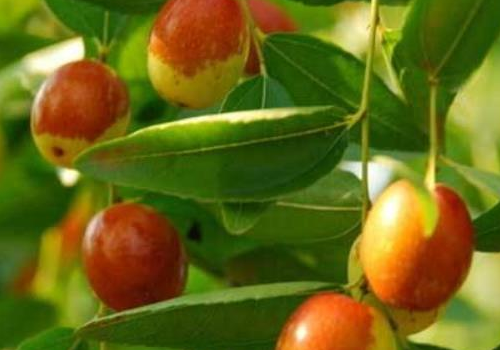
After a jujube sapling is planted, it generally bears fruit in the second year. As the saying goes, “Peaches take three years, plums four, pears five, walnuts and persimmons six or seven, mulberry trees can feed silkworms in seven years, and a planted jujube tree can already bring in money.” This refers to the short time before a jujube tree bears fruit.
How long is the lifespan of a jujube tree:
As the saying goes, “a thousand-year turtle, a hundred-year jujube,” so how many years can a jujube tree live? And how many years until a newly planted jujube tree bears fruit? According to the experience of Teacher Wang, a large jujube grower in Shaanxi, a jujube tree can live more than 100 years, and under normal circumstances 20-30 years is no problem. If a jujube sapling is grafted, it will bear fruit in 2—3 years; if a sapling sprouted from the roots of a jujube tree is used, it can bear fruit in 3-4 years; and a sapling generally sown from seed (jujube pit) needs about 7 years to bear fruit.
In Nanshuiyu Village, Pingyang Township, Fuping County, there is a large jujube tree. The tree is more than 8 m tall, with a trunk circumference of 4.8 m, a trunk height near the ground of 1.9 m, and a coverage area of more than 70 sq m. According to research, this jujube tree was planted in the early years of the Jin Dynasty, and it has a history of more than 800 years so far. It is still growing very robustly now, and can produce more than 140 jin of fresh jujubes each year. According to expert measurement, this is the oldest and thickest-trunked large jujube tree in the Taihang Mountains, and is known as the “King of Jujube Trees.”
That is the introduction to how long it takes for a jujube tree to bear fruit; its lifespan is still quite long.
How many years until Hovenia dulcis flowers and bears fruit, and how much does a jin of seed cost
Hovenia dulcis is something many people know about and can be eaten, but many people say they do not dare to eat it because it looks too strange, so how many years until Hovenia dulcis flowers and bears fruit? And how much does a jin of seed cost:
How many years until Hovenia dulcis flowers and bears fruit:
Hovenia dulcis is still in the seedling stage and needs good seedling management. It generally flowers and bears fruit in five to six years. Each spring, after weeds grow, weeding is carried out, watering is done well, and fertilization is done well in March of spring and June of summer, which can promote the growth of Hovenia dulcis.
How much does a jin of Hovenia dulcis seed cost:
The price of Hovenia dulcis seed is about 25-40 yuan per jin, but prices vary depending on seed quality, variety, place of origin, market, and so on. Hovenia dulcis trees are distributed throughout the Yellow River basin and Yangtze River basin in China. In production, it is mainly propagated by seed, and can also be propagated by layering and root division. It generally takes 5 to 6 years of planting before it begins to bear fruit, with the flowering period in June and the fruiting period from August to October. With modern dwarfing and branch-pulling techniques, fruiting can be advanced to 3-4 years.
That is the introduction to when Hovenia dulcis flowers; now you know the price too!
Can jujube trees be grafted? How many years can a jujube tree live?
Jujube trees are generally more commonly grown in the north, and some people also grow them in the south, but not as commonly as in the north. Therefore, fruit growers who plant jujube trees should first understand the growth habits of jujube trees, as this is very helpful for growing jujube trees.
Growth habits of jujube trees
Jujube trees grow in mountainous areas, hills or plains below 1700 m altitude. They are warmth-loving fruit trees. The average annual temperature in producing areas is about 15°C. The temperature during bud break needs to be 13-15°C, during shoot and leaf growth it is 17°C, during flowering and fruit set it is 22-25°C, and during fruit ripening it needs to be 18-22°C. Jujube trees are relatively tolerant of drought and waterlogging, but the flowering period requires relatively high air humidity, otherwise pollination and fruit set are unfavorable. In addition, jujube has a strong light requirement and is relatively sensitive to light, has strong adaptability to soil, and is tolerant of poor soil and salinity. However, it fears wind, so when establishing an orchard, care should be taken to avoid windy gaps.
Can jujube trees be grafted
Hello, jujube trees can be grafted. The main grafting methods for jujube trees are the following three:
1. Side grafting: Take a scion that has already been sealed with wax, and cut the scion into two opposite cut faces, with the long face about 3 cm and the short face about 2 cm. On the grafting part of the rootstock, choose a smooth side, use pruning shears to make a downward slanted cut, with the angle between the cut and the vertical axis of the rootstock at about 15 degrees, and the length of the cut equal to the long face of the scion. Insert the scion into the rootstock cut with the long cut face facing inward and the short cut face facing outward, so that the cambium of the scion and the rootstock align. Then cut off the rootstock about 0.8 cm above the joint, and tie the joint and the cut surface at the top of the rootstock tightly and firmly with a plastic strip to prevent the scion from loosening and losing water. This method is simple to operate and has a high grafting survival rate. The suitable rootstock thickness is 0.7-2 cm.
2. Cleft grafting: Take a scion that has already been sealed with wax, and cut the scion into two slanted faces of equal length, with the slanted faces 3-5 cm long. First cut off the upper part of the rootstock, trim the cut smooth, use a splitting knife or scissors to split the rootstock from the center to a depth of 5-7 cm, insert the prepared scion, align the cambium of the scion and the rootstock, and tie and wrap the joint tightly with a plastic strip. This method is suitable for thicker rootstocks.
3. Bark grafting: also called under-bark grafting. Take a scion that has already been sealed with wax, cut the lower end into a smooth cut face 3-5 cm long, lightly cut the two sides on the back of the cut face to expose the cambium, then cut a short slanted face 0.5 cm long on the back of the lower end of the long cut face to make insertion easier. Choose a smooth place to cut off the rootstock and trim the cross section smooth. Use a small knife to make a vertical cut on one side of the rootstock, deep to the xylem, and use the knife to separate the upper bark from the xylem. When inserting the scion, face the long cut inward and the small cut outward, and slowly insert it downward along the cut gap. Tie and wrap tightly with a plastic strip. This method is suitable for thicker rootstocks, that is, rootstocks with a diameter of 2 cm or more.
How many years can a jujube tree live
As the saying goes, “a thousand-year turtle, a hundred-year jujube,” so how many years can a jujube tree live? And how many years until a newly planted jujube tree bears fruit? According to the experience of Teacher Wang, a large jujube grower in Shaanxi, a jujube tree can live more than 100 years, and under normal circumstances 20-30 years is no problem. If a jujube sapling is grafted, it will bear fruit in 2—3 years; if a sapling sprouted from the roots of a jujube tree is used, it can bear fruit in 3-4 years; and a sapling generally sown from seed (jujube pit) needs about 7 years to bear fruit.
In Nanshuiyu Village, Pingyang Township, Fuping County, there is a large jujube tree. The tree is more than 8 m tall, with a trunk circumference of 4.8 m, a trunk height near the ground of 1.9 m, and a coverage area of more than 70 sq m. According to research, this jujube tree was planted in the early years of the Jin Dynasty, and it has a history of more than 800 years so far. It is still growing very robustly now, and can produce more than 140 jin of fresh jujubes each year. According to expert measurement, this is the oldest and thickest-trunked large jujube tree in the Taihang Mountains, and is known as the “King of Jujube Trees.”
Jujube tree pruning techniques
1. Pruning jujube trees is suitable in winter. In winter, jujube trees are in a dormant state, and there are many dead branches on the tree that should not remain. If they are not cut off in time, it is very unfavorable for the growth of the jujube tree the following year. Pruning jujube trees in winter has little effect on them because their reactions are relatively slow, and at the same time it can stimulate the growth of the jujube tree the next year. Second, jujube tree pruning can also be carried out in summer. In summer, jujube branches grow very vigorously. To avoid nutrient consumption caused by excessive branch growth, excessively growing jujube branches must be cut off. Only in this way can high yields of jujube trees be ensured.
2. Jujube tree pruning techniques need to follow some basic choices, such as the principle of “promote in the early stage, control in the later stage, block upward and release downward.” Specifically, this roughly means that in the early growth stage of the jujube tree, that is, during the 1-2 years, try not to prune it, but once the jujube tree canopy reaches the height we want, we must prune and control it, that is, block the upward growth of the jujube tree and appropriately guide it to develop horizontally.
3. There are many pruning methods for jujube trees, and different pruning purposes use different methods. Common jujube tree pruning methods include branch propping, branch pulling, girdling, bundling, bud wiping, pinching, bending, and shoot twisting, and each method or means is used to achieve a certain purpose. Jujube tree pruning technique is a fairly specialized technique. It is not enough for us to know only some theory; we must also have some practical experience. The specific situation of each jujube tree will differ somewhat, and the methods we use are different. To learn jujube tree pruning techniques, we must fully combine the theoretical knowledge from books with our actual operations.
People living in the south may not see many jujube trees. The growth age of jujube trees is relatively long, and if a jujube tree bears relatively many jujubes, its income is also quite good, and market demand for jujubes is also relatively high.