What to Do When Cattleya Orchid Leaves Turn Yellow? Correct Pruning Methods Explained
Cattleya orchids are called the “Queen of Orchids” because most in this genus have brilliantly colored flowers. What to do when Cattleya orchid leaves turn yellow and how to prune:
What to do when Cattleya orchid leaves turn yellow:
1. Water-yellowing: because of overwatering, the soil stays waterlogged and wet for long periods, aeration is relatively poor, and even some fibrous roots become completely rotten. At this point, watering should be reduced and done reasonably according to need.
2. Fertilizer-yellowing: usually refers to overfertilizing, shown by old leaves turning yellow and dropping at the tips, while new leaves, though relatively thick and somewhat glossy, generally appear uneven and not spread out. If it is a valuable flower, you can scatter a layer of bok choy or radish seeds, then pull out the seedlings after a few days, so as to consume the excess nutrients.
3. Drought-yellowing: because the plant has not been watered thoroughly or has been dehydrated for a long time, the new leaves keep a relatively normal color, but the lower leaves gradually dry, yellow and drop from the bottom upward, becoming aged.
4. Alkaline-yellowing: this mainly occurs in the south in some acid-loving soils, while in the north the water tends to be alkaline, causing leaves to gradually fade, turn yellow and even drop. The simplest solution is to water with fermented rice-washing water or rainwater.
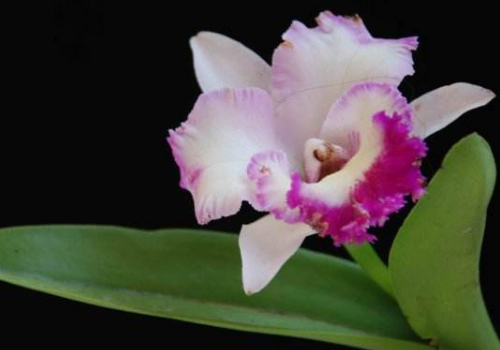
How to prune Cattleya orchids:
1. Every time you prune, sterilize the pruning shears, let them dry in a cool place, and then prune.
2. Cattleya usually has many flowers, but they do not all bloom at the same time; when some flowers are blooming, others have already withered or turned brown, so these withered flowers should be cut off promptly to avoid affecting blooming.
3. If you want good flowers again the next year, it is best to cut the inflorescence axis off from the base. When the substrate ages, it should be replaced in time; repotting is best done in May or June when new leaves grow, ideally wrapping another layer of sphagnum over the original sphagnum area and placing it in a slightly larger pot.
Even the most beautiful flower still needs careful tending.
Cattleya Cattleya hybrida Cattleya illustrated guide: how to grow Cattleya / how to propagate Cattleya
Cattleya profileCattleya Cattleya hybrida
Cattleya growing methods and precautions, introduction to Cattleya
Cattleya is a horticultural hybrid in the genus Cattleya and one of the most famous orchids internationally. The pseudobulbs are club-shaped or cylindrical, with 1 to 3 leaves at the top; the leaves are thick and hard, with the midrib sunken; flowers are single or several, borne at the tips of the pseudobulbs, large and beautiful, with bright and rich colors. Native to tropical America, it is the national flower of Brazil, Argentina, Colombia and other countries. There are more than several thousand cultivars. Colors include white, yellow, green, red and purple, etc. Propagation is by division, tissue culture or sterile sowing. It likes warmth, moisture and ample light. It is usually potted with fern roots, moss, bark chunks, etc. During the growing period it needs relatively high air humidity, appropriate fertilizing and ventilation.
The flowers are large, elegant and magnificent, with delicate and changeable colors and rich fragrance, and it has the international reputation of "King of Foreign Orchids" and "Queen of Orchids".
Three sepals with pointed tips extending vertically are the greatest distinguishing feature of this flower.
Cattleya has not been cultivated in China for long; large-scale production only began after the 1980s. But it enjoys a very high status in the flower market. It is much favored by the public. It has become one of the important flowers for festivals and holidays and for giving to relatives and friends.
Morphological characteristics of Cattleya
This genus is evergreen, with pseudobulbs club-shaped or cylindrical; the pseudobulbs are spindle-shaped, and the plant height is more than 25 cm; one stem has 2 to 3 leaves, and the leaves are thick and long-ovate. It usually blooms once in autumn, and some can bloom 2 times, with different cultivars blooming in all four seasons. The flower stalk is 20 cm long, with 5 to 10 flowers; the flowers are large, about 10 cm in diameter, with a special fragrance, and each flower can remain open for a very long time; apart from black and blue, it has almost every color, with beautiful appearance and color, and has the title of "King of Orchids".
In cultivation, Cattleya is divided into single-leaf and double-leaf types. Propagation is by division, tissue culture or sterile sowing. Winter temperature 15-20°C. It blooms 1 to 2 times a year, and the ornamental flowering period is generally about 3 to 4 weeks.
Plants of the genus Cattleya are perennial herbaceous plants, epiphytic orchids, evergreen year-round. The plant has 1 to 3 thick leathery leaves, which are tissues for storing water and nutrients.
You can use 6 parts crushed fern root, 1 part vermiculite, plus charcoal and gravel, etc. Transplanting is best done after the dormant period ends.
Ecological habits of Cattleya
It is a perennial herbaceous epiphyte, mostly growing attached to the branches and trunks of large trees. It likes a warm and humid environment; the overwintering temperature is about 15°C at night and 20-25°C during the day; maintaining a large day-night temperature difference is crucial, and constant day-night temperature must not be used, still less should the night temperature be higher than the day temperature. It requires a semi-shaded environment, and in spring, summer and autumn, 50%-60% of the light should be shaded out.
Cattleya likes a warm and humid environment; in such an environment, the leaves and pseudobulbs are dark green, glossy and full of life. Flower buds can develop smoothly, the flowers bloom fully, and the flower colors are brilliant. New roots and young shoots grow vigorously. If the temperature is around 11°C, flowering is delayed, the flowers cannot open fully, and the flowering period is shorter. If the temperature is around 5°C, the leaves appear yellow and lifeless, the pseudobulbs develop longitudinal wrinkles, the flower buds cannot grow larger or taller, and the flower sheath turns brown, with growth severely hindered. If the temperature drops to 1-2°C, the leaves wither and yellow or turn brown and drop, and the flower buds die. Of course, if the night temperature is higher than 20°C, the flowering period often becomes too short. In greenhouse cultivation in the north, special attention should be paid to maintaining a relatively large day-night temperature difference, so that the daytime greenhouse temperature is 5-10°C higher than at night. Day and night temperatures must not be equal, still less should the night temperature be higher than the daytime temperature.
During the spring and autumn growing seasons of Cattleya, ample water and relatively high air humidity are required. It must not be overly dry, otherwise growth is affected. In winter, Cattleya almost stops growing.
In greenhouses with poor ventilation, Cattleya should be moved outdoors under a shade shed for a period, otherwise growth will be poor and rot disease is likely to occur.
Too much light can cause severe sunscald or growth stagnation and yellowing leaves. In winter indoors in a greenhouse, light can be shaded slightly or not at all. Among orchids, Cattleya belongs to the light-loving types. If light is insufficient, it blooms less, does not bloom, or the flower quality is poor. The leaves become thin and soft, the pseudobulbs become slender, and growth vigor weakens. In order to produce good flowers, the light can be a bit stronger; even slightly yellow leaves will not affect the plant's growth. Growers whose purpose is flower production often adopt this cultivation method, and flower yield increases noticeably.
Growth pattern
Cattleya pseudobulbs are club-shaped or cylindrical, with 1-3 thick leathery leaves, and are tissues for storing water and nutrients. Flowers are single or several, borne at the tips of the pseudobulbs, large and beautiful, with bright and rich colors. The sepals and petals are similar, the lip is 3-lobed, its base surrounds the area below the stamens, and the mid-lobe is extended and prominent.
The flowers are large, elegant and magnificent, with delicate and changeable colors and rich fragrance, and it has the international reputation of "Queen of Orchids".
Three sepals with pointed tips extending vertically are the greatest distinguishing feature of this flower. Cattleya is a horticultural hybrid in the genus Cattleya and one of the most famous orchids internationally. The pseudobulbs are club-shaped or cylindrical, with 1 to 3 leaves at the top; the leaves are thick and hard, and the flowers are single or several, borne at the tips of the pseudobulbs, large and beautiful, with bright and rich colors.
Native to tropical America, it is the national flower of Brazil, Argentina, Colombia and other countries. There are more than several thousand cultivars. Colors include white, yellow, green, red and purple, etc. Propagation is by division or sterile sowing. It likes warmth, moisture and ample light. It is usually potted with fern roots, moss, bark chunks, etc. During the growing period it needs relatively high air humidity, appropriate fertilizing and ventilation.
Plants of the genus Cattleya are epiphytic orchids, evergreen year-round. The plant has 1 to 3 thick leathery leaves, which are tissues for storing water and nutrients. Flowers are single or several, borne at the tips of the pseudobulbs. The sepals and petals are similar, the lip is 3-lobed, its base surrounds the area below the stamens, and the mid-lobe is extended and prominent.
Cattleya has thick stems and leaves and vigorous aerial roots, and is drought-tolerant; it will not die even if not watered for a month. It can be grown on rooftops, balconies, under eaves and under large trees, but it requires fresh, circulating air and appropriate shading; a shade net can be used to block 50% to 60% of the sunlight. It requires daytime temperatures of 25°C to 30°C and nighttime temperatures of 15°C to 20°C; small seedlings are best overwintered in a greenhouse in winter.
As for humidity, reducing watering during the flowering period can promote flower bud differentiation; after new shoots or flower buds form, more water should be given, but watering at night should be avoided, and especially when a cold wave strikes, watering must stop completely; normally air humidity should be kept at 60% to 65%. Cattleya can be grown in plastic pots or ceramic pots; for mature plants, the growing medium can be 6 parts crushed fern root and 1 part [sphagnum], plus charcoal and gravel, etc.
Transplanting is best done after [the dormant period] ends; in winter Cattleya almost stops growing.
In greenhouses with poor ventilation, Cattleya should be moved outdoors under a shade shed for a period, otherwise growth will be poor. During the vigorous spring, summer and autumn growing seasons of Cattleya, note that some fermented solid fertilizer should be placed in different parts of the pot surface, once every 1 to 2 months, or liquid fertilizer applied once every 1 to 2 weeks. Small seedlings should be fertilized even more frequently so they can grow quickly. Cattleya likes a semi-shaded environment; in North China during spring, summer and autumn, shade nets, bamboo blinds, etc. can be used for shading, and during this period 50%-60% of sunlight can be blocked out; too much light can cause severe sunscald or growth stagnation.
Cultivation techniques for Cattleya
For potting, marl, fern roots, bark chunks or broken bricks are commonly used as the medium; in spring and autumn, spray water more often and maintain relatively high air humidity; in winter during flower bud development, high temperature and high humidity are needed, with attention to ventilation and shading; during the growing period, fertilize once every ten days.
Propagation by division, combined with repotting, is generally carried out in March. First knock the plant out of the pot, remove the cultivation material, cut off decayed roots and pseudobulbs, and separate the clumps; after separation, each clump should retain at least 3 or more pseudobulbs and carry new shoots. Newly planted plants should be placed in a relatively shaded environment for 10 to 15 days, and water should be sprayed on the leaves every day. The growing medium is best as moss, fern roots, bark chunks or gravel, and some broken bricks, charcoal pieces and the like should be placed at the bottom of the pot. In hot seasons, pay attention to ventilation and air permeability. During the growing season, some fermented solid fertilizer should be placed in the pot, or liquid fertilizer applied once every 10 to 15 days, and ample water and relatively high air humidity should be maintained.
Management
For autumn-winter-flowering Cattleya that require short-day conditions, the flowering period can be controlled by shortening or extending the light period so that they bloom on schedule. For temperature-type cultivars, the flowering period can be controlled by adjusting temperature. To grow Cattleya well, special attention should be paid to the following aspects of management.
1.Temperature
Its optimum growth temperature is 20°C to 30°C from March to October, and 12°C to 24°C from October to March of the following year, with 25°C to 30°C during the day being good, 15°C to 20°C at night being best, and a daily temperature difference of 5°C to 10°C being suitable. In winter the greenhouse temperature should not be lower than 10°C, otherwise the plant stops growing and enters a semi-dormant state; below 8°C, generally less cold-tolerant cultivars are prone to cold damage, while more cold-tolerant cultivars can withstand low temperatures of 5°C. In late autumn and early winter, when the ambient temperature drops below 12°C, they should be moved indoors early. In summer, when the temperature exceeds 35°C, measures such as building shade frames, spraying water in the environment and increasing ventilation should be used to create a relatively cool environment for them, so that they can continue to maintain vigorous growth, pass the summer safely, and avoid the occurrence of stem and leaf...
2.Light
It likes a semi-shaded environment with scattered light. If the light is too strong, its leaves and pseudobulbs are prone to yellowing or scorching, and diseases are induced. If the light is too weak, it will instead cause leggy leaves and thin leaf texture. Under normal circumstances, in spring, summer and autumn, black nets can be used to shade 50% to 60% of the light; in winter, no shading is used in the greenhouse, and plants placed indoors can be put by the window to receive a little direct sunlight.
3.Water
Cattleya not only needs moist growing medium, but also requires relatively high air humidity. It is an epiphytic orchid with fleshy roots, so a growing medium with good drainage and aeration should be used to avoid waterlogging and root rot. During the growing season, ample water is required, but it should not be overwatered; especially in winter, when humidity is low and light is poor, the plant is in a semi-dormant state, and watering must be strictly controlled, otherwise root rot and death are likely. In addition, after the flowers fade, Cattleya has a dormant period of about 40 days, during which the growing medium should be kept slightly moist. Generally, in spring, summer and autumn, water once every 2 to 3 days, and in winter water once a week; when the medium at the bottom of the pot is slightly moist, that is the most suitable time to water. Watering should be thorough in one go, and slightly acidic water is best; do not water or spray at night, to prevent moisture lingering on the leaf surface and causing disease. Cattleya should generally maintain 60% to 65% air humidity; a humidifier can be used to humidify 2 to 3 times a day, plus leaf spraying, to create a moist, suitable growing environment for it.
4.Growing medium
For growing Cattleya, the medium can usually be a mix of fern roots, moss, bark chunks, sphagnum, perlite, peat soil, coal cinder, etc. Generally, vigorously growing plants should have their medium replaced once every 1 to 2 years, best in spring when new shoots have just sprouted or after the flowers fade, combined with division for repotting.
5.Fertilizer
A considerable part of the nutrients Cattleya needs can be obtained through the mycorrhizae symbiotic with its root system, so it needs relatively little fertilizer. Applying manure or urine is taboo, and incompletely decomposed organic fertilizer must not be used either. Otherwise, it easily leads to root rot and death of the plant. Decomposed dry cake fertilizer powder or slow-release compound fertilizer granules can be buried in the growing medium. During the growing season, spray the leaves once every half month with a mixture of 0.1% urea plus 0.1% monopotassium phosphate. When the temperature exceeds 32°C or falls below 15°C, stop fertilizing; during the flowering period and the dormant period after the flowers fade, fertilizing should also be suspended, to avoid fertilizer damage to the roots.
Care points
Cattleya is robust by nature and easy to grow, and is one of the most popular orchids; its cultivation methods are often used as a reference for growing other orchids. Through hybridization of closely related species, many hybrids with rich colors and different sizes and shapes have been produced. Although Cattleya has many cultivars, their cultivation methods differ little. Cattleya belongs to the epiphytic orchids (aerial orchids); they have large pseudobulbs for storing water and nutrients, and thick, stout roots covered with a spongy, water-rich velamen. Therefore Cattleya is quite drought-tolerant, and you should generally wait until the roots have dried before watering it. At the same time, when planting, a medium with particularly good drainage must be used.
Location
It does not necessarily need an orchid shed or greenhouse; it can also be grown on a balcony or rooftop.
Light
Whether grown in a greenhouse or indoors, light is the most important factor affecting the vigor and flowering of Cattleya plants; insufficient sunlight will delay flowering or result in a low flowering rate. Cattleya needs relatively more light; except at noon, direct sunlight can be allowed to fall on the plant. Orchid plants can be placed on east-facing and shaded south-facing windowsills, and can also be grown on west-facing windowsills. If grown in a greenhouse, shade to 50%-70% of full light. If light is sufficient, the leaves should be medium green and the pseudobulbs upright. But some cultivars do not need too much sunlight, such as the deep vermilion flower types and mini small-flower types that bloom in winter.
Temperature
Growth is best at 21-30°C during the day and 15-16°C at night. For small seedlings, nighttime is best at 18-21°C. For Cattleya, especially mature plants, it is best to have a day-night temperature difference of 6-10 degrees. Cattleya can tolerate high temperatures of 35°C; if humidity is also high at the same time, air circulation and shading should be strengthened.
Watering
Watering should be carried out in two ways: pouring water into the pot and humidifying the air. The amount of watering is determined by many factors: pot size, material, temperature, light, and so on. Mature Cattleya should be watered after the growing medium has dried, while small seedlings need the growing medium to remain relatively continuously moist. Vigorously growing plants need more water than dormant plants. Note that watering should stop when a cold wave strikes.
Humidity
A relative humidity of 50%-80% is most suitable for Cattleya. In greenhouse cultivation, it is best to use a humidifier for humidifying; in indoor cultivation, the pot can be set on a plate covered with gravel, with a small amount of water in the plate, and the plant's roots must not come into contact with the water. Normally, especially under high humidity or low temperature conditions, the air should remain circulating to prevent fungi and bacteria.
Fertilizer
If potted, apply a balanced-ratio compound fertilizer; if grown hanging on a tree fern board, apply a high-nitrogen compound fertilizer (such as N:P:K of 30:10:10). During the plant's vigorous growing period, fertilize at least once every two weeks; if not in that period, fertilize once a month. The concentration is usually 1/2 or 1/4 of the recommended concentration, diluted with water. It is recommended to thoroughly flush the plant once a month with clean water, to prevent salt from the fertilizer from accumulating on the plant.
Repotting
When the plant's rhizome has grown beyond the edge of the pot, or the growing medium in the pot has begun to collapse and drainage is no longer smooth, it should be repotted in time. This situation usually appears after two years of cultivation. Repotting is best done in spring after the flowering period, when new roots have not yet grown.
Mature plants usually use larger chunks of growing medium than small seedlings; once a plant has grown at least six mature pseudobulbs, it can be moved as a whole into a larger pot without division. If you want to propagate by division, each pot should contain at least 3-5 pseudobulbs. The pot size should be such that it will not be outgrown in roughly two years.
Propagation methods of Cattleya
In March, when new shoots have just sprouted or after flowering, cut apart the rhizome at the base; each clump should have at least 2-3 pseudobulbs and carry new shoots. The clumps should not be too small, otherwise the new plants recover slowly and bloom late.
Cattleya propagation mostly uses division, tissue culture or sterile sowing. It likes warmth, moisture and ample light. Because it is an epiphytic orchid, the roots need to maintain good aeration; in winter the nighttime temperature should be kept at about 15-18°C, and should be a bit higher during the day. It blooms 1 to 2 times a year, and the ornamental flowering period is generally 3 to 4 weeks. When planting with fern root and sphagnum, it must be planted firmly and compactly, so that when the plant is lifted by hand, the roots do not pull out of the pot. The roots should be evenly spread through the potting material. Finally, use scissors to trim the surface material flat, preferably with a slight rise in the middle. If planting with bark chunks, volcanic ash or broken bricks, larger-particle material should be placed in the lower part of the pot to facilitate drainage and aeration. In the upper part, especially on the pot surface, small-particle material should be placed to help maintain humidity in the pot.
Propagation is by division, tissue culture or sterile sowing. It likes warmth, moisture and ample light. Winter temperature 15-18°C. For growing Cattleya, sphagnum, fern roots, bark chunks or broken bricks are usually used as potting materials. When planting, first fill the bottom of the pot with some larger-particle broken bricks and charcoal pieces, then use a mixed material of 2 parts fern root and 1 part sphagnum, or use longan bark or oak bark processed to 1 cm in diameter, and plant the Cattleya roots in a porous clay pot. These potting materials should be soaked thoroughly with water before use.
Cultivar classification of Cattleya
Such as 'Red Wax', and there are also hybrids between the genus Cattleya and other closely related genera, such as 'Pink Extreme', 'Beauty', 'Little Wood', 'Golden Billy', 'Heredity', 'Shirley', and hybrids among genera closely related to Cattleya.
In addition, Cattleya can also be divided into two major categories, single-color flowers and multicolor flowers, according to flower color, and can also be divided into four major categories, large, medium, small and miniature, according to flower size.
Different cultivars of Cattleya differ considerably in flowering period.
First, winter-flowering and early-spring-flowering cultivars, with flowering periods mostly between January and March; cultivars include 'Big Eyes', 'Tricolor', 'California Miss', 'Lemon Tree', 'Yanggang', 'Red Rose', etc.
Second, late-spring-flowering cultivars, with flowering periods between April and May; cultivars include 'Ruby', 'Daughter', 'Three Suns', 'Big Brother', 'Spearmint', 'Dreams Come True', etc.
Third, summer-flowering cultivars, with flowering periods between June and August; cultivars such as 'Grand Marshal', 'Akifen', 'Helen Brown', 'Chinese Beauty', 'Yellow Finch', etc.
Fourth, autumn-winter-flowering cultivars, with flowering periods between October and December; cultivars such as 'Jin Chaoqun', 'Sapphire', 'Red Bat', 'Yellow Diamond', 'Green', 'Autumn Old Man', 'Autumn Light', 'Star of Brightness', 'Green Virgin', etc. Fifth, irregular cultivars, whose flowering period is not limited by season, such as 'Victory', 'Golden Butterfly', 'Doll', etc.
Common cultivars
Common Cattleya cultivars: large-flowered Cattleya, Laelia Cattleya, orange-yellow Cattleya, two-colored Cattleya, etc., and a large number of excellent hybrids.
Perennial herb. Pseudobulbs club-shaped, 10-15 cm long, with leaves at the top, leathery, light green, flowers large and purplish red. Cultivated cultivars have rich colors, including white, yellow, orange-red, deep red, purplish red and multicolor. Common cultivars include the yellow "Xiangshan" and "Sunset", the green "Yulin", the white "Graceful", the pink "True Beauty", the red "Fireball", the purplish red "Long River", and the bicolor "Christmas Candy", etc.
The first category is the single-leaf type, in which each pseudobulb has only one large, broad leaf; the pseudobulb is obovate in shape, connected below to a creeping rhizome; the flowers are relatively large, usually with 1 to 3 flowers per flower sheath.
Such as "Red Wax", and there are also hybrids between the genus Cattleya and other closely related genera, such as "Pink Extreme", "Beauty", "Little Wood", "Golden Billy", "Heredity", "Shirley", and hybrids among genera closely related to Cattleya.
In addition, Cattleya can also be divided into two major categories, single-color flowers and multicolor flowers, according to flower color, and can also be divided into four major categories, large, medium, small and miniature, according to flower size.
Different cultivars of Cattleya differ considerably in flowering period. First, winter-flowering and early-spring-flowering cultivars, with flowering periods mostly between January and March; cultivars include "Big Eyes", "Tricolor", "California Miss", "Lemon Tree", "Yanggang", "Red Rose", etc. Second, late-spring-flowering cultivars, with flowering periods between April and May; cultivars include "Ruby", "Daughter", "Three Suns", "Big Brother", "Spearmint", "Dreams Come True", etc. Third, summer-flowering cultivars, with flowering periods between June and September; cultivars such as "Grand Marshal", "Akifen", "Helen Brown", "Chinese Beauty", "Yellow Finch", etc. Fourth, autumn-winter-flowering cultivars, with flowering periods between October and December; cultivars such as "Jin Chaoqun", "Sapphire", "Red Bat", "Yellow Diamond", "Green", "Autumn Old Man", "Autumn Light", "Star of Brightness", "Green Virgin", etc. Fifth, irregular cultivars, whose flowering period is not limited by season, such as "Victory", "Golden Butterfly", "Doll", etc.
Distribution range of Cattleya
Native to tropical America; the genus Cattleya is native to tropical America, and all are epiphytic orchids, often growing attached to trees in forests or on rocks beneath the forest.
Landscape uses of Cattleya
Cattleya flowers are endlessly varied in shape and color, brilliant and eye-catching, and often appear at celebrations and banquets, used for flower arranging and ornamental display. For example, using Cattleya and Phalaenopsis as the main materials, with Oncidium, fragrant solomonseal and asparagus fern in a vase, it is bright and elegant, with a strong sense of rhythm. If Cattleya is the main flower, with anthurium, baby's breath, split-leaf philodendron and bear grass, it appears light and lively. Cattleya is the most beloved epiphytic orchid. The flowers are large and brilliantly colored, the flower form is strange and beautiful, the flower colors are richly varied and extremely magnificent, and it has the reputation of "Queen of Orchids"; moreover, the flowering period is long, and a single flower can stay open for about 1 month; as a cut flower in water it can be enjoyed for 10-14 days.
Uses and functions of Cattleya
Cattleya flowers are endlessly varied in shape and color, brilliant and eye-catching, and often appear at celebrations and banquets, used for flower arranging and ornamental display.
For example, using Cattleya and Phalaenopsis as the main materials, with Oncidium, fragrant solomonseal and asparagus fern in a vase, it is bright and elegant, with a strong sense of rhythm. If Cattleya is the main flower, with anthurium, baby's breath, split-leaf philodendron and bear grass, it appears light and lively.
Moreover, the flowering period is long, and a single flower can stay open for about 1 month; as a cut flower in water it can be enjoyed for 10-14 days.
Cattleya, together with Dendrobium, Phalaenopsis and Vanda, ranks among the four major ornamental orchid groups with the highest ornamental value, and its lovely image is indispensable in bridal bouquets.
National flower and city flower of Cattleya
It is the national flower of Costa Rica
Cattleya gift-giving etiquette
Use 1-2 cut flowers to make a corsage; the beautiful mini bouquet is delightful. If it is a potted plant, the pot can be wrapped in thin decorative paper and tied with an ornament.
According to relevant records, the stems of this plant were used by the British as binding material in 1818 and brought from Brazil to the UK. The British horticulturist William Cattley cultivated these branches, and they bloomed in 1824. At this time, the botanist Dr. Lindley saw the beautiful flowers of the Cattleya, considered them a new species of orchid, and so named the genus Cattleya, to which the Cattleya belongs, after Cattley. The genus Cattleya has more than 60 species. After nearly 200 years of cultivation and breeding, there are very many horticultural cultivars, and it has become an important group of ornamental orchid plants. Plants of the genus Cattleya are perennial herbaceous plants, epiphytic orchids, evergreen year-round. The plant has 1 to 3 thick leathery leaves, which are tissues for storing water and nutrients.
Cultural background of Cattleya
What are foreign orchids? What kind of orchids can be called foreign orchids? According to the explanation in the book "Chinese Orchids and Foreign Orchids" written by the famous Chinese orchid expert Mr. Lu Sicong: "Foreign orchids are so called relative to Chinese orchids; they arose in the West and are orchids favored by Westerners." Chinese orchids here refer to some terrestrial orchid species among the plants of the genus Cymbidium in the orchid family, such as Cymbidium goeringii and Cymbidium faberi in the traditional sense, all orchid species with a long history of cultivation in China. Compared with Chinese orchids, the types of foreign orchids are much richer; there are not only species of the genus Cymbidium, but more species are classified respectively into other genera of the orchid family. Because many species among foreign orchids are native to the tropics, people often also call foreign orchids tropical orchids, but this name is not accurate, because not all foreign orchids are native to the tropics, and the two concepts cannot be equated.
Generally speaking, foreign orchids are divided into terrestrial orchids and epiphytic orchids according to their different growth habits. As the name suggests, terrestrial orchids are orchids that grow in the ground, just like Chinese orchids; while epiphytic orchids are orchids that grow attached to other objects, such as growing on large trees; these orchids generally grow in the tropics and have aerial roots.
One of the most famous orchids internationally. The pseudobulbs are club-shaped or cylindrical, with 1 to 3 leaves at the top; the leaves are thick and hard, with the midrib sunken; flowers are single or several, borne at the tips of the pseudobulbs, large and beautiful, with bright and rich colors. The sepals and petals are similar, the lip is 3-lobed, its base surrounds the area below the stamens, and the mid-lobe is extended and prominent. The parentage is very complex; the most important parent is the large-lipped Cattleya, native to tropical America, and the national flower of Brazil, Argentina, Colombia and other countries. There are more than several thousand cultivars. Colors include white, yellow, green, red and purple, etc.
For Cattleya planted for 2 to 3 years, the plant gradually grows larger. The original pot can no longer accommodate the crowded plant and root system, and most of the growing material in the pot has decayed, so it should be repotted and divided in time. In North China, it is generally more suitable to divide the pot in mid-March, when new shoots have just grown. For plants about to bloom, divide or repot only after they have finished flowering. When dividing, usually first dig the plant out of the pot, remove the old potting material around the root system, and expose the roots; for overly vigorous plants, part of the roots at the bottom can be cut off. For ordinary plants, cut off the decayed roots and pseudobulbs, and cut apart the larger plant so that each separated clump has at least 3 pseudobulbs and carries new shoots. If divided too small, it will affect the recovery growth and flowering of the new plants. Plant the tidied new divisions in a new pot. When planting, be sure to make the new shoots face the edge of the pot, and leave space for 2 to 3 years of growth. Newly planted Cattleya should be placed in a semi-shaded, humid place for 2 to 3 weeks, with a small amount of water sprayed on the leaves every day, to keep the leaves and pseudobulbs from shriveling. Do not water the roots, and do not fertilize.
Pokemon
Cattleya (カトレア, Caitlin) is one of the Elite Four of the Unova region, using Psychic-type Pokemon. In the fourth generation, she appears as the owner of the Battle Castle. In her lines she mentions, "Chasing everything is the beginning of misfortune; while there are things you cannot do, there are also things you can do. Knowing this is very important - someone used to nag me about this," which may be a lesson from her own growth.
Flower language of Cattleya
Respect and admiration
Cattleya pictures