What are the hydroponic methods and precautions for Cordyline fruticosa?
Cordyline fruticosa is suitable for indoor cultivation, but it is not very easy to grow. Does Annie know how to grow Cordyline fruticosa well? What should be noted in hydroponics?
How to grow Cordyline fruticosa well:
1. The soil for potting requires looseness. Equal parts of leaf mold or peat soil, garden soil and river sand can be mixed and a small amount of dry livestock manure added as the culture medium.
2. During the growth period, apply liquid fertilizer once every 1—2 weeks…. Insufficient fertilizer can easily cause old leaves to fall off and new leaves to become smaller.
3. Repot every spring before a large amount of new leaves grow, and combine with pruning to carry out division and cutting propagation.
4. During the growing season, the potting soil should often be kept moist, while also maintaining relatively high air humidity; dry air can easily cause leaf tips and edges to turn yellow and withered. After autumn, watering should be reduced, the potting soil should be kept appropriately dry, and watering should be done after the potting soil is slightly dry. Low temperatures and wet potting soil often easily cause root rot.
5. Cordyline fruticosa likes sufficient light, but in summer and autumn it should be appropriately shaded (shading degree about 50%); exposure to scorching sun can easily cause leaf scorch and yellowing. It can also tolerate shade, but if the light is too weak for a long time, the colors will not be vivid. In hot, dry climates, Cordyline fruticosa often suffers from scale insects or red spider mites, so attention should be paid to spraying pesticides for control.
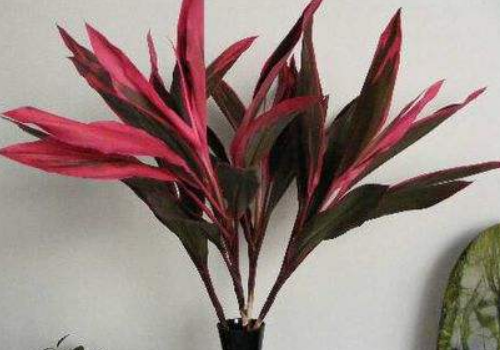
What should be noted in hydroponics of Cordyline fruticosa:
When potting, garden soil plus a small amount of river sand can be used as the growing medium, with a few baked and crushed eggshells added as base fertilizer. During the growing period, keep the potting soil moist regularly. In summer, watering should be frequent; do not let the potting soil become dry, otherwise growth will be poor and leaf color inferior.
Throughout the year, only 3 to 4 applications of dilute fertilizer water are needed, and it can grow vigorously. Usually place it indoors in a bright place, avoid direct sunlight in summer, and give more sunlight in winter. The overwintering temperature should be above 10°C. The water depth should be about 5 to 10 cm, and change the clear water once every 3 to 4 days. Do not move the position or change the direction within 10 days. Roots will develop in about 15 days. After rooting, stop changing the water; when the water decreases, just add more in time. Frequently changing the water instead easily causes yellowing and withering of leaves. After rooting, give a small amount of light and drip in a small amount of compound nutrient solution, and thereafter apply nutrient solution once every 3 weeks.
Cordyline fruticosa has vivid colors, patterned leaves, and an elegant plant form. It is bright, vivid and beautiful, and is one of the most representative types of foliage plants. We can often see it in indoor halls, corridors, studies, windowsills and other locations, adding a lot of joyful atmosphere to life.
Now you know how to grow Cordyline fruticosa well, right?
How to grow hydroponic flowers so they flourish
One,Hydroponic flowers are cultivated ornamental plants using a non-solid medium(water or water with an appropriate amount of plant nutrient solution added). At present, household hydroponic flowers are mostly grown in static water, with dissolved oxygen below 1 mg/l. The flowers barely maintain life in an oxygen-deficient vessel. As summer temperatures rise, plant physiological metabolism becomes vigorous, microorganisms multiply greatly, oxygen consumption increases sharply, dissolved oxygen continuously decreases, and water quality deteriorates, creating many unfavorable factors for the growth of hydroponic flowers. This may cause root rot, withered and drooping branches and leaves, and even cause the plants and flowers to die. Therefore, in summer, in addition to preventing extreme heat and high temperatures, increasing the oxygen content of the nutrient solution is the key to ensuring that hydroponic flowers safely pass the summer.How to grow hydroponic flowers so they flourish
Two,How to increase the dissolved oxygen content of the nutrient solution?
There are many ways to increase dissolved oxygen, summarized into two categories: chemical methods and physical methods. The following are several easy-to-operate and effective methods.1. Increase the frequency of replacing the nutrient solution. Replacing the nutrient solution is a simple way to increase dissolved oxygen. According to measurements, the dissolved oxygen content of fresh nutrient solution increases by 70%-90% compared with the original solution, and it can promptly improve the physiological oxygen deficiency of flowers. For flowers that have already grown water roots, it is appropriate to change the nutrient solution once every 3-5 days, and no more than 7 days. When changing the nutrient solution, note that the temperature difference between the new solution and the original solution should not be too large; too large a temperature difference may cause physiological disorder in the flower roots. When changing the solution, patiently rinse the roots with clear water, remove withered roots and rotten roots, and shorten aging roots to promote new roots. If the nutrient solution suddenly becomes turbid, or there are mosquito egg masses, a new nutrient solution should be replaced immediately.
2. Vibration for oxygen enrichment. For smaller hydroponic flowers in vessels, as long as the roots are clear and undamaged and the nutrient solution is transparent, the vibration method can be used to increase oxygen. The operation method is to hold the flower with one hand and hold the vessel with the other hand, and gently shake more than 10 times. After shaking, the dissolved oxygen content of the nutrient solution can increase by more than 30%. Hydroponic flowers with turbid nutrient solution or poor root development are not suitable for the vibration oxygen enrichment method, and the nutrient solution must be completely replaced.
3. Aerate into the vessel. If while caring for hydroponic flowers there is also a tank of ornamental fish nearby, the oxygen rod of the fish tank can be put into the vessel for aeration.
How to grow hydroponic flowers so they flourish
Three,What position is suitable for placing hydroponic flowers in summer?
The flower materials selected for hydroponic flowers are mostly shade-tolerant foliage flowers and flowers with both ornamental flowers and leaves. Such as Syngonium podophyllum, Aglaonema 'White Jade', Spathiphyllum, Anthurium, Bromeliaceae, etc. These flowers like warmth and humidity, are slightly tolerant of shade, and avoid high temperature and dry heat. "Hydroponics" only changes the cultivation form; it cannot change their growth habits and required environmental factors. In summer, it is best to place hydroponic flowers in a bright, slightly humid, cooler environment with good ventilation. Avoid direct sunlight, but do not make it too shady, so as to avoid hindering photosynthesis, weakening growth, elongating stem nodes, and thinning leaf texture. This causes the leaves of flowers with colored patches and patterns to lose their luster.
Four,Can hydroponic flowers be placed in an air-conditioned room?
Yes. However, hydroponic flowers should not be placed directly facing the air outlet of the air conditioner. Too fast wind speed will damage the branches and leaves, causing leaf curling in mild cases and scorched edges and withering in severe cases. It is also necessary to consider that the temperature requirements of flowers are higher during the day than at night. If the air conditioner is turned off at night and the ambient temperature is higher than the daytime temperature when the air conditioner is on, it is unfavorable for the growth of hydroponic flowers. When the air conditioner is on, place a basin of clear water beside the flowers or spray the leaf surfaces to increase environmental humidity. If the flowers are placed some distance away from the air conditioner outlet and the day-night temperature difference is not large, there is no problem.How to grow hydroponic flowers so they flourish
Five,What should be done if hydroponic flowers have root rot?
As temperatures continue to rise, water temperature also rises, microorganisms multiply faster, dissolved oxygen decreases, and water quality deteriorates. Improper addition of nutrient solution, making the dissolved concentration too high, may also cause root rot in hydroponic flowers, especially in Liliaceae plants such as Cordyline fruticosa, Dracaena marginata (fine-leaf dragon tree), and Dracaena concinna. For flowers with root rot, the following methods can restore their growth: a. Remove all rotten roots; if the stem has already been infected, also use a sharp knife to cut off the infected part. b. Soak the pruned flowers in 0.5% potassium permanganate solution for 10-20 minutes for sterilization. c. Take out the soaked flowers and rinse them in running water. d. Put the cleaned flowers back into the original vessel and grow them in clear water (the vessel should be washed clean). e. Change the water once every 1-2 days, changing only clear water without adding nutrient solution. If the water quality is clear, the frequency of water changes can be reduced. After 10-15 days of care, new roots can sprout. f. Initially sprouted new roots should still be grown in clear water. Wait until the temperature stabilizes at 18-25 degrees, then cultivate with nutrient solution.
Six,What should be done if algae grow in the nutrient solution?
Algae growing in the nutrient solution is a common phenomenon in the process of cultivating hydroponic flowers. Especially in summer, when the temperature is high, the vessel is transparent, and the environment is bright. Or if the interval for replacing the nutrient solution is too long, it will trigger massive algae growth. Algae compete with flowers for oxygen, and their secretions pollute the solution, causing the quality of the nutrient solution to decline. Algae attached to the flower roots hinder root respiration and interfere with the normal physiological activities of the flowers, causing great harm. Once algae grow in the nutrient solution, decisively pour out the polluted solution, thoroughly clean the vessel, brush off the algae attached to the flower roots, and replace with new nutrient solution.How to grow hydroponic flowers so they flourish
Seven,What fertilizer should be used for hydroponic flowers? How should fertilizer be applied in summer?
Hydroponic flowers are a special cultivation form, belonging to a soilless cultivation method. The roots of the flowers are anchored in water (or a dedicated plant nutrient solution), so it is also called nutrient solution cultivation.
Hydroponic flowers should be cultivated with a matching plant nutrient solution. However, different flowers have different nutrient element requirements at different growth stages. If five or six bottles or even a dozen bottles of hydroponic flowers are grown at the same time, and the varieties are all different, it is unrealistic to buy a bottle of matching plant nutrient solution for each kind of flower. For simplicity, a general-purpose plant nutrient solution can be chosen.
General-purpose plant nutrient solutions generally contain all the nutrient elements necessary for flower growth (including major elements and trace elements), with a balanced ratio of various elements. The inorganic salts are in ionic form, and the scope of application is wide. They are suitable for the nutrient needs of different flower varieties at different growth stages, are non-toxic and harmless, and their pH value and ion concentration are favorable for nutrient absorption. There are many types of plant nutrient solutions sold on the market, with good and bad mixed together. It is best to go to a specialty hydroponic flower shop to buy products with good manufacturer reputation.
In summer, there are different views on whether to use nutrient solution cultivation or only clear water cultivation. According to the author's experience, for flowers that are relatively tolerant of high temperatures and grow vigorously, use nutrient solution cultivation; for flowers with fine roots that are in a semi-dormant or dormant state at temperatures around 30°C, use only clear water cultivation. For example, Spathiphyllum, Epipremnum aureum, mini Monstera, Philodendron 'Red Emerald', Philodendron, etc., when cultivated with nutrient solution, are suitable for maintaining growth advantages and enhancing ornamental quality. For flowers such as Coleus, Begonia maculata, Bromeliaceae, etc., a bottle of clear water is enough for them to pass the summer safely.
When mixing the nutrient solution, strictly follow the ratio indicated in the instructions, and do not arbitrarily increase the concentration. This is because the root tissue structure of flowers sprouted in hydroponic conditions has changed, being looser than soil-cultivated roots and having larger cells. The cell walls become thinner, and they directly absorb water, nutrients and oxygen from the nutrient solution, making them extremely sensitive to the concentration of the nutrient solution; too high a concentration is harmful to flowers. As long as the concentration of major elements is not lower than the level of micromoles per 1 liter, a lower concentration is beneficial to flower growth. In summer, it is appropriate to replace the nutrient solution once every 5 days.
How to grow hydroponic flowers so they flourish
Eight,Can soil-cultivated flowers be changed to hydroponic flowers in summer?Changing soil-cultivated flowers to hydroponic flowers is suitable in spring and autumn, when the temperature is around 15-25°C, which is suitable for flower growth, and they easily adapt to the changed cultivation environment. To change the cultivation form of flowers in summer, the following factors should be considered: 1. Select varieties that are relatively closely related to wetland flowers. 2. Flowers that still grow normally and develop soundly at temperatures around 30°C. Experiments have shown that Araceae plants such as Syngonium podophyllum, mini Monstera, Philodendron 'Red Emerald', Philodendron 'Green Giant', Epipremnum aureum, and some Bromeliaceae flowers have a relatively high survival rate when changed from soil cultivation to hydroponics in summer. They adapt quickly to the hydroponic environment, and their roots rarely rot. After 15-20 days of cultivation, not only do lateral roots grow from old roots, but water roots can also sprout from the root stem ends. When changing from soil cultivation to hydroponics, the soil around the flower roots should be cleaned off. Rinse repeatedly to protect the roots from damage or minimize damage, use a relatively large-capacity vessel for cultivation, change the water once a day, and after five days, change the water once every 2-3 days. When the water roots grow to 5 cm long, cultivate with low-concentration plant nutrient solution.
What flowers are suitable for hydroponics?
(1) Araceae, such as Epipremnum aureum, Aglaonema modestum, Dieffenbachia, Aglaonema commutatum 'White Stem', Aglaonema 'Silver Queen', Philodendron bipinnatifidum, Philodendron 'Florida Beauty', Caladium bicolor, Monstera deliciosa, mini Monstera, Spathiphyllum, Philodendron 'Red Emerald', Philodendron 'Green Emerald', Philodendron panduriforme, Philodendron oxycardium, Philodendron 'Green Emperor', Syngonium podophyllum, Alocasia, Anthurium, Alocasia cucullata, Philodendron etc.
(2) Liliaceae, such as Dracaena godseffiana, Dracaena 'Sun God', Aloe, Dracaena 'Twelve Curls' types, Chlorophytum comosum, Cordyline fruticosa, Dracaena, Dracaena angustifolia, Sansevieria trifasciata, Dracaena sanderiana 'Golden Edge', Scilla, Rohdea japonica, Reineckea carnea 'Silver Edge', Ophiopogon jaburan 'Silver Line', Hyacinthus orientalis, Tulipa.
(3) Piperaceae, such as Peperomia argyreia, Peperomia maculosa, Peperomia serpens 'Variegata', Peperomia obtusifolia, Peperomia caperata, etc.
(4) Euphorbiaceae, such as Euphorbia trigona, Euphorbia neriifolia, Euphorbia lactea, Codiaeum variegatum, Excoecaria cochinchinensis, Pedilanthus tithymaloides 'Silver Edge', etc.
(5) Commelinaceae, such as Tradescantia pallida, Tradescantia spathacea, Tradescantia zebrina, etc.
(6) Crassulaceae, such as Aeonium, Sedum spectabile, Pachyphytum, Graptopetalum paraguayense, Kalanchoe daigremontiana, etc.
(7) Other flowers such as Palmae: Rhapis excelsa, Chamaedorea elegans; ferns: Asplenium nidus; Apocynaceae: Aucuba japonica 'Variegata'; Cyperaceae: Cyperus alternifolius; Lamiaceae: Coleus; Asteraceae: Kleinia, Senecio cineraria, Gynura aurantiaca; Begoniaceae: Begonia maculata, Begonia semperflorens, Begonia masoniana; Orchidaceae: Paphiopedilum; Cactaceae: Cactus, Trichocereus, Harrisia; Araliaceae: Schefflera, Hedera nepalensis var. sinensis, Hedera canariensis 'Variegata', Hedera helix; Urticaceae: Pilea cadierei; Aizoaceae: Oscularia deltoides; Acanthaceae: Hypoestes phyllostachya; Agavaceae: Agave, etc.