How to Grow Edgeworthia chrysantha and How It Differs from Scindapsus Flower
Many people cannot tell Edgeworthia chrysantha and Scindapsus flower apart, so let's take a look. How do you grow Edgeworthia chrysantha? What is the difference from Scindapsus flower:
How to grow Edgeworthia chrysantha:
1. Soil
Edgeworthia chrysantha likes fertile soil, requires good soil drainage and loose soil texture, with sandy soil being best, and it dislikes saline-alkaline soil. For pot cultivation, place a layer of broken tiles at the bottom of the flower pot, which is quite helpful for drainage.
2. Light and temperature
Edgeworthia chrysantha likes a semi-shaded growing environment, the climate should be mild, and it can tolerate cold. In spring and autumn, place the potted Edgeworthia chrysantha in a spot with good sunlight. When the summer sun is strong, the leaves tend to turn yellow, so shade is needed; it can be kept in a cool, ventilated place, but it must not be too shaded. In winter, it can be placed indoors facing the sun, and sufficient light must be ensured. The temperature should be kept within a relatively mild range; in winter it can tolerate low temperatures, but note that excessive cold will delay the flowering period.
3. Watering and fertilizing
Edgeworthia chrysantha likes moisture but cannot tolerate waterlogging. During the growing season, it needs frequent watering to keep the soil moist, but not waterlogged. Edgeworthia chrysantha likes fertile soil, so the base fertilizer must be applied generously. After that, topdressing does not need to be too frequent; basically apply nitrogen fertilizer or compound fertilizer once in spring and summer, apply some plant ash in autumn and winter, and apply some nitrogen fertilizer after flowering.
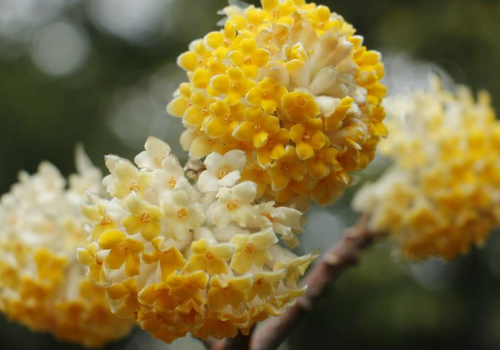
What is the difference between Edgeworthia chrysantha and Scindapsus flower:
Scindapsus flower has two different meanings: one is the name of the flower produced by the Scindapsus plant; the other is the Tibetan medicine brand dried flower Edgeworthia chrysantha, scientific name Edgeworthia chrysantha, a shrub that blooms in spring with a rich floral fragrance. Scindapsus flower is also known as Golden Pothos, vine taro, stone citrus, dichondra, and Qing San Gao flower.
Edgeworthia chrysantha is the flower bud of Edgeworthia chrysantha, a plant in the Thymelaeaceae family, and is a deciduous shrub. Origin: produced south of the Yangtze River basin and in Henan, Shaanxi, and other places.
Have you learned how to grow Edgeworthia chrysantha?
The Benefits and Effects of Scindapsus Flower, and the Side Effects of Scindapsus Flower
Scindapsus, native to tropical rainforest regions, is an evergreen vine in the Araceae family. Scindapsus flower has two different meanings: one is the flower produced by the Scindapsus plant; the other is a Tibetan medicine, scientific name Edgeworthia chrysantha, a shrub that blooms in spring with a rich floral fragrance.
The Benefits and Effects of Scindapsus Flower
First is its decorative effect. Keeping such a pot of Scindapsus indoors or outdoors, seeing its vivid, dripping green can give people an aesthetic sense of pleasure and make the body and mind feel refreshed, so its decorative effect is outstanding.
Air-purifying effect. Scindapsus is a large evergreen vine. Like spider plant and ivy, it has a very strong ability to purify the air. Scindapsus can absorb benzene, trichloroethylene, formaldehyde, and other substances in the air. Placing Scindapsus in a newly renovated home is the perfect choice. According to research by environmental scientists, one pot of Scindapsus in a room of 8-10 sq m is equivalent to an air purifier. It can be seen that Scindapsus's air-purifying ability is quite strong.
Air-circulating effect. Scindapsus can help circulate air and let indoor spaces ventilate. Why say this? Plants themselves also breathe, absorbing carbon dioxide and releasing oxygen. Scindapsus is usually placed by the window. When it is too windy outside, it blocks some of it; if there is no wind, it itself will also release new oxygen. The oxygen enters our living space, making us more energetic and making the indoor air fresher.
Absorbing kitchen odors. This is originally also one aspect of purifying the air. Placing Scindapsus in the kitchen can effectively absorb some of the oily smoke odors caused by stir-frying and cooking, and remove some other kitchen odors. This keeps our kitchen's air fresh.
The Benefits and Effects of Scindapsus Flower, and the Side Effects of Scindapsus Flower (Text: Jiankang Wuyou Network)
The Benefits and Effects of Scindapsus Flower Tea
Scindapsus flower tea can lower blood sugar and balance the sugar content in the blood, effectively reducing and preventing the occurrence of complications. It is especially useful for diabetic patients.
Scindapsus flower tea can lower blood lipids and effectively reduce the content of blood cholesterol and triglycerides in the blood, achieving the effect of clearing blood stasis. Patients with high blood pressure can also drink more Scindapsus flower tea.
Scindapsus flower tea, for activating blood in coronary heart disease and softening arterial blood vessels, has the effect of dilating blood vessels and increasing coronary artery flow. Scindapsus flower tea promotes qi and activates blood, and is antibacterial and anti-inflammatory. It has very good medicinal effects on vascular inflammation, high fever with convulsions, and sore, swollen throat.
Scindapsus flower tea can also enhance the body's immunity, and long-term use has an anti-cancer effect. Drink more for more health, drink more for more beauty. Scindapsus flower tea is the best prescription, the most natural prescription. Scindapsus flower grows in places closest to the sky, and drinking Scindapsus flower tea makes your body healthier.
For Scindapsus flower tea, steep 4-5 flowers in boiling water every morning and evening. Replace after steeping 3 to 4 times; for your body to be healthier, drinking Scindapsus flower tea is your best choice.
If the above information about The Benefits and Effects of Scindapsus Flower, and the Side Effects of Scindapsus Flower does not satisfy you, you can use the search function on this site to find more related content!
What Is Scindapsus Flower Like? The Benefits and Effects of Scindapsus Flower
Scindapsus flower is also called Golden Pothos, vine taro, stone citrus, and dichondra. It is a plant in the Araceae family and a rare plant unique to Tibet. It is a Tibetan medicine and has certain medicinal value. We may not know too much about Scindapsus flower, but as a Tibetan medicine, it has a great effect on some human diseases. So what benefits and value does Scindapsus flower have in life? Below, we will explain the benefits and effects of Scindapsus flower, hoping to help everyone.
Introduction to Scindapsus Flower
Scindapsus flower, a Tibetan medicine, is produced in the cold regions of Tibet. It is slightly cold in nature, has a growing period of only more than 40 days, and is a rare herbaceous plant unique to Tibet. Aliases: Golden Pothos, vine taro, stone citrus, dichondra. Scindapsus flower, a Tibetan medicine, scientific name Edgeworthia chrysantha, shrub. It blooms in spring with a rich floral fragrance. It is easily mistaken for the flower of the former. Both are plants in the Araceae family. The effects of Scindapsus flower are adjunctive treatment for diabetes, coronary heart disease, high blood pressure, and various vascular inflammations.
The Scindapsus vine grows several meters long, with aerial roots at the nodes. As the growing age increases, the stem thickens and the leaves also become larger and larger. Leaves are alternate, green, and a few leaves may also carry slightly yellow mottling, with entire margins and heart-shaped. Scindapsus is native to Central America and likes warm, humid environments, requiring loose, fertile soil with good drainage. Water once every 3-5 days, and add an appropriate amount of nutrient solution; it likes warm, semi-shaded environments.
The flower language of Scindapsus flower is watching over happiness. Because of its tenacious vitality, it is also called the flower of life. It lives as soon as it meets water.
The Medicinal Value of Scindapsus Flower
Application of Tibetan Scindapsus flower and its extracts in the preparation of diabetes drugs. The Tibetan plant Scindapsus flower (Scindapsus aureus (Linden ex Andre) Engl) and its extracted parts have an inhibitory effect on α-glucosidase and the effect of treating diabetes. In particular, the petroleum ether extract and ethyl acetate extract of Tibetan Scindapsus flower have a very strong inhibitory effect on α-glucosidase, and can be used as α-glucosidase inhibitors and in the preparation of diabetes treatment drugs.
Research found that the petroleum ether and ethyl acetate extraction fractions of Tibetan Scindapsus flower extract have a very strong effect of inhibiting α-glucosidase. Therefore, Tibetan Scindapsus flower and its extracts can lower blood sugar and promote insulin secretion, and can be used to prepare drugs for treating diabetes. The project conducted by Guangdong University of Technology, the application of Tibetan Scindapsus flower and its extracts in the preparation of diabetes drugs, and the conclusions of in vivo experiments on mouse blood sugar show that Tibetan Scindapsus flower indeed has the effect of lowering blood sugar.
The Benefits and Effects of Scindapsus Flower
1. Air-purifying effect
Scindapsus flower can purify the air and has an extremely strong ability to absorb harmful gases such as formaldehyde and benzene.
2. Antibacterial and anti-inflammatory effect
Scindapsus flower has antibacterial and anti-inflammatory uses. Scindapsus flower can promote qi and activate blood, and is antibacterial and anti-inflammatory. It has very good curative effects in treating vascular inflammation, high fever with convulsions, sore and swollen throat, and other conditions.
3. Blood lipid-lowering effect
Scindapsus flower has the effect of lowering blood lipids and can effectively reduce the content of blood cholesterol and triglycerides in the blood, achieving the effect of clearing blood stasis. For patients with high blood lipids, it is a very good choice.
4. Blood sugar-lowering effect
Scindapsus flower has the effect of lowering blood sugar. It can very well balance the sugar content in the blood, effectively reducing and preventing the occurrence of complications.
5. Blood pressure-lowering effect
Scindapsus flower has the effect of lowering blood pressure and stabilizing blood pressure. Scindapsus flower can effectively prevent stroke and acute coronary heart disease as well as severe renal failure caused by them. Patients with high blood pressure can steep Scindapsus flower in water to drink to make the body healthier.
6. Blood vessel-softening effect
For activating blood in coronary heart disease and softening arterial blood vessels, Scindapsus flower has the effect of dilating blood vessels and increasing coronary artery flow.
7. Anti-cancer effect
One of the benefits and effects of Scindapsus flower is that it also has a very powerful anti-cancer effect. Scindapsus flower can enhance the body's immunity, and long-term use has an anti-cancer effect.
The above is the explanation of the benefits and effects of Scindapsus flower. Is everyone clear now? For more home decoration knowledge, please pay attention.