How to Grow Umbrella Plant and Its Benefits and Effects
Umbrella plant not only beautifies courtyards but also purifies water quality. How do you grow umbrella plant? Benefits and effects:
How to grow umbrella plant:
1. Choose short plants (about 15-20 cm tall), with 5-7 stems per clump of muddy seedlings, wash the soil off the roots of the umbrella plant with clean water, and place it in a water basin.
2. Press down the roots of the umbrella plant with sand or pebbles to secure it and prevent it from falling over, then add clean water until the roots of the plant are submerged.
3. In winter, never move it outdoors to prevent frost damage. Change the warm water once every half month, or just add a little water when the water in the basin runs low.
4. Autumn is the growing season for umbrella plant. While new branches and leaves grow, old branches turn yellow and wither; just prune them off. Change the water every 3-5 days, or just add a little water when the water in the basin runs low.
5. Adding inorganic fertilizer to the basin 1-2 times a month is even better; it can keep the plant compact and delightfully green.
Benefits and effects of umbrella plant:
1. Ornamental value
Umbrella plant (water bamboo palm) is easy to manage and cultivate, clean and elegant, with the bearing of a bonsai. If paired with rockery and ornamental stones to make a small bonsai, it has a highly natural beauty. In the south it is mostly grown in the open ground, decorating stream banks, rockeries and stone crevices, with a distinctive charm.
2. Water purification
According to research, water bamboo has a removal rate of up to 90% for nitrogen, phosphorus and other harmful gases. Planting umbrella plant (water bamboo palm) in a courtyard pond allows you to enjoy it while purifying the water, creating a fresh and natural living environment for us.
3. Practical value
Because of the characteristics of umbrella plant (water bamboo palm), it is an excellent material for making summer sleeping mats. After being made into a mat, when a person lies on it, sweat is absorbed by the bamboo filaments, body temperature drops accordingly, making the person feel cool and comfortable; as sweat is absorbed by the bamboo filaments, they become even more supple and cool.
4. Fragrance value
Umbrella plant (water bamboo palm) is a new type of fragrance. The method is: place a few bamboo stems in a bottle containing essential oil; the essential oil with alcohol content will volatilize along the bamboo. The scent released is fresh and natural. Umbrella plant (water bamboo palm) does not need energy and relies only on its own evaporation, so it can be used on any occasion.
Have you learned how to grow umbrella plant?
How to Grow Aquatic Plants, and What Aquatic Plants There Are
✿ Related Reading Recommendations
✿ Jacaranda
✿ Silverbush Tree Price ✿ What Benefits and Effects Does Crown Daisy Have (◕‿◕✿) For flowers and bonsai, and plant cultivation, please follow the Meilele Flowers and Bonsai section!
.....
A prominent feature of aquatic plants is that they have well-developed aerenchyma, so even when growing in oxygen-free or oxygen-poor sludge, they can still survive. And many aquatic plants have strong adaptability to their environment. Today, the editor will introduce to you how to grow aquatic plants.
.....
As the editor just said, many aquatic plants are highly adaptable, so how do you grow aquatic plants? Unlike other plants, aquatic plants are rarely planted for ornamental purposes alone. Almost all aquatic plants are important for creating a good ecosystem.
.....
.....
And a good ecological environment is the foundation for maintaining the beauty of a water body. To achieve this, it is necessary to reasonably balance and configure different aquatic plants to regulate light, oxygen and nutrient levels, so as to create an aquatic environment suitable for both animals and plants to flourish.
.....
.....
How do you grow aquatic plants? Aquatic plants should be planted according to the habits of different species or varieties. During garden construction, there are two different technical approaches to planting aquatic plants. One is to build planting troughs at the bottom of the pond, spread at least 15 cm of culture soil, and plant the aquatic plants into the soil; the other is to plant the aquatic plants in containers and then sink the containers into the water.
.....
.....
The two methods introduced above each have advantages and disadvantages. The method of planting aquatic plants in containers and then sinking them into the water is more commonly used, because it is easy to move; for example, in northern winters the containers must be taken out and stored to prevent severe cold; when changing soil, adding fertilizer, or dividing plants in spring, the work is also more flexible and labor-saving. Moreover, this method can keep the pond water clear, and cleaning the pond bottom and changing water are also more convenient.
.....
.....
As for how to grow aquatic plants, the editor will briefly give a few methods. The management of aquatic plants is generally relatively simple; just pay attention to a few points.
1. Check for pests and diseases.
2. Check whether the plants are crowded; generally divide the clumps once every 3 to 4 years.
3. Apply additional fertilizer regularly.
4. Remove weeds from the water; when the pond bottom or pond water is too turbid, change the water or thoroughly clean it. To plant aquatic plants, you must master some principles to make them grow well.
.....
.....
Now that we have finished discussing how to grow aquatic plants, let us learn what aquatic plants there are. It is worth mentioning that there are many aquatic plants; the editor can only list a few common ones, and there is no way to cover them all. According to the lifestyle of aquatic plants, they are generally divided into the following major categories: emergent plants, floating-leaf plants, submerged plants and floating plants, as well as emergent herbaceous plants.
.....
.....
Emergent aquatic plants are tall, with brilliant flower colors; the vast majority have distinct stems and leaves, standing upright, with the lower part or base submerged in water, roots or rhizomes rooted in mud for growth, and the upper plant standing out of the water surface. There are many kinds of emergent plants, commonly including lotus, purple loosestrife, sweet flag, yellow flag iris, softstem bulrush, powdery thalia, pickerelweed, variegated giant reed, cattail, Oriental water plantain, umbrella plant, reed, wild rice stem, etc.
.....
.....
Floating-leaf aquatic plants have well-developed rhizomes, large and brightly colored flowers, no obvious above-ground stems or weak slender stems that cannot stand upright, and leaves floating on the water surface. Common species include Victoria water lily, water lily, Nuphar japonicum, fox nut, floating heart, etc. Emergent herbaceous plants: canna, pickerelweed, purple loosestrife, powdery thalia, aquatic iris, red knotweed, fountain grass, cattail, Oriental water plantain. Plants suitable for growing at the water's edge.
.....
Many aquatic plants not only have beautiful flowers but also purify the air, among other things. Today the editor's introduction on how to grow aquatic plants ends here. Thank you all for reading.
Water Bamboo Cyperus alternifolius Water Bamboo Illustrated Guide: How to Grow Water Bamboo / How to Propagate Water Bamboo
Water Bamboo ProfileWater Bamboo Cyperus alternifolius
Water Bamboo Cultivation Methods and Precautions Introduction to Water Bamboo
Water bamboo is a bamboo used mainly for timber and also for shoots. The bamboo culm is slender, with long internodes and a green color; the rhizome internodes are shorter, and the root system is well developed. The material is flexible, highly elastic, with very strong fibers and a smooth surface. The whole water bamboo plant is a treasure; it is not only one of the industrial raw materials but also widely used. The bamboo shoots taste fresh and sweet, and bamboo woven utensils and handicrafts are beautiful and durable. After burning, it can produce bamboo oil and bamboo charcoal; bamboo oil has a rich fragrance and can be used as an ingredient in cosmetics, etc.; bamboo charcoal is used for heating, blacksmithing, and architectural coatings. Water bamboo also has many medicinal values.
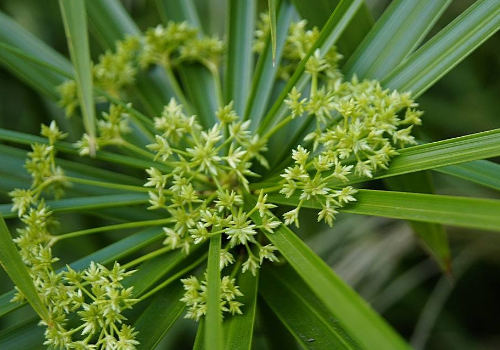
The rhizome of water bamboo is short, thick and large, with hard fibrous roots. The culm is somewhat robust, 30-150 cm tall, nearly cylindrical, slightly rough in the upper part, and wrapped at the base with leafless sheaths, the sheaths brown. There are 20 bracts, almost equal in length, about 2 times longer than the inflorescence, 2-11 mm wide, spreading in all directions, flat; the repeatedly compound umbel with long lateral branches has many primary rays, the longest rays up to 7 cm, each primary ray bearing 4-10 secondary rays, the longest up to 15 cm; spikelets densely clustered at the top of the secondary rays, elliptical or oblong-lanceolate, 3-8 mm long, 1.5-3 mm wide, flattened, with 6-26 flowers; the rachilla has no wings; glumes closely imbricate, membranous, ovate, apex acuminate, about 2 mm long, pale white, with rusty spots, or yellowish brown, with 3-5 veins; stamens 3, anthers linear, apex with setaceous appendages; style short, stigmas 3. The nutlet is elliptical, nearly trigonous, 1/3 the length of the glume, brown.
Cultivated in all provinces north and south of our country as an ornamental plant; native to Africa, widely distributed in swamps at the edges of large lakes and rivers in forest and grassland regions.
Aliases: water bamboo, umbrella plant, water bamboo palm, windmill grass,
Family and genus: Cyperaceae, Cyperus.
It naturally has a quiet posture, with upright stems and lush leaves, distinct layers, elegant and natural, evergreen all year round; it is an excellent indoor display plant and also a good material for cut flowers. Its maintenance is simple and its management is extensive; it can be grown in water or in pots. Therefore it is deeply favored by bonsai enthusiasts. [2]
Water bamboo is native to India and Indonesia. It likes warm, humid, ventilated and well-lit conditions, tolerates shade, and avoids exposure to scorching sun.
The root system is fine; it can be propagated by cutting the roots and dividing clumps, and management is very convenient. In spring, summer and autumn, water [3] cultivation is best, and in winter it can be changed to pot cultivation. Water cultivation can be done in narcissus basins, rock basins, glass containers, pottery basins or porcelain bowls. Plant the plant into the basin, fill it with one of coarse river sand, white stones, Yuhua stones, or pebbles, then pour in water (river water or rainwater is best; settled tap water can also be used), and you can also add small rockeries and other decorative pieces to enhance the appearance.
Morphological Characteristics of Water Bamboo
The main culm of water bamboo is 1-1.5 m tall and 3-5 mm in diameter (after cultivation it can be 5-7 m tall and about 3-5 cm in diameter); the newly grown young bamboo has white powder below the nodes; the sheath is hairless, dark green, mixed with light reddish brown. The sheath leaf is broadly triangular to lanceolate. The lower part of the culm is appressed and flat, while the upper part has a concave leaf surface shaped like a boat; branchlets are often solitary, with 2-5 leaves; the upper part of the leaf sheath often has fine hairs, and each side of the sheath mouth has a tiny leaf ear; the leaf blade is oblong-lanceolate, 8-16 mm wide, hairless or nearly hairless except for the lower base. Spikelets are clustered at the top of leafy branchlets, subtended by reduced ovate leaves, and the spikelets contain three to four florets.
Wild plants generally have culms 1 to 2 m tall and about 1 cm in diameter (cultivated culms can reach 5 or 6 m tall and 2 to 3 cm in diameter). The sheath tip is hairless, and the skin is dark green. The sheath leaf is triangular or lanceolate. Branchlets are solitary, with three to five leaves. Spikelets contain three to four florets.
After flowering, the leaves of water bamboo remain green, and the underground part does not die either, unlike most bamboos, which die after flowering. Therefore it has good ornamental value.
Ecological Habits of Water Bamboo
Water bamboo likes warm and humid conditions, good ventilation, and sufficient light. It tolerates partial shade and is very cold-tolerant. In the East China region, it can overwinter in the open ground with slight protection. It is not strict about soil and is best suited to fertile, slightly clayey soil.
The root system is fine; it can be propagated by cutting the roots and dividing clumps, and management is very convenient.
In spring, summer and autumn, water cultivation is best, and in winter it can be changed to pot cultivation. Water cultivation can be done in narcissus basins, rock basins, glass containers, pottery basins or porcelain bowls. Plant the plant into the basin, fill it with one of coarse river sand, white stones, Yuhua stones, or pebbles, then pour in water (river water or rainwater is best; settled tap water can also be used), and you can also add small rockeries and other decorative pieces to enhance the appearance.
In summer, evaporation is relatively high; pay attention to topping up and changing the water to keep the water quality from being polluted. Autumn is dry, so prevent it from being blown over by wind; often spray the leaves, and let it receive night dew in the evening. Water bamboo does not need much fertilizer; just dissolve one or two fertilizer tablets in water and pour it on.
In winter, it is best to change from water cultivation to pot cultivation; vermiculite, river sand, or loose culture soil can all be used. Maintain a certain humidity, prune appropriately, and place it in a warm, sunny indoor spot. It can overwinter safely as long as the temperature does not drop below 5°C.
Distributed south of the Yangtze River basin. It grows in riverbanks, lakeside thickets, or rocky hillsides.
Water bamboo likes to grow in water, hence its name; it is a perennial herb of the Cyperaceae family. Water bamboo is easy to grow and needs little management; as long as there is a certain amount of light every day, air circulation, and frequent watering, it can grow stout, lush and green. Viewed, it is elegant and generous, giving people enjoyment of beauty. Water bamboo is not very strict about soil; grown in garden soil, it always grows upright and graceful for more than ten years; when the seedlings are weak, just water them with a small amount of diluted human urine or chemical fertilizer.
Distribution Area of Water Bamboo
Native to the West Indies and Madagascar. Now commonly cultivated in various places in our country.
Water bamboo mostly grows on riverbanks, beside lakes, or on rocky hillsides, and is widely distributed in the Yangtze River basin; wild plants are found throughout the mountainous areas of eastern Hubei. Farmers in counties along the river often plant it beside their homes, and it is especially abundant in Qichun, Huangmei, Xishui and other counties. It is often used for potted ornament or as cut foliage for flower arrangements.
Landscape Uses of Water Bamboo
Umbrella plant has dense clumps and peculiar leaf shapes; it is a good indoor foliage plant. Besides potted ornament, it is also a material for making bonsai, and can also be hydroponically grown or used as cut flower material. In the Jiangnan area, where there is no frost period, it can be cultivated in the open ground and is often placed at stream banks and in the crevices of rockery stones as decoration, with a distinctive natural charm; but for the planting site, special attention must be paid to light conditions, and the ecological habits of the plant should be considered as much as possible, choosing a shaded side for planting and viewing.
Uses and Species Value of Water Bamboo
The whole water bamboo plant is a treasure; it is not only one of the industrial raw materials but also widely used.
The bamboo shoots taste fresh and sweet, and bamboo woven utensils and handicrafts are beautiful and durable. After burning, it can produce bamboo oil and bamboo charcoal; bamboo oil has a rich fragrance and can be used as an ingredient in cosmetics, etc.
Bamboo charcoal is used for heating, blacksmithing, and architectural coatings.
Water bamboo also has many medicinal values.
Appreciation Value
Water bamboo is easy to manage and grow, clean and elegant, refined and unrestrained, with the bearing of a bonsai. It is suitable for display on desks and tables. If paired with rockery and ornamental stones to make a small bonsai, it has a natural charm. In the south, planted in the open ground, it is suitable for decorating stream banks, rockeries and stone crevices.
It can be grown in soil in flower pots, or in water in water-holding containers. For water cultivation, you can use lake water, river water, well water, rainwater, or tap water that has been settled for 24 hours; electrolyzed acidic ion water is best, and mineral water should be avoided. A few colored glass balls or pebbles can be placed in the bottle to stabilize the center of gravity and increase the beauty.
Purification Value
Water bamboo has the value of purifying the environment.
After water bamboo was cultivated in domestic sewage for 10 d, the removal rates of TN, TP, COD and BOD in the sewage reached 91%, 92%, 70% and 73% respectively, among which the absorption amounts of N and P by water bamboo accounted for 55% and 53% of the purification amounts respectively. In a subsurface-flow constructed wetland planted with windmill grass, the removal rates of TN, TP, COD and BOD were 64%, 47%, 74% and 74% respectively. Compared with a constructed wetland without plants, the removal rates of TN, TP, COD and BOD increased by 28%, 19%, 14% and 13% respectively.
Other Values
Water bamboo, also water bamboo summer sleeping mats, can be used to make summer sleeping mats.
The advantages of water bamboo summer sleeping mats are: neat edges, beautiful color, tightly woven, durable, and able to dissipate heat and absorb sweat. Water bamboo produced in Dongting Lake is fine in texture, likes shade and moisture, and has particularly good water absorption, so the bamboo body is cool. After the bamboo is split into strips and woven into mats, it still maintains its original characteristics and strengths. When a person lies on a water bamboo summer sleeping mat, sweat is absorbed by the bamboo filaments, body temperature drops accordingly, making the person feel a gentle breeze coming from the mat; as sweat seeps into the bamboo filaments, they become even more supple and cool. Therefore, the longer a water bamboo summer sleeping mat is used, the better its heat dissipation and sweat absorption performance, and the cooler it feels the more you sleep on it.
Craftsmanship: From cutting bamboo, sizing, splitting strips, drawing filaments, steaming and boiling to weaving and edge binding, a water bamboo summer sleeping mat goes through thirteen processes, all done by hand. In particular, the bamboo filaments are steamed and boiled, so the mat is soft and not easy to break, and does not breed bamboo powder insects. If used with care, one water bamboo summer sleeping mat can be enjoyed for twenty or thirty years.
Water bamboo can also be used as a puzzle, cut into different shapes and arranged into different patterns.
In addition, the juice squeezed from water bamboo leaves can be used as a light green dye for painting.
Medicinal or Dietary Therapeutic Value of Water Bamboo
The medical information and health dietary therapy information on Huahua Network is for reference only and cannot be used as a basis for diagnosis or medical treatment. For any health problems, consult professional medical personnel, and for the treatment of any disease, follow medical advice.
Ultimate flower-care task: To love yourself, start from reality and strictly follow medical advice. Toward illness, do not be careless, do not delay, do not give up hope; face it bravely, warm the silent world with love, and care for the flower field in your heart with your heart.
Medicinal Value
[Introduction to the Benefits of Water Bamboo Leaf]:
Water Bamboo Leaf ("Bencao Shiyi")
[Alternative Names] Chicken Tongue Grass, Chicken Tongue Huang ("Quanzhou Bencao").
[Source] The whole plant of the Commelinaceae plant water bamboo leaf.
[Collection] Harvested in summer and autumn, dried in the sun.
[Nature and Flavor] "Quanzhou Bencao": sweet in flavor, neutral in nature.
[Meridian Entry] "Quanzhou Bencao": enters the liver and spleen meridians.
[Functions and Indications - Benefits of Water Bamboo Leaf] Clears heat, promotes urination, reduces swelling, and detoxifies.
Treats lung heat with wheezing and coughing, red and white dysentery, difficult urination, sore throat, and carbuncles, boils and furuncles.
① "Fujian Folk Herbal Medicine": promotes urination, clears heat, reduces swelling, and detoxifies.
② "Quanzhou Bencao": treats erysipelas, deep-rooted boils, beriberi, heart disease, heat dysentery, fever with mania and epilepsy, sore throat and snake, scorpion and insect bites, etc.; external application treats joint swelling and pain.
[Usage and Dosage] Oral administration: decocted in water, 15-25 grams (50-100 grams if fresh).
External use: pound and apply.
[Selected Formulas] ① To treat pneumonia with high fever, wheezing and coughing: fresh water bamboo leaf 25-40 grams.
Add an appropriate amount of water, decoct, mix with honey and take, twice a day.
② To treat intestinal heat with red and white dysentery: fresh water bamboo leaf 50 grams.
Wash clean, decoct in water, mix with a little brown sugar and take orally.
③ To treat difficult urination: fresh water bamboo leaf 50-100 grams.
Add an appropriate amount of water, decoct, mix with rock sugar and take orally, twice a day.
(Formulas ① and below are from "Quanzhou Bencao") ④ To treat mouth sores and rotten tongue: fresh water bamboo leaf 100 grams, pound to extract juice, add one cup of boiled water, rinse the mouth for about five to six minutes, several times a day.
⑤ To treat sores and boils: fresh water bamboo leaf 150 grams, rock sugar 25 grams.
Stew and take, and apply the medicinal residue to the affected area.
⑥ To treat corns: pound fresh water bamboo leaf with winter honey until mashed and apply to the affected area, changing two to three times a day.
(Formulas ④ and below are from the "Collection of Proven Formulas" of Taijiang District, Fuzhou) ⑦ To treat finger inflammation before pus forms: one handful of fresh water bamboo leaf stems and leaves, a little vinegar residue.
Pound together and apply externally.
Propagation Methods of Water Bamboo
Propagation can be done by division, cuttings, or sowing.
1. Division propagation: Division is generally carried out in early spring when repotting, and this method is commonly used for home propagation of umbrella plant. When dividing, take the mother plant out of the pot and divide it into several small clumps to pot separately. This method is simple and easy to survive. Variegated forms such as variegated umbrella plant must be propagated by division.
2. Cutting propagation: Cuttings can be taken in all four seasons, but it is best to do so before flowering. When taking cuttings, cut about 3-5 cm from the top of a robust stem, and cut off part of the involucre; insert the stem part into sand, lay the involucre flat and close against the sand, and spread a thin layer of sand on top of the bracts. Maintain sand moisture and air humidity, place in a ventilated and shaded place, and at a temperature of 20-25°C, roots can form in about 20-30 days.
3. Seed propagation: This can be carried out around April. Evenly scatter the seeds in a shallow basin filled with river sand, cover with a thin layer of soil, press lightly, soak with water and cover with glass. At room temperature of about 20°C, seedlings can emerge in about 10-15 days. When the seedlings are 5 cm tall, they can be transplanted into small pots for care.
Based on the characteristic that water bamboo can grow both in water and on land, if you use a rectangular watertight flower pot, arrange several clumps of umbrella flowers of different heights, leave the water surface exposed, and decorate with a few ornamental stones, you can create a natural waterscape; seeing the sparse shadows slanting across, the scenery is pleasant and has a distinctive charm. Water bamboo is commonly propagated by division and cuttings, and can also be sown. Cuttings are carried out in June-July; robust branches selected before flowering root most easily. Take 3-5 cm from the stem tip, and cut the whorled leaves in half to reduce water evaporation, then insert into sand or vermiculite, making the leaves lie flat on the substrate, water thoroughly, and afterwards keep the substrate moist; roots can form in 20 days. Division can be carried out throughout the year, but it is best done in mid-to-late March when repotting. Sowing in April also sprouts into seedlings easily. There are many propagation methods for water bamboo, such as sowing, division, and cuttings. 1. Cuttings. These can be divided into soil cuttings and water cuttings. Soil cuttings are generally done in the summer growing season: cut 5 cm to 6 cm below the umbrella-shaped bracts at the top of the stem, cut off the tips of the bracts, leave 3 cm to 4 cm in length, trim into a leaf disk 6 cm to 8 cm in diameter, then insert the flowering stem into a basin or sand bed filled with sand, making the leaf disk closely against the sand surface, place in a shaded place, maintain air and basin soil humidity, and after more than 20 days water bamboo begins to take root and grow new buds, and sprouts small plantlets. For water cuttings, use a washed wide-mouth bottle filled with cooled boiled water, cut 8 cm below the umbrella-shaped bracts at the top of the stem, cut each bract by 1/2, insert into the wide-mouth bottle filled with water, with water temperature 25°C; afterwards, new buds are produced in the bract axils and grow upward, and fibrous roots extend into the water, and after more than 20 days seedlings can be transplanted. When doing water cuttings in summer, the cooled boiled water needs to be changed once every 2 to 3 days to prevent the cuttings from being contaminated by bacteria and rotting.
Division. It is best done in March to April when repotting. Take the overcrowded mother plant out of the pot, divide it into several clumps, pot them separately, and plant them as they are divided; they survive very easily. Generally, after potting, it is a complete foliage flower plant.
Sowing. Generally, seeds are picked in September to October when they mature, aired in a shaded place to dry, and then stored. In March to April of the following year, scatter the seeds into a pot with culture soil, press flat, cover with a thin layer of soil, soak with enough water, then cover with glass and keep the pot soil moist. After 10 days, water bamboo germinates successively, and when the seedlings are 5 cm tall, they can be moved into small pots.
Water bamboo grows relatively fast and is easy to cultivate; it can even grow well when water floods the potting soil, and can also grow in water, hence the name water bamboo. In the high-temperature summer season, maintain relatively high air humidity and keep the potting soil moist, avoid direct strong light, and apply dilute liquid fertilizer once every two weeks. In winter, the room temperature should not be lower than 5°C. If fertilizer and water are insufficient, the plants are crowded, the temperature is too low, or the potting soil is dry, the stems and leaves will turn yellow and wither.
Cultivation techniques and care for water bamboo
Water bamboo has relatively high requirements for water. It is best to use mineral water and purified water, and tap water only secondarily, but it must be left to settle before use. The water surface should touch 3 cm above the upper part of the roots; do not submerge too much, so as to avoid root rot affecting respiration. If the stems rot, the rotted parts must be cut off promptly to prevent the rot from spreading; it is best to cut at the bamboo nodes. Generally speaking, once water bamboo has taken root, it is not prone to rotting. If rotting occurs, besides cutting off the rotted parts, you can also put some Lianglübao in the water to promote rooting. As for the water, change it once every half month.
When potted, keep the soil moist during the growing season, or plant it directly into a watertight pot and keep about 5 cm of water in the pot, which saves the trouble of watering every day. In the peak growing season, fertilize 1-2 times per month. To control height, in May you can apply 400 ppm of paclobutrazol once, which can effectively control excessive growth. This plant has a wide range of adaptability to light and can grow well in full sun or semi-shade, but placing it in semi-shade in summer is more beneficial to its growth and can keep the leaves tender green and not old.
Soilless cultivation
Root division by cutting can be carried out in spring, summer, and autumn. When dividing, dig the plant out of the pot, cut the rhizome with a sharp knife, wash away the old soil between the roots with clean water, then cut off the old and withered fibrous roots, place it in a watertight pot, and then fill the pot with washed white stones, coarse sand, or Yuhua stones and cobblestones to cover the plant roots; the covering material should be judged by covering the root crown, and should not be too little. At the same time, you can also take some mountain stones, coral, or other bonsai decorative accessories and place them on top of the covering material, which can both prevent the plant from lodging and add scenery to the pot.
Once water bamboo is potted, it must be watered immediately. The water level should be such that the pot is filled without overflowing. For the pot water, it is best to use river, pond, or canal water; tap water that has been left standing for some time can also be used.
Growth habits
Water bamboo prefers warm, humid, humus-rich clay soil. It is shade-tolerant but not cold-tolerant, and the winter temperature should not be lower than 5°C. It is widely distributed in swamps at the edges of large lakes and rivers in forest and grassland areas.
Cultural background of water bamboo
Water Bamboo Pavilion
[Author: Wu Ji]
[Era: Song Dynasty]
[Poem]:
A pool of clear water and several stalks of bamboo, enough to make people compose verses in praise.
Now after official duties I have no vulgar matters, so I may as well take guests along for a brief outing.
Water bamboo pictures