How to care for the purple-edged peperomia and pruning tips for when it grows tall
Besides being ornamental, the purple-edged peperomia also has certain medicinal properties. How do you care for the purple-edged peperomia? How do you prune it when it grows tall:
How to care for the purple-edged peperomia:
1. The water the purple-edged peperomia needs
The purple-edged peperomia likes a humid environment. May to September is the growing season, and during the growing season it needs more watering. In hot weather, spray or splash water on the leaves to maintain a relatively high air humidity, keeping the leaf pattern clear and the foliage emerald green.
2. The fertilizer the purple-edged peperomia needs
Fertilize once a month until overwintering.
3. The soil the purple-edged peperomia needs
It requires loose, fertile, well-drained soil, which can be mixed from river sand, mud surface material and leaf mold.
4. The temperature the purple-edged peperomia needs
It likes warmth, with an optimum growing temperature of around 25°C, and the overwintering temperature should not be lower than 10°C.
5. The light the purple-edged peperomia needs
Avoid direct sunlight; it is best grown in semi-shade. In summer, pay attention to shading and place it somewhere that does not receive direct sunlight, where it can get diffused light.
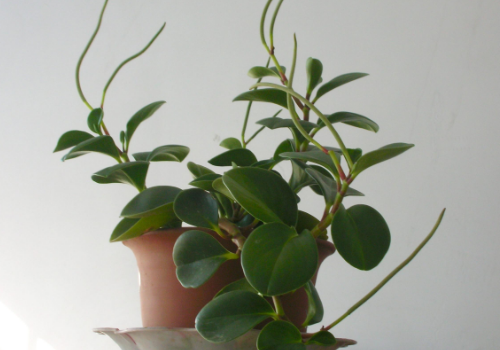
How to prune the purple-edged peperomia when it grows tall:
1. Direct pruning: simply cut off the overly tall branches. Because it has very strong regenerative ability, just continue caring for it after pruning, and before long it will send out new branches and leaves.
2. Prune the overly long branches, then use the cut branches for cuttings propagation, and this way your purple-edged peperomia will multiply more and more. The cut branches can also be grown in water.
Now you have learned how to care for the purple-edged peperomia.
How to prune the purple-edged peperomia when it grows tall, and how to pinch the purple-edged peperomia
The purple-edged peperomia is relatively large and grows quickly. Some friends think growing fast is a good thing, but actually it is not. Growing too fast not only brings no benefit, but also affects its growth condition. Therefore, when it grows too fast, we still need to prune it to some extent. Below, the editor will introduce its specific methods.
How to prune the purple-edged peperomia when it grows tall
1. Direct pruning: simply cut off the overly tall branches. Because it has very strong regenerative ability, just continue caring for it after pruning, and before long it will send out new branches and leaves.
2. Prune the overly long branches, then use the cut branches for cuttings propagation, and this way your peperomia will multiply more and more. The cut branches can also be grown in water.
How to pinch the purple-edged peperomia
Pinching the purple-edged peperomia actually means nipping off the top part of the plant. Moreover, when pinching, you can not only pinch off the growing tip on the main stem, but also remove the leaves on the tops of the side shoots. This is also to regulate its growth and promote its growth.
Propagation methods for the purple-edged peperomia
1. Division method
First, if conditions permit, with a greenhouse that has temperature control equipment, division propagation can be carried out almost all year round. For the potting soil for division, we can mix it ourselves: add some perlite and sand to the prepared leaf mold and peat soil, stir evenly, add an appropriate amount of base fertilizer, and keep the soil fertile. At the same time, note that the soil must be loose and breathable, and not prone to waterlogging. Then comes the care during the growing season. During the growing season, it is best to apply a top dressing once every half month. For watering, use water that has been left to settle in a water tank for 1~2 days; in winter, restrict watering.
Temperature changes directly affect leaf color, and the suitable temperature is 15~20°C. The purple-edged peperomia is afraid of heat. In the intense summer heat, it can be placed under a shade shed and sprayed with water to cool it down. In addition, too much heat or too much moisture can cause the stems and leaves to turn black and rot, affecting the normal growth of the purple-edged peperomia, so when watering, the water must be controlled appropriately, neither too much nor too little. In winter, place it in a spot with ample light; in summer, avoid direct sunlight.
2. Leaf cuttings propagation
It can also be propagated by leaf cuttings. During the period of May to June, you can choose to use leaf cuttings propagation. In addition, the leaf cutting cannot be just a single leaf; it needs to have a petiole of about 1CM. Use a knife to cut off the leaf, let it dry, then insert it diagonally into a prepared sand bed or substrate, inserting it to 1/3 of the leaf. River sand is enough for the substrate. Keep the substrate moist and maintain air humidity, and it will root in about 10-15 days.
Why have all the leaves of the purple-edged peperomia fallen off?
1. Whether it has been overwatered. Watering should be done by the principle of "see dry, see wet"; do not water when not dry, and water thoroughly when you do.
2. Whether it has been overfertilized. If so, change the soil quickly.
3. If the original spot was cold, look carefully at the leaves to see whether there is red spider mite damage. This flower is most susceptible to this pest. Spraying 1500 times diluted abamectin can prevent it; agricultural supply stores have small 50 ml bottles of the pesticide.
4. Glasswort is a light-loving plant; check whether it has been placed in a spot without sunlight for too long.
Although the purple-edged peperomia is relatively easy to plant, caring for it is rather troublesome. It often develops various problems, such as the ones described above, which it is prone to. So we should follow the methods and take timely protective measures to let it grow healthily.