How to care for Daphne odora 'Aureomarginata' in winter? After-bloom care like this
Daphne odora 'Aureomarginata' blooms in spring each year, and generally blooms only once. How to care for Daphne odora 'Aureomarginata' in winter? After-bloom care like this:
How to care for Daphne odora 'Aureomarginata' in winter:
1. Move it indoors
The safe overwintering temperature for Daphne odora 'Aureomarginata' is above 5°C, so during the day it can be placed at a south-facing window to receive sunlight, and on clear days the window can be opened for ventilation; at night it must be moved to a warmer spot indoors, because outdoor temperatures are low at night and even with the window closed, leaving it by the window may cause frost damage.
2. Fertilizing
If no base fertilizer was applied to the potting soil of Daphne odora 'Aureomarginata' at the start, then it needs to be top-dressed frequently, but raw fertilizer and concentrated fertilizer must not be used; soybean water or monopotassium phosphate solution can be used. Do not let ants, earthworms and other creatures appear in the soil.
3. Watering
In winter Daphne odora 'Aureomarginata' grows relatively slowly, so the amount of water given must be controlled properly. Usually we can tell from the leaves' response whether the watering amount is appropriate: if the leaves are upright and pointing upward, it means water and fertilizer are normal; if the leaves droop, it means too much or too frequent watering. If too much water is given and waterlogging occurs, it can easily lead to root rot.
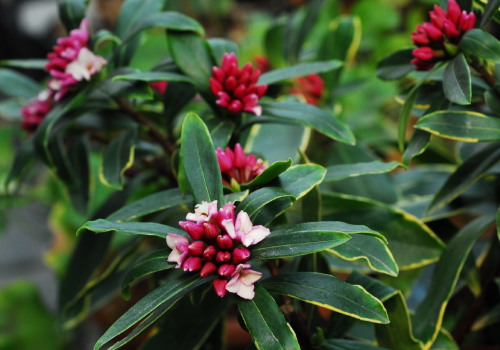
After-bloom care for Daphne odora 'Aureomarginata':
1. Increase light and lower temperature
They bloom very profusely when in flower; at this time placing them in a spot with light can make the floral fragrance more intense. This makes them even more beautiful. At the same time, appropriately lowering the temperature of their living space to about 5°C can extend the flowering period, letting Daphne odora 'Aureomarginata' display its beauty for a longer time.
2. Prune branches and leaves
This flower has strong sprouting ability, so after blooming it can be pruned appropriately to make its appearance more graceful and enhance its growth. Therefore, after blooming, scissors can be used to remove branches and leaves that are poorly developed, too densely grown, or detrimental to the overall appearance, making them look more shapely.
3. Prevent pests and diseases
When Daphne odora 'Aureomarginata' blooms, the roots give off a rather pleasant smell that easily attracts ants, earthworms and the like, which feed on them, so pest control must be carried out. In addition, mosaic disease caused by a virus will also threaten the normal growth of Daphne odora 'Aureomarginata' after blooming; this disease causes its leaves to develop spots and become deformed, leading to failure to bloom and grow normally. Therefore, once symptoms of mosaic disease are found, the roots must be dug out and removed promptly and burned to prevent it from spreading.
Do you have any other questions about the care of Daphne odora 'Aureomarginata'?
How to care for Daphne odora 'Aureomarginata' in winter
Winter care methods for Daphne odora 'Aureomarginata'
Placement location
After Frost's Descent, Daphne odora 'Aureomarginata' should be moved indoors for care. During the day place it at a south-facing window to receive sunlight; at night move it to a warmer spot indoors, and do not leave it by the window to avoid frost damage from overly low temperatures. In winter keep the indoor temperature above 5°C, and open the window for ventilation on clear days.
Fertilizing requirements
The potting soil of Daphne odora 'Aureomarginata' may have no base fertilizer, so liquid fertilizer should be applied frequently as a top dressing. But note: raw fertilizer and concentrated fertilizer are taboo, and ants and earthworms must not appear in the potting soil (although earthworms help enhance soil fertility, having earthworms in a household potted plant is still a bit disgusting). When fertilizing, it is better to be dilute than concentrated.
For the liquid fertilizer, mainly choose soybean water or monopotassium phosphate solution. If the fertilizer is too concentrated, water promptly, watering several times in a row to let the fertilizer drain out from the bottom of the pot and reduce fertilizer damage, then place the pot in a ventilated spot so the potting soil dries as quickly as possible.
Watering method
In winter Daphne odora 'Aureomarginata' grows relatively slowly, so watering should be based on conditions. If the leaves are upright and pointing upward, it means water and fertilizer are normal; if the leaves droop, it means too much or too frequent watering. Once the cause is found, correct it promptly.
If root rot occurs due to overwatering, deal with it promptly: take the plant out of the pot in time, cut off the rotted roots, wash them with a fungicide, and then replant. Of course, to help the plant recover as quickly as possible, part of the upper leaves can be cut off to reduce nutrient consumption.
What to do if Daphne odora 'Aureomarginata' drops buds in winter
The flowering period of Daphne odora 'Aureomarginata' is mainly in winter, but the winter environment is harsh, and improper care can easily cause bud drop. Prepare in advance and pay attention to the following points:
Temperature control
Daphne odora 'Aureomarginata' likes warmth and cannot tolerate strong light. Overly strong sunlight and low temperatures can both cause bud drop. Besides controlling temperature, note that in a stuffy environment Daphne odora 'Aureomarginata' easily contracts mosaic disease, which causes a large number of buds to drop, so Bordeaux mixture should be sprayed promptly for prevention and control.
Fertilizing
After autumn begins, pay attention to fertilizing, applying thin fertilizer frequently, all the way until the flower buds open. Before the buds form, mainly use phosphorus fertilizer; after the buds form, switch to monopotassium phosphate solution for foliar spraying or root drenching, and the fertilizer solution should be sprayed evenly on both the front and back of the leaves. In this way, before winter arrives, the buds are already growing firmly on the branches, and there is no need to worry about bud drop!
Potted management of Daphne odora 'Aureomarginata', and appreciation of Daphne odora 'Aureomarginata' pictures
Daphne odora 'Aureomarginata' belongs to the Thymelaeaceae family, genus Daphne, an evergreen small shrub, and is a variety of daphne. No matter when, planting plants is a technical job that tests a person, requiring not only knowledge but also enough patience and care. So next, let's take a look together with the editor at the potted management of Daphne odora 'Aureomarginata'!
Potted management of Daphne odora 'Aureomarginata'
Daphne odora 'Aureomarginata' has a strong fragrance and likes semi-shade or sunny spots, and dislikes scorching sun exposure and rainstorms. Daphne odora 'Aureomarginata' has poor cold resistance and cannot tolerate waterlogging; it is suitable for growing in fertile, loose, well-drained, slightly acidic soil, and in ordinary management a relatively extensive management style is adopted.
The main propagation method of Daphne odora 'Aureomarginata' is cutting propagation; the parts used for cuttings are old branches and young branches. This method has a high survival rate and is simple and easy to learn, saving labor and effort. For potted Daphne odora 'Aureomarginata', the potting soil should preferably be loose, humus-rich, slightly acidic leaf mold or mountain soil (or freeze-crumbled pond soil), mixed with an appropriate amount of river sand and decomposed cake fertilizer.
1. Potting soil
The pot used for potted Daphne odora 'Aureomarginata' should be moderate in size, and it should be planted shallowly in humus-containing, loose, slightly acidic soil. The potting soil ratio is garden soil : leaf mold : sand = 4 : 4 : 2. After the potting soil for potting is mixed, sterilize it under the blazing sun.
2. Repotting
Daphne odora 'Aureomarginata' is generally repotted once every 2 years, repotting in early spring when the buds have not yet sprouted. After taking it out of the pot, remove the outer layer of soil from the roots, keep the soil around the roots, add new culture soil and plant it, with the planting depth the same as the original depth; if the Daphne odora 'Aureomarginata' plant is relatively large, a larger pot should be used. After planting, firm the potting soil, water thoroughly, and place it in a cool, ventilated spot for 10 to 15 days, after which normal cultivation and management can be carried out.
3. Watering
The leaves of Daphne odora 'Aureomarginata' contain a large amount of waxy substance, so the transpiration of its leaves is very small, and therefore it cannot tolerate moisture; ordinarily watering should follow "water when dry, stop when wet." In early spring when the buds are about to sprout, water once thoroughly, and afterward water thoroughly again after the potting soil has dried out completely.
In summer, besides maintaining alternating dry and wet potting soil, it is also necessary to regularly spray water around it and on the leaves to lower the temperature. In late autumn, keep the potting soil in a semi-dry state to slow down the growth vigor, which is beneficial for overwintering. In winter when growth stalls, the potting soil should be on the dry side, and watering should be reduced.
4. Fertilizing
Daphne odora 'Aureomarginata' does not like heavy fertilizer; under ordinary circumstances, applying a decomposed dilute fertilizer solution once a month is enough. Applying a dilute fertilizer solution once before and after flowering can make the plant luxuriant with fragrant flowers and vivid colors.
Fertilizing precautions: 1. Do not splash the fertilizer solution onto the leaves. 2. Fertilize when the potting soil is dry. 3. Do not apply human excrement or chemical fertilizer.
5. Pruning
Pruning: Daphne odora 'Aureomarginata' has strong sprouting ability and tolerates pruning; after flowering it can be pruned and shaped according to the desired plant shape, mainly removing weak branches, overly dense branches and the like.
6. Propagation
In spring, take 8 cm to 10 cm from the top of last year's branches, keep 2 to 3 leaves at the top, dip in rooting powder, and insert into the cutting medium, with the insertion depth being 1/2 to 2/3 of the cutting; water thoroughly, and keep the cutting medium moist but on the dry side; roots can form in about 20 days.
In summer, take cuttings from current-year young branches, with the insertion depth being about 1/2 of the cutting; after inserting, water thoroughly, and afterward keep the cutting medium moist but on the dry side, but the leaves need frequent sprinkling until roots form. In addition, grafting in spring, summer and autumn and propagation by air layering can also be used.
7. Prevention and control
The roots of Daphne odora 'Aureomarginata' are fleshy aromatic roots, and the roots are sweet, easily harmed by bacteria and especially by earthworms; sterilized soil or crushed garlic heads can be buried in the potting soil to kill them. In summer, high temperatures and frequent rain make white mold disease easy to occur; placing the pot in a spot with circulating air can prevent white mold disease from occurring.
8. Other related precautions
1. In summer and early autumn, provide shade or move it to a cool spot, and do not let strong light shine directly on it. In winter, protect it from the cold; indoors it should not be below 0°C, with not freezing as the standard.
2. Avoid frequent heavy rain; constantly wet potting soil will cause root rot.
3. When it is flowering, giving Daphne odora 'Aureomarginata' appropriate light can make the floral fragrance stronger, and appropriately lowering the temperature (about 5°C) can extend the flowering period.
Summary: The above is the relevant information on the potted management of Daphne odora 'Aureomarginata'. Did everyone remember it all? The editor's information is not comprehensive enough, so please forgive me. Different plants have different planting methods, and differences in details also determine the key to success or failure.