When Does the Velvet Calathea Bloom? Reasons for Not Blooming and Solutions
The velvet calathea can effectively absorb harmful substances from the air, which greatly improves the home environment. When does the velvet calathea bloom? What to do if it does not bloom:
When does the velvet calathea bloom:
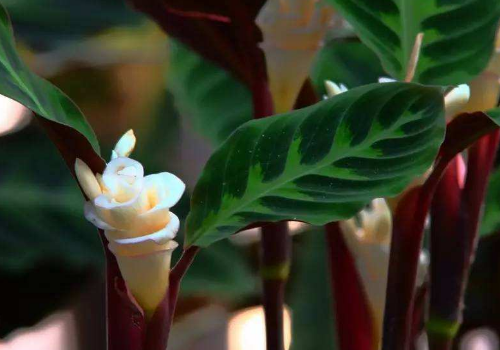
The flowering period of the velvet calathea is from May to June each year. The capitulum is ovate, about the size of a goose egg, borne singly on a scape; the scapes vary in length; the bracts are imbricate, broadly ovate, about 5 cm wide, purple inside; the bracteoles are linear; the sepals are oblong, up to 2.5 cm long; the corolla is violet or white.
What to do if the velvet calathea does not bloom:
1. High humidity. The main cause is overwatering, especially in autumn. Autumn is the period of flower bud differentiation; overwatering leads to incomplete flower bud differentiation, making it difficult to form complete flower buds.
2. Lack of light. The velvet calathea blooms in late spring and early winter, so care in autumn and winter is very important. Insufficient sunlight leads to insufficient nutrients stored in the plant itself, making it difficult to grow quickly when spring arrives, and even more unable to produce the nutrients needed for blooming.
3. Excessive nitrogen fertilizer. Excessive nitrogen fertilizer promotes rapid growth of branches and leaves, especially the sprouting of branches in spring. The vigorous sprouting breaks through the leaf buds formed in late autumn and early winter, causing crazy leaf growth, lacking the nutrients for flower buds, making it difficult to bloom.
Therefore, based on the above analysis, to ensure the velvet calathea blooms, in autumn you should avoid the above three points, and blooming is still quite easy.
Now you have some understanding of the velvet calathea, right?
When Does the Velvet Calathea Bloom (Which Month) What to Do if the Velvet Calathea Does Not Bloom
The velvet calathea is a plant with high ornamental value. Its leaves are relatively large, green all year round, with some patterns distributed on them, looking very beautiful. Because the velvet calathea is generally mainly appreciated for its leaves, many people overlook its flowers. In fact, it is also a variety that can bloom.
When Does the Velvet Calathea Bloom (Which Month)
The flowering period of the velvet calathea is from May to June each year. The capitulum is ovate, about the size of a goose egg, borne singly on a scape; the scapes vary in length; the bracts are imbricate, broadly ovate, about 5 cm wide, purple inside; the bracteoles are linear; the sepals are oblong, up to 2.5 cm long; the corolla is violet or white.
What to Do if the Velvet Calathea Does Not Bloom
1. High humidity. The main cause is overwatering, especially in autumn. Autumn is the period of flower bud differentiation; overwatering leads to incomplete flower bud differentiation, making it difficult to form complete flower buds.
2. Lack of light. The velvet calathea blooms in late spring and early winter, so care in autumn and winter is very important. Insufficient sunlight leads to insufficient nutrients stored in the plant itself, making it difficult to grow quickly when spring arrives, and even more unable to produce the nutrients needed for blooming.
3. Excessive nitrogen fertilizer. Excessive nitrogen fertilizer promotes rapid growth of branches and leaves, especially the sprouting of branches in spring. The vigorous sprouting breaks through the leaf buds formed in late autumn and early winter, causing crazy leaf growth, lacking the nutrients for flower buds, making it difficult to bloom.
Therefore, based on the above analysis, to ensure the velvet calathea blooms, in autumn you should avoid the above three points, and blooming is still quite easy.
How to Extend the Flowering Period of the Velvet Calathea
1. The normal flowering period of the velvet calathea is about one month, and with a little attention in care it can be extended.
2. Stop fertilizing. During the flowering period, do not fertilize. Move the plant to a warm, shaded place indoors, reduce light, and especially do not expose it to strong light.
3. Pay attention to timely ventilation. Do not open windows in windy weather, so as to avoid flowers falling off. On sunny days, open windows in time for ventilation to avoid a stale indoor environment.
4. Control watering. During the flowering period, reduce the amount of watering, and try not to spray water on the leaves and flowers. At night, ensure the potting soil and leaf surfaces are dry to reduce flower drop.
Fertilizer and Water Techniques for the Velvet Calathea Through the Four Seasons
1. Fertilizing. It has relatively high requirements for fertilizer and water, but it is most afraid of random fertilizing, concentrated fertilizer, and one-sided application of nitrogen, phosphorus, and potassium fertilizers. It is required to follow the fertilizing principle of “light fertilizer applied frequently, small amounts with more applications, complete nutrition.”
2. Watering. The velvet calathea commonly uses flower pots with a diameter of 15-20 cm. During the growing season, keep sufficient water and relatively high air humidity, frequently spray water on the leaf surface and around the plant to increase air humidity, and keep the potting soil moist. When the temperature is low in winter, the potting soil can be slightly dry.
3. Spring, summer, and autumn: water once every 1-4 days for outdoor care, and once every 2-6 days for indoor care. On sunny days or during high temperatures, the watering interval is shorter; during rainy days or low temperatures, the interval is longer or no watering is done. Try to arrange watering in the morning when the temperature is lower. In summer, water in the morning or evening when the temperature is low, and also frequently mist the plant.
4. Winter: During the winter dormant period, the main work is to control fertilizer and water. The interval is about 7-10 days. On sunny days or during high temperatures, the interval is shorter; during rainy days or low temperatures, the interval is longer or no watering is done. Try to arrange watering at noon on sunny days when the temperature is relatively high.
If the velvet calathea is cultivated well, it generally blooms in early summer each year, with mostly white flowers. Of course, some people cause it not to bloom due to improper cultivation, which is generally caused by aspects such as watering, fertilizing, and light. You can observe the actual situation and then treat it.
How to Grow the Velvet Calathea How to Extend the Flowering Period
Yellowing leaves of the velvet calathea are generally caused by fertilizer, water, or light. How to grow the velvet calathea? How to extend the flowering period:
How to grow the velvet calathea:
1. The suitable growth temperature for the velvet calathea is 18-25°C. In winter, the temperature should not be lower than 13°C, and in summer the temperature should not exceed 35°C, otherwise it is extremely unfavorable to the growth of the velvet calathea, causing the stems and leaves to stop growing or to freeze to death.
2. The velvet calathea has relatively high water requirements. During the growing season, it must be watered thoroughly to keep the potting soil moist. But if the soil is too wet, it will cause root rot, or even death, so special attention should be paid.
3. If the air humidity is low, the leaves will immediately curl, reacting very sensitively. For indoor cultivation, the air humidity must be maintained at 70%-80%. In winter, keep it slightly dry; if too wet, the leaves easily turn yellow and wither.
4. The most suitable soil is fertile, loose, and well-drained leaf mold. For potting, use a mixed soil of culture soil, peat soil, and coarse sand.
How to extend the flowering period of the velvet calathea:
1. The normal flowering period of the velvet calathea is about one month, and with a little attention in care it can be extended.
2. Stop fertilizing. During the flowering period, do not fertilize. Move the plant to a warm, shaded place indoors, reduce light, and especially do not expose it to strong light.
3. Pay attention to timely ventilation. Do not open windows in windy weather, so as to avoid flowers falling off. On sunny days, open windows in time for ventilation to avoid a stale indoor environment.
4. Control watering. During the flowering period, reduce the amount of watering, and try not to spray water on the leaves and flowers. At night, ensure the potting soil and leaf surfaces are dry to reduce flower drop.
Alright, have you all learned how to grow the velvet calathea?