What to Do About Root Rot in Heartleaf Ice Plant? Detailed Explanation of Its Differences from Panax notoginseng
Panax notoginseng is a very precious medicinal herb in China, and it looks somewhat similar to the heartleaf ice plant. What should be done about root rot in the heartleaf ice plant? And what are the differences from Panax notoginseng:
What to do about root rot in the heartleaf ice plant:
1. Pruning during the winter dormant period
Entering winter, the heartleaf ice plant enters its dormant period, and the leaves stop growing. At this time, be sure to promptly prune away unhealthy branches such as diseased and pest-infested branches, overlapping branches, twin branches, thin and weak branches, aged branches, inward-growing branches, and leggy branches, so as to prevent pests and diseases from affecting other healthy branches. This also keeps nutrients from being wasted on surplus branches, helps the heartleaf ice plant store energy during the dormant period and extend its lifespan, and allows it to grow better the following year.
2. Pruning the heartleaf ice plant during the normal growing period
For a heartleaf ice plant in its vigorous growing period, because it grows rapidly during this time, it needs to be pruned regularly according to the plant's growth so as to keep the plant shape attractive. The plant shape can be corrected freely according to personal preference, with no very standard guideline requirements. If some gardening enthusiasts have the means but do not want to prune, they can also build a support frame themselves and let it grow naturally. In addition, here is a little tip: if you want your heartleaf ice plant's branches to be more lush and verdant, you can pinch out the growing tips, that is, cut off the top of the longer middle branches to encourage them to produce new buds, which then become branches. Repeating this action continuously can make the plant produce more buds and make the plant shape fuller and very beautiful.
What are the differences between the heartleaf ice plant and Panax notoginseng:
1. They belong to different families and genera
The family and genus of the heartleaf ice plant: the heartleaf ice plant is a type of begonia plant, native to southern Africa. In China it is cultivated for ornamental use only.
The family and genus of Panax notoginseng: Panax notoginseng is a plant of the genus Panax in the family Araliaceae, and it is a precious medicinal herb unique to China, with great medicinal value.
2. Different appearance characteristics
Heartleaf ice plant: its stems are relatively thin and weak, very slender, fleshy and very thick, with a bright, fresh green color. The branches have ridges on them, and after extending they become semi-prostrate.
Panax notoginseng: its rhizome and the branches and leaves of the plant grow upright, and the leaves have serrated edges, so they are not smooth and flat.
Now you understand the differences between the heartleaf ice plant and Panax notoginseng.
What are the differences between Panax notoginseng and the heartleaf ice plant? What should be done about root rot in the heartleaf ice plant?
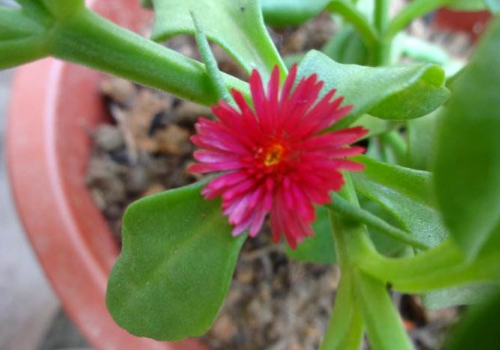
The heartleaf ice plant has lush, verdant leaves that contrast beautifully with its small rose-red flowers. It not only has high ornamental value but also has the feature of purifying the air, and it is often used as a hanging plant placed on windowsills, tabletops, and other places. Panax notoginseng is a very precious medicinal herb in China, and it looks somewhat similar to the heartleaf ice plant. Let us take a look at what differences they have.
What are the differences between Panax notoginseng and the heartleaf ice plant
1. They belong to different families and genera
The family and genus of the heartleaf ice plant: the heartleaf ice plant is a type of begonia plant, native to southern Africa. In China it is cultivated for ornamental use only.
The family and genus of Panax notoginseng: Panax notoginseng is a plant of the genus Panax in the family Araliaceae, and it is a precious medicinal herb unique to China, with great medicinal value.
2. Different appearance characteristics
Heartleaf ice plant: its stems are relatively thin and weak, very slender, fleshy and very thick, with a bright, fresh green color. The branches have ridges on them, and after extending they become semi-prostrate.
Its leaves are oblong and opposite; it grows in a leaning, prostrate manner and branches a great deal; the flowers of the heartleaf ice plant are borne singly at the top of the branches or in the leaf axils, in an inverted cone shape; most of the petals are red-purple and grow in a spoon shape, with the center part pale yellow, shaped like a chrysanthemum, and the flowering period is from spring to autumn, lasting a very long time.
Panax notoginseng: its rhizome and the branches and leaves of the plant grow upright, and the leaves have serrated edges, so they are not smooth and flat.
The leaves of Panax notoginseng are very thin, and the leaves are wider and larger than those of the heartleaf ice plant, and are also covered with fine hairs. Its flowers grow in a spherical shape, with petals that are thick and small, clustered together, so they are dense like a ball, and the flower stalks are very long, each bearing a single flower.
What to do about root rot in the heartleaf ice plant
1. Pruning during the winter dormant period
Entering winter, the heartleaf ice plant enters its dormant period, and the leaves stop growing. At this time, be sure to promptly prune away unhealthy branches such as diseased and pest-infested branches, overlapping branches, twin branches, thin and weak branches, aged branches, inward-growing branches, and leggy branches, so as to prevent pests and diseases from affecting other healthy branches. This also keeps nutrients from being wasted on surplus branches, helps the heartleaf ice plant store energy during the dormant period and extend its lifespan, and allows it to grow better the following year.
2. Pruning the heartleaf ice plant during the normal growing period
For a heartleaf ice plant in its vigorous growing period, because it grows rapidly during this time, it needs to be pruned regularly according to the plant's growth so as to keep the plant shape attractive. The plant shape can be corrected freely according to personal preference, with no very standard guideline requirements. If some gardening enthusiasts have the means but do not want to prune, they can also build a support frame themselves and let it grow naturally. In addition, here is a little tip: if you want your heartleaf ice plant's branches to be more lush and verdant, you can pinch out the growing tips, that is, cut off the top of the longer middle branches to encourage them to produce new buds, which then become branches. Repeating this action continuously can make the plant produce more buds and make the plant shape fuller and very beautiful.
Points to note when growing the heartleaf ice plant
1. Growing environment:
The heartleaf ice plant likes a warm, dry environment with airy, well-ventilated conditions, and it is suitable to grow it in sandy soil with good drainage.
2. Growing temperature:
It is best to keep the growing environment temperature at around 15 degrees. If the winter temperature is on the low side, it will enter the dormant period, so insulation work needs to be done in advance.
3. Fertilizer and water needs:
Generally, spring and summer are the vigorous growing period of the heartleaf ice plant, and during this time it has a relatively high demand for fertilizer and water; after late autumn, the heartleaf ice plant grows slowly and no longer has much demand for fertilizer and water.
How to grow heartleaf ice plant from seed
1. Seed collection and treatment
First, when the seeds mature, collect them promptly; do not wait until they are overripe to collect them, as that is not good. After collecting them, store them in a cool, dry place and wait until early spring of the following year to plant.
2. Treatment before sowing
Soak them in clean water at about 50 degrees Celsius, stirring continuously for about 20 minutes, then remove them and place them in clean water to soak for another 4 to 5 hours. Next, wrap them in a damp cloth and leave them in an environment at 28 to 30 degrees, and once you see them showing white, they can be sown. Although these treatments seem very troublesome, they are very effective at increasing the chance of germination.
3. Choice of container and substrate
For the container, the main consideration is its drainage performance. For the substrate, we should choose sandy soil rich in nutrients and with strong drainage.
4. Timing
Generally, we choose to sow in spring, when it is relatively warm, so the seed survival rate will be correspondingly higher.
5. Sowing and later management
First, put most of the substrate into the container; it does not need to be too full. After filling it, scatter the seeds on top, then cover with a thin layer of soil. Next, we need to keep all the various factors suitable and wait for the seeds to germinate.
The heartleaf ice plant and Panax notoginseng still have many differences, and as long as everyone observes carefully, they are quite easy to distinguish. During the growing process, the heartleaf ice plant needs water, fertilizer, and temperature to be well controlled; only in this way can the heartleaf ice plant grow vigorously.
What causes root rot in spider plants, and what to do about root rot in spider plants / watering and fertilizing are the key points
When growing spider plants, you often encounter some headache-inducing things, such as yellowing leaves, root rot, and so on. If a spider plant has root rot, what causes it? What should be done about root rot in spider plants? The editor will give each netizen a detailed answer.What causes root rot in spider plants
Root rot is obviously not a normal phenomenon, so what causes root rot in spider plants? According to statistics, there are mainly three causes, namely: overwatering, excessive fertilizing, and poor soil aeration, so the specific cause should be investigated from these three aspects.
1. Overwatering
Spider plants need water to grow, but overwatering will cause the roots to be soaked in water for a long time, and over time this will cause the roots to rot. You can think about whether standing water in the pot often occurs during your own growing process; if it does, then this indicates that root rot is caused by this.
2. Excessive fertilizing
When growing spider plants, fertilizing is indispensable. However, when we fertilize too much, it not only causes the leaves to turn yellow but may also cause the roots to rot. We have previously introduced what to do when spider plant leaves turn yellow, so what should be done about root rot in spider plants? Reducing the amount and concentration of fertilizer is key.
3. Poor soil aeration
Poor aeration may cause two problems, namely that the water applied cannot be absorbed by the lower root system, and that when too much water is applied it cannot drain out through the holes at the bottom of the pot. If you find that the upper roots are rotting while the lower roots are normal, then it is very likely due to poor aeration.
What to do about root rot in spider plants
1. Take the spider plant out of the potting soil
When root rot occurs, you should first dig the spider plant out of the potting soil, cut off the roots that have already rotted, and then disinfect the roots.
2. Disinfect the roots
Disinfect the roots with a potassium permanganate solution or a carbendazim solution, which can be purchased from professional places. If you do not have the corresponding medicine, you can first wash the roots with clean water, then place them in a ventilated place to dry, and be sure not to place them in direct sunlight.
3. Replant
After disinfecting the roots, they need to be transplanted into new potting soil. For the specific steps and methods, you can refer to the growing methods and points to note for spider plants.
4. Later care
After replanting, be sure to change the care method and avoid the previous root rot phenomenon happening again. Therefore, when watering, be careful not to overwater, and when fertilizing, also be careful not to use too high a concentration. The soil should mainly be sandy soil with relatively good aeration.