What to Do When the Leaves of Daphne odora 'Aureomarginata' Turn Yellow and Drop
In the process of growing Daphne odora 'Aureomarginata', you will inevitably encounter all kinds of problems, so what should you do when its leaves turn yellow? How do you solve leaf drop:
What to do when the leaves of Daphne odora 'Aureomarginata' turn yellow:
One: Soil that is too alkaline
Solution: replace with acidic soil, or add ferrous sulfate solution to the potting soil. (The clever editor presents you with a full set of soil acidification methods, please take a look! →_→ Soil acidification methods)
Two: Too intense sunlight
Solution: place Daphne odora 'Aureomarginata' in a spot with plenty of bright, indirect light for growing.
Three: Temperature too low
Solution: potted Daphne odora 'Aureomarginata' should be moved indoors before Frost's Descent, and the temperature should be kept no lower than 5°C.
Four: Too much water
Solution: replant with clean, sterilized potting soil, place in a cool, ventilated spot, and water reasonably.
Five: Improper fertilizing
Solution: fertilize reasonably, choose well-rotted soybean cake fertilizer water, and dilute it before applying.
Six: Pests and diseases
Solution: during the outbreak period, spray the pesticide promptly, once a week, spraying continuously or drenching the roots 5~6 times, and the effect will be fairly obvious.
How to solve leaf drop in Daphne odora 'Aureomarginata':
One: Metabolism
Solution: normal metabolism, no need to worry too much, just let it grow naturally.
Two: Sudden rainstorm
Solution: avoid rain exposure, especially in summer; no matter where it is grown, do a good job of rain protection to reduce rainstorm damage.
Three: Improper watering
Solution: watering should follow the principle of watering when dry and stopping when wet; especially in high summer temperatures, avoid overwatering, and better dry than waterlogged.
Four: Improper fertilizing
Solution: Daphne odora 'Aureomarginata' should be fertilized lightly; after fertilizing, quickly rinse with clean water; after severe leaf drop occurs, control watering and stop fertilizing, and once it returns to normal, just resume normal care.
Have you got the solutions about Daphne odora 'Aureomarginata' leaves?
What to do when the leaves of Daphne odora 'Aureomarginata' turn yellow
Reason one for yellowing leaves in Daphne odora 'Aureomarginata': Soil that is too alkaline
Daphne odora 'Aureomarginata' is suitable for growing in loose, fertile soil rich in humus. If the chosen soil is strongly alkaline, it will cause the leaves of Daphne odora 'Aureomarginata' to gradually turn yellow.
Solution: replace with acidic soil, or add ferrous sulfate solution to the potting soil. (The clever editor presents you with a full set of soil acidification methods, please take a look! →_→Soil acidification methods)
Reason two for yellowing leaves in Daphne odora 'Aureomarginata': Too intense sunlight
Daphne odora 'Aureomarginata' likes sunlight but fears high temperatures and scorching sun. In summer, the plant should be placed in a cool, airy environment, or in a place without direct sunlight. If the sunlight is too intense or there is no sunlight, the leaves will turn yellow.
Solution: place Daphne odora 'Aureomarginata' in a spot with plenty of bright, indirect light for growing.
Reason three for yellowing leaves in Daphne odora 'Aureomarginata': Temperature too low
Daphne odora 'Aureomarginata' has poor drought resistance. If the temperature is too low, the plant's growth is inhibited, and the leaves easily turn yellow and fall off.
Solution: potted Daphne odora 'Aureomarginata' should be moved indoors before Frost's Descent, and the temperature should be kept no lower than 5°C.
Reason four for yellowing leaves in Daphne odora 'Aureomarginata': Too much water
Daphne odora 'Aureomarginata' likes shade and fears waterlogging, so watering should be controlled in pot cultivation. When the potting soil is too wet, root rot and stem rot easily occur, causing the leaves to turn yellow.
Solution: replant with clean, sterilized potting soil, place in a cool, ventilated spot, and water reasonably.
Reason five for yellowing leaves in Daphne odora 'Aureomarginata': Improper fertilizing
Daphne odora 'Aureomarginata' likes fertilizer, especially well-rotted organic fertilizer, but the amount must be right and fertilizing must be frequent. If too much fertilizer is applied and water is not given in time, fertilizer burn easily occurs, causing the leaves of Daphne odora 'Aureomarginata' to turn yellow.
Solution: fertilize reasonably, choose well-rotted soybean cake fertilizer water, and dilute it before applying.
Reason six for yellowing leaves in Daphne odora 'Aureomarginata': Pests and diseases
Daphne odora 'Aureomarginata' is easily attacked by pests and diseases when poorly cared for; with fusarium wilt or leaf spot disease, the leaves will turn yellow and dry up.
Solution: during the outbreak period, spray the pesticide promptly, once a week, spraying continuously or drenching the roots 5~6 times, and the effect will be fairly obvious.
How to grow Daphne odora 'Aureomarginata' and what to do when its leaves turn yellow
Daphne odora 'Aureomarginata' is a traditional famous flower of our country and also a world-famous flower. Daphne odora 'Aureomarginata' is also called Ruixiang, Shuixiang, and Lujia. Next, let us go and look at the propagation of Daphne odora 'Aureomarginata'.
Basic information about Daphne odora 'Aureomarginata':
Daphne odora 'Aureomarginata' is a traditional famous flower of our country and also a world-famous flower. In modern horticultural history, it was honored together with Changchun monk's Clivia and Japan's five-needle pine as the three treasures of horticulture. Daphne odora 'Aureomarginata' is famous worldwide for its four excellences of "color, fragrance, posture, and charm," leaving behind the chant "The peony is the nation's beauty and heavenly fragrance, but among daphne flowers the golden-edged one is best."
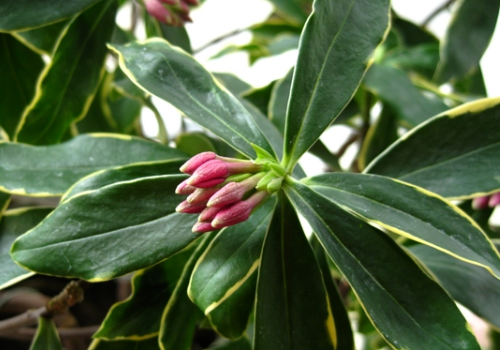
Daphne odora 'Aureomarginata' is a variety of Daphne odora, an evergreen small shrub of the genus Daphne in the family Thymelaeaceae. It has a fleshy root system. The leaves are densely whorled, oval, about 5-6 cm long and 2-3 cm wide; the leaf surface is smooth and thick, leathery, hairless on both sides, dark green on the surface and pale green on the underside, with golden-yellow leaf margins and short, thick petioles; it bears terminal head inflorescences, the perianth is tubular, with four lobes at the upper end about 1.5 cm across, each flower composed of dozens of small florets, opening from outside inward, with a flowering period of more than two months, the full bloom period during the Spring Festival, the flower color vivid purplish-red, and the fragrance rich.
Growing methods for Daphne odora 'Aureomarginata':
1. Soil: for potted Daphne odora 'Aureomarginata', the potting soil should preferably be fertile, loose, humus-rich, acidic leaf mold soil, mixed with an appropriate amount of river sand and well-rotted cake fertilizer.
2. Watering: the roots of Daphne odora 'Aureomarginata' are fleshy, so special attention should be paid to controlling watering in routine care and management. If watered too much and the potting soil stays too wet for a long time, root rot is easily caused. After rain, the accumulated water in the pot must be poured out promptly.
3. Sunlight: although Daphne odora 'Aureomarginata' likes partial shade, in winter and spring it should be placed in an environment with sunlight. If there is sufficient light during the growing period and the fertilizer effect is suitable, it can make the branches plump and the leaves dark, and the flowers vivid and fragrant. In summer it should be placed in a well-ventilated cool place, and water should be sprayed to cool it down during hot weather.
4. Temperature: after Frost's Descent, move Daphne odora 'Aureomarginata' indoors to a sunny spot, keep the room temperature at around 5°C, and control watering; the water content of the potting soil should be kept at around 45% so that it can make it through the winter.
5. Fertilizing: Daphne odora 'Aureomarginata' relatively likes fertilizer, so during the growing season a thin liquid fertilizer should be applied about every 10 days. Before and after flowering, a thin cake fertilizer water should be applied once each as a top dressing.
6. Pests: the main pests harming Daphne odora 'Aureomarginata' are aphids and scale insects, which mostly appear in dry, hot climates and should be prevented and controlled early. The main disease is mosaic disease caused by a virus; infected plants show colored spots and deformities on the leaf surface, poor flowering, and stunted growth. Once discovered, they should be dug out with the roots and burned with fire.
7. Pruning: the branches and trunk of Daphne odora 'Aureomarginata' grow in clusters, with strong sprouting ability and tolerance to pruning, so branch training must be carried out after flowering.
Yellowing leaves of Daphne odora 'Aureomarginata'
1. Soil that is too alkaline: potted Daphne odora 'Aureomarginata' should preferably use fertile, loose, humus-rich, acidic leaf mold soil. If the selected soil is strongly alkaline, it will cause the leaves of Daphne odora 'Aureomarginata' to turn yellow and fall off. Solution: replace the potting soil or apply ferrous sulfate solution to ensure the soil's acidity.
2. Too intense sunlight: Daphne odora 'Aureomarginata' fears the high temperatures and scorching sun of midsummer. In summer it should be placed on a cool, airy flower stand, or in a place without direct sunlight; too intense sunlight may cause the leaves to turn yellow. Solution: place Daphne odora 'Aureomarginata' in a spot with plenty of bright, indirect light for growing.
3. Temperature too low: Daphne odora 'Aureomarginata' has relatively poor cold resistance. If the temperature is too low, the leaves will turn yellow and fall off, and the plant will also suffer frost damage. Solution: potted Daphne odora 'Aureomarginata' should be moved indoors before Frost's Descent, keeping the room temperature no lower than 5°C.
Is Daphne odora 'Aureomarginata' poisonous?
Daphne is very fragrant and not poisonous. If you can stand that smell, you can put it in the bedroom, but this is hard to say; it has its disadvantages and of course its benefits too, and smelling it too much is not good for the human body. Isn't there an old saying in China? Things reverse at their extreme. When something goes too far, the good can become bad, and the bad may also become good.
The uses of Daphne odora 'Aureomarginata'
1. Ornamental: Daphne odora 'Aureomarginata' has high ornamental value, with a graceful tree posture, vigorous branches that curve and stretch naturally, neat and bright leaves that are verdant and deep green, a rich floral fragrance, and a long flowering period. It is a precious flower with excellent posture, color, fragrance, and charm, and is deeply favored by the broad masses of flower lovers.
2. Medicinal: besides its ornamental value, Daphne odora 'Aureomarginata' also has relatively high medicinal value. Daphne odora 'Aureomarginata' contains daphnin; its roots, stems, leaves, and flowers can all be used as medicine. It is sweet in nature and non-toxic, and has the effects of clearing heat and detoxifying, reducing inflammation and relieving pain, promoting blood circulation and removing blood stasis, and dissipating nodules. It has been included in the compilation of the "Great Dictionary of Chinese Medicine."
3. Gifting: Daphne odora 'Aureomarginata' is famous worldwide for its four excellences of "color, fragrance, posture, and charm." It blooms around the Spring Festival, with branches full of clusters and bunches, a profusion of flowers like brocade, and a rich, clear fragrance, adding an auspicious sign to the New Year. Thus it has become an item for adding auspiciousness and blessings to people's homes during the Spring Festival, and is also one of the choices for many people when giving gifts among relatives and friends.
If you want to learn more related information, you can continue to follow No.1 Home Network.