Reasons Why Daphne odora 'Aureomarginata' Does Not Bloom and How to Fix It
Besides its very beautiful appearance and abundance of blossoms, Daphne odora 'Aureomarginata' is also a plant with an extremely rich fragrance. Why does Daphne odora 'Aureomarginata' not bloom? What to do if it does not bloom:
Why Daphne odora 'Aureomarginata' does not bloom:
The flowering period of Daphne odora 'Aureomarginata' is from February to March, but there are three reasons why it does not bloom:
1. High humidity
The main reason is overwatering, especially in autumn. Autumn is the period of flower bud differentiation; overwatering leads to incomplete flower bud differentiation, making it difficult to form complete flower buds.
2. Lack of light
Daphne odora 'Aureomarginata' blooms in late spring and early winter, so care in autumn and winter is very important. Insufficient sunlight leads to insufficient nutrients stored in the plant itself, making it difficult to grow quickly when spring arrives, and even more unable to produce the nutrients needed for blooming.
3. Too much nitrogen fertilizer
Too much nitrogen fertilizer promotes rapid growth of branches and leaves, especially the sprouting of branches in spring. The vigorous sprouting breaks through the leaf buds formed in late autumn and early winter, growing leaves wildly, lacking the nutrients for flower buds, making it difficult to bloom.
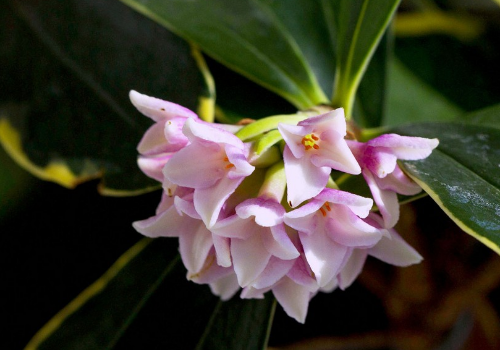
What to do if Daphne odora 'Aureomarginata' does not bloom:
1. Water appropriately
The main reason is overwatering, especially in autumn. Autumn is the period of flower bud differentiation; overwatering leads to incomplete flower bud differentiation, making it difficult to form complete flower buds.
2. Provide timely light
Daphne odora 'Aureomarginata' blooms in late spring and early winter, so care in autumn and winter is very important. Insufficient sunlight leads to insufficient nutrients stored in the plant itself, making it difficult to grow quickly when spring arrives, and even more unable to produce the nutrients needed for blooming. 3. Reduce nitrogen fertilizer
Too much nitrogen fertilizer promotes rapid growth of branches and leaves, especially the sprouting of branches in spring. The vigorous sprouting breaks through the leaf buds formed in late autumn and early winter, growing leaves wildly, lacking the nutrients for flower buds, making it difficult to bloom.
Do you friends know how to solve the problem if Daphne odora 'Aureomarginata' does not bloom?
What to do if Daphne odora 'Aureomarginata' does not bloom
Why does Daphne odora 'Aureomarginata' not bloom?
The flowering period of Daphne odora 'Aureomarginata' is from February to March, but there are three reasons why it does not bloom:
High humidity
The main reason is overwatering, especially in autumn. Autumn is the period of flower bud differentiation; overwatering leads to incomplete flower bud differentiation, making it difficult to form complete flower buds.
Lack of light
Daphne odora 'Aureomarginata' blooms in late spring and early winter, so care in autumn and winter is very important. Insufficient sunlight leads to insufficient nutrients stored in the plant itself, making it difficult to grow quickly when spring arrives, and even more unable to produce the nutrients needed for blooming.
Too much nitrogen fertilizer
Too much nitrogen fertilizer promotes rapid growth of branches and leaves, especially the sprouting of branches in spring. The vigorous sprouting breaks through the leaf buds formed in late autumn and early winter, growing leaves wildly, lacking the nutrients for flower buds, making it difficult to bloom.
Therefore, based on the above analysis, to ensure that Daphne odora 'Aureomarginata' blooms, in autumn you should avoid the occurrence of the above three points, and blooming is still quite easy.
How to extend the flowering period of Daphne odora 'Aureomarginata'
The normal flowering period of Daphne odora 'Aureomarginata' is about one month, and with a little extra attention in care it can be extended.
Stop fertilizing
During the flowering period, do not fertilize. Move the plant indoors to a warm, shaded place and reduce light, especially avoiding strong light exposure. Pay attention to timely ventilation; do not open windows on windy days to avoid causing flowers to drop. On sunny days, open windows in time to ventilate and avoid a stale indoor environment.
Control watering
During the flowering period, reduce the amount of watering, and try not to spray water on the leaves and flowers. At night, ensure the potting soil and leaf surfaces are dry to reduce flower drop.
Why does Daphne odora 'Aureomarginata' die after blooming
Because fertilizing needs to stop during flowering, and after blooming the branches and leaves sprout, producing new branches, which also consumes a large amount of nutrients, but the nutrients originally stored in the old branches have basically been exhausted. Many flower lovers neglect fertilizing after blooming, causing the plant to suffer severe nutrient deficiency and suddenly die.
After one blooming, water thoroughly once, then gradually apply some nitrogen fertilizer to promote the growth of branches and leaves, applying light fertilizer frequently. Once the plant is stable, gradually supplement with phosphorus and potassium fertilizer.
Why Daphne odora 'Aureomarginata' does not bloom and how to extend its flowering period
Flower growers share a common worry: when it does not bloom, they worry about why there are no flowers; when it blooms, they worry that it will soon fade. This really is a difficult problem! Daphne odora 'Aureomarginata' not blooming is a common issue, so let's take a look at why Daphne odora 'Aureomarginata' does not bloom!
Why Daphne odora 'Aureomarginata' does not bloom:
The flowering period of Daphne odora 'Aureomarginata' is from February to March, but there are three reasons why it does not bloom:
High humidity
The main reason is overwatering, especially in autumn. Autumn is the period of flower bud differentiation; overwatering leads to incomplete flower bud differentiation, making it difficult to form complete flower buds.
Lack of light
Daphne odora 'Aureomarginata' blooms in late spring and early winter, so care in autumn and winter is very important. Insufficient sunlight leads to insufficient nutrients stored in the plant itself, making it difficult to grow quickly when spring arrives, and even more unable to produce the nutrients needed for blooming.
Too much nitrogen fertilizer
Too much nitrogen fertilizer promotes rapid growth of branches and leaves, especially the sprouting of branches in spring. The vigorous sprouting breaks through the leaf buds formed in late autumn and early winter, growing leaves wildly, lacking the nutrients for flower buds, making it difficult to bloom.
Therefore, based on the above analysis, to ensure that Daphne odora 'Aureomarginata' blooms, in autumn you should avoid the occurrence of the above three points, and blooming is still quite easy.
How to extend the flowering period of Daphne odora 'Aureomarginata':
The normal flowering period of Daphne odora 'Aureomarginata' is about one month, and with a little extra attention in care it can be extended.
Stop fertilizing
During the flowering period, do not fertilize. Move the plant indoors to a warm, shaded place and reduce light, especially avoiding strong light exposure. Pay attention to timely ventilation; do not open windows on windy days to avoid causing flowers to drop. On sunny days, open windows in time to ventilate and avoid a stale indoor environment.
Control watering
During the flowering period, reduce the amount of watering, and try not to spray water on the leaves and flowers. At night, ensure the potting soil and leaf surfaces are dry to reduce flower drop.
Why does Daphne odora 'Aureomarginata' die after blooming:
Because fertilizing needs to stop during flowering, and after blooming the branches and leaves sprout, producing new branches, which also consumes a large amount of nutrients, but the nutrients originally stored in the old branches have basically been exhausted. Many flower lovers neglect fertilizing after blooming, causing the plant to suffer severe nutrient deficiency and suddenly die.
After one blooming, water thoroughly once, then gradually apply some nitrogen fertilizer to promote the growth of branches and leaves, applying light fertilizer frequently. Once the plant is stable, gradually supplement with phosphorus and potassium fertilizer.