When Does the Southern Magnolia Bloom? Causes of Yellowing Leaves and Solutions
Caring for the southern magnolia does require a bit of attentiveness for it to bloom abundantly. When does the southern magnolia bloom? What to do about yellowing leaves:
When does the southern magnolia bloom:
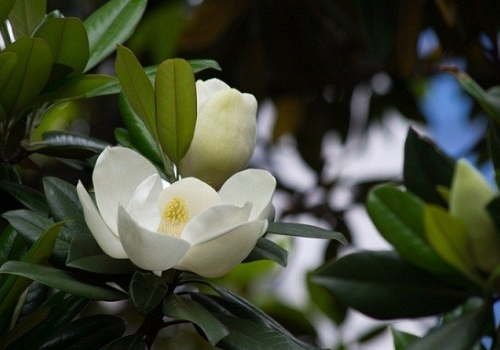
The southern magnolia generally blooms from April to June, most commonly from mid-April to early May. Southern magnolias bloom at different times, and on the same tree you can see flowers in all stages: some are shyly waiting to open, their emerald-green buds fresh and lovely; some have just bloomed, and a few little bees can't wait to dive inside. The fully open southern magnolia flowers are as white and tender as a baby's smiling face, sweet, pure and endearing. Seen from a distance, a single southern magnolia is like a large family spanning several generations, thriving endlessly.
What to do about yellowing southern magnolia leaves:
1. Yellowing southern magnolia leaves are caused by insufficient light
When growing a southern magnolia, it has a certain need for light. If there is not enough light and the southern magnolia goes without light for a long time, its leaves will turn yellow. This situation easily occurs with potted southern magnolias.
When growing a southern magnolia in a pot, you must meet its light requirements and give it plenty of light.
2. Yellowing southern magnolia leaves are caused by air humidity being too low
The southern magnolia needs suitable humidity. If the air humidity is too low where the southern magnolia is grown, the air becomes too dry, and this can also cause the southern magnolia's leaves to turn yellow.
If you grow a southern magnolia in the northwest region of our country, this phenomenon easily occurs because the air is relatively dry. When growing a southern magnolia, to avoid yellowing leaves, it is best to maintain suitable air humidity.
3. Yellowing southern magnolia leaves are caused by overwatering
When growing a southern magnolia, watering is also very important, because if the southern magnolia is watered too much, the soil becomes too wet or water accumulates, which will cause the southern magnolia's root system to rot, preventing it from normally absorbing water and nutrients, and thereby causing its leaves to turn yellow.
Therefore, when growing a southern magnolia, watering must be moderate; do not water too much.
4. Yellowing southern magnolia leaves are a fertilizing problem
When growing a southern magnolia, fertilizing is also a very important step. If too little fertilizer is applied, or if the pot and soil have not been changed for a long time, nutrients will be relatively lacking, causing the leaves to be very thin and yellow. So when growing a southern magnolia, fertilize in a timely manner and change the potting soil regularly.
If too much fertilizer is applied, it will instead cause the southern magnolia's new leaves to be thick and plump, while the old leaves dry at the tips and turn yellow. At this point, stop fertilizing and increase watering.
The reasons for yellowing southern magnolia leaves have been covered, right?
Magnoliaceae plants: southern magnolia, white orchid and banana shrub
Having written about magnolias, it is necessary to write about several other common Magnoliaceae plants. Most have elegant pale flowers, each with its own clear, rich fragrance, and all are quite nice!
Southern magnolia
Southern magnolia: I quite like its fragrance. Every year in May and June it blooms, especially pure white, and the flowers are enormous, really as big as a bowl, but because the leaves are too lush and dense, the scattered giant flowers are not conspicuous. I don't know when or where I got the information, but I had always mistakenly believed that the southern magnolia was the city flower of Shanghai. Actually it is not; Shanghai's city flower is the white magnolia. Instead, the city tree of my hometown Changzhou is this southern magnolia. I also discovered another misunderstanding: Eileen Chang, writing about being confined at home by her father and seeing a tree of white magnolias outside the window, said they looked like waste paper, like discarded waste paper, and she extremely disliked them. What I had always thought were early-spring white magnolias were actually more likely this kind of southern magnolia, with its tall tree form, certainly able to bloom up to her second-floor window, and with a long flowering period. The white flowers gradually turn somewhat yellow and still stick to the branches, gradually becoming the appearance in Eileen Chang's eyes.
The buds are also enormous.
Southern magnolia: Latin scientific name: Magnolia Grandiflora Linn.
A plant of the Magnoliaceae family and Magnolia genus. A very tall tree; it is said that in its native America it can reach 30 m tall. This tree is also often used in the green belts of Shanghai's residential areas and roads. I have never seen one 30 m tall, but 4 or 5 m ones are always around, especially tall and full, evergreen through the four seasons, with large leaves, thick and leathery, a very glossy dark green, only often covered with dust because of environmental pollution. Of course, this is also one of the tree's merits: it can tolerate smoke and resist wind, and absorb dust and toxic gases from the air. It sacrificed its own beauty for the environment, so it would obviously be improper for us to dislike it for that.
Because its flowers are huge and shaped like lotus flowers, in some places the southern magnolia is also called "lotus magnolia." Its fragrance is rich and elegant; even if only a few bloom on the tree, you can smell them from far away. Actually, up close, the fragrance is still the same and does not become stronger just because you are near.
The tree is too tall, so the flowers are not easy to photograph. I have taken a few from a distance, but never got a satisfactory picture. Surely I cannot move a ladder and climb the tree just to photograph flowers. At such times I think of Eileen Chang's small building, from whose second-floor window one could photograph the magnolias blooming toward it.
Like other Magnoliaceae plants, the southern magnolia likes light, needs shade when young, and prefers a warm, humid climate. Like the white magnolia, it is relatively cold-hardy and can be planted outdoors in places such as Beijing and Lanzhou.
The leaves of young seedlings are still relatively soft.
White orchid
Every year in early summer, when gardenias bloom, white orchids also bloom. On the roadside you often meet an elderly woman carrying a basket of flowers and calling out, "Gardenias, white orchids." Her voice rises and falls, and hearing it seems to let you smell the fragrance of white orchids. Gardenias need no explanation; they have always been a fragrance I like, with pure white flowers, the only regret being that they attract many small black insects. White orchid flowers are much smaller, delicate and exquisite, like a jade pendant, pure white or somewhat pale yellow, and their fragrance is a bit more refined. I often can't resist buying a string and hanging it on my lapel or backpack, and the fragrance lasts all day. The elderly women usually thread several flowers together with thin wire, with a small loop at the top so it can be hung directly on a button.
I don't know where they get the white orchids. In Shanghai and the Jiangsu-Zhejiang region, white orchids generally cannot overwinter outdoors and can only be grown in pots, nor do they grow very large; in winter they need to be moved indoors or into an enclosed balcony to overwinter.
There are more white orchids in the south. In Kunming and Guangzhou, white orchids can grow to over ten meters. When I went to Guangzhou and saw the tall and majestic white orchids, with green leaves and fragrant flowers all over the tree, I almost did not recognize them. There is also an orange-yellow kind, locally called yellow orchid, also called yellow Michelia; its color and fragrance are somewhat close to osmanthus, though the flower shape is completely different.
The white orchid's flowering period is relatively long, almost from April to September, elegantly fragrant throughout the summer. This is the advantage of the south.
White orchid (scientific name: Michelia alba DC.):
A tree of the Magnoliaceae family. It likes light, fears high temperatures, is not cold-hardy, and is suited to slightly acidic soil. It likes warmth and humidity, is not tolerant of drought or waterlogging, and is relatively sensitive to toxic gases such as sulfur dioxide and chlorine, with poor resistance. [
For a home potted white orchid, choose a loose, highly breathable soil rich in humus for cultivation. Usually choose a breathable clay pot, purple clay pot (or tub), or a plastic pot with more drainage holes in the bottom. The soil in the pot should preferably contain a certain amount of granular soil of varying sizes to facilitate water drainage and air permeability.
Banana shrub
The name "banana shrub" (Hanxiao) is truly special; you remember it after hearing it once. But when I first learned of the banana shrub, I really could not understand why such a plain flower had such a good name. I guess the name may be related to its flower shape: even at its fullest bloom, the petals do not open completely; the flower blooms without fully opening, reserved and restrained. Or perhaps it is because of its fragrance. Every time I pass by it, I am involuntarily drawn by that scent; the utterly inconspicuous flowers and leaves nevertheless contain such sweet fragrance. As for the banana shrub's fragrance, some say it is like banana, some say apple; I myself think it is more like the flavor of cantaloupe ice cream, with a fresh, clear sweetness. In short, it is that kind of delightful fruity sweet fragrance, neither too strong nor too light, just right.
Banana shrub, scientific name: Michelia figo (Lour.) Spreng
An evergreen shrub, 2-3 m tall, with gray-brown bark; the leaves are pale green, leathery and glossy, and there are yellow-brown hairs on the petioles and pedicels.
It blooms in spring, with a flowering period from April to June. The banana shrub's flowers are not as large as those of other Magnoliaceae plants, and when fully open they are also close to the yellow-green of the leaves, so if you do not look carefully you hardly notice them. That is why it needs to give off such a captivating fragrance to attract insects' attention.
When the buds swell and the outer bracts are about to split and fall off, the picked banana shrub flowers have the strongest fragrance.
In the later stage of blooming, the fragrance becomes much fainter. I always like to photograph the fallen flowers covering the ground.
Key care points for potted banana shrub:
It has fleshy roots; keep the potting soil moist, and avoid waterlogged conditions, otherwise the roots rot easily. During the growing and flowering periods it needs a lot of water, so water promptly; if too dry, the leaves easily fall off.
It likes fertilizer; decomposed cake fertilizer, bone meal, etc. can make the leaves bright green and increase the number of flowers.
Properly prune away leggy branches, diseased and weak branches, etc.
The overwintering temperature is 0-5 degrees; provide proper protection in winter. Large plants grown in the ground can tolerate lower temperatures.
Keep good ventilation; generally there are few pests and diseases.
Michelia maudiae:
The white kind that blooms together with its leaves belongs to Michelia maudiae, and its fragrance is very elegant.
Rescuing yellowing and falling leaves
Because the roots of potted flowers cannot stretch freely and root development is restricted, if management is poor and watering and fertilizing are improper, yellowing leaves occur more easily than in open-ground flowers. In mild cases the appearance is diminished; in severe cases the whole plant dies. Therefore a correct diagnosis must be made promptly and the right remedy applied. The causes, symptoms and remedial measures are briefly described below:
(1) Too much water. The potting soil stays too wet for a long time, causing the soil to lack oxygen and the roots to rot. After damage, the young leaves first turn pale yellow, and then the old leaves gradually become dark yellow. At this point, immediately control watering, stop fertilizing, and loosen the soil frequently so the soil is well aerated.
(2) Drought and dehydration. If flowers are missed when watering or are given half-water for a long time (that is, wet on top and dry below), the leaves become dull and lusterless, and the leaves wilt and droop. First the lower leaves age, and yellowing and scorching spread from bottom to top. At this point water moderately, let the plant gradually recover, and then return to normal water and fertilizer management.
(3) Long-term lack of fertilizer. If no fertilizer has been applied for a long time or the pot and soil have not been changed, the soil lacks nutrients, causing the branches and leaves to become weak and the leaves to turn yellow. The pot must be repotted in time, replaced with new fertile, loose growing soil, and gradually given more flower fertilizer or dilute fertilizer water.
(4) Excessive fertilization. If the fertilizer concentration is too high or undecomposed fertilizer is applied, the nutrient solution concentration in the soil becomes too high, causing the flower cells to lose water and plasmolysis to occur, so that the edges of the old leaves scorch, until the whole plant dies. In this case, immediately stop fertilizing, increase watering so the fertilizer flows out through the drainage holes, or immediately repot, rinse the soil ball with water and replant it in the pot, or remove part of the old soil and replace it with new growing soil.
(5) Hot high temperatures. In summer, if cool-loving or shade-loving flowers such as clivia, cyclamen, fuchsia, and wax begonia are placed in a hot place under direct sunlight, the tips of young leaves or the leaf edges very easily scorch. They need to be moved promptly to a well-ventilated, cool place for care.
(6) Too much shade. Most flowers like sunlight. If they are kept for a long time in a place with too much shade or insufficient light, their growth gradually weakens, the leaves become thin and yellow, and they do not bloom or bloom very little. Be sure to move potted flowers to a sunny place.
(7) Soil and water tending alkaline. In most areas of the north, the soil and water contain more salt and alkali. When growing flowers that like acidic soil, such as camellia, rhododendron, orchid, banana shrub, gardenia, osmanthus, pearl orchid, night-blooming jasmine, white orchid, and southern magnolia, because the soil lacks soluble iron that the flowers can absorb, the leaves gradually turn yellow-white, and even the whole plant dies. When planting, use acidic soil, frequently spray a 0.2% ferrous sulfate solution on the leaf surfaces, and at the same time regularly water with alum fertilizer water.
(8) Too dense and unventilated. If potted flowers are given too much nitrogen fertilizer, the branches and leaves grow too luxuriantly, and if they are not pruned for a long time, the inner branches and leaves lack light, and yellowing and leaf drop easily occur. Pruning should be strengthened to improve ventilation and light penetration, while watering reasonably and appropriately increasing phosphorus and potassium fertilizer.
(9) Dry air. When the air for indoor flower growing is excessively dry, some flowers that like humid environments, such as orchid, Monstera deliciosa, white orchid, jasmine, hibiscus, and banana shrub, often show dry leaf tips, or scorched leaf edges, or scorched spots on the leaves, with curled edges. In winter, the problem is more severe in areas where indoor coal stoves are used for heating. At this time, frequently use warm water close to room temperature to spray and wash the branches and leaves to increase air humidity. For some precious flowers, it is best to cover them with a plastic film cover and place a small basin of clean water inside the cover.
(10) Damage from pests and diseases. Leaf spot disease caused by fungal and other pathogen infection easily causes local necrosis of the leaves, with yellow spots or patches appearing, and in severe cases the entire leaf withers, yellows and falls off. After infection by mosaic virus, yellow-green mottled patches appear on the leaves. When damaged by pests such as red spider mites, the leaves also become locally yellow and withered, or even the whole leaf wilts, yellows and falls off. When pests or diseases are found, promptly spray pesticides such as thiophanate-methyl and dimethoate for control.
(11) Strong stimulation. When preventing and controlling pests and diseases, using too high a pesticide concentration, or being polluted by toxic gases in the air, or suddenly watering with cold water when the temperature is high, etc., all easily cause scorching of leaf tips or local leaf surfaces, and even death of the whole plant. Therefore, attention should be paid to the reasonable use of pesticides, trying to eliminate sources of air pollution, and avoiding watering flowers with cold water around midday in midsummer.