Reasons Why Jasminum Sambac Does Not Bloom and a Detailed Guide to Pruning Methods
Pruning Jasminum sambac still requires skill; casual pruning will not only fail to achieve a beautiful effect but can also have the opposite effect. What are the reasons Jasminum sambac does not bloom? How to prune:
What are the reasons Jasminum sambac does not bloom:
1. Being placed in shade for a long time causes leaves to grow leggy and thin, while flower bud differentiation and flower bud opening both require direct sunlight. Therefore, jasmine should be placed outdoors in direct sunlight.
2. If too much nitrogen fertilizer is applied, it causes leaves to grow leggy and affects flower bud formation. Therefore, in the early stage before budding, control nitrogen fertilizer application, appropriately apply phosphorus fertilizer such as bone residue, fish bones, rice-washing water and other composted fertilizers, and appropriately control water, and it will bud and bloom.
3. Branches and leaves are too dense, which then causes excessive nutrient consumption and inhibits flower bud formation. This can be combined with whole-plant pruning in April to May to make the branches and leaves of jasmine well spaced and promote flower bud differentiation.
4. Too much watering, water accumulation in the potting soil, too low temperature, and outdoor rain exposure during the budding period can all cause bud drop. Prevention methods: control moisture, loosen the soil appropriately, and avoid direct heavy rain exposure.
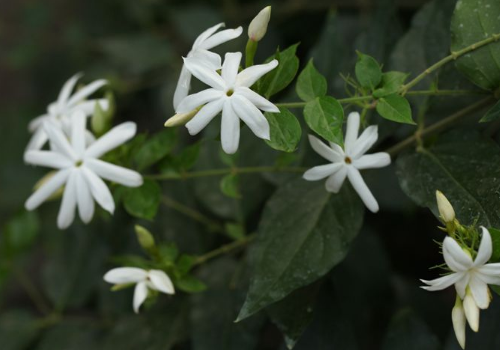
How to prune Jasminum sambac:
1. After flowering, pruning should remove the faded flowers together with about 4 pairs of leaves below them. This part has strong sprouting ability, can produce more side branches, and bloom more, but it should be handled flexibly according to the length of the flowering branches, because leggy branches need to be cut back slightly more heavily, and the plant should be kept in as good a shape as possible. This can not only control leggy branches but also increase the overall ornamental value. Slender branches can be cut off from the junction between the side branch and the main branch to avoid consuming too many nutrients.
2. Before spring sprouting, appropriate pruning should be carried out, removing elongated branches, weak branches, and overly old branches, and appropriately shortening vigorous branches. 3. If new branches have already grown and are growing well, pinch them when they reach more than 10 cm to promote a second flush of new shoots and more flowers.
3. After each flowering, remove the faded flowers promptly, appropriately trim overlong branches, and apply fertilizer once. How much to cut is generally determined by plant height and personal preference, generally between one and three nodes below the flower; if it is a non-flowering elongated shoot, it should be cut back more.
4. Pruning should generally be done on sunny days in combination with leaf thinning, and diseased branches should be cut off at the same time.
Only by understanding the reasons Jasminum sambac does not bloom can it be cared for better.
How to grow jasmine? Jasmine cultivation methods
Jasmine is a relatively common household flower that is deeply loved by everyone. Today Flower and Bonsai Network will share with you the cultivation methods of jasmine.How to grow jasmineAlright, next we will introduce jasmine cultivation methods from jasmine morphology and varieties, jasmine growth habits, jasmine propagation, and jasmine pest and disease control.
Jasmine (Jasminum sambac) is said to have been introduced from ancient Persia during the Han Dynasty, and its name is a transliteration; in ancient texts it also appears as Meili, Mali, and Mori. Ji Han of the Jin Dynasty records in Nanfang Caomu Zhuang: "The naximing flower (that is, the Arabian jasmine) and the jasmine flower were both transplanted by Hu people from the Western Regions to Nanhai, and the southern people loved their fragrance and competed to plant them." Jasmine cultivation in our country first began in the Nanhai region, later spread to Guangdong and Yunnan, and then spread throughout the country. By the Song Dynasty, cultivation was already widespread. In the Ming Dynasty, jasmine flowers were used to "steam oil and extract liquid, for use as facial fat and hair gloss." In the Qing Dynasty, they were used for scenting tea, and together with bailan, zhulan, and daidai, became one of the four major tea flowers. Now, cultivation is especially common in Guangzhou, Fuzhou, Hangzhou, Suzhou, and other places.
(1) Jasmine morphology and varieties
1. Morphological characteristics
Jasmine is a subtropical evergreen small shrub of the genus Jasminum in the family Oleaceae. The roots are fibrous, with many branch roots and strong rooting ability. The stem is upright or trailing, about 1 m tall. Leaves are simple, opposite, elliptical or ovate, entire, and glossy. Flowers are borne on new shoots of the current year, terminal or axillary, in cymes; each inflorescence usually bears 1-17 flowers; the flowers are white, extremely fragrant, and mostly open at night. The flowering period is quite long, from early summer to late autumn, with flowers opening continuously. It can be roughly divided into three periods: from Xiaoman to Xiazhi, during the plum rain season, called "mei flowers"; from Xiaoshu to Chushu, called "fu flowers"; from Bailu to late autumn, called "autumn flowers." Among them, the fu flowers are the most numerous and especially fragrant.
2. Varieties
There are many cultivated varieties of jasmine. Divided by flower structure, they can be classified into three types.
(1) Single-petal jasmine: branches are relatively soft and somewhat trailing. Flower buds are more pointed, flowers are smaller, and the fragrance is elegant, fresh, and pure. When blooming, small white flowers dot the branches, with a distinctive graceful appearance. In the past it was mainly cultivated in Zhejiang, especially most flourishing in Jinhua. Common ones include the Jinhua type and the Taiwan, China type.
(2) Double-petal jasmine: branches are upright and thick-hard. Petals are in two or more layers, flowers are slightly shorter, rounder, and plumper, the floral fragrance is stronger and more intense, and fragrance release is later and slower. Fu flowers generally open at 8-9 pm at night, 1-2 hours later than the single-petal type, and natural fragrance release can last about 20 hours. It has strong vitality and is relatively easy to cultivate. Common ones include the Guangdong type and the Hong Kong, China type.
(3) Multi-petal jasmine: branches are rather soft, and new branches resemble those of a vine. Petals overlap, and the layers are distinct when open. Flowers are small, the fragrance is light, and the quality is poor. Most seen is the Baozhu type.
(2) Jasmine growth habits
Jasmine prefers warmth and humidity, and grows fastest especially under high temperature and high humidity in summer. Its optimum growth temperature is 25-35°C; it fears cold and is quite sensitive to low temperatures. The minimum temperature cannot be lower than 3°C, and a short period of light frost can cause leaf damage and drop. It prefers light and fears shade, and is especially suited to growth and development under direct strong light and long-day conditions, under which the floral fragrance is also strongest; but it is also tolerant of partial shade. Under shade, the plant's leaves are pale, branches are slender, flowers are few, and the fragrance is light. It prefers fertile, loose, slightly acidic sandy and semi-sandy soil, and fears poor, heavy clay, and alkaline soil. It fears drought and waterlogging, and it is best to keep the soil often moist; both water accumulation and drought can affect growth and development.
Although jasmine has wide adaptability, it still has relative requirements for its living environmental conditions, such as temperature, light, soil, and moisture.
(1) Temperature: Jasmine prefers warmth and fears cold, and is quite sensitive to temperature. Generally, when the daily average temperature is about 10°C, the root system begins to grow slowly; when the daily average temperature is about 19°C, branches begin to sprout; only when the daily average temperature is above 23°C can it conceive flower buds and form flowers. A temperature of 25-35'C is the best temperature for jasmine growth, and 32-37°C is the most suitable temperature for flowering. If the temperature remains below 9°C for 1 consecutive month, it will drop a large number of leaves. If the temperature is below 0°C, there is a risk of being frozen to death. Therefore, for household potted jasmine, when the temperature drops below 10°C, cold protection and warmth measures should be taken to help it overwinter safely.
(2) Light: Jasmine prefers light and fears shade, and direct strong light and long-day light are especially suitable for its growth and development. If light is sufficient, branches are thick and leaves are thick, leaf color is deep green, flowers are numerous and large, fragrance is rich, resistance to pests and diseases is also strong, pests and diseases are fewer, and cold resistance is also strong. If sunlight is insufficient, stems and branches are slender and weak, leaves are thin and yellow and easily drop, flowers are small and few, fragrance is faint, disease resistance is weak, and cold resistance is also poor. According to experimental measurements, when light duration is on the low side, or too little, jasmine plants cannot conceive flower buds.
(3) Soil: Jasmine prefers loose, fertile, slightly acidic sandy and semi-sandy soil, and fears poor, clay-heavy, and alkaline soil. Because its plant root system is relatively well developed, during plant growth and development, especially during the flowering period, it needs to absorb large amounts of nutrients and water from the soil, so deep, fertile, loose sandy loam is required. If this kind of soil is used for planting, the plant is robust and flower quality is also good. If the soil used is relatively clay-heavy with poor aeration, low fertility, and lacking organic matter, root growth is hindered, the plant is short, stems and branches are slender, and flowering is sparse and small.
(4) Moisture: Jasmine fears drought and also fears waterlogging. If drainage is poor, long-term water accumulation or drought will both affect the plant's growth and development. Due to different varieties, water requirements also differ somewhat: single-petal jasmine has a deeper root distribution and is relatively drought tolerant; while double-petal jasmine has vigorous roots but does not penetrate as deeply as single-petal jasmine, is relatively less drought tolerant, and requires more water.
(3) Jasmine propagation methods
Jasmine propagation generally uses cuttings. This method has the advantages of a high propagation coefficient, high survival rate, and convenient management. Cutting propagation is divided into hardwood cuttings and softwood cuttings.
1. Hardwood cuttings
(1) Cutting time: generally at the end of March. At this time the temperature begins to rise, sap begins to flow, and plants begin to sprout and grow. Cutting at this time means the cuttings callus quickly, grow quickly, and have a relatively high survival rate.
(2) Cutting selection: sturdy, pest- and disease-free 2- to 3-year-old branches are best. Such branches appear gray-white on the surface. The selection of cuttings is generally combined with pruning of the mother plant, choosing from the pruned branches.
(3) Cutting length: cut the selected branches into 10-15 cm segments, with the upper end cut flat and the lower end cut at a slant. Insert them into loose, fertile potting soil with good drainage. After cutting, within one and a half months, use the "small amount, many times" watering method, that is, water frequently and lightly, to keep the potting soil "dry-dry wet-wet," that is, in a moist state that is neither dry nor wet, which is beneficial for callus formation and rooting at the cut end of the cuttings. This is the key to cutting survival.
2. Softwood cuttings
(1) Cutting time: May to August is suitable. At this time the branches have already formed a semi-lignified state and are growing vigorously, and the survival rate after cutting is extremely high.
(2) Cutting soil: the cultivation soil for cuttings can be cultivated soil that has been crushed and sieved, but 40% rice husk ash or fine gravel must be mixed in; it can also be fine soil sifted from the cultivation soil used for planting jasmine. Overall, the requirement for the cultivation soil is that it be fine, loose, fertile, and well drained.
(3) Cutting pot: a small pot with a diameter of about 22 cm can be chosen. On the drainage hole at the bottom of the pot, place two broken pot pieces crosswise to block soil but not water; spread a 3 cm thick layer of granular soil, fill the top with cultivation soil, and gently shake the pot to settle the soil.
(4) Cutting selection: use tender green branches grown in the current year, choosing vigorous ones with at least 3 pairs of leaves. The method of taking cuttings is to cut off two forked small branches together with a section of old branch, then cut open from the middle to become two cuttings (Figure 21); then remove one pair of leaves at the base of the cuttings. This method is called "heel cutting," that is, carrying a small section of old branch, which after cutting makes callus formation and survival easier. Note that cuttings must be inserted immediately after cutting and must not be stored too long, otherwise the cuttings will lose a large amount of water and cannot survive after insertion.
Figure 21 Cutting of softwood cuttings
1. Select branch; 2. Insert
(5) Cutting method: when cutting, according to a spacing of 5-6 cm, insert the selected cuttings evenly into the prepared potting soil. For example, a small pot with a 22 cm diameter can generally hold 30 cuttings; if too few are inserted, relatively speaking it is harder to survive. The depth for inserting cuttings into the soil is preferably 1/3 of the cutting length, and must not be too deep. After cutting, immediately water the potting soil once thoroughly, and move the cutting pot to a wind-protected, shaded place.
(6) Management after cutting: within 20-30 days after cutting, spray water on the leaf surface 2-3 times a day. After about 1 month, after the cuttings sprout and root, gradually move them into sunlight, gradually increase light, and appropriately apply dilute fertilizer water.
With softwood cuttings, jasmine seedlings cut early can also bloom a small amount in the same year.
But note that they absolutely must not be divided and potted, because by then it is already autumn and the temperature is beginning to drop. If they are potted at this time, the roots damaged during division cannot heal quickly, and given their own poor cold resistance, it is difficult for them to overwinter safely. Therefore, potting and planting of softwood cutting seedlings should be carried out during Qingming and Yushui in the second year, which is most suitable.
(4) Jasmine cultivation and management
Some people report that jasmine is difficult to grow: some grow branches and leaves but do not bloom, some are often in a state of thin branches and yellow leaves, and some inexplicably have branches scorch and die. In fact, jasmine has strong adaptability and is not difficult to grow. The above problems are all caused by improper management. The specific cultivation and management methods are introduced below.
1. Potting
Before potting, two things must be done well: preparation of the cultivation soil and selection of the flowerpot.
Cultivation soil is the foundation for flower growth and blooming. Potted jasmine, because it is planted in potting soil with limited nutrients, requires that the potting soil contain rich organic matter; according to the requirements of jasmine growth habits, the soil must also have good water retention, drainage, and loose aeration properties. This kind of cultivation soil is generally prepared by oneself, and there are three methods:
① Layer soil and plant materials such as fallen leaves, vegetable peelings, fruit peels, green grass, bran, etc., and animal materials such as chicken, duck, and pigeon manure, barnyard manure, animal offal, feathers, fish scales, fish intestines, bone meal, and residual water from washing fish and meat, etc., in a jar, that is, one layer of soil and one layer of animal and plant materials, pile them well and press them firm, and after more than half a year of fermentation and decomposition, they can be used. If the soil is clay-heavy, an appropriate amount of fine sand can be mixed in. The composition ratio of the cultivation soil is generally 4 parts soil, 4 parts compost, and 2 parts fine sand.
② In winter, dig up the surface soil of rice fields or garden soil, ditch mud, etc., and after freezing and loosening improvement, that is, letting it freeze and sun-expose for a period in severe cold, then crush it finely and mix it with rice husk ash. Among this, 7 parts soil and 3 parts ash.
③ Use coked soil ash, that is, 7 parts of piled and smoked turf mud fully mixed with 3 parts of clear water sand.
Among the above three cultivation soils, the first humus soil has the best texture. If the latter two cultivation soils are used, then 2%-3% fermented soybean cake or rapeseed cake should be added to the soil as base fertilizer, and topdressing should also be applied appropriately more. If there are no conditions to make cultivation soil, cultivation soil sold in flower and tree shops can also be used.
For potted jasmine, unglazed clay pots are generally chosen, because the walls of unglazed clay pots are porous and have good permeability, which is beneficial for controlling the degree of dryness and wetness of the potting soil and better suits the jasmine root system's characteristics of preferring moisture and aeration. Glazed pots and porcelain pots have smooth, non-porous walls and poor water and air permeability, which is unfavorable for jasmine root growth, so they are mostly not used. As for pot size, generally the pot diameter should be slightly smaller than the crown, that is, slightly smaller than the distribution range of the plant's branches and leaves. If the seedling is small and planted in a large pot, the seedling roots cannot quickly fill the potting soil, and each time it is watered, the moisture in the potting soil cannot be quickly consumed, so the seedling is often in an overly moist environment, which will not only affect seedling root growth but may even cause the seedling to be "drowned." Conversely, if a large plant is planted in a small pot, the water and fertilizer in the potting soil cannot meet the needs of root growth and development, which will also lead to poor plant growth or even death.
The potting time for jasmine seedlings should be determined according to local climate conditions. Generally, it should be carried out when the daily average temperature is stably above 10°C. For the Shanghai, Nanjing, and Hangzhou area, potting after Qingming is suitable. Before potting, if a new pot is used, soak it in clear water for several days to let it fully absorb water and become moist and remove the fire; then use two broken pot pieces, large and small, placed upside down on the bottom hole in a "" shape, with the small piece below and the large piece above, so that the hole does not leak soil but can seep water; never place the broken pot pieces upright on the bottom hole, blocking the hole and affecting drainage and aeration. Then add a 3 cm thick layer of coarse granular cultivation soil on top of the broken pot pieces.
When planting, first prune the seedlings appropriately, cutting off dead branches and appropriately cutting off individual long roots, striving to make the root system even all around, which can promote balanced root growth.
Then, divide four or five seedlings into two clumps and place them in the pot, holding the seedling stems with the left hand so that the roots are evenly distributed in the pot, and using a trowel with the right hand, add soil until the pot is 80% full, then gently shake the flowerpot with both hands so that the cultivation soil and seedling roots closely fit together. The planting depth of the seedlings should be appropriate, generally about 1.5 cm deeper than the depth at which the original seedlings grew; and it must not be too deep or too shallow. If too deep, root aeration is poor; if too shallow, roots are exposed and the plant is not stable enough, both of which are unfavorable for plant growth. After planting, press the potting soil slightly firm, water thoroughly, and then place the flowerpot in a stable place; if the pot is placed improperly and the flowerpot tilts, it will cause uneven dryness and wetness of the potting soil, leading to localized waterlogging and localized root rot.
2. Watering
According to jasmine's habits of preferring moisture, fearing water accumulation, and preferring aeration, watering should follow the principle of "do not water if the potting soil is not dry; water as soon as the soil is dry." Soil dryness means the surface of the potting soil turns white. Watering should be thorough at one time, with thorough watering and smooth drainage, so that the potting soil is in a dry-dry wet-wet, alternating dry and wet state. This is because jasmine both needs moisture and cannot lack air. If the potting soil is often in a moist state, air cannot enter the soil, and the jasmine plant will grow poorly due to lack of oxygen and may even die. When first learning to grow flowers, two tendencies may appear: first, watering too frequently, causing the potting soil to remain waterlogged for a long time; second, watering too little, causing large cracks to open in the potting soil. Neither is suitable, and both must be corrected at any time.
Watering jasmine must be determined according to season, climate, and the growth condition of the jasmine. For the Jiangsu and Zhejiang region, it can roughly be managed as follows:
From mid-March to early April, after jasmine overwinters, the root system begins activity, and it can be watered once every 3-5 days.
From mid-April to mid-May, the temperature begins to warm up, but the temperature is still not high; the jasmine plant is sprouting branches and growing leaves, and water consumption is not very large. At this time, it can be watered once every 2-3 days, and watering can be done any time from 10 am to 2 pm each day. But during this period, jasmine branches and leaves are continuously growing, the temperature is gradually rising, and the amount of watering should also increase accordingly.
From late May to early June is the spring flower opening period, and the temperature is relatively high, so jasmine water demand gradually increases. At this time, it can be watered once every 1-2 days, before 10 am and after 3-4 pm each day. During this period, watering should also be handled flexibly: on sunny and windy days, water appropriately more; on cloudy days, it is better to water appropriately less.
From mid-June to late August is exactly the "sanfu" hot weather, with the highest temperatures, and jasmine is also in its peak flowering period, with a very large water requirement. During this period, it is not only necessary to water every day, but also to water enough and thoroughly, and even to water once each in the morning and afternoon. When watering, also pay attention to sprinkling water on the leaf surface. Only in this way can the flowering period be extended and the fragrance be made richer. But during this period there are often showers, and if water accumulates in the pot, it should be poured out promptly.
In September and October, the temperature gradually drops. Although jasmine is still blooming autumn flowers, the amount of flowering gradually decreases, and growth activity is also weakening. At this time, it can be watered once every 1-2 days. If there is continuous autumn rain and water accumulates in the pot, it should be poured out promptly, and 1-2 small holes can also be made in the potting soil with thin wire to facilitate drainage of rainwater.
Starting in November, the temperature turns cold, and attention should be paid to controlling moisture to promote solid branch growth in preparation for safe overwintering. When the weather is dry, it can be watered once every 3-5 days.
From late November to early March of the following year is the period for jasmine cold protection and overwintering. At this time, moisture must be strictly controlled; otherwise, too much watering will lower soil temperature and be unfavorable for the plant's safe overwintering. Generally, it can be watered once every 5-10 days or so. This depends on the location where the pot is placed: pots placed in a sunny spot by a window can be watered once every 5-7 days; pots placed in a shaded place can be watered once every 10 days or so, as long as the potting soil remains moderately moist.
3. Fertilizing
For potted jasmine, rational fertilization is the key to growing the potted plant well and increasing flowering. In ordinary households, fertilizer sources are very broad. Methods for making dry fertilizer and liquid fertilizer by oneself have already been introduced in the previous flower section, and will not be repeated here.
For fully decomposed homemade fertilizer and human and animal manure and urine fertilizers, the mixing ratio with water is generally: 2 parts fertilizer and 8 parts water. Cake fertilizers such as soybean cake and rapeseed cake can also be used directly after being pounded into powder without fermentation. The method of use can be either dry application or application after soaking. The amount used is generally 25 grams of cake fertilizer per pot. Granular fertilizers sold in flower and tree shops can also be used according to the instructions.
Fertilizing should follow the principle of rational fertilization according to time, plant, and fertilizer type. Generally, the method of "light fertilizer applied frequently" is used, and small plants should be fertilized less while large plants should be fertilized more.
Fertilizing time and requirements: around Guyu, after potted plants are moved from indoors to outdoors, begin fertilizing, applying diluted homemade liquid fertilizer once every 2-3 days, with liquid fertilizer and water mixed at 2:8, to promote plant growth. During budding and when the first batch of flowers opens, appropriately supplement phosphorus fertilizer, such as 0.3% superphosphate extract, etc.; but for plants newly repotted and changed to new soil, it is not suitable to fertilize at the initial flowering stage, because the new root wounds have not yet fully healed, and fertilizing easily causes root rot. When the first batch of flowers is about to finish but there are still 30%-40% of flowers, fertilizer application should be appropriately concentrated to benefit the formation of the next batch of flowers. After they finish, the concentration of fertilizer applied can be increased to a fertilizer-to-water ratio of 3:8, and the number of fertilizer applications should be increased, fertilizing once every other day. After the second batch of flowers opens, the fertilizing requirements are the same as after the first batch of flowers opens. When the third batch of flowers opens, it is already autumn, and the temperature gradually decreases, so the number of fertilizer applications must also gradually decrease. At first, fertilize once a week, and reduce nitrogen fertilizer, such as reducing the proportion of human and animal manure and urine and cake fertilizer with relatively high nitrogen content, and increase the application of phosphorus and potassium fertilizers such as plant ash and bone meal, to inhibit leggy growth and improve branch maturity. After Shuangjiang, fertilizing can be reduced or stopped.
The time of fertilizing should be handled flexibly; generally, fertilizing shortly before evening is suitable. When fertilizing, the potting soil should not be too dry. If it is too dry, that is, if the potting soil turns white, it is easy to burn the potted plant's roots and is also not conducive to the plant's absorption of fertilizer. Therefore, fertilizing should be combined with watering. If fertilizing in the evening, then on the next morning, without waiting for the potting soil to dry, water promptly; this is called "return water," which helps the plant fully absorb the fertilizer. If "raw fertilizer" is mistakenly used, or the fertilizer is too concentrated, burning the potted plant's roots and causing leaf tips and edges to scorch yellow, leaves to lose water and droop, and a large number of leaves to drop, then immediately take "fertilizer removal" measures. Rinse the potting soil with clear water 2-3 times, using a large amount of water, so that the raw fertilizer or overly concentrated fertilizer liquid drains out from the bottom drainage hole with the watering. At the same time, place the potted plant in a shaded place, stop fertilizing, and after 5-7 days, when the plant has regrown new roots, put it back in its original place.
4. Cold protection and overwintering
Jasmine prefers warmth and fears cold. In places with frost in winter, effectively doing the cold protection work for overwintering is a crucial link. There are mainly the following four reasons jasmine dies in winter.
First, freezing. When the temperature drops below 0°C, the jasmine potted plant dies because its branches and leaves freeze.
Second, chilling. When the temperature drops, although it does not fall below 0°C, when it drops to 3-5°C, the physiological functions of the potted plant are damaged, and if management is improper, it can also lead to the death of the potted plant.
Third, the potting soil is too wet. When the temperature drops below 10°C, the plant is in a dormant state and needs very little water. At this time, if watered too much and the potting soil is too wet, the potted plant's root system remains in an unaerated state for a long time and is prone to suffocation and death.
Fourth, the potting soil is too dry. In winter, because of long-term lack of watering, the potting soil dries and cracks, causing the potted plant to wither and die.
Therefore, in order to ensure that potted jasmine can overwinter safely, two tasks must be done well: cold protection and warmth, and control of potting soil moisture.
First, cold protection and warmth. In the lower Yangtze region, in early November the temperature drops and may fall to 5-10°C. At this time, jasmine potted plants should be moved indoors and placed at a sunny window, so that the plant both gets sunlight and is not attacked by cold wind. When the temperature drops to 0°C, at night the potted plant should be moved away from the window to prevent cold wind from entering through window cracks and freezing the potted plant; but on the next morning, after the sun comes out and the temperature rises, the potted plant should be moved back to the window. When freezing is about to occur indoors, at night the potted plant should also be covered together with the pot using a plastic film bag, and the bag opening tied tightly (Figure 22), then the potted plant placed in a warmer place; on the next morning after the sun comes out, when the temperature rises above 0°C, the plastic bag should be removed promptly; or the bag opening should be untied for ventilation. If the potted plant is kept covered in the bag for a long time, there is a risk of being suffocated to death. When a cold wave strikes, opening doors and windows also requires preventing cold wind from attacking the potted plant.
Second, control potting soil moisture. For potted jasmine, the potting soil in winter should preferably be moist but dry-refreshing. After the potted plant is moved from outdoors to indoors, the frequency and amount of watering should be gradually reduced. Generally speaking, only when the surface layer of the potting soil turns white and the soil layer feels "hard" when touched with a finger is watering needed, and the amount of water only needs to be 1/4 of the amount used when watering outdoors. When the temperature drops below 0°C and the potted plant enters a completely dormant state, it needs very little water, and the potting soil should be even drier; even if the potting soil is very dry but the leaves are not soft, there is no need to water. You can wait until the potting soil becomes hard and the leaves show slight wilting before watering. Of course, the potting soil cannot be too dry either; if it is excessively dry, it will cause the potted plant to dry to death. In the lower Yangtze region, after about February, when the severe cold has passed and the temperature rises above 0°C, jasmine potted plants gradually recover vitality, and their water requirements also increase slightly. At this time, watering can be appropriately increased compared with the previous period. If the potting soil is found to be hard, water immediately, and the leaves must never be allowed to wilt.
5. Repotting and soil replacement
After 2-3 years of growth, potted jasmine roots become tangled in the potting soil, twisted into a ball, and the physical and chemical properties of the cultivation soil have also deteriorated, with effective nutrients significantly reduced. This will seriously affect the continued growth of the jasmine plant, with thin branches and leaves, obviously reduced flowering, and some only growing branches and leaves with very little or even no flowering. At this time, repotting and soil replacement should be carried out promptly.
The repotting time can be chosen in late spring, when jasmine has already begun to sprout and grow branches. In the lower Yangtze region of Jiangsu, Zhejiang, and Shanghai, repotting in early May is suitable, and it must not be too early, so as to avoid increasing leggy branches. The new soil used for repotting should be slightly coarser than the soil used when planting seedlings. For the new flowerpot, as mentioned above, fill broken tiles or broken pot pieces over the bottom drainage hole, then first spread a layer of coarse granular cultivation soil at the bottom of the pot.
The repotting method is the same as for other flowers. First take the potted plant out of the original pot. When removing from the pot, use the right hand's middle finger and index finger facing downward to clamp the base of the plant, place the pot upside down in the palm, and pat the bottom of the pot with the left hand so that the root system and soil ball come out intact (Figure 23). Then use scissors or a small iron shovel to remove 2-3 cm of the hard top layer of the soil ball, remove 3-5 cm of surface soil around the soil ball, cut away 1/3 of the soil at the bottom of the soil ball together with roots, and then use scissors to trim away some of the surrounding fine weak roots and overly long roots (Figure 24). After pruning, use a corresponding or slightly larger pot to replant. The planting method is the same as when planting seedlings (Figure 25). But note that because the distance between the soil ball and the pot wall is relatively small, when adding soil, add soil while gently tamping with a thin bamboo pole so that the new soil and soil ball combine closely, which is beneficial for the plant to establish. After planting, water thoroughly immediately.
1 Use the right hand's middle finger and index finger facing downward to clamp the base of the plant.
2. Place upside down on the right palm, pat the bottom of the pot with the left hand, and remove the intact soil ball and roots.
For some potted plants, if growth is still vigorous, they can still bloom abundantly as long as management is strengthened, so there is no need to rush to repot. If not repotting, you can simply add some new soil to the original pot: scrape off about 2 cm deep from the surface layer of the potting soil, pour out the old soil, and add new cultivation soil.
6. Shaping and pruning
Shaping and pruning, also called branch training and pruning, includes leaf removal, branch training, bud removal, pinching, and removal of blind buds. This can not only make the shape graceful and improve ornamental value, but also promote jasmine potted plants to sprout earlier, bloom earlier, bloom more, and bloom well. 1. Remove about 2 cm of old soil from the surface layer.
(1) Leaf removal: In the lower Yangtze region of Jiangsu and
Zhejiang, around early April, when the daily average temperature has reached about 10°C, jasmine potted plants should undergo a general leaf removal. The specific method is: after the potting soil has dried, except for keeping 2 robust old leaves at the upper ends of 2-3 branches retained on the plant,
remove all the remaining leaves. When removing leaves, special attention must be paid to two points: first, do not damage the young buds in the leaf axils, because if one bud is damaged, one branch will be lost and many flowers will be missed; second, do not remove leaves when the potting soil is moist, because after leaf removal jasmine has poor water absorption, the potting soil is not easy to dry, and this is unfavorable for jasmine root growth. Leaves are also the basis for judging whether the pot is dry or wet: if the leaves are limp and the leaf tips droop, it indicates the potting soil is too dry and needs watering; if the leaves are normal, it reflects that the potting soil is not short of water and watering can be temporarily withheld.
(2) Branch training: includes pruning and shaping. While removing leaves, carry out pruning, cutting off dead branches, pest- and disease-damaged branches, aged branches, and thin weak branches. Generally speaking, jasmine can grow five flushes of branches in a year: the first flush is thick and strong, the second is next, and by the fourth and fifth flushes they are very thin and weak. When pruning, the thin weak branches of the fourth and fifth flushes can be cut off (Figure 27); because these thin weak branches cannot conceive large numbers of flower buds, they both waste nutrients and affect ventilation and light penetration, which is unfavorable for robust growth of the potted plant.
Through leaf removal and pruning, nutrients are concentrated, and jasmine can bloom earlier. When pruning, shaping can also be carried out at the same time. Because after a period of growth, jasmine potted plants often show uneven branches, individual branches that are especially long, and some branches that are bare with no branching, which harms the appearance. If these branches are appropriately cut back and given a graceful shape, their ornamental value can be improved.
(3) Bud removal: around Xiaoman, when new shoots are growing, the first batch of flower buds appears along with them. Because the temperature is still relatively low at this time and the temperature difference between day and night is large, the flower buds develop poorly, the flowers are small, and the fragrance is poor. In order to avoid wasting the plant's nutrients and to promote more new shoots and conceive more and better flower buds, this first batch of flowers should be completely removed in time before they develop and grow, including the flower buds at the tips of the branches (Figure 28).
At the same time, for branches that do not grow flower buds and only grow "opposite leaves," their tops should also be removed. The length removed is half the branch length. Generally, if there are four or five pairs of leaves, remove two pairs; if there are three pairs of leaves, remove one pair (Figure 29).
(4) Pinching: after one or two years of growth, jasmine potted plants often send out several leggy branches from the base of the plant. Such leggy branches generally do not grow buds or bloom. In order to transform leggy branches into flowering branches, pinching must be carried out (Figure 30). The pinching length should make the remaining part comparable to the height of the main stem. Generally, the tip of a branch with 2-3 pairs of small leaves is cut off. After pinching, the lower part below the cut usually sends out 4-8 new branches, and flower buds grow at the branch tips. Handled this way, it can both bloom more and help remodel the branches.
(5) Removal of blind buds: when jasmine blooms, it often first opens 1 flower at the tip of a branch; then, after one or two days, opens 2 flowers side by side; then opens a third pair of flowers. If in the leaf axils of the two leaves below these flowers no buds have grown, they are called "blind buds," which will not produce branches or flower buds. Therefore, after the last pair of flowers matures, the upper end of the branch, including the two leaves that do not grow buds,
should be cut off together (Figure 31). This can stimulate the young buds in the leaf axils at the lower end of the branch to grow branches and develop buds, increasing the number of flowers.
In addition, during management, control moisture for jasmine potted plants and reduce watering so that the potting soil is slightly on the dry side, controlling branch and leaf growth and allowing nutrients and water to be supplied in a concentrated way to the flowering branches.
This is an important key to promoting more flowering in jasmine. This method is called "drying the plant to promote flowering." The best time to carry out "drying the plant to promote flowering" is when the flower buds of each flush have grown to about the size of mung beans and the first flower has just revealed white, about one week before flowering; at this time, it is also the bud conception period of the next flush of flowers. As for the specific method of controlling the "heat" of watering: water only when the potting soil turns white, cracks appear on the pot wall, and the young leaves and flower buds of the jasmine plant wilt and droop, commonly known as "flower heads falling."
If the above management measures are done well, plus reasonable fertilizer and water management, then the jasmine potted plant will certainly be covered with abundant flowers.
7. Pest and disease control
There are many types of pests and diseases of potted jasmine, but the main ones are brown spot disease, southern blight, and scale insects. Control methods are as follows:
(1) Brown spot disease: during the jasmine growth period, it may occur from May to October. It mainly damages young branches and young leaves, causing branches to die. On infected branches, black spots appear.
Control methods: cut off diseased branches promptly and burn them immediately to prevent infection and spread. You can also spray branches and leaves with 800-times carbendazim or thiophanate-methyl solution for control.
(2) Southern blight: under high temperature and humid conditions, especially after thunderstorms in June to July, it is prone to occur. It usually starts at the stem base near the ground and then gradually spreads and expands, forming a layer of white silky film, which is the pathogen's mycelium, and then small granular sclerotia gradually form in the mycelium, resembling rapeseeds. The phloem at the diseased area rots, leaves wither and drop, and in severe cases the whole plant dies.
Control methods: ① Replace the potting soil, remove the old soil, and replace with new soil. ② Change the location, placing the potted plant in a place with sufficient sunlight and good air circulation. ③ Mix an appropriate amount of 70% quintozene into the potting soil to disinfect the soil, generally 5 grams per pot.
(3) Scale insects: these are pests with tiny bodies that suck the sap of potted plants and parasitize branches and leaves. After the plant is damaged, gray-white spots appear on the leaves, growth is hindered, and in severe cases the whole plant dies.
Control methods: manual capture or brushing off with a brush can be used; branches and leaves can also be sprayed with 60-times petroleum emulsion.
Efficacy and effects of honeysuckle, honeysuckle planting techniques
Japanese honeysuckle can be found in every part of the country, and it is deeply loved by people for its floral fragrance. Of course, honeysuckle tea and honeysuckle distillate also often appear in people's daily lives. But when it comes to the benefits and effects of honeysuckle as well as honeysuckle cultivation techniques, few people know about them, I believe. Below, the editor will give everyone a detailed introduction to the benefits and effects of honeysuckle and honeysuckle cultivation techniques.
【Benefits and EffectsHangzhou white chrysanthemum Rangoon creeper Solomon's seal Rhodiola rosea Peony Calendula Lily Chinese rose Carnation Rosemary
[Japanese honeysuckle] The benefits and effects of Japanese honeysuckle, Japanese honeysuckle cultivation techniques
——————————————————————————————————————————————
[Plant Profile]
——————————————————————————————————————————————
Chinese name:Japanese honeysuckle
Scientific name:Japan-es
Alternative names:Japanese honeysuckle, honeysuckle vine, silver vine, two-color flower vine, two-treasure vine, right-turning vine, Zifeng vine, mandarin duck vine
Family:Caprifoliaceae
Genus:Lonicera
Origin and distribution:Distributed in Shandong, Henan, Inner Mongolia, Hunan, Zhejiang, Jiangxi, Fujian, Hunan, Guangdong, Guangxi, Sichuan, and most other regions nationwide.
Morphological characteristics:The vine can reach 9 m in length, with a hollow stem and many branches. Leaves are opposite, ovate or long-ovate, 3-8 cm long and 1-3 cm wide, with short pubescence on young leaves and a grayish-green underside. Flowers are borne in pairs in the leaf axils or at the tips of flowering branches, with 2 leaf-like bracts; the pedicels and flowers both have short pubescence. The corolla is white when it first opens and turns golden yellow after 2-3 days, hence the name Japanese honeysuckle. The calyx is short and small, 5-lobed, with triangular lobes; the corolla is slightly two-lipped, 3-5 cm long, the tube about equal in length to the lips, the upper lip 4-lobed, the lower lip not lobed, covered outside with pubescence and glandular hairs; stamens 5, ovary hairless, style slightly longer than the stamens, both extending beyond the corolla. The berry is spherical, black and glossy when ripe.
The benefits and effects of Japanese honeysuckle
——————————————————————————————————————————————
● Japanese honeysuckle tea: sweet in taste and cold in nature, it has effects such as clearing heat and detoxifying, dispelling wind-heat, and can treat symptoms such as summer-heat syndrome, diarrhea and dysentery, influenza, sores, boils and swellings, acute and chronic tonsillitis, and periodontitis.
● The stems, leaves and flowers of Japanese honeysuckle all have medicinal value, with effects of detoxifying, reducing inflammation, killing viruses, killing bacteria, promoting urination and relieving itching.
● Japanese honeysuckle distillate: fresh Japanese honeysuckle carries a delicate fragrance and is the best product for preventing and treating prickly heat and impetigo in children in summer.
Because Japanese honeysuckle is cold in medicinal nature, it is not suitable for long-term drinking and is only suitable for temporary drinking in hot summer to prevent and treat dysentery. What the editor wants to remind everyone here is that people with a cold-deficiency constitution and women during menstruation should not drink Japanese honeysuckle tea, as adverse reactions may occur. Although it has many benefits and effects, drinking too much can also be counterproductive.
Japanese honeysuckle cultivation techniques
——————————————————————————————————————————————
【Seed propagation]On November 11, pick the fruit, put it in water and rub it clean, remove the pulp and shriveled grains, take the plump seeds and dry them for later use. In April of the following year, place the seeds in warm water at 35-400°C and soak for 24 hours, take them out and mix with 2-3 times their volume of wet sand to promote germination. When about 30% of the seeds have cracked, they can be sown. Before sowing, choose fertile sandy loam, deep-plow 30-33 cm, and make flat beds about 65-70 cm wide; the length of the beds is not limited. After making the beds, water them thoroughly, and when the soil is slightly dry and loose, level the bed surface. At a row spacing of 21-22 cm, draw 3 shallow furrows per bed, evenly scatter the seeds in the furrows, and cover with 1 cm of fine soil. After sowing, keep the ground moist; a layer of weeds can be covered on the bed surface, and water should be sprayed once every two days. Seedlings can emerge in about ten days. Seedlings can grow to 1 m tall in the same year. After growth stops in autumn, cut off the upper branches, leaving 30-40 cm, and transplant in early winter or the following spring. The seeding rate is about 15 kg per hectare.
【Cutting propagation]It is further divided into two types: direct cutting and seedling raising by cutting.
● Direct cutting: In places with good water conditions, it can be done in all four seasons, generally carried out in the rainy season or in early winter together with pruning. Select vigorous, pest-free, heavily flowering 1-2-year-old branches, cut them into 30-35 cm lengths, remove the lower leaves and use them as cuttings, using them as soon as they are cut. On the prepared land, dig holes at a row spacing of 165 cm and a plant spacing of 150 cm, with holes 16-18 cm deep. Place 5-6 cuttings per hole, spread them apart and bury them obliquely in the soil, leaving about 7-10 cm exposed above ground. After planting, fill the soil and press it firm. In dry years, water after planting to increase the survival rate. The specific row and plant spacing can vary according to the terrain. For plain cultivation, after the winter wheat seedlings emerge, together with pruning, cut off vigorous branches with 2 or 3 branchlets and insert them in holes at 4 500 plants per hectare within the wheat rows, and water immediately after planting.
● Seedling raising by cutting: In order to save Japanese honeysuckle branches and facilitate management, seedling raising by cutting is often used. The method is: choose a plot with convenient watering, deep-plow and level it, and use farmyard manure as base fertilizer. From July to August, open furrows at a row spacing of 23-26 cm, about 16 cm deep, with a plant spacing of 2 cm, place the cuttings obliquely in the furrows, then fill the soil, cover level and press firm. After planting, water once, and afterward, if the weather is dry, water once every 2 days to keep the soil moist. In about half a month, they can take root and sprout, and be transplanted in spring or autumn of the following year.
Conclusion:In fact, growing Japanese honeysuckle is not difficult, and it is not strict about soil requirements; it can be cultivated on barren hills and field ridges. Of course, sandy soil that is fertile, deep, and loose in texture is best for growing Japanese honeysuckle.
[More plant encyclopedia]
Agave Canna Red spider lily Forget-me-not Dandelion Dendrobium officinale Chinese yew Kapok Osmanthus Begonia Hydroponic plants
Home feng shui plants Bedroom feng shui plants Plum blossom Aloe Jasmine Anti-radiation plants Pennywort Potted plants Bonsai making Drug plants
Mistletoe Indoor flowers Money tree Lucky bamboo Potted plant making Anthurium Living stones Geranium Garden Christmas cactus Peace lily
Cuban oregano Peperomia Spring Festival flowers Hydroponic lucky bamboo African jasmine Rose Succulents Tropical plants Rosa rubus