How to Grow Ageratum conyzoides and Its Medicinal Value
Ageratum conyzoides has extremely cost-effective ornamental and medicinal value. How do you grow Ageratum conyzoides? What medicinal value does it have?
How to grow Ageratum conyzoides:
1. Growing Ageratum conyzoides requires choosing a suitable potting soil. For general potted plants, one Ageratum conyzoides seedling can be planted in a 4-inch flower pot. For the soil, choose a mix of garden soil and fine sand, and add some fertilizer. After potting the Ageratum conyzoides seedlings, water the pot thoroughly and place it in a shady spot to slow the growth rate of the seedlings.
2. Ageratum conyzoides needs proper water and fertilizer management. Basically, keep the potting soil moist, and water when the potting soil looks dry. During vigorous growth, water more frequently; in winter, reduce watering. For fertilizing, generally apply a dilute fertilizer solution once every 10——15 days. To promote better blooming, frequently spray with some phosphorus and potassium fertilizers. Ageratum conyzoides has lush clumps and elegant flower colors, with good ornamental value.
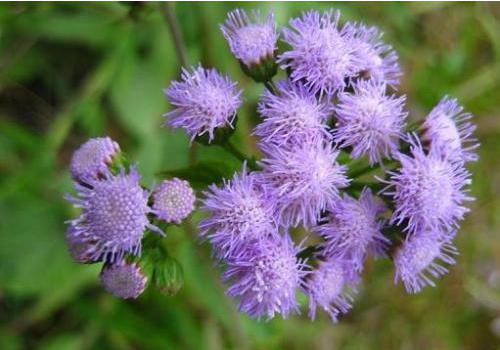
What medicinal value does Ageratum conyzoides have:
Ageratum conyzoides medicinal use: the whole plant, or the leaves and young stems, are used as medicine. Harvest in summer and autumn, wash clean, and use fresh or dry in the sun. Nature and flavor: pungent, slightly bitter, cool. Functions and indications: dispel wind and clear heat, relieve pain, stop bleeding, and expel stones. Used for upper respiratory tract infections, tonsillitis, pharyngitis, acute gastroenteritis, stomach pain, abdominal pain, uterine bleeding, kidney stones, bladder stones; externally used to treat eczema, oral thrush, carbuncles and sores, cellulitis, lower limb ulcers, otitis media, and traumatic bleeding. Dosage and administration: 0.5-1 liang. For external use, an appropriate amount; mash fresh herb or grind dried herb into powder and apply to the affected area, or squeeze the juice and drop it into the ear, or decoct in water and wash.
Have you all learned how to grow Ageratum conyzoides?
Ageratum conyzoides Ageratum conyzoides illustrated guide: how to grow Ageratum conyzoides / how to propagate Ageratum conyzoides
Ageratum conyzoides ProfileAgeratum conyzoides Ageratum conyzoides
How to Grow Ageratum conyzoides and Precautions: An Introduction to Ageratum conyzoides
Ageratum conyzoides is native to tropical America. It is a perennial herb, often cultivated as an annual, 30-60 cm tall, with the whole plant covered in hairs.
The stems are spreading, rooting at the nodes, and covered with white soft hairs. The leaves are opposite, with ovate leaf blades. The flower heads are capitula, and all the florets are tubular flowers; the flower colors include light blue, blue, pink, white, etc. The flowering period is from July until frost.
The achene is 1.5-1.8 mm long and easily sheds. The 1000-seed weight is 0.15 g. It likes a warm environment with plenty of sunlight.
It is not demanding about soil. It is not cold-tolerant and grows poorly under extreme heat. It has strong branching ability and tolerates pruning. Propagated by sowing; for superior varieties, propagation by cuttings can be used. Used for flower bed and flower border arrangements, potted ornamental display, and as cut flowers.
Ageratum conyzoides is distributed in Guangdong, Guangxi, Yunnan, Guizhou, Sichuan, Jiangxi, Fujian and other places in China. It is both cultivated and found as naturalized wild distribution 0; it grows in mountain valleys, under forests on hillsides or at forest edges, by rivers or on hillside grasslands, at field edges or on wasteland. In Zhejiang and Hebei, only cultivated plants are seen.
Morphological Characteristics of Ageratum conyzoides
Ageratum conyzoides is an annual herb, 50-100 cm tall, sometimes less than 10 cm, with sparse short soft hairs and yellow glandular dots; there are slightly more hairs along the veins on the upper surface and on the lower surface of the leaves, sometimes nearly hairless below; the petioles of the upper leaves, or the axillary young branches and the petioles of the leaflets on axillary branches, are usually covered with dense, spreading, white long soft hairs. The capitula, 4-18 of them, are arranged at the top of the stem in usually compact corymbose inflorescences; the inflorescence diameter is 1.5-3 cm, rarely arranged in loose corymb-like forms.
The pedicel is 0.5-1.5 cm long and covered with dusty short soft hairs. The involucre is bell-shaped or hemispherical, 5 mm wide. The involucral bracts are in 2 layers, oblong or lanceolate-oblong, 3-4 mm long, hairless outside, with torn edges. The corolla is 1.5-2.5 mm long, hairless outside or with dusty fine soft hairs at the tip, with the limb 5-lobed, light purple. The achene is blackish brown, 5-ribbed, 1.2-1.7 mm long, with sparse white fine soft hairs. The pappus scales are 5 or 6, oblong, with the apex sharply narrowed or gradually narrowed into a long or short awn, or some scales truncate at the apex without an awn-like tapering tip; all pappus scales are 1.5-3 mm long.
Ageratum conyzoides has no obvious main root. The stem is stout, 4 mm in diameter at the base, or rarely slender, with the base less than 1 mm in diameter, unbranched or branched from the base or from the middle upward, or the lower base prostrate and often producing adventitious roots at the nodes. All stems and branches are light red, or the upper part green, covered with white dusty short soft hairs or the upper part covered with dense spreading long tomentum. The leaves are opposite, sometimes alternate in the upper part, often with axillary undeveloped leaf buds. The middle stem leaves are ovate or elliptical or oblong, 3-8 cm long, 2-5 cm wide; from the middle leaves upward and downward, and the leaves on axillary branchlets, gradually become smaller or small, ovate or oblong; sometimes all the leaves of the plant are small, only 1 cm long and only up to 0.6 mm wide. All leaves are blunt or broadly wedge-shaped at the base, with three basal veins or inconspicuous five basal veins, acute at the apex, with rounded serrations at the margin, and with petioles 1-3 cm long, both surfaces covered with sparse white short soft hairs and yellow glandular dots; there are slightly more hairs along the veins on the upper surface and on the lower surface of the leaves, sometimes nearly hairless below; the petioles of the upper leaves, or the axillary young branches and the petioles of the leaflets on axillary branches, are usually covered with dense, spreading, white long soft hairs.
Ecological Habits of Ageratum conyzoides
Ageratum conyzoides grows in mountain valleys, under forests on hillsides or at forest edges, by rivers or on hillside grasslands, at field edges or on wasteland. In Zhejiang and Hebei, only cultivated plants are seen.
Ageratum conyzoides likes a warm environment with plenty of sunlight. It is not demanding about soil. It is not cold-tolerant and grows poorly under extreme heat. It has strong branching ability and tolerates pruning.
Cultivation Techniques of Ageratum conyzoides: Raising Seedlings
Ageratum conyzoides seeds are tiny, so sowing requires meticulous work. Generally, sow in a greenhouse in early February, or sow outdoors in early April. The culture soil should be half farmyard manure and half garden soil, mixed with a small amount of leaf mold, evenly mixed, and then sifted. For small-scale seedling raising, flower pots can be used (for large-scale seedling raising, beds can be made). Put the culture soil into the pot, press it firm, and water thoroughly; after the water seeps down, evenly scatter the seeds on the wet soil. The covering soil must not be too thick; just enough to cover the seeds tightly is sufficient. Keep the potting soil moist. Seedlings can emerge in about 10 days. When the seedlings have 2 pairs of true leaves, prick them out into small plastic nutrient pots, one plant per pot. The seedlings grow slowly.
To achieve early shaping and early blooming, cutting propagation can be used for seedling raising. For cutting propagation, prepare large mother plants, place them in a greenhouse in winter, and in early spring take vigorous branches, keeping 2-4 true leaves and not leaving the growing point. The branch length is 5-6 cm, and the cut should be below a node; insert immediately after cutting. The insertion depth is 1/3-1/2 of the cutting length. In hot seasons, place the cuttings in a shady spot after insertion to prevent high temperature and sun exposure. Apart from low temperatures in winter, cutting propagation can be carried out in other growing seasons and roots easily.
Planting Out
When the Ageratum conyzoides seedlings have 2-4 branches, plant them out into pots. Plant 1 plant in a 4-inch flower pot; the potting soil should be 1/3 farmyard manure, 1/3 garden soil, and 1/3 fine sand, mixed and sifted. After planting the seedlings, press the potting soil firm, water thoroughly, and place in a shady spot; after 7-10 days, move to a sunny spot. At this point, they have basically recovered from transplanting and begin normal growth. Pay attention to water and fertilizer management; water when the surface layer of the potting soil turns white and looks dry. Each watering should be sufficient; do not water only halfway. Entering the hot season, during the peak growth period of the plants, water twice a day. Water once every 10-15 days with dilute cake fertilizer water, and appropriately increase the application of phosphorus and potassium fertilizers. This can make the plants dwarf, with more flowers and brighter colors, improving ornamental value.
Pruning
Ageratum conyzoides has a long flowering period. To keep the plant type short and compact, with many flowers and a beautiful appearance, it must be pinched back multiple times, generally 3-4 times of pinching and tipping. To form a rounded plant shape, with flower buds forming at the top of each branch and blooming at the same time, making the branches and leaves lush, with many flowers and bright colors, beautiful and spectacular. After the first batch of flowers has bloomed, prune and trim promptly; generally keep old branches 5-6 cm high and cut off the upper part, while thinning out overly dense branches. Then ensure sufficient water and fertilizer to promote the sprouting of new branches, so that the leaves are green and the flowers fresh.
Seed Collection
Ageratum conyzoides seeds are easy to shed after maturity, so they should be harvested in time. Harvest when most of the florets in the capitulum have dried up and the achene pappus is clearly exposed. After air-drying, the seeds can be rubbed off, cleaned, put into a cloth bag, and stored in a cool, dry place. Ageratum conyzoides has a long flowering period, and seed maturity is not concentrated, so multiple harvests should be carried out. The leaves are large and produce a lot of starch through photosynthesis, making them good material for photosynthesis experiments.
Temperature Environment
Ageratum conyzoides has strong adaptability to light. When maintaining it indoors, place it in a place with bright light as much as possible, such as a well-lit living room, bedroom, study, and similar places. It likes a moist or semi-dry growing environment and requires the relative air temperature of the growing environment to be 50-70%. When the relative air humidity is too low, the lower leaves turn yellow and fall off, and the upper leaves lose their luster. Ageratum conyzoides is not cold-tolerant. Before frost arrives, move it indoors and place it in a sunny spot. The nighttime temperature should be above 5°C, and with a daytime temperature of 10°C-15°C it can grow and bloom normally. Water once every 3-5 days, and water once every half month with dilute cake fertilizer water. After maintaining it indoors for a period, move it outdoors to a shaded place (with insulation conditions in winter) for a period, and alternate in this way.
Humidity Management
It likes a moist or semi-dry climate environment and requires the relative air temperature of the growing environment to be 50-70%. When the relative air humidity is too low, the lower leaves turn yellow and fall off, and the upper leaves lose their luster.
Temperature Management
Because it is native to subtropical regions, it has strict requirements for winter temperature; when the environmental temperature is below 8°C, growth stops.
Light Management
It has strong adaptability to light. When maintaining it indoors, place it in a place with bright light as much as possible, such as a well-lit living room, bedroom, study, and similar places. After maintaining it indoors for a period (about one month), move it outdoors to a shaded place (with insulation conditions in winter) for a period (about one month), and alternate in this way.
How to Grow Ageratum conyzoides
1、Cultivating Strong Seedlings
Ageratum conyzoides seeds are tiny, so sowing requires meticulous work. Generally, sow in a greenhouse in early February, or sow outdoors in early April. The culture soil should be half farmyard manure and half garden soil, mixed with a small amount of leaf mold, evenly mixed, and then sifted. For small-scale seedling raising, flower pots can be used (for large-scale seedling raising, beds can be made). Put the culture soil into the pot, press it firm, and water thoroughly; after the water seeps down, evenly scatter the seeds on the wet soil. The covering soil must not be too thick; just enough to cover the seeds tightly is sufficient.
Keep the potting soil moist. Seedlings can emerge in about 10 days. When the seedlings have 2 pairs of true leaves, prick them out into small plastic nutrient pots, one plant per pot. Ageratum conyzoides seeds are small, and the seedlings grow slowly. To achieve early shaping and early blooming, cutting propagation can be used for seedling raising. For cutting propagation, prepare large mother plants, place them in a greenhouse in winter, and in early spring take vigorous branches, keeping 2-4 true leaves and not leaving the growing point. The branch length is 5-6 cm, and the cut should be below a node; insert immediately after cutting. The insertion depth is 1/3-1/2 of the cutting length. In hot seasons, place the cuttings in a shady spot after insertion to prevent high temperature and sun exposure. They root in about 10 days and can then be pricked out. Apart from low temperatures in winter, cutting propagation can be carried out in other growing seasons and roots easily.
2、Planting Out and Management
When the Ageratum conyzoides seedlings have 2-4 branches, plant them out into pots. Plant 1 plant in a 4-inch flower pot; the potting soil should be 1/3 farmyard manure, 1/3 garden soil, and 1/3 fine sand, mixed and sifted. After planting the seedlings, press the potting soil firm, water thoroughly, and place in a shady spot; after 7-10 days, move to a sunny spot. At this point, they have basically recovered from transplanting and begin normal growth. Pay attention to water and fertilizer management; water when the surface layer of the potting soil turns white and looks dry. Each watering should be sufficient; do not water only halfway. Entering the hot season, during the peak growth period of the plants, water twice a day. Water once every 10-15 days with dilute cake fertilizer water, and appropriately increase the application of phosphorus and potassium fertilizers. This can make the plants dwarf, with more flowers and brighter colors, improving ornamental value.
3、Plant Pruning
Ageratum conyzoides has a long flowering period. To keep the plant type short and compact, with many flowers and a beautiful appearance, it must be pinched back multiple times, generally 3-4 times of pinching and tipping. To form a rounded plant shape, with flower buds forming at the top of each branch and blooming at the same time, making the branches and leaves lush, with many flowers and bright colors, beautiful and spectacular. After the first batch of flowers has bloomed, prune and trim promptly; generally keep old branches 5-6 cm high and cut off the upper part, while thinning out overly dense branches. Then ensure sufficient water and fertilizer to promote the sprouting of new branches, so that the leaves are green and the flowers fresh.
4、Winter Management
Ageratum conyzoides is not cold-tolerant. Before frost arrives, move it indoors and place it in a sunny spot. The nighttime temperature should be above 5°C, and with a daytime temperature of 10°C-15°C it can grow and bloom normally. Water once every 3-5 days, and water once every half month with dilute cake fertilizer water.
Propagation Methods of Ageratum conyzoides
Ageratum conyzoides likes a warm environment with plenty of sunlight. It is not demanding about soil. It is not cold-tolerant and grows poorly under extreme heat. It has strong branching ability and tolerates pruning. Propagated by sowing; for superior varieties, propagation by cuttings can be used.
It is often propagated by sowing and cuttings. For sowing, sow in spring in April. It germinates 2 weeks after sowing. For cuttings, cut vigorous top shoots as cuttings between May and June; they root in about 15 days after insertion, with a high survival rate. The seeds have the ability to self-sow and reproduce.
Sown seedlings are transplanted once when 3-4 cm tall, and planted out or potted when 7-8 cm tall. During the growing period, fertilize once every half month, and pinch back when there are 6-7 leaves to encourage more branching. During the flowering period, apply phosphorus fertilizer 1-2 times. After the flowers fade, prune heavily once, and after new branches sprout, they will continue to bloom continuously.
For Ageratum conyzoides seed propagation, raise seedlings in indoor hotbeds from March to April in early spring, and plant out in the open field in mid-April. For some superior varieties, cutting propagation can be used, or tissue culture can be applied for rapid seedling raising. Ageratum conyzoides has strong adaptability and is not particular about soil; it can grow well in sandy loam, garden soil, and slightly acidic or slightly alkaline soil. Under conditions of sufficient sunlight, the flowers are dense and the flower colors are brilliant; in shaded environments, the stems and leaves are bright green, and the ground-covering effect is good. Ageratum conyzoides tolerates pruning; after flowering, it can be pruned at any time to form new flowers. During the growing period, an appropriate amount of topdressing is required, using compound chemical fertilizer or dried chicken manure. Remember to irrigate immediately after fertilizing; otherwise, it easily burns the leaf surface or the plant roots.
In early spring, Ageratum conyzoides can produce seedlings with about 9 pairs of leaves and many large buds in about 60 days. When raising seedlings, sow about 1.5 g of seeds per square meter of seedbed. Because the seeds are very small, in order to sow evenly, mix the seeds with about 30-50 times their volume of fine sand or fine soil before sowing, and cover the seeds with about 0.3 cm of fine soil. Control the soil temperature at 22-25°C; dry seeds emerge in 5 days after sowing.
Disease and Pest Control of Ageratum conyzoides
Ageratum conyzoides is often harmed by root rot, rust, cutworms, and whiteflies. For root rot, spray with a 1000-fold dilution of 10% antibacterial agent 401 acetic acid solution; for rust, spray with a 2000-fold dilution of 50% carboxin wettable powder.
Distribution Range of Ageratum conyzoides
Ageratum conyzoides is native to Mexico and is now widely distributed in tropical regions of the Eastern Hemisphere.
In China, it was first recorded in G. Bentham (1861)'s "Flora of Hong Kong", and was discovered in southern Yunnan at the end of the 19th century. It is now commonly distributed in low mountains, hills, and plains throughout the Yangtze River basin and areas to the south. Another species originating from Central America, Ageratum houstonianum, has been introduced and cultivated in southern China for ornamental purposes and often escapes as a weed.
Uses and Functions of Ageratum conyzoides
Ageratum conyzoides flowers have effects on health: 1. The flower colors of Ageratum conyzoides stimulate the senses and have an effect on people's psychology. Different flower colors of Ageratum conyzoides have different effects. 2. The floral fragrance of Ageratum conyzoides stimulates the sense of smell and is very beneficial to health. 3. The aromatic oil of Ageratum conyzoides flowers can be antibacterial and enhance human immunity. According to physiologists' research, the "pheromones" contained in the floral fragrance of Ageratum conyzoides have a similar ability to human "sex hormones." 4. Ageratum conyzoides flowers can purify the air. Research has found that Ageratum conyzoides flowers have the effect of absorbing and killing toxins and preventing air pollution.
Application Value
Ageratum conyzoides has lush clumps and elegant flower colors. It is often used to configure flower beds and ground cover, and can also be used as embellishment in small courtyards, roadsides, and beside rocks. Dwarf varieties can be potted for ornamental display, and tall-stemmed varieties are used for cut flowers in vases or for making flower baskets.
Used for flower beds, potted plants, ground cover, flower borders, flowered lawns, etc., as well as ground-covering material.
Among residents in Africa and the Americas, the whole plant is used for clearing heat and detoxifying and for reducing inflammation and stopping bleeding. In South America, local residents highly value the use of the whole plant to treat non-uterine vaginal bleeding in women.
Medicinal or Dietary Therapeutic Value of Ageratum conyzoides
The medical information and healthy dietary therapy information on Huahua.com is for reference only and cannot be used as a basis for diagnosis or medical treatment. For any health problems, consult professional medical personnel, and for the treatment of any disease, follow medical advice.
Ultimate flower-protecting mission: Love yourself, start from practical reality, and strictly follow medical advice. For illness, do not be careless, do not delay, do not give up hope, face it bravely, use love to warm the silent world, and use your heart to care for the flower field within.
In folk medicine, Ageratum conyzoides is used as the whole plant to treat colds and fever, boils and eczema, traumatic bleeding, burns and scalds, etc.
Among residents in Africa and the Americas, the whole plant is used for clearing heat and detoxifying and for reducing inflammation and stopping bleeding. In South America, local residents highly value the use of the whole plant to treat non-uterine vaginal bleeding in women. In Chinese folk medicine, however, the whole plant is often used to treat colds and fever, boils and eczema, traumatic bleeding, burns and scalds, etc.
Landscape Uses of Ageratum conyzoides
Ageratum conyzoides can be used to arrange flower beds and flower borders, and can also be used as ground cover plants. Tall varieties can be used as cut flowers, potted flowers, etc. It can also be planted in flower clusters, flower groups, or along the edges of paths, and can also embellish rock gardens; after pruning, it can bloom quickly.
Ageratum conyzoides has lush clumps and elegant flower colors. It is often used to configure flower beds and ground cover, and can also be used as embellishment in small courtyards, roadsides, and beside rocks. Dwarf varieties can be potted for ornamental display, and tall-stemmed varieties are used for cut flowers in vases or for making flower baskets. Used for flower beds, potted plants, ground cover, flower borders, flowered lawns, etc., as well as ground-covering material.
Ageratum conyzoides has a high seed-setting rate and fast propagation speed. Ageratum conyzoides mainly has three color series: blue, white, and violet-purple, and the plants can grow to 20-25 cm tall. It is best used as a potted plant and as a border plant in courtyards, or to embellish rock gardens, or for indoor ornamental display. If applied on a large scale in flower beds as a base-tone color configuration, it also has a unique effect.
The Flower Language of Ageratum conyzoides
The flower language of Ageratum conyzoides: respect and love
Ageratum conyzoides is also known as Sheng Hong Ji, in the Asteraceae family, Ageratum genus. It is native to Mexico. In Guangdong it is called Xian Xia Hua, Bai Hua Cao, Bai Mao Ku, Bai Hua Chou Cao; in Yunnan it is called Chong Yang Cao; in Guizhou it is called Nong Pao Cao, Lu Sheng Ma; in Guangxi it is called Chou Lu Cao.
Ageratum conyzoides Pictures
Ageratum conyzoides Ageratum conyzoides L. illustrated guide: how to grow Ageratum conyzoides / how to propagate Ageratum conyzoides
Ageratum conyzoides ProfileAgeratum conyzoides Ageratum conyzoides L.
Aliases: Sheng Hong Ji, Xian Xia Hua, Mao She Xiang, Die Zi Cao, Nan Feng Cao, Liu Zai Huang, Bai Hua Cao, Bai Hua Chou Cao
Classification: Annual herbaceous flower
Family and Genus: Plantae, Angiosperms, Dicotyledoneae, Asterales, Asteraceae, Ageratum genus
Full Bloom Period: All seasons
Ageratum conyzoides is also known as Sheng Hong Ji, in the Asteraceae family, Ageratum genus. It is native to Mexico. It is distributed from low altitudes up to areas at 2800 m. It is found in Guangdong, Guangxi, Yunnan, Guizhou, Sichuan, Jiangxi, Fujian and other places in China, both cultivated and found as naturalized wild distribution 0; it grows in mountain valleys, under forests on hillsides or at forest edges, by rivers or on hillside grasslands, at field edges or on wasteland. In Zhejiang and Hebei, only cultivated plants are seen.
How to Grow Ageratum conyzoides and Precautions: An Introduction to Ageratum conyzoides
Ageratum conyzoides is also known as Sheng Hong Ji, in the Asteraceae family, Ageratum genus. It is native to Mexico. It is distributed from low altitudes up to areas at 2800 m. It is found in Guangdong, Guangxi, Yunnan, Guizhou, Sichuan, Jiangxi, Fujian and other places in China, both cultivated and found as naturalized wild distribution 0; it grows in mountain valleys, under forests on hillsides or at forest edges, by rivers or on hillside grasslands, at field edges or on wasteland. In Zhejiang and Hebei, only cultivated plants are seen.
Morphological Characteristics of Ageratum conyzoides: Roots and Stems
Ageratum conyzoides is an annual herbaceous plant, 50-100 cm tall, sometimes less than 10 cm. It has no obvious main root. The stem is stout, 4 mm in diameter at the base, or rarely slender, with the base less than 1 mm in diameter, unbranched or branched from the base or from the middle upward, or the lower base prostrate and often producing adventitious roots at the nodes. All stems and branches are light red, or the upper part green, covered with white dusty short soft hairs or the upper part covered with dense spreading long tomentum.
Leaves
The leaves of Ageratum conyzoides are opposite, sometimes alternate in the upper part, often with axillary undeveloped leaf buds. The middle stem leaves are ovate or elliptical or oblong, 3-8 cm long, 2-5 cm wide; from the middle leaves upward and downward, and the leaves on axillary branchlets, gradually become smaller or small, ovate or oblong; sometimes all the leaves of the plant are small, only 1 cm long and only up to 0.6 mm wide. All leaves are blunt or broadly wedge-shaped at the base, with three basal veins or inconspicuous five basal veins, acute at the apex, with rounded serrations at the margin, and with petioles 1-3 cm long, both surfaces covered with sparse white short soft hairs and yellow glandular dots; there are slightly more hairs along the veins on the upper surface and on the lower surface of the leaves, sometimes nearly hairless below; the petioles of the upper leaves, or the axillary young branches and the petioles of the leaflets on axillary branches, are usually covered with dense, spreading, white long soft hairs.
Flowers
The capitula of Ageratum conyzoides, 4-18 of them, are arranged at the top of the stem in usually compact corymbose inflorescences; the inflorescence diameter is 1.5-3 cm, rarely arranged in loose corymb-like forms. The pedicel is 0.5-1.5 cm long and covered with dusty short soft hairs. The involucre is bell-shaped or hemispherical, 5 mm wide. The involucral bracts are in 2 layers, oblong or lanceolate-oblong, 3-4 mm long, hairless outside, with torn edges. The corolla is 1.5-2.5 mm long, hairless outside or with dusty fine soft hairs at the tip, with the limb 5-lobed, light purple.
Fruit
The achene of Ageratum conyzoides is blackish brown, 5-ribbed, 1.2-1.7 mm long, with sparse white fine soft hairs. The pappus scales are 5 or 6, oblong, with the apex sharply narrowed or gradually narrowed into a long or short awn, or some scales truncate at the apex without an awn-like tapering tip; all pappus scales are 1.5-3 mm long.
The flowering and fruiting period of Ageratum conyzoides is year-round.
Ecological Habits of Ageratum conyzoides
Ageratum conyzoides likes a warm environment with plenty of sunlight. It is not demanding about soil. It is not cold-tolerant and grows poorly under extreme heat. It has strong branching ability and tolerates pruning.
Cultivation Techniques of Ageratum conyzoides: Planting Out
When the Ageratum conyzoides seedlings have 2-4 branches, plant them out into pots. Plant 1 plant in a 4-inch flower pot; the potting soil should be 1/3 farmyard manure, 1/3 garden soil, and 1/3 fine sand, mixed and sifted. After planting the seedlings, press the potting soil firm, water thoroughly, and place in a shady spot; after 7-10 days, move to a sunny spot. At this point, they have basically recovered from transplanting and begin normal growth. Pay attention to water and fertilizer management; water when the surface layer of the potting soil turns white and looks dry. Each watering should be sufficient; do not water only halfway. Entering the hot season, during the peak growth period of the plants, water twice a day. Water once every 10-15 days with dilute cake fertilizer water, and appropriately increase the application of phosphorus and potassium fertilizers. This can make the plants dwarf, with more flowers and brighter colors, improving ornamental value.
Pruning
Ageratum conyzoides has a long flowering period. To keep the plant type short and compact, with many flowers and a beautiful appearance, it must be pinched back multiple times, generally 3-4 times of pinching and tipping. To form a rounded plant shape, with flower buds forming at the top of each branch and blooming at the same time, making the branches and leaves lush, with many flowers and bright colors.
After the first batch of flowers has bloomed, prune and trim promptly; generally keep old branches 5-6 cm high and cut off the upper part, while thinning out overly dense branches. Then ensure sufficient water and fertilizer to promote the sprouting of new branches, so that the leaves are green and the flowers fresh.
Humidity
It likes a moist or semi-dry climate environment and requires the relative air temperature of the growing environment to be 50-70%. When the relative air humidity is too low, the lower leaves turn yellow and fall off, and the upper leaves lose their luster.
Temperature
Because it is native to subtropical regions, it has strict requirements for winter temperature; when the environmental temperature is below 8°C, growth stops. It has strong adaptability to light. When maintaining it indoors, place it in a place with bright light as much as possible, such as a well-lit living room, bedroom, study, and similar places. After maintaining it indoors for a period (about one month), move it outdoors to a shaded place (with insulation conditions in winter) for a period (about one month), and alternate in this way.
Management
Ageratum conyzoides is not cold-tolerant. Before frost arrives, move it indoors and place it in a sunny spot. The nighttime temperature should be above 5°C, and with a daytime temperature of 10°C-15°C it can grow and bloom normally. Water once every 3-5 days, and water once every half month with dilute cake fertilizer water.
Propagation Methods of Ageratum conyzoides: Seed Propagation
Ageratum conyzoides seeds are tiny, so sowing requires meticulous work. Generally, sow in a greenhouse in early February, or sow outdoors in early April. The culture soil should be half farmyard manure and half garden soil, mixed with a small amount of leaf mold, evenly mixed, and then sifted. For small-scale seedling raising, flower pots can be used (for large-scale seedling raising, beds can be made). Put the culture soil into the pot, press it firm, and water thoroughly; after the water seeps down, evenly scatter the seeds on the wet soil. The covering soil must not be too thick; just enough to cover the seeds tightly is sufficient. Keep the potting soil moist. Seedlings can emerge in about 10 days. When the seedlings have 2 pairs of true leaves, prick them out into small plastic nutrient pots, one plant per pot. Ageratum conyzoides seeds are small, and the seedlings grow slowly.
Cutting Propagation
To achieve early shaping and early blooming, cutting propagation can be used for seedling raising. For cutting propagation, prepare large mother plants, place them in a greenhouse in winter, and in early spring take vigorous branches, keeping 2-4 true leaves and not leaving the growing point. The branch length is 5-6 cm, and the cut should be below a node; insert immediately after cutting. The insertion depth is 1/3-1/2 of the cutting length. In hot seasons, place the cuttings in a shady spot after insertion to prevent high temperature and sun exposure. They root in about 10 days and can then be pricked out. Apart from low temperatures in winter, cutting propagation can be carried out in other growing seasons and roots easily.
Key Maintenance Points for Ageratum conyzoides: Cultivating Strong Seedlings
Ageratum conyzoides seeds are tiny, so sowing requires meticulous work. Generally, sow in a greenhouse in early February, or sow outdoors in early April. The culture soil should be half farmyard manure and half garden soil, mixed with a small amount of leaf mold, evenly mixed, and then sifted. For small-scale seedling raising, flower pots can be used (for large-scale seedling raising, beds can be made). Put the culture soil into the pot, press it firm, and water thoroughly; after the water seeps down, evenly scatter the seeds on the wet soil. The covering soil must not be too thick; just enough to cover the seeds tightly is sufficient.
Keep the potting soil moist. Seedlings will emerge in about 10 days or so. When the seedlings have 2 pairs of true leaves, prick them out into small plastic pots, one plant per pot. Ageratum seeds are small and the seedlings grow slowly. To achieve an early shape and early flowering, cutting propagation can be used. For cutting propagation, prepare large stock plants and keep them in a greenhouse in winter; in early spring take healthy branches, keeping 2-4 true leaves and removing the growing point. The cuttings should be 5-6 cm long, with the cut made below a node, and inserted as soon as they are cut. Insert the cuttings to a depth of 1/3-1/2 of their length. In hot seasons, place the cuttings in a cool, shady spot after insertion to prevent high temperatures and sun exposure. They root in about 10 days and can then be pricked out. Apart from low temperatures in winter, cutting propagation can be carried out in any growing season and roots easily.
Planting out and management
When the ageratum seedlings have produced 2-4 branches, plant them out into pots. Use one plant per 4-inch pot; the potting soil should be 1/3 farmyard manure, 1/3 garden soil and 1/3 fine sand, mixed and sifted. After planting the seedlings, firm the potting soil, water thoroughly, and place in a shady spot; move to a sunny spot after 7-10 days. By then they have basically recovered from transplanting and begin normal growth. Pay attention to water and fertiliser management: water when the surface of the potting soil turns pale and dry, and water thoroughly each time, never giving only a half watering. In the hot season, when the plants are growing vigorously, water twice a day. Apply dilute cake fertiliser water once every 10-15 days, and appropriately increase phosphorus and potassium fertiliser. This keeps the plants compact, with more flowers and brighter colours, improving their ornamental value.
Plant pruning
Ageratum has a long flowering period. To keep the plant short and compact, with many flowers and an attractive appearance, it must be pinched back several times, generally 3-4 times. To form a rounded plant shape with flower buds at the tip of every branch, flowering at the same time and making the foliage luxuriant, with many brightly coloured flowers, beautiful and spectacular. After the first flush of flowers has finished, prune and trim promptly; generally keep the old branches 5-6 cm high and cut off the upper parts, while also thinning out overly dense branches. Then ensure sufficient water and fertiliser to encourage new growth, so that the leaves stay green and the flowers fresh.
Winter management
Ageratum is not cold hardy. Move it indoors before frost arrives and place it in a spot with plenty of sunlight. The night temperature should be above 5°C, and it will grow and flower normally at daytime temperatures of 10°C-15°C. Water once every 3-5 days, and apply dilute cake fertiliser water once every half month.
Variety classification of ageratum
Commonly cultivated ageratum varieties include 'Blue Danube': a dwarf type, 15-18 cm tall, with blue-purple flowers. The 'Hawaii' series: dense, neat stems and leaves, 15 cm tall, with flowers in colours from deep blue to red and pure white. The 'Pacific' series: 20 cm tall, with deep blue-purple flowers. 'Pink Mutation': 15-20 cm tall, with pink flowers.
Overview of the genus and species of ageratum
Ageratum is native to Mexico and is now widely distributed in the tropical regions of the Eastern Hemisphere. It was first recorded in China in G. Bentham's (1861) Flora of Hong Kong, and was found in southern Yunnan at the end of the 19th century. It is now commonly distributed in the low mountains, hills and plains of the Yangtze River basin and areas to the south. Another species originating from Central America, A. houstonianum, has been introduced and cultivated in southern China as an ornamental and often escapes to become a weed.
Annual herb, growing in fields, wasteland, hillside grassland, valley scrub and other places below 2800 m altitude. It has a high seed-setting rate and reproduces quickly. Ageratum mainly comes in 3 colour ranges: blue, white and violet-purple, and the plants can grow to 20-25 cm tall. It is best used as a potted plant and as an edging plant in courtyards, or to accent a rock garden, or as an indoor ornamental. If used on a large scale in flower beds as a base colour planting, it also has a distinctive effect.
Ageratum is a perennial herb of the genus Ageratum in the Asteraceae family; it is a biennial or perennial herb, and each gram of seed contains about 7000 seeds. At a temperature of 26-29°C, this species germinates 7-10 days after sowing, and during the germination period it should be placed in sunlight. The flowers are small, with dense flower heads at the tips of the branches. It tolerates pruning and will flower again after cutting back. It is mostly propagated by seed, but can also be propagated by cuttings. After sowing, it can be transplanted in 15-20 days, and it flowers in about 13 weeks; in southern regions it flowers in 11-12 weeks.
Uses and purposes of ageratum
Potted ageratum is used to decorate windowsills, balconies or roof gardens, understated and eye-catching.
Ageratum planted in the ground is used in flower beds, flower borders, planting troughs and lawn edges, with clear and bright landscape layers. Accenting small courtyards and roadsides, it is natural and elegant, evoking the atmosphere of spring.
Landscape uses of ageratum
Ageratum has lush clumps and elegant flowers, and is often used to plant up flower beds and ground cover; it can also be used to accent small courtyards, roadsides and rocks. Dwarf varieties can be potted for ornamental display, while tall varieties are used for cut flowers in vases or for making flower baskets.
For flower beds, pots, ground cover, flower borders, flowering lawns and so on, as well as a ground-covering material.
Medicinal or dietary therapy value of ageratum
The medical information and health dietary therapy information on Huahua.com is for reference only and cannot serve as a basis for diagnosis or medical treatment. Consult professional medical staff for any health problem, and follow medical advice for the treatment of any disease.
Ultimate flower-protecting mission: to love yourself, start from reality and strictly follow medical advice. For illness, do not be careless, do not delay, do not give up hope; face it bravely, warm the silent world with love, and care for the flower field within your heart.
Medicinal value
Among residents of Africa and the Americas, the whole plant is used to clear heat and detoxify and to reduce inflammation and stop bleeding. In South America, local residents hold the use of the whole plant to treat non-uterine vaginal bleeding in women in very high regard.
This species has many other names: in Guangdong it is called xianxia flower, white grass flower, white-haired bitter, white-flowered stinking grass; in Yunnan it is called Chongyang grass; in Guizhou it is called pus-bubble grass and green shengma; in Guangxi it is called stinking stove grass. In Baoshan, Yunnan, it is also called shuiding medicine. In Chinese folk medicine, the whole plant is used to treat colds and fever, boils and eczema, traumatic bleeding, burns and scalds, and so on.
The flower language of ageratum
Ageratum flower language: "trust", "hope to receive a reply", and so on.
Ageratum pictures