Heartleaf Philodendron Support and Climbing Methods and Solutions for Leaf Drop
Heartleaf philodendron is a plant grown in many homes and public spaces. How to support a heartleaf philodendron for climbing? What to do about leaf drop:
How to support a heartleaf philodendron for climbing:
First choose a moss pole, though other cylindrical poles can be used as a substitute, wrap it with a layer of brown outer covering, then insert the pole in the center of the flower pot, and wind the vines that have grown to about 30 cm around the pole. At least four plants should be planted in each pot, as this can create a very lush effect; too few will affect the ornamental value. Use a relatively thin rope to secure them, and be sure to be gentle when securing so as not to snap them, then simply care for them normally.
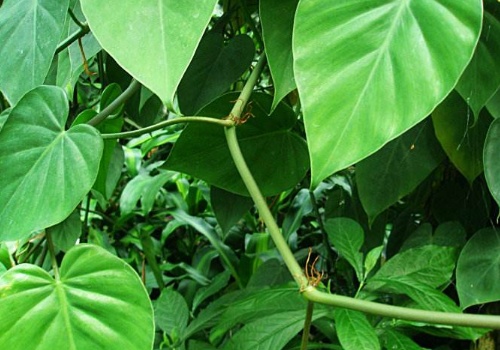
What to do about heartleaf philodendron leaf drop:
1. In summer, be sure to avoid direct sunlight, and keep the potting soil moist. When you notice it drying out, spray water on its surface. It is best to fertilize 1 to 2 times each month; do not fertilize too many times, otherwise the branches will collapse and the appearance will be affected. Repot once every spring, and prune the old roots that have become tangled together; if not trimmed, this will lead to poor absorption and the plant will be unable to support its large leaves.
2. It is not cold-tolerant, and the winter temperature should be kept above 10°C. Too cold a temperature will cause it to die. The summer temperature should be kept between 25°C and 32°C. If we are a bit more particular, the humidity is best kept at 70%, so that it will grow faster. During its growth and development, it needs to be placed in a semi-shaded location.
Have you learned the care methods for heartleaf philodendron?
Does Heartleaf Philodendron Bloom? What to Do When the Leaves Turn Yellow
Heartleaf philodendron has a certain beneficial effect in feng shui, but the placement is quite particular. Does heartleaf philodendron bloom? What to do when the leaves turn yellow:
Does heartleaf philodendron bloom:
Actually, it does not bloom. It is itself a foliage plant, so when we usually grow it, we mainly value it for its leaves, because the shape of the leaves is quite attractive, and on top of that, at a glance they are all emerald green, which lifts people's mood. So since it is a foliage plant, if the leaves turn yellow, then the ornamental value is greatly reduced. For this phenomenon, we should take corresponding measures to remedy it.
What to do when heartleaf philodendron leaves turn yellow:
First, simply cut off the useless leaves from the petioles. When placing it by the window, pay attention to air circulation, and it is best to place it in an environment with scattered sunlight.
In summer, be sure to avoid direct sunlight, and keep the potting soil moist. When you notice it drying out, spray water on its surface. It is best to fertilize 1 to 2 times each month; do not fertilize too many times, otherwise the branches will collapse and the appearance will be affected. Repot once every spring, and prune the old roots that have become tangled together.
Heartleaf philodendron does not bloom.
Propagation Methods for Heartleaf Philodendron
Cutting Propagation of Heartleaf Philodendron
Cuttings of heartleaf philodendron are suitable from May to September. Cut robust stems with 2-3 nodes and insert them directly into coarse sand or sphagnum moss, keeping the medium moist and the temperature at around 22-24℃. About 20-25 days after insertion, they will take root.
Seed Propagation of Heartleaf Philodendron
Seed propagation of heartleaf philodendron uses indoor seedling trays for sowing. The suitable germination temperature is around 25-30℃. About 10-15 days after sowing, they will germinate. Once the seedlings reach 5-6 cm in height, transplant them.
Division Propagation of Heartleaf Philodendron
When the heartleaf philodendron plant grows tall, you can cut side branches with aerial roots directly from the plant for potting, or first pinch off the growing tips to encourage more branching. Once the side branches grow to about 15-20 cm, they can be cut off together with their aerial roots for potting.
The placement of heartleaf philodendron is very particular. In fact, heartleaf philodendron should not be placed in a study; this is a feng shui taboo in the study. Because heartleaf philodendron is itself a vining climbing plant and belongs to the yin nature, it will absorb all the positive energy in the study, easily causing some unfounded disputes, and likewise making people's thinking especially chaotic, which will hinder people's development in career and studies. Therefore, this plant must never be placed in the study. For the sake of your own future, please be sure to remember this.
Do not let heartleaf philodendron grow attached to a wall! A plant like heartleaf philodendron belongs to the yin nature, so if you put it outside and let it wrap around your house, or even cover the entire wall, then this becomes a cold, yin house. Over time, health and fortune will inexplicably encounter obstacles.
If heartleaf philodendron grows some dead branches or withered leaves, and it is placed in a room at that time, this will cause people's fortunes to decline correspondingly. All things prefer a scene full of vitality. If there are dead branches and withered leaves, it is not very good, nor is it attractive, so when we notice this phenomenon, we must promptly cut off those branches and leaves.