Solutions for Mandevilla Losing Leaves and How It Differs from Double Happiness Vine
There is also a plant in daily life called Double Happiness Vine, and the two look very similar in appearance. What should you do when Mandevilla loses leaves? And how does it differ from Double Happiness Vine:
What should you do when Mandevilla loses leaves:
1. Lack of water: when the water shortage is severe, leaf drop will occur, but before the leaves fall, their edges will gradually turn yellow. At this point, replenish water in time, and water thoroughly.
2. Lack of fertilizer: when fertilizer is lacking, the leaves will also drop. Before they fall, the leaf color will gradually fade to yellow, and finally they will drop. Therefore, in daily fertilizing, pay attention to balanced nutrients, make a simple application plan, and follow the plan.
3. Lack of light: so-called lack of light means the plant does not get plenty of sunlight, and this can easily cause its leaves to drop. To avoid leaf drop caused by light, give it plenty of sunlight in daily care.
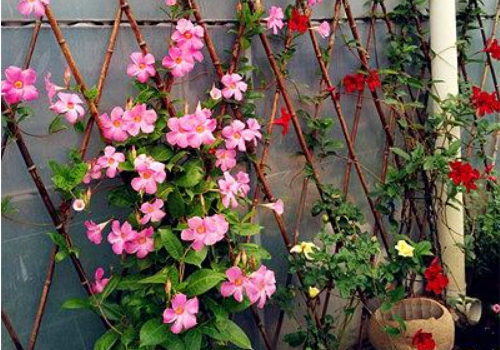
The difference between Mandevilla and Double Happiness Vine:
Mandevilla and Double Happiness Vine are the same plant. Mandevilla is a new type of climbing plant, also called Red Wrinkled Vine, Double Gland Vine, Double Happiness Vine, Wen Vine, and Red Cicada Flower. It is native to tropical America and is a perennial evergreen plant in the Apocynaceae family. The twining stems of Mandevilla are soft and tough, spiraling upward along a support, and the pink, trumpet-like flowers are large and upright, with flower stems reaching 6~8 cm.
Now you know the difference between Mandevilla and Double Happiness Vine.
What is the flower language of Mandevilla, the difference between Double Happiness Vine and Mandevilla / leaves differ in wrinkles
We often hear people mention Double Happiness Vine, Red Cicada Flower, Mandevilla, and so on. Are there any differences among them? For example, what is the difference between Double Happiness Vine and Mandevilla? Today we will take a detailed look at the differences among them, and at the end also explain what the flower language of Mandevilla is.
The difference between Double Happiness Vine and Mandevilla
In the earliest times, people in the Americas only called this plant Mandevilla. It is a very common plant in the Americas, and after it was introduced around the world, various different names appeared. In many places, Mandevilla is also called Red Wrinkled Vine, Double Happiness Vine, Red Cicada Flower, and so on. Therefore, when understanding the difference between Double Happiness Vine and Mandevilla, pay attention to the following points.
1. Double Happiness Vine and Mandevilla belong to the same plant
What people often call Mandevilla and Double Happiness Vine are actually the same plant, and Red Cicada Flower and others are also mixed names for this new type of climbing plant. Its twining stems are soft and very tough, and the flowers it produces are large and vivid. The flowering period of Mandevilla is, like that of Double Happiness Vine, very long, and the cultivation methods for Mandevilla also apply to Double Happiness Vine.
2. The leaves of Double Happiness Vine and Mandevilla are different
Although the two are the same plant, the difference between Double Happiness Vine and Mandevilla does exist. Usually, what people mean by Mandevilla has the characteristics of large leaves, wrinkles, strong vining habit, and very large flowers; Double Happiness Vine has the characteristics of large leaves, no wrinkles, strong vining habit, and large flowers. Therefore, the difference between the two is that Mandevilla leaves have wrinkles, while Double Happiness Vine leaves do not.
In addition, what people often call Red Cicada Flower also belongs to the same plant as Double Happiness Vine and Mandevilla, but its characteristics are small, smooth leaves, weak vining habit, and slightly smaller flowers. These subtle differences are actually not obvious without careful observation, and they do not have much impact on cultivation, so they do not affect growing it.
Whether it is Red Cicada Flower, Double Happiness Vine, or Mandevilla, they all share one common feature, which is that the flowering time is relatively long. In summer and autumn, they bloom for a long time, but it is said that these plants seen on the market are all unscented. However, given its extremely long flowering period, many people still feel it is very worthwhile. Those who want to grow it do not need to worry about the difference between Double Happiness Vine and Mandevilla.
What is the flower language of Mandevilla
As a plant loved by many people, Mandevilla has its own unique flower language. The flower language of Mandevilla is love and virtue. When we see the beautiful flowers of Mandevilla, they are as unforgettable as beautiful things such as love and virtue. If you want to express such feelings, Mandevilla is one of the best choices.
Cultivation methods for Mandevilla (Double Happiness Vine, Wen Vine, Red Cicada Flower)
Mandevilla (Double Happiness Vine, Wen Vine, Red Cicada Flower)
Scientific name: mandevilla sanderi
Aliases: Red Wrinkled Vine, Double Gland Vine, Double Happiness Vine, Wen Vine, Red Cicada Flower
Family and genus: Apocynaceae
Morphological characteristics: perennial evergreen climbing plant, with slender rhizomes. Leaves opposite, long ovate, apex acute, leathery, leaf surface wrinkled, leaf color deep green and glossy. Flowers axillary, corolla funnel-shaped, flower colors include red, peach red, pink, etc.
Ecological habits: likes light, warmth, and moisture. Native to South America. During the flowering period, Mandevilla often shows a magnificent display with more flowers than leaves. When a breeze comes, waves of refreshing fragrance make people feel relaxed and happy, hence the elegant name “Mandevilla”.
Flowering period: summer and autumn; with proper management, it flowers in all four seasons.
Garden use: large flowers and brilliant colors; it is the queen of tropical climbing plants. Indoor potted plants, balcony hanging displays, outdoor hedges, trellises, and small courtyard beautification.
