Can Dipladenia be placed indoors in a bedroom? Causes of yellowing leaves and solutions
Dipladenia is currently very popular among consumers on the market in our country. This is mainly because it has extremely high ornamental value. Can Dipladenia be placed indoors in a bedroom? Causes of yellowing leaves and solutions:
Can Dipladenia be placed indoors in a bedroom:
It is best not to place it indoors in a bedroom; it can be placed on a balcony or in a living room. Dipladenia can be grown both indoors and outdoors. When grown indoors, it can be made into a potted plant, placed on a balcony or elsewhere, or grown as a hanging plant. When grown outdoors, Dipladenia can be used for fences, trellises, or as a small courtyard landscaping plant. When cultivating it outdoors, be careful not to grow it in low-lying areas, so as to avoid poor plant growth caused by water accumulating in the soil.
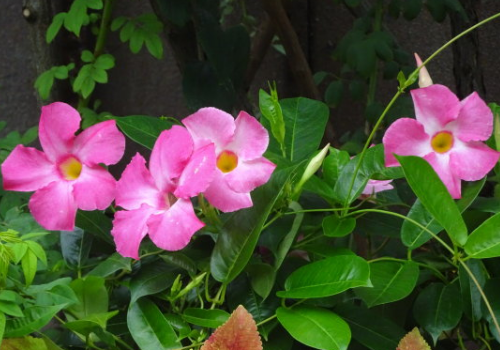
Causes of yellowing leaves in Dipladenia and solutions:
1. Yellowing due to lack of fertilizer. If the new leaves are very dull in color, appearing yellow or pale green, while the old leaves are normal in color or turn from green to yellow, it can basically be determined that it lacks fertilizer. We should check to see whether its soil has become dry and compacted. If there is this symptom, consider changing the soil. In addition, when fertilizing, the amount should be small and the frequency should be high, and some alum water can be added.
2. Yellowing due to lack of light. If we often place it in a very dark place, its leaves will not be able to get sunlight, making it difficult to form chlorophyll, and the leaves of the whole plant will gradually turn yellow and then begin to fall. Generally, we need to supplement light for it, and this way it can be alleviated.
Dipladenia is not recommended for indoor cultivation.
What soil to use for planting Dipladenia? What to do if Dipladenia leaves turn yellow
Dipladenia has large, brightly colored flowers and a refreshing fragrance, and can be used for beautifying small courtyards such as containers, fences, trellises, and rooftops. So what soil is more suitable for planting Dipladenia? What should be done if Dipladenia leaves turn yellow? Next, let us learn about it together.
I. What soil to use for planting Dipladenia
For indoor potted cultivation in the north, leaf mold soil plus a small amount of coarse sand can be used; in the south, pond mud, peat soil, and river sand can be mixed in a ratio of 5:3:2. During the growing period, a compound fertilizer can be applied 3-5 times as a top dressing, but the amount of nitrogen fertilizer should be controlled to avoid excessive vegetative growth that affects reproductive growth and reduces flowering. During the care process, watering should be properly controlled to form a well-developed root system.
II. What to do if Dipladenia leaves turn yellow
1. Drought yellowing: The yellowing caused by lack of water is different from the yellowing caused by too much water. The yellowing caused by lack of water shows dry and withered leaf tips or edges, and old leaves wither, yellow, and fall from bottom to top, but new leaves grow relatively normally. Just pay attention to watering thoroughly and sufficiently.
2. Yellowing due to lack of fertilizer: This shows as the color of young leaves becoming lighter, appearing yellow or pale green, while old leaves are relatively normal or gradually turn from green to yellow. Check the potting soil frequently; if there is dry compaction, the soil should be changed. Usually apply thin fertilizer frequently and water with some alum water at the appropriate time to supplement iron.
3. Light yellowing: If placed in a shaded environment for a long time, the leaves cannot get enough sunlight and cannot form chlorophyll, and the leaves of the whole plant turn yellow and then fall off. Supplementing light can prevent this problem.
4. Fertilizer yellowing: Yellowing of flowers caused by excessive fertilization or too high concentration shows as dry brown tips on new leaves; generally the leaf surface is thick and dull, and uneven and not spread out, while old leaves scorch yellow and fall off. Fertilization should be stopped immediately, and in severe cases, a large amount of water should be used to wash out part of the fertilizer.
5. Scorch yellowing: Direct sunlight shining on some shade-loving flowers (such as spider plant, hosta, etc.) can easily cause the leaf tips and leaf margins to wither, and yellow spots appear on the sun-facing parts of the leaves. Moving them to a shaded place is enough.
6. Water yellowing: Young leaves are dark yellow and dull, old leaves show no obvious change, branches are thin and yellow-green, and new shoots shrink and do not grow, indicating excessive watering. Remove the flower from the pot, place it in a ventilated and cool place to let the soil ball dry naturally, and then put it back into the pot.
Why do Dipladenia leaves turn yellow? Caused by light/watering/fertilization (with solutions)
Whenever Dipladenia blooms, the spectacular sight of more flowers than leaves is always intoxicating. However, the prerequisite for enjoying this is knowing the cultivation methods and precautions for Dipladenia; otherwise, yellowing leaves may occur. So why do Dipladenia leaves turn yellow? If they turn yellow, how should we handle it? This article focuses on explaining these two aspects.
Why do Dipladenia leaves turn yellow
Before exploring why Dipladenia leaves turn yellow, we need to first know the most suitable growing environment for Dipladenia. It prefers warm, humid places with sufficient light, and the best temperature is 20-31 degrees. The maximum temperature should not exceed 35 degrees, and the minimum should not be lower than 10 degrees; otherwise, yellowing leaves may occur. Below, several main causes of yellowing leaves and treatment measures are introduced.
I. Watering
1. Caused by too much watering
Cause and symptoms: We know that no matter what plant we care for, watering should be moderate. If Dipladenia is watered too much, the following symptoms will appear: new leaves are relatively yellow and lack luster; old leaves are very normal; branches are thin and have a small amount of yellow; new shoots shrink. At this time, why do Dipladenia leaves turn yellow? The reason is that too much water causes water yellowing.
Treatment measures: Remove Dipladenia from the pot, then place it in a cool place to dry before putting it back into the pot. After that, pay attention not to water too much.
2. Too little watering
Cause and symptoms: When we find that Dipladenia leaves turn yellow, while the leaf tips and edges become dry and withered; and old leaves begin to turn yellow and fall from bottom to top, then we can determine that the reason why Dipladenia leaves turn yellow is too little watering, which causes Dipladenia to become drought-stressed.
Treatment measures: Pay attention to watering. Each watering needs to maintain a sufficient amount, but be careful not to water too frequently, otherwise water yellowing may occur.
II. Fertilization
1. Too much fertilization (fertilizer yellowing)
Symptoms and cause: If dry brown appears at the tips of newly grown leaves of Dipladenia, and the leaves look very thick but lack luster, while also appearing uneven and unable to spread out, then it belongs to fertilizer yellowing. At this time, why do Dipladenia leaves turn yellow? The reason is too much fertilizer application.
Treatment measures: Stop fertilizing and check whether the fertilizer concentration is too high. If it is a relatively serious case of yellowing leaves, then we need to use a large amount of water to rinse, but note that after rinsing the water should be drained away.
2. Too little fertilization (lack-of-fertilizer yellowing)
Symptoms and cause: The color of new leaves looks very dull, with more yellow or pale green appearing. Although old leaves are normal in color, they gradually turn from green to yellow. This phenomenon is called lack-of-fertilizer yellowing. In this case, why do Dipladenia leaves turn yellow? The reason is lack of fertilizer.
Treatment measures: Check whether the soil is dry and compacted. If so, the soil needs to be replaced. At the same time, increase the frequency of fertilization, but do not apply too much each time, and add some alum water when fertilizing.
III. Light
1. Too much light (scorch yellowing)
Symptoms and cause: When the leaf tips and edges are found to have withered, and yellow spots appear on the leaves facing the sun, this situation belongs to scorch yellowing, and the cause is excessively strong light.
Treatment measures: Avoid relatively strong direct sunlight shining on it, and at the same time move Dipladenia to a relatively cool place.
2. Too little light (lack-of-light yellowing)
Symptoms and cause: The leaves of the plant slowly turn yellow and begin to fall off. At this time, why do Dipladenia leaves turn yellow? The reason is that Dipladenia has been in a dark place for a long time and lacks light.
Treatment measures: Supplement light for Dipladenia, or move it to a place with relatively sufficient light, and the yellowing of leaves will be alleviated.
Summary: The main reasons for yellowing leaves in Dipladenia are fertilization, watering, and light. When yellowing leaves appear, do not panic. Identify the corresponding cause according to the different symptoms, then take reasonable measures, and the symptoms of yellowing leaves can be improved.