Is Billbergia nutans (queen's tears) toxic? Detailed guide to care precautions
Billbergia nutans is actually quite easy to grow. Is Billbergia nutans toxic? Care precautions:
Is Billbergia nutans toxic:
Billbergia nutans should be non-toxic, because there is currently no clear information proving that Billbergia nutans is toxic or non-toxic.
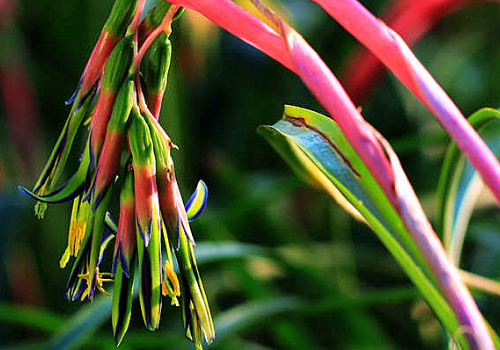
Billbergia nutans (Billbergia nutans Wendl.) is an ornamental plant in the Bromeliaceae family, with an extremely short stem. The leaves grow in a rosette cluster, up to 50 cm long, with drooping tips and sparse small spines along the leaf margins; the flower scape is 30 cm long, with a drooping tip, bearing 4-12 flowers, hairless, and the inflorescence axis is bent in a knee-like zigzag; the involucral bracts are narrow and closely appressed to the flower scape, pink to pale red; there are 3 sepals, orange-red with blue-purple edges, and 3 petals, green with blue-purple edges, with acute tips that are reflexed; there are 6 stamens; the anthers extend beyond the flower; the ovary is inferior, green, with axial placentation, and the stigma is twisted. Seeds are numerous and small. It is often cultivated in greenhouses in China for ornamental purposes. Native to Brazil. Generally, plants that have been cultivated for 3 years or whose bulb diameter exceeds 8 cm can bloom and fruit. Suitable for potted ornamental display.
Care precautions for Billbergia nutans:
1. When Billbergia nutans is not repotted for many years, the plant does not easily produce offset plants, and the clump tends to age, with growth vigor deteriorating. It should be repotted once every 1-2 years, and repotting is best done after flowering. The substrate can be prepared with 1 part peat soil, 1 part vermiculite, and 0.5 part perlite, or 1 part each of peat soil and tree fern.
2. After Billbergia nutans finishes flowering, the flower stems should be cut off promptly to help the plant sprout new shoots.
Billbergia nutans is non-toxic.
Billbergia nutans Billbergia nutans illustrated guide: how to grow Billbergia nutans / how to propagate Billbergia nutans
Billbergia nutans profileBillbergia nutans Billbergia nutans
How to grow and care for Billbergia nutans, an introduction to Billbergia nutans
Billbergia nutans is native to South America. The leaves are sword-shaped, hard in texture, with fine teeth. The inflorescence is slender, a spike, with several large rose-red bracts. It is relatively cold-tolerant and can withstand short periods of 2°C low temperatures. Generally, plants that have been cultivated for 3 years or whose bulb diameter exceeds 8 cm can bloom and fruit. Seeds can be collected and sown for propagation, with a high germination rate and easy management of young plants, making it suitable for potted ornamental display.
Billbergia nutans is a perennial evergreen herbaceous plant in the genus Billbergia of the Bromeliaceae family. It is a small bromeliad, often growing in multi-plant clumps. The plant is rosette-shaped, composed of 12-15 leaves.
Morphological characteristics of Billbergia nutans
Billbergia nutans has an extremely short stem. The leaves grow in a rosette cluster, up to 50 cm long and 15 mm wide, with drooping tips and sparse small spines along the leaf margins; the flower scape is 30 cm long, with a drooping tip, bearing 4-12 flowers, hairless, and the inflorescence axis is bent in a knee-like zigzag; the involucral bracts are narrow and closely appressed to the flower scape, pink to pale red; there are 3 sepals, 1.3-2.7 cm long, orange-red with blue-purple edges; there are 3 petals, 3.6-4 cm long, green with blue-purple edges, with acute tips that are reflexed; there are 6 stamens; the anthers are 7 mm long and extend beyond the flower; the ovary is inferior, green, 1 cm long, with axial placentation, and the stigma is twisted. Seeds are numerous and small.
It is often cultivated in greenhouses in China for ornamental purposes. Native to Brazil.
Billbergia nutans is a perennial evergreen herbaceous plant in the genus Billbergia of the Bromeliaceae family. It is a small bromeliad, often growing in multi-plant clumps. The plant is rosette-shaped, composed of 12-15 leaves. The leaves are sword-shaped or narrowly lanceolate, hard in texture, dark green, covered with white scales on the underside in a powdery coating, with small serrations along the margins. It blooms in spring, with the flower scape emerging from the leaf cluster, and the spike inflorescence arching and drooping, about 30 cm long, with rose-red bracts and a yellow-green corolla with blue edges.
Ecological habits of Billbergia nutans
It is relatively cold-tolerant and can withstand short periods of 2°C low temperatures.
Cultivation techniques for Billbergia nutans
(1) Temperature: It prefers a warm climate, with an optimal growth temperature of 21-27°C. Among ornamental bromeliads, it is a species with strong temperature adaptability and can withstand low temperatures of 2-5°C. In South China it can overwinter outdoors, but in regions further north it needs to be moved indoors for warmth during winter, and when cold waves hit, the plant should be covered with a plastic bag to prevent cold damage. In hot summers, ventilation should be strengthened to drive away stuffiness.
(2) Light: It prefers partial shade and avoids exposure to strong sunlight. When light is too intense, the leaves will turn yellow and may even be scorched, developing burnt spots. From May to September, shade should be provided, blocking 50%-70% of light, or the plant should be placed in a location with sufficient light. In other periods, sufficient sunlight is needed.
(3) Watering: It prefers moist soil conditions. If the potting soil is too dry, the leaf tips will scorch and the plant will grow poorly. During the growing period, water should be supplied abundantly to keep the potting soil moist; but over-wet conditions and waterlogging should be avoided to prevent root rot.
(4) Environmental humidity: It likes to grow in environments with very high relative air humidity, and the relative air humidity should preferably be maintained above 85%. Only when the relative air humidity is high will the plant show a bright, glossy luster. When the air is dry, the plant becomes dull and lusterless, and the leaves become thin and lifeless. During the growing period, especially when the air is dry, water should be sprayed around the surrounding environment frequently to keep the air humid. When temperatures are low in winter, a plastic bag can be placed over the potted plant, which both keeps it warm and maintains suitable relative air humidity, thus benefiting the plant's growth.
(5) Fertilization: Before flowering in spring, apply 1-2 topdressings of fertilizer combining phosphorus and potassium, which can make the flowers larger and more brightly colored. After flowering, the plant's fertilizer requirements are not high, and generally no fertilization is needed. Only when the plant becomes thin and weak due to nutrient deficiency should a nitrogen-based fertilizer be appropriately applied as a topdressing. Stop fertilizing in winter.
(6) Pruning: After flowering, the flower stems should be cut off promptly to help the plant sprout new shoots.
(7) Repotting: When the plant is not repotted for many years, it does not easily produce offset plants, and the clump tends to age, with growth vigor deteriorating. It should be repotted once every 1-2 years, and repotting is best done after flowering. The substrate can be prepared with 1 part peat soil, 1 part vermiculite, and 0.5 part perlite, or 1 part each of peat soil and tree fern.
Pest and disease control for Billbergia nutans
Generally, pests and diseases rarely occur. Only when relative air humidity is low and ventilation is poor are red spider mites and scale insects likely to breed and cause harm.
Common problems in cultivation and care
1. Scorched leaf tips: ① air that is too dry; ② insufficient watering causing the potting soil to become too dry.
2. Root rot or stem rot: often caused by overwatering, and especially likely to occur in winter when temperatures are low and conditions are wet and waterlogged.
Propagation methods for Billbergia nutans
Propagation is by division and sowing.
(1) Division: Carry this out after the plant flowers, in conjunction with repotting, using a sharp knife to divide the clustered plant into several clumps. The new divisions should not be too small,
each clump should have at least two mother plants and carry 1-2 offset plants. If the divided new plants are small, although they can survive, the plant shape will not be attractive. After dividing, apply sulfur powder or plant ash to the wounds, then pot them separately. Newly divided plants can bloom in the second year after planting.
(2) Sowing: Carry this out immediately after the fruit matures. After removing the fruit skin and washing clean, sow the seeds in the substrate in spots, water thoroughly, then cover the pot with glass or a plastic bag, maintaining a temperature above 20°C. Generally, they germinate after 1-2 weeks. Seedling plants need to be grown for 3 years before they can bloom, so this method is seldom used.
Landscape uses of Billbergia nutans
Billbergia nutans has leaves like an orchid, and when in bloom the colors are brilliant and varied, very beautiful.
It can be enjoyed both for its foliage and its flowers, and it is robust in nature and easy to grow, making it suitable for home cultivation.
The roles and uses of Billbergia nutans: ornamental and health benefits
Billbergia nutans is a crassulacean acid metabolism (CAM) plant, suitable for placement in bedrooms or studies, where it can keep indoor air fresh.
Billbergia nutans pictures
Billbergia nutans blooming
When does Billbergia nutans bloom
The blooming time of Billbergia nutans is generally in spring. In spring, the flowers of Billbergia nutans slowly open, the flower scape emerges, and spike inflorescences grow, with very brilliant colors.
How long must Billbergia nutans be grown before it blooms
Under normal circumstances, Billbergia nutans needs to be grown for about 3 years, or it will bloom and fruit only after its bulb grows to more than 8 cm. After Billbergia nutans blooms, it sets seed, and the seeds can be kept for sowing, with a fairly high success rate for propagation.
The above is an introduction to the question of Billbergia nutans blooming. Now let us look at the cultivation techniques for Billbergia nutans!