How to Grow Billbergia nutans and Tips for Dealing with Rhizome Rot
The emerald-green leaves of Billbergia nutans are also very beautiful. How do you grow Billbergia nutans? What should you do if the rhizome rots?
How to grow Billbergia nutans:
Billbergia nutans likes a warm, humid environment with plenty of sunlight. Only under bright light conditions can it flower normally and produce the most beautiful leaves, but in summer it still needs protection from direct midday sun. The suitable growing temperature is 20-30°C in summer and 15-18°C in winter; below 10°C it struggles to grow, and the nighttime minimum should be kept at 5°C. Billbergia nutans is relatively cold-tolerant and can withstand short periods of 2°C. The soil should be a neutral or slightly acidic sandy loam mixed with leaf mold or peat soil.
What should you do if the rhizome of Billbergia nutans rots:
When rhizome rot occurs in Billbergia nutans, it is actually caused by overwatering, especially in winter, when low temperatures combined with waterlogging very easily lead to rhizome rot in Billbergia nutans.
So when watering Billbergia nutans, be sure not to let water accumulate, and in winter be sure to maintain a suitable temperature. This can prevent rhizome rot in Billbergia nutans.
Now you know how to grow Billbergia nutans, right?
Billbergia nutans Billbergia nutans Illustrated Guide: How to Grow Billbergia nutans / How to Propagate Billbergia nutans
Billbergia nutans ProfileBillbergia nutans Billbergia nutans
How to Grow Billbergia nutans and Precautions: An Introduction to Billbergia nutans
Billbergia nutans is native to South America. The leaves are sword-shaped, hard in texture, with fine teeth. The inflorescence is slender, a spike, with several large rose-red bracts. It is relatively cold-tolerant and can withstand short periods of 2°C. Generally, plants that have been grown for 3 years or whose bulb diameter exceeds 8 cm can flower and fruit. Seeds can be collected and sown for propagation, with a high germination rate and easy management of young plants, making it suitable for potted ornamental display.
Billbergia nutans is a perennial evergreen herbaceous plant in the genus Billbergia of the Bromeliaceae family. It is a small bromeliad, often growing in clusters of multiple plants. The plant is rosette-shaped, composed of 12-15 leaves.
Morphological Characteristics of Billbergia nutans
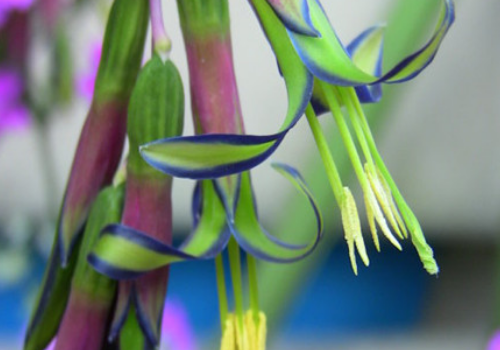
Billbergia nutans has an extremely short stem. The leaves grow in a rosette cluster, up to 50 cm long and 15 mm wide, with drooping tips and sparse small spines along the leaf margins; the flower scape is 30 cm long, drooping at the tip, bearing 4-12 flowers, hairless, with the inflorescence axis bent in a knee-like zigzag; the involucral bracts are narrow, closely appressed to the flower scape, pink to pale red; there are 3 sepals, 1.3-2.7 cm long, orange-red with blue-purple margins; 3 petals, 3.6-4 cm long, green with blue-purple margins, acute at the tip, reflexed; 6 stamens; anthers 7 mm long, protruding beyond the flower; the ovary is inferior, green, 1 cm long, with axile placentation, and the stigma is twisted. Seeds are numerous and small.
It is commonly cultivated in greenhouses in China for ornamental purposes. Native to Brazil.
Billbergia nutans is a perennial evergreen herbaceous plant in the genus Billbergia of the Bromeliaceae family. It is a small bromeliad, often growing in clusters of multiple plants. The plant is rosette-shaped, composed of 12-15 leaves. The leaves are sword-shaped or narrowly lanceolate, hard in texture, dark green, covered with white scales on the underside in a powdery coating, with small serrations along the margins. It flowers in spring; the flower scape emerges from the leaf cluster, and the spike inflorescence arches and droops, about 30 cm long, with rose-red bracts and a yellow-green corolla with blue margins.
Ecological Habits of Billbergia nutans
Relatively cold-tolerant, able to withstand short periods of 2°C.
Cultivation Techniques for Billbergia nutans
(1) Temperature: It likes a warm climate, with an optimal growing temperature of 21-27°C. Among ornamental bromeliads, it is a species with strong temperature adaptability and can withstand low temperatures of 2-5°C. In South China it can overwinter outdoors, but in regions further north it needs to be moved indoors for warmth during winter, and when cold waves hit, the plants should be covered with plastic bags to prevent cold damage. In hot summers, ventilation should be strengthened to dispel stuffiness.
(2) Light: It likes partial shade and dislikes exposure to strong sunlight. When light is too intense, the leaves will turn yellow or even become scorched, developing burnt spots. From May to September, shade should be provided, blocking 50%-70% of light, or the plant should be placed in a location with sufficient light. During the rest of the year, it needs ample sunlight.
(3) Watering: It likes moist soil conditions. If the potting soil is too dry, the leaf tips will wither and scorch, and the plant will grow poorly. During the growing period, water should be supplied adequately to keep the potting soil moist; but avoid excessive moisture and waterlogging to prevent root rot.
(4) Environmental Humidity: It likes to grow in environments with very high relative air humidity; the relative air humidity should ideally be maintained above 85%. When relative air humidity is high, the plant will display a bright, glossy luster. When the air is dry, the plant will become dull and lusterless, with thin, listless leaves. During the growing period, especially when the air is dry, water should be sprayed around the surrounding environment frequently to humidify the air. When temperatures are low in winter, a plastic bag can be placed over the potted plant, which both keeps it warm and maintains suitable relative air humidity, thereby benefiting the plant's growth.
(5) Fertilizing: Before flowering in spring, apply 1-2 top dressings of a phosphorus-potassium combined fertilizer, which can make the flowers larger and more brilliant. After flowering, the plant's fertilizer requirements are not high, and generally no fertilizing is needed; only when the plant becomes thin and weak due to nutrient deficiency should a nitrogen-based fertilizer be appropriately applied. Stop fertilizing in winter.
(6) Pruning: After the flowers fade, the flower stems should be pruned promptly to encourage the plant to sprout new shoots.
(7) Repotting: If not repotted for many years, the plant will not easily produce offsets, and the clump will easily age, with declining vigor. It should be repotted once every 1-2 years, preferably after flowering. The substrate can be prepared with 1 part peat soil, 1 part vermiculite, and 0.5 part perlite, or 1 part each of peat soil and tree fern.
Pest and Disease Control for Billbergia nutans
Generally, pests and diseases rarely occur. Only when relative air humidity is low and ventilation is poor are red spider mites and scale insects likely to infest and cause harm.
Common Problems in Cultivation
1. Withered and scorched leaf tips: (1) The air is too dry; (2) Insufficient watering causes the potting soil to become too dry.
2. Root rot or stem rot: Usually caused by overwatering, especially in winter when low temperatures combine with waterlogging.
Propagation Methods for Billbergia nutans
Propagation by division and by seed.
(1) Division: Carry out after the plant flowers, in conjunction with repotting. Use a sharp knife to divide the clustered plant into several clumps. The divided new plants should not be too small;
each clump should have at least two mother plants and carry 1-2 offsets. If the divided new plants are small, they may survive but will have an unattractive shape. After dividing, apply sulfur powder or wood ash to the wounds, then pot them separately. Newly divided plants can flower the following year after planting.
(2) Sowing: Carry out immediately after the fruit matures. After removing the fruit skin and washing clean, sow the seeds in the substrate in spots, water thoroughly, then cover the pot with glass or a plastic bag, maintaining a temperature above 20°C; generally they germinate after 1-2 weeks. Seedlings need 3 years of cultivation before they can flower, so this method is rarely used.
Landscape Uses of Billbergia nutans
The leaves of Billbergia nutans resemble those of an orchid, and when in bloom the colors are brilliant and vibrant, very beautiful.
It can be enjoyed both for its foliage and its flowers, and it is robust and easy to grow, suitable for home cultivation.
The Role and Uses of Billbergia nutans: Ornamental and Health Benefits
Billbergia nutans is a Crassulacean Acid Metabolism (CAM) plant, suitable for placement in bedrooms or studies, where it can keep indoor air fresh.
Billbergia nutans Pictures
How Long Does Billbergia nutans Take to Flower
Generally, Billbergia nutans needs to be grown for about 3 years, or until its bulb grows to more than 8 cm, before it will flower and fruit. The flowering time is usually in spring. In spring, the flowers of Billbergia nutans will gradually open, the flower scape emerges, and a spike inflorescence grows, with very brilliant colors.
Billbergia nutans likes a warm, humid growing environment and needs to be kept moist, but not overly wet. During care, strong light exposure must be avoided; it can be placed in living rooms, courtyards, and many other locations to beautify the home environment.
That's all for today's content. I hope this article helps you grow your Billbergia nutans well.