Can the Rabbit's Foot Fern be kept indoors in a bedroom? Introduction to hydroponic methods
The market price of the Rabbit's Foot Fern is not as expensive as other plants; it is still quite affordable. Can the Rabbit's Foot Fern be kept indoors in a bedroom? Can it be grown hydroponically?
Can the Rabbit's Foot Fern be kept indoors in a bedroom:
The Rabbit's Foot Fern can be kept indoors in a bedroom and is harmless to the human body. The Rabbit's Foot Fern can be placed on coffee tables, next to printers, and in other such places; toluene, the Rabbit's Foot Fern and others can absorb formaldehyde from the air. Distribution range: The Rabbit's Foot Fern is native to New Zealand and Japan, and is distributed across tropical and subtropical regions of Asia and Oceania.
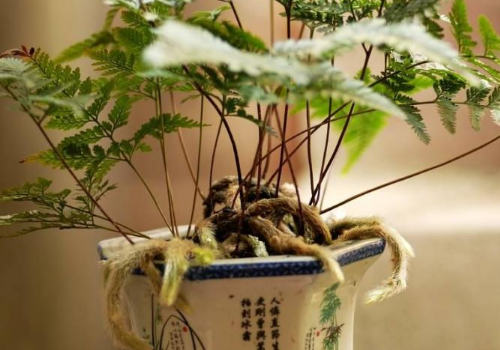
Can the Rabbit's Foot Fern be grown hydroponically:
1. Preparation
One healthy Rabbit's Foot Fern, one planting basket, one transparent flower pot for convenient observation of the water level, an appropriate amount of cotton, non-woven fabric and colored stones.
2. Production process
1. Making the planting basket
Spread cotton at the bottom of the planting basket and cover it with a layer of non-woven fabric to maintain the water supply for the plant during cultivation. A cotton thread passes through the bottom of the planting basket to secure the plant's roots.
2. Potting the hydroponic Rabbit's Foot Fern
Rinse the Rabbit's Foot Fern clean in water; the roots can be trimmed appropriately, and if trimming is done, be careful to let the wounds dry slightly. Place the plant into the planting basket and secure it upright with cotton thread to prevent it from falling over. Cover the top with non-woven fabric, then decorate with colored stones. A fresh and clean hydroponic Rabbit's Foot Fern is thus completed.
3. Later care of the hydroponic Rabbit's Foot Fern
First place the Rabbit's Foot Fern in a semi-shaded spot for about one week to recover from transplanting. Once the whole plant has regained its vigor, it can be grown normally. Remember to always pay attention to changes in the water level in the pot, and if it is low, remember to top it up in time.
Change the water in the pot once every two weeks, and be careful to clean out any moss in the pot; if you like, you can keep a few small fish in the transparent pot below. The small fish can eat the substances secreted by the plant's roots and metabolic waste, increasing the ornamental value while also cleaning the water in the pot.
The Rabbit's Foot Fern can be grown hydroponically.
Can the Rabbit's Foot Fern be kept indoors in a bedroom
The Rabbit's Foot Fern can be kept indoors in a bedroom and is harmless to the human body. The Rabbit's Foot Fern can be placed on coffee tables, next to printers, and in other such places; the Rabbit's Foot Fern can absorb formaldehyde from the air.
Can the Rabbit's Foot Fern be grown hydroponically? Rabbit's Foot Fern cultivation techniques
The Rabbit's Foot Fern is a very popular fern on the market today, with very high ornamental value. If grown at home, it can be made into a miniature landscape, or made into a hanging basket and placed indoors or on a balcony. However, the traditional soil-grown potted method no longer quite meets people's needs, and the gradually emerging hydroponic potted plants are more attractive, being not only simple and convenient but also clean and beautiful. Many people then ask, can the Rabbit's Foot Fern also be grown hydroponically?
Can the Rabbit's Foot Fern be grown hydroponically
1. Preparation
One healthy Rabbit's Foot Fern, one planting basket, one transparent flower pot for convenient observation of the water level, an appropriate amount of cotton, non-woven fabric and colored stones.
2. Production process
1. Making the planting basket
Spread cotton at the bottom of the planting basket and cover it with a layer of non-woven fabric to maintain the water supply for the plant during cultivation. A cotton thread passes through the bottom of the planting basket to secure the plant's roots.
2. Potting the hydroponic Rabbit's Foot Fern
Rinse the Rabbit's Foot Fern clean in water; the roots can be trimmed appropriately, and if trimming is done, be careful to let the wounds dry slightly. Place the plant into the planting basket and secure it upright with cotton thread to prevent it from falling over. Cover the top with non-woven fabric, then decorate with colored stones. A fresh and clean hydroponic Rabbit's Foot Fern is thus completed.
3. Later care of the hydroponic Rabbit's Foot Fern
First place the Rabbit's Foot Fern in a semi-shaded spot for about one week to recover from transplanting. Once the whole plant has regained its vigor, it can be grown normally. Remember to always pay attention to changes in the water level in the pot, and if it is low, remember to top it up in time.
Change the water in the pot once every two weeks, and be careful to clean out any moss in the pot; if you like, you can keep a few small fish in the transparent pot below. The small fish can eat the substances secreted by the plant's roots and metabolic waste, increasing the ornamental value while also cleaning the water in the pot.
Rabbit's Foot Fern cultivation techniques
1. Light
The Rabbit's Foot Fern is an evergreen herbaceous epiphytic fern that prefers a warm, semi-shaded environment and is suited to diffused light. It must not be exposed to direct sunlight, otherwise it easily wilts and curls. For home cultivation, it can simply be placed in a bright spot indoors.
2. Watering
The Rabbit's Foot Fern should be kept with moist potting soil, and during the growing season water should be supplied abundantly; generally watering once every 2 to 3 days is sufficient. Although the soil should be kept moist, for the Rabbit's Foot Fern a mild drying out between waterings is also fine. The Rabbit's Foot Fern should not be overwatered either; too much water can cause the leaves to drop.
3. Temperature
The Rabbit's Foot Fern is native to New Zealand and Japan, and is distributed across tropical and subtropical regions of Asia, Oceania, the Americas and the Pacific Islands.
4. Air humidity
It likes a high-humidity environment and does not tolerate dryness. During care, mist the plant and its growing environment frequently to increase humidity. The suitable humidity is around 80%; excessive dryness will cause the leaf edges to turn yellow and wither, or even the entire leaf to turn yellow and wither.
5. Soil and fertilizing
A loose, breathable sandy loam is best for the soil. The Rabbit's Foot Fern has low fertilizer requirements and does not like strong fertilizer; during care, a little diluted fertilizer can be applied sparingly.
What points should be noted when growing the Rabbit's Foot Fern
1. Propagation methods
The Rabbit's Foot Fern is a fern and has no seeds; it generally reproduces by spores. However, home cultivation generally uses cuttings to propagate, carried out in spring.
2. Pests and diseases
The main disease that appears during the growth of the Rabbit's Foot Fern is root rot, and the main pests are aphids and red spider mites, all caused by environmental factors.
Why do the leaves of the Rabbit's Foot Fern turn yellow and withered
1. Lack of water at the roots
Immerse the flower pot in a container filled with water. When the surface of the potting soil looks moist, take the pot out. Master watering this way every time. Cut off the withered leaves.
2. Improper lighting
Although the Rabbit's Foot Fern is shade-tolerant and does not like strong direct light, its growing conditions must still include a certain amount of light. It is best kept in semi-shade; it must not be placed in too shady a spot, and even less in direct sunlight in summer.
3. Air humidity too low
It not only likes water but is also especially fond of a damp growing environment. In addition to normal watering, mist the plant frequently to increase humidity so as to keep it growing well.
4. Excess fertilizer
It has low fertilizer requirements and does not like strong fertilizer; apply as little and as diluted as possible.
From the above we can see that the Rabbit's Foot Fern is also suitable for hydroponics, which is undoubtedly good news for most people. Whether hydroponic or soil-grown, the cultivation methods for the Rabbit's Foot Fern are not very difficult, so flower lovers who are interested might as well give it a try.