How does bladderwort eat insects in water and how can it be made to bloom
Bladderwort, like pitcher plants, needs to prey on insects, so how does bladderwort eat insects in water? How can it be made to bloom:
How bladderwort eats insects in water:
Bladderwort is a plant that lives in water, and when it comes to eating insects in the water, it is in no way inferior to pitcher plants. Bladderwort does not live long; it is an annual aquatic plant, but it is widely distributed, found throughout the world. Its root system is extremely undeveloped, reduced to the point of being completely absent. Its stem is very thin, and the green threads like hairs growing on it are its leaves. The stem is very long, like a rope, and among the densely packed green threads are dotted many small pouches; the small bags growing in the leaves are plump like little air bubbles, and seem to be used for floating. In fact, these are the insect-catching tools. These small bags are uniquely constructed; each pouch has an opening connected to the outside, and on the opening there is a small lid that opens inward, with four long trigger hairs on the lid, seeming to leisurely summon small insects to come and play in the water. If a small insect in the water swims to the opening of that bag, as long as it gently touches the trigger hairs, the small lid opens inward. Many small insects, not knowing the danger, think they have found a comfortable, peaceful nest, and so they flow in with the current. As a result, this “nest” only allows entry and no exit; it closes the lid, and this lid can only open inward, and cannot be pushed open outward.
How can bladderwort be made to bloom:
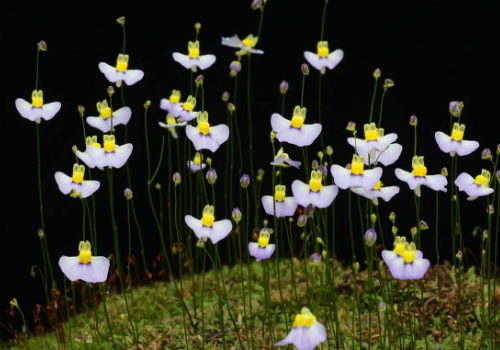
Bladderworts are mainly grown using the water-tray method, and the water level can be high or low. They like diffused light, stay above 0 degrees in winter, and humidity of 30-90% is fine. In the south, where it is warm, green algae tends to grow explosively, so pure water or RO machine water can be used to keep the environment poor and weakly acidic, and an appropriate container can be used to let the bladderwort occupy the vast majority of the area, giving it an advantage in light and space and slowing the spread of green algae. Varieties that are relatively intolerant of heat (tricolor, long-leaf, etc.) should be placed in a shady, ventilated spot in summer to escape the heat.
Now you know how to grow bladderwort so that it blooms.
Southern bladderwort illustrated guide: how to grow southern bladderwort / how to propagate southern bladderwort
Chinese scientific name: southern bladderwortLatin name: Utricularia australis
Place of origin: Australia
Growing medium: peat, sphagnum moss, perlite, sand, etc.
Survival temperature: 5-35°C
Suitable temperature: 20-30°C
Humidity: >60%
Introduction:
Southern bladderwort (Utricularia australis) is a perennial submerged or floating herbaceous plant, rootless, and in autumn the tips of the plant produce winter buds for dormancy, spherical in shape. The leaves are filamentously divided, and the insect-catching bladders grow on the leaves. The raceme is axillary, the corolla is yellow, the lower lip is marked with red lines, and there are 2 stamens. The capsule is spherical, 3~4 mm in diameter, and the seeds are flattened and hexagonal.
Southern bladderwort (scientific name: Utricularia australis) is a medium-sized perennial floating aquatic carnivorous plant in the genus Utricularia, family Lentibulariaceae. Southern bladderwort has a vast geographical range, found throughout Europe, tropical and temperate Asia, including China and Japan in East Asia, central and southern Africa, Australia, and the North Island of New Zealand. The species name "australis" is Latin for "southern," and also reflects the fact that this species was discovered in Australia in 1810. The flowering season of southern bladderwort is April to October, the corolla is yellow, the fruit is spherical, and the plant also turns red under strong summer light. However, its leaves grow on the same side, it has winter buds in winter, and the inflorescence axis has scales, which distinguishes it from Utricularia aurea. Peter Taylor observed this species producing fruit only in mainland China, while in other parts of the world it mostly only flowers without fruiting. As for the native plants in the Taiwan region of China, there are currently 2 situations, flowering and non-flowering, and some populations do set seed, which may be related to whether the chromosome number of that population is a non-integer multiple.
Chinese scientific name: southern bladderwort
Latin scientific name: Utricularia australis
Kingdom: Plantae
Division: Angiosperms
Class: Dicotyledoneae
Order: Lamiales
Family: Lentibulariaceae
Genus: Utricularia
Subgenus: Utricularia
Species: southern bladderwort
1. Morphological characteristics
Southern bladderwort
Perennial submerged or floating herbaceous plant, rootless, and in autumn the tips of the plant produce winter buds for dormancy, spherical in shape. The leaves are filamentously divided, and the insect-catching bladders grow on the leaves. The raceme is axillary, the corolla is yellow, the lower lip is marked with red lines, and there are 2 stamens. The capsule is spherical, 3~4 mm in diameter, and the seeds are flattened and hexagonal. Plant morphology provided with participation by the Chinese Field Herbarium (Institute of Botany, Chinese Academy of Sciences)
2. Growing environment
Ponds, lakes, rice paddies
3. Distribution range
Domestically produced in Jiangsu, Anhui, Zhejiang, Fujian, Taiwan, Hubei, Hunan, Guangdong, Hainan, Guangxi, Guizhou, Sichuan and Yunnan. Southern bladderwort
Overseas distribution is in Europe, Africa and India, Sri Lanka, Indochina, Malaysia, Indonesia, the Philippines, Japan and Australia.
4. Insect-eating process
Southern bladderwort is an annual submerged herbaceous plant, rootless and drifting with the water; its stem is slender and soft, and its beautiful butterfly-like flowers rise above the water surface. What is especially interesting is that there are many insect-catching bladders at the base of its leaves; a one-meter-long bladderwort has about 1,200 or more small bladders. They prey through these insect-catching bladders; outside the bladder opening there is a valve that can open inward, with 2 large green branched trigger hairs on the edge, and beside the trigger hairs there are some tubes that secrete sweet liquid. After small insects such as water fleas and mosquitoes and flies, or microorganisms, touch the trigger hairs swinging with the water, they transmit a signal to the valve and the insect-catching bladder; the originally half-collapsed insect-catching bladder rapidly expands, creating a pressure difference, the valve opens, and the small insect flows into the bladder with the water, stimulating the inner wall of the bladder, and the valve then closes and cannot be pushed back open. [/td][/tr][/table]
Upright bladderwort illustrated guide: how to grow upright bladderwort / how to propagate upright bladderwort
Chinese scientific name: upright bladderwortLatin name: Utricularia recta
Place of origin: Bhutan, China, India and Nepal
Growing medium: peat, sphagnum moss, perlite, sand, etc.
Survival temperature: 5-35°C
Suitable temperature: 15-25°C
Humidity: >50%
Introduction:
Upright bladderwort (scientific name: Utricularia recta) is a small, annual-like carnivorous plant in the genus Utricularia. Upright bladderwort grows submerged in water, reaching up to 60 cm, with leaves bipinnately finely divided, rootless, sending short shoot branches from the main axis, rising to the water surface, with the shoot branches bearing flowers or small leaves, and the flower axis rising above the water.
Upright bladderwort (scientific name: Utricularia recta) is a small, annual-like carnivorous plant in the genus Utricularia. Its species epithet "recta" comes from the Latin "recte," meaning "upright," referring to its upright flower stem. Upright bladderwort is distributed in Bhutan, China, India and Nepal. It grows terrestrially in swamps, at an altitude range of 900 m to 4000 m. In 1859, Daniel Oliver described it as a variety of Utricularia wallichiana (U. wallichiana). In 1968, Krishnaier Subramanyam and Banneker changed it to a variety of Utricularia scandens (U. scandens). In 1986, Peter Taylor, after further observing its morphological characteristics, elevated it to species status.
Chinese scientific name: upright bladderwort
Binomial name: Utricularia recta
Kingdom: Plantae
Division: Angiosperms
Order: Lamiales
Family: Lentibulariaceae
Genus: Utricularia
Subgenus: Bivalvaria
Species: upright bladderwort U. recta
1. Morphological characteristics
Upright bladderwort grows submerged in water, reaching up to 60 cm, with leaves bipinnately finely divided, rootless, sending short shoot branches from the main axis, rising to the water surface, with the shoot branches bearing flowers or small leaves, and the flower axis rising above the water. The normal submerged leaves bear bladder-like bodies, whose openings have inward-facing valves, and on the valves there are sensitive mechanisms; as soon as a small insect in the water touches the mechanism, the valve opens inward, and at the same time the bladder body suddenly expands, sucking in the small insect, and the valve then immediately closes; the small insect rots in the bladder and becomes food for the bladderwort. It is often cultivated in aquariums. Utricularia bifida grows in wet places, with leaves basal, linear-spatulate or linear, shriveling at flowering time, flowers yellow, flower stem [span] upright, slender and weak, 10~20 cm tall. Widely distributed in southern China.
Upright bladderwort, 1 family of the Asteridae subclass of the Dicotyledoneae. Carnivorous herbaceous plants, growing in water or wet places, often rootless. Flowers in racemes, spikes or solitary; bisexual, zygomorphic, calyx with (2)4~5 lobes, the odd lobe positioned at the rear, often bilabiate, persistent; corolla 5-lobed, bilabiate, the lower lobe more or less spurred; stamens only 2 in the anterior position, attached to the corolla, anthers 1-locular, pollen grains oblate-spheroidal or prolate-spheroidal, with one to many colpi or colpoids, the outer wall exine and inner layer equally thick, or thicker, with a faint or clear reticulum. Pistil composed of 2 carpels, ovary superior, 1-locular, free central placentation, often without a style, stigma 2-lobed (the rear lobe more or less undeveloped), with numerous to only 2 anatropous ovules, more or less sunken in the placenta. Capsule splitting into 2~4 valves, or circumscissile, or indehiscent, seeds one to numerous, without endosperm. Chromosome base number x=6,8,9,11,21.
2. Growth habits
Upright bladderwort is aquatic or terrestrial, an annual herb; leaves whorled, pinnately compound, divided into numerous filamentous segments, with small bladders at the base of the segments, or in terrestrial species alternate, often disappearing before flowering. Flowers bisexual, zygomorphic, few, yellow, pale purple or white, arranged in racemes on the flower stem; calyx 2-lobed, often enlarging in fruit; corolla bilabiate, with a spur at the base; stamens 2; ovary superior, 1-locular, with many ovules; fruit a small capsule. The morphology of plants in this genus is very interesting; the distinguishing points usually used to separate root, stem and leaf are not applicable to this genus. In aquatic species, the leaves are finely divided like threads, rootless, and this is so even at the embryonic stage. Flowers grow on short branches, protruding above the water surface; in addition, on the main axis there are also short branches growing toward the water surface, with very small leaves. On the ordinary submerged leaves there are many small bladder-like bodies; these are the insect-catching bladders, whose openings have membranous valves, constructed to allow entry but not exit; if small aquatic insects swim inside, the hairs growing inside the bladder secrete an enzyme that digests them for nutrition. As for the other terrestrial species, they have special stolons extending within the moss or other soil layers, and also have small bladder-like bodies. Still other species, such as U. montana Poir. (not a domestically produced species), are epiphytes, whose tuberous branches have water-storage tissue. According to Goebel's research, these organs are homologous, and at the same primordial body at the growing point any one of them can develop, or they can change from one kind to another. Likewise, after producing a set of spirally arranged primary leaves at germination, 1 or 2 aquatic branches appear laterally at the growing point; although in position this branch has no direct relationship with the leaves, it is clearly homologous with the leaves.
3. Binomial name
Utricularia recta
P.Taylor
4. Synonyms
Utricularia scandens var. firmula
(Oliv.) Subr. & Banerjee
Utricularia wallichiana var. firmula
Oliv.
[/td][/tr][/table]