How to sow mulberry seeds, and how much does one jin cost
Mulberry is also a kind of plant, and many people know about it. So what is the sowing method for mulberry seeds? How much does one jin cost:
Mulberry seed sowing method:
1. Sowing time: Mulberry can be sown in spring, summer or autumn; for summer and autumn sowing, new seeds of the current year can be used. Harvest purple ripe mulberries, rub off the fruit flesh, wash the seeds, and sow immediately or store them in wet sand.
2. Seed treatment: Before sowing mulberry, soak the seeds in 50°C warm water, let them cool naturally, then soak for another 12 hours, place them in wet sand to store and promote germination, keep them moist regularly, and sow when the seed coat cracks and the white shows.
3. Sowing method: When sowing mulberry, open furrows at a row-to-plant spacing of 20-30 cm, with a furrow depth of 1 cm, use 7.5-15 kg of seed per sq m, cover with soil, seedlings emerge after about 10 days, and thin the seedlings when they are 3-4 cm tall.
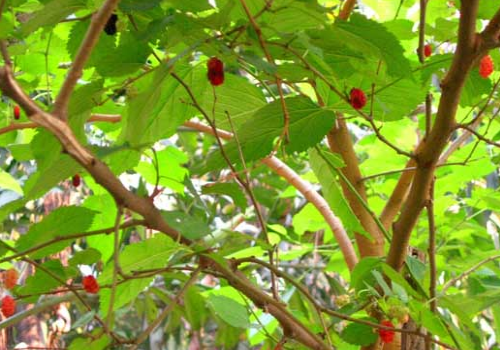
How much does mulberry cost per jin:
The price of mulberry seeds is about 30-40 yuan per jin, but prices vary greatly depending on seed quality, variety, place of origin and market. Mulberry likes a warm and humid climate and is slightly shade-tolerant. It begins to sprout when the temperature is above 12°C, the suitable growing temperature is 25-30°C, growth is inhibited above 40°C, and growth stops below 12°C. It is drought-tolerant, not waterlogging-tolerant, tolerant of poor soil, and highly adaptable to soil. In production, seed propagation, grafting propagation and cutting propagation are commonly used.
That is all for the introduction to mulberry seed planting methods. Now you know the price, right!
How to plant mulberry? What are the propagation methods for mulberry?
Image: Mulberry planting
[Common questions] How to plant mulberry? What are the propagation methods for mulberry?
[Expert answer]
(1) Mulberry seedling planting method
1. Planting method
Before planting, first use phosphate fertilizer plus yellow mud slurry to coat the roots to improve the survival rate. On sloping land and semi-dry paddy fields, plant in flat furrows; in paddy fields, plant on raised beds. Plant according to the above specifications by stretching a line. After planting, return soil to the green stem part, firm it, then water thoroughly to settle the roots.
2. Watering and drainage
After planting, water promptly during drought, drain promptly when waterlogged, and replant promptly when missing seedlings are found.
3. Fertilizing and weeding
When new shoots grow to 3-4 cun tall, apply the first fertilizer, with 7-10 jin of manure water + urea per mu; when they grow to 5-6 cun tall, apply the second fertilizer together with weeding, with 500-1000 jin of farmyard manure + 40 jin of compound fertilizer + 20 jin of urea per mu. Keep the fertilizer 3 cun away from the mulberry seedlings to avoid burning them to death, and open furrows for deep application and return soil. After the second fertilizer, spray a dryland herbicide such as Henaisi or Duer once, taking care not to spray it on the mulberry seedlings; after 20 days, apply the third fertilizer, with 100 jin of bio-organic fertilizer + 40 jin of urea per mu. After this fertilizer, spray once with dimethoate + dichlorvos, at a concentration of 2 capfuls of dimethoate and 2 capfuls of dichlorvos per bucket of water in a knapsack sprayer. Do not spray other pesticides, so as to avoid poisoning the silkworms.
(2) Mulberry branch propagation method
Besides planting mulberry seedlings, mulberry branches can also be used for propagation. The method is as follows:
1. Site selection and land preparation:Choose dry paddy fields with fertile soil and no waterlogging, and plow and harrow them level.
2. Branch selection and planting method
Choose mature branches about 1 m near the root. The best planting time is during winter pruning in December, planting as they are cut to improve the survival rate. The planting methods include the vertical method and the horizontal method.
① Vertical method: Cut mulberry branches into about 5 cun (3-4 buds), open furrows, place the branches vertically (buds facing up), return soil to bury the branches or leave one bud exposed, press the mud firm, water thoroughly, keep moist for 20 days, cover with full film, and remove the film after budding.
② Horizontal branch burial method: This is a new technique, most suitable for improved varieties without seeds. After leveling the land, open furrows about 1.5 cun deep according to the specifications, then lay 2 branches cut to about 2 chi long flat (laying 2 is to ensure the number of sprouts), return soil about 0.8 cun, press lightly, water, cover with film, and remove the film after budding.
3. Post-planting management
After the buds grow to 5 cun tall, combine with weeding and apply a light dressing of 300-400 jin of farmyard manure + 15 jin of urea per mu. Apply again after 20 days, with 60 jin of compound fertilizer + 30 jin of urea per mu, and carry out pest removal after fertilizing.
(3) Direct sowing and intercropping to establish a plantation method
This is a new technique for quickly establishing a plantation and improving economic benefits. The specific method is as follows:
1. Preparation before sowing:Choose good land with loose soil that is easy to break up. After plowing and breaking it up, open drainage ditches, draw lines at a row width of 2.1-2.4 chi, apply decomposed organic fertilizer along the lines, turn it evenly with the soil, and level the ground.
2. Sowing method:Sowing in February-March is most suitable. First fully break up and thoroughly water the soil 3 cun wide along the mulberry sowing row line, then dibble mulberry seeds along the mulberry row line, with a sowing rate of 2-3 liang per mu (sow 3-6 seeds every 3 cun), cover the seeds thinly with fine soil, and finally cover with grass and water again. Intercrop economic crops such as soybeans, peanuts and vegetables between the rows (not too close to the mulberry seedlings). The intercrops can be sown at the same time as sowing or appropriately earlier, striving to finish harvesting by May so as not to affect mulberry growth.
3. Management, after sowingAt the small seedling stage, pay attention to watering, and weed, fertilize and remove pests in time. After the intercrops are harvested, fertilize in time, and silkworms can soon be raised. To build up the trees, do not carry out summer pruning that year; in winter, prune about 1.5 chi above the ground, keep 6000-7000 plants per mu (row spacing 2.1-2.4 chi, plant spacing 4-5 cun), retain enough strong plants, dig up excess seedlings for sale or for own planting, and apply heavy winter fertilizer.
[Editor's comments] The above are the three most common propagation methods and planting methods for mulberry. The First Agricultural Economics editor has compiled and introduced them for you here, hoping they are helpful to you. For more related materials, please follow the relevant columns or special topics of First Agricultural Economics. We will provide you with more and more professional articles. Thank you for your attention and support. First Agricultural Economics is wholeheartedly at your service!
Detailed explanation of mulberry planting methods!
Mulberry is native to central and northern China and is now cultivated from the northeast to the southwest provinces and regions, and in the northwest as far as **. It is also cultivated in Korea, the countries of Central Asia, Europe and other places. Mulberry has a wide range of uses: its wood can be made into utensils, its branches can be woven into baskets, its bark can be used as a papermaking raw material, its fruit can be eaten and used for winemaking, and its leaves, fruit and root bark can be used as medicine. Today I will briefly introduce how to plant mulberry.
How to plant mulberry: Mulberry seedling planting method
Before planting, first use phosphate fertilizer plus yellow mud slurry to coat the roots to improve the survival rate. On sloping land and semi-dry paddy fields, plant in flat furrows; in paddy fields, plant on raised beds. Plant according to the above specifications by stretching a line. After planting, return soil to the green stem part, firm it, then water thoroughly to settle the roots. After planting, water promptly during drought, drain promptly when waterlogged, and replant promptly when missing seedlings are found.
When the new shoots of mulberry grow to 3 to 4 cun tall, apply the first fertilizer, with 7 to 10 jin of manure water + urea per mu. When they grow to 5 to 6 cun tall, apply the second fertilizer together with weeding, with 500 to 1000 jin of farmyard manure + 40 jin of compound fertilizer + 20 jin of urea per mu. Keep the fertilizer 3 cun away from the mulberry seedlings to avoid burning them to death, and open furrows for deep application and return soil.
After the second fertilizer, spray a dryland herbicide once, taking care not to spray it on the mulberry seedlings. After 20 days, apply the third fertilizer, with 100 jin of bio-organic fertilizer + 40 jin of urea per mu. After this fertilizer, spray once with dimethoate + dichlorvos, at a concentration of 2 capfuls of dimethoate and 2 capfuls of dichlorvos per bucket of water in a knapsack sprayer. Do not spray other pesticides, so as to avoid poisoning the silkworms.
How to plant mulberry: Mulberry branch propagation method
Choose dry paddy fields with fertile soil and no waterlogging, and plow and harrow them level. Choose mature branches about 1 m near the root. The best planting time is during winter pruning in December, planting as they are cut to improve the survival rate. The planting methods include the vertical method and the horizontal method. The vertical method is to cut mulberry branches into about 5 cun (3-4 buds), open furrows, place the branches vertically (buds facing up), return soil to bury the branches or leave one bud exposed, press the mud firm, water thoroughly, keep moist for 20 days, cover with full film, and remove the film after budding.
The horizontal branch burial method is a new technique, most suitable for improved varieties without seeds. After leveling the land, open furrows about 1.5 cun deep according to the specifications, then lay 2 branches cut to about 2 chi long flat; laying 2 is to ensure the number of sprouts. Return soil about 0.8 cun, press lightly, water, cover with film, and remove the film after budding. For post-planting management, after the buds grow to 5 cun tall, combine with weeding and apply a light dressing of 300-400 jin of farmyard manure + 15 jin of urea per mu. Apply again after 20 days, with 60 jin of compound fertilizer + 30 jin of urea per mu, and carry out pest removal after fertilizing.
How to plant mulberry: Direct sowing and intercropping method
Choose good land with loose soil that is easy to break up. After plowing and breaking it up, open drainage ditches, draw lines at a row width of 2.1-2.4 chi, apply decomposed organic fertilizer along the lines, turn it evenly with the soil, and level the ground. Sowing in February-March is most suitable. First fully break up and thoroughly water the soil 3 cun wide along the mulberry sowing row line.
Then dibble mulberry seeds along the mulberry row line, with a sowing rate of 2-3 liang per mu. Generally, sow 3-6 seeds every 3 cun, cover the seeds thinly with fine soil, and finally cover with grass and water again. Intercrop economic crops such as soybeans, peanuts and vegetables between the rows. Remember not to be too close to the mulberry seedlings. The intercrops can be sown at the same time as sowing or appropriately earlier, striving to finish harvesting by May so as not to affect mulberry growth.
Management: after sowing, at the small seedling stage, pay attention to watering, and weed, fertilize and remove pests in time. After the intercrops are harvested, fertilize in time, and silkworms can soon be raised. To build up the trees, do not carry out summer pruning that year; in winter, prune about 1.5 chi above the ground, keep 6000-7000 plants per mu, with row spacing of 2.1-2.4 chi and plant spacing of 4-5 cun, retain enough strong plants, dig up excess seedlings for sale or for own planting, and apply heavy winter fertilizer.